



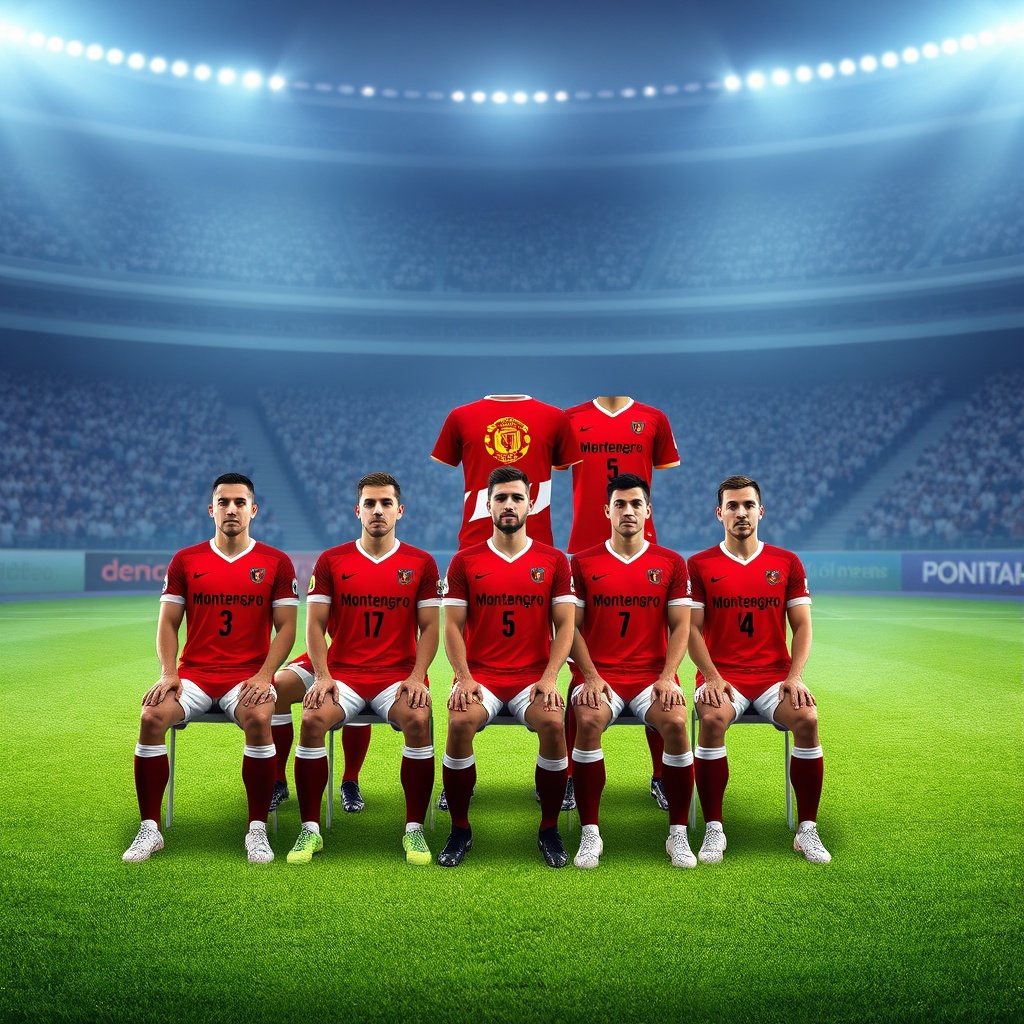
In the complex and fragmented geopolitical tapestry of the Balkans, football often acts as a mirror of sovereignty, pain, and national affirmation. Montenegro, a nation of just over 620,000 inhabitants nestled between the Adriatic Sea and rugged mountains, translates its own soul onto the green rectangle. Known as the team of the Hrabri Sokoli (the Brave Falcons), the Montenegrin national team is one of the youngest football projects on the planet, officially born in 2006 after the peaceful dissolution of the state union with Serbia. Since then, football in the country has ceased to be merely an appendage of Belgrade, transforming into a laboratory of tactical resistance, visceral passion, and the systematic export of raw talent. However, Montenegro's trajectory is far from a straight line of rapid ascent. It is a pendulum-like narrative: oscillating between the near-miracle of reaching the European elite in its early years and the bitterness of internal political crises, deficient infrastructure, and the melancholy of a generational transition that struggles to consolidate. This dossier examines the inner workings of Montenegrin football, mapping its history, its peaks of ephemeral brilliance, its geopolitical fractures, and the tactical labyrinth that defines its present and future.
1. Origins and Formation of National Identity
To understand the genesis of football in Montenegro, one must look back to the period when the territory was an integral part of Yugoslavia, under the aegis of Marshal Josip Broz Tito. For decades, Montenegrin players were fundamental pieces on the board of the Yugoslav national team, poetically known as the "Brazil of Europe" due to its refined technique and creativity. Clubs like FK Budućnost Podgorica (then Titograd) and FK Sutjeska Nikšić functioned as outposts for scouting talent for the giants of Belgrade, Red Star and Partizan. Icons of the caliber of Dejan Savićević and Predrag Mijatović, although developed on the dirt pitches and asphalt of Montenegro, achieved global stardom wearing the colors of Yugoslavia and, subsequently, the Federal Republic of Yugoslavia (composed only of Serbia and Montenegro).
The turn of the millennium brought with it the inevitable breath of self-determination. On May 21, 2006, a historic referendum sealed Montenegro's independence, dissolving the last remaining union of the former Yugoslav federation. The moment was one of dramatic irony for football: the Serbia and Montenegro national team had already qualified for the World Cup in Germany, held in June of that year. Thus, a team representing a politically extinct country took the field on German soil, carrying a mix of melancholy and disconnection. Montenegrin players like goalkeeper Dragoslav Jevrić were part of that somber campaign that ended in the group stage. It was the definitive end of an era and the tentative beginning of another.
The Football Association of Montenegro (FSCG), under the leadership of legendary former AC Milan midfielder Dejan Savićević, was quickly structured. Provisional affiliation with UEFA occurred at the end of 2006, followed by official admission as the entity's 53rd member in January 2007, and FIFA affiliation in May of the same year. The first chapter of this new history was written on March 24, 2007, under a torrential downpour at the modest Gradski Stadion in Podgorica. Faced with an electrifying and highly nationalistic atmosphere, Montenegro faced Hungary in a historic friendly. Coach Zoran Filipović fielded a team built on spirit and grit. The 2-1 victory, sealed with goals from Mirko Vučinić and Igor Burzanović, both from penalties, was not just a sporting result; it was the birth certificate of a new national identity.
The national team's early years were marked by a herculean effort to build its own style of play. Unlike the Serbian school, often associated with a physical and pragmatic game, or the Croatian school, characterized by the technical excellence of its midfielders, Montenegro had to adopt a hybrid style. The scarcity of human resources—due to a small population—imposed a survivalist mentality. Montenegrin football was born under the sign of defensive resilience, complemented by flashes of individual genius up front. The red and gold of the national flag became the colors of armor that the players wore with almost military pride, reflecting the historical character of a people who, over the centuries, resisted neighboring empires in their mountain fortresses.
The Birth of the Brave Falcons
- The first official goal: Scored by Mirko Vučinić in the 62nd minute of the friendly against Hungary in 2007, converting a penalty that symbolized the team's ground zero.
- The qualifying debut: Occurred on September 6, 2008, a 2-2 draw against Bulgaria in Podgorica, valid for the 2010 World Cup qualifiers.
- The cauldron's affirmation: The Gradski Stadion, with a capacity of just over 15,000 spectators, quickly gained a reputation as a hostile territory for European giants due to the proximity of the stands and the fanaticism of the ultras.
2. Golden Era, Great Campaigns, and Eternal Idols
The zenith of Montenegrin football materialized during the qualification cycle for Euro 2012. Under the command of charismatic and astute Croatian coach Zlatko Kranjčar, Montenegro shocked the European continent. Drawn into a group that included the powerful England, Switzerland, Bulgaria, and Wales, the Balkan team was widely considered a mere participant. However, what followed was one of the most impressive defensive campaigns in the recent history of UEFA qualifiers. Montenegro began the journey with three consecutive 1-0 victories against Wales, Bulgaria, and Switzerland, demonstrating impeccable tactical organization and surgical pragmatism.
The peak of this memorable campaign occurred on October 12, 2010, at the legendary Wembley Stadium. Facing an England side packed with stars like Wayne Rooney, Steven Gerrard, and Rio Ferdinand, Kranjčar's men resisted suffocating pressure. With a colossal performance from goalkeeper Mladen Božović and young defender Stefan Savić, Montenegro held on for a 0-0 draw that was celebrated in Podgorica as if it were a world title. In June 2011, the national team reached its highest historical position in the FIFA Ranking, hitting 16th place globally—an unbelievable feat for a country that had only existed independently for five years.
However, the Montenegrin Federation made a highly controversial decision that is still debated in the cafes of Podgorica today: after two consecutive defeats, Zlatko Kranjčar was fired by president Dejan Savićević, citing off-field disciplinary issues. Branko Brnović took over as head coach and managed to secure a spot in the playoffs by snatching an epic 2-2 draw against England at home, with a goal from Andrija Delibašić in stoppage time. The dream of playing in Euro 2012, however, collapsed against the Czech Republic. In the playoffs, the greater experience and solidity of the Czechs prevailed, with 2-0 defeats in Prague and 1-0 in Podgorica. The elimination left a deep scar, but it established the standard of what that golden generation was capable of producing.
This golden era was paved by the talent of a trinity of players who defined the country's football on the international stage. The first is Mirko Vučinić. The striker, who shone intensely in Italy with the jerseys of Lecce, Roma, and Juventus, was the prototype of the Balkan star: technical, unpredictable, sometimes indolent, but capable of deciding matches with a single touch of genius. His technical leadership was indisputable, and his iconic celebration—taking off his shorts and putting them on his head after scoring against Switzerland—symbolized the irreverence of a football that refused to be constrained by modern conventions.
Alongside Vučinić emerged Stevan Jovetić. Developed by Partizan and polished at Fiorentina, Jovetić was Montenegro's "golden boy." Possessing refined dribbling, sharp vision, and a keen eye for goal, he became the top scorer in the national team's history. Unfortunately, Jovetić's career was severely limited by a tragic succession of serious knee injuries, which prevented him from reaching the level of the world's best, although he left his mark at giants like Manchester City, Inter Milan, Sevilla, and Monaco. The third pillar of this era is Stefan Savić. The defender, who established himself as one of the defensive sheriffs of Diego Simeone's Atlético Madrid, personified the warrior soul of Montenegro, combining physical imposition, impeccable reading of the game, and a quiet leadership that sustained the national team's defense for over a decade.
The Pillars of the Golden Generation
- Mirko Vučinić: The first great captain, whose class and goals in the Italian Serie A gave international credibility to the young Montenegrin team.
- Stevan Jovetić: The technical genius of the attack, whose longevity and decisive goals made him the country's greatest football icon.
- Stefan Savić: The defensive rock who took the Montenegrin fighting spirit to the biggest stages of European football, including Champions League finals.
- Mladen Božović: The goalkeeper who performed miracles in the 2010/2011 campaign, keeping clean sheets against continental powerhouses.
3. Rivalries, Crises, and Power Behind the Scenes
The geopolitics of the Balkans is an ever-open wound, and football often acts as the salt that irritates it. For Montenegro, the most complex and tension-filled relationship is, inevitably, with Serbia. Although the political separation in 2006 was peaceful—unlike the bloody wars that marked the dissolution of Croatia, Bosnia, and Kosovo in the 1990s—the sporting sphere harbors a silent and deep rivalry. Many athletes born in Montenegrin territory chose to play for the Serbian national team for reasons of sporting prestige, financial gain, or ethnic identification, as a significant portion of Montenegro's population identifies as Serbian. Cases like those of Adam Marušić and Esteban Saveljić (the latter an Argentine of Montenegrin descent) show the reverse path: players born outside Montenegro who were recruited to wear the red jersey, sparking intense debates about national identity.
The most dramatic and politically charged moment in the history of Montenegrin football occurred on June 7, 2019, before a match against Kosovo, valid for the Euro 2020 qualifiers. Kosovo declared independence from Serbia unilaterally in 2008, an act that Belgrade does not recognize. Hours before the clash in Podgorica, the then-coach of Montenegro, the Serbian Ljubiša Tumbaković, along with Serbia-born players Filip Stojković and Mirko Ivanić (both playing for Red Star at the time), refused to participate in the match due to extreme pressure and threats from ultras groups and nationalist tabloids in Belgrade.
The reaction of the Football Association of Montenegro was immediate and ruthless. Tumbaković was summarily fired the same day for "violation of professional duties," and the players involved were never called up again. The episode exposed in raw form the ethnic and political fractures that divide the Montenegrin dressing room itself. The match against Kosovo ended in a melancholy 1-1 draw, played behind closed doors due to previous punishments for racist behavior by Montenegrin fans against England. The incident made it clear that, in Montenegro, tactical decisions are often secondary to the dictates of regional geopolitics.
Behind the scenes of power, the central figure is, undoubtedly, Dejan Savićević. President of the FSCG since before the country's formal independence, "Il Genio" governs Montenegrin football with an iron fist. While his mythical stature as a former player opens doors at UEFA and FIFA, his management is often the target of fierce criticism. Internal opponents accuse him of excessive centralization of power, lack of financial transparency, and failure to modernize the local league, the Meridianbet 1. CFL. The national championship is widely seen as a peripheral tournament, plagued by suspicions of match-fixing, a low technical level, and a lack of investment in basic infrastructure. The absence of an integrated national plan for developing young talent under Savićević's aegis is pointed out by local analysts as the main reason why Montenegro has failed to make the definitive leap to become a constant presence in major tournaments.
Political and Administrative Knots
- The Tumbaković Scandal (2019): The refusal of the coach and Serbian athletes to face Kosovo laid bare the identity tensions within the national team.
- Savićević's Hegemony: In power for over two decades, the Milan legend faces political wear and tear and accusations of administrative stagnation.
- The Fragility of the Local League: The Montenegrin first division suffers from a lack of competitiveness and the early flight of young talent to alternative markets.
4. The Current Moment: Tactics, Generation, and Challenges
Currently, the Montenegro national team is going through an extremely delicate period of tactical and generational transition. Under the command of different coaches in recent years, including Miodrag Radulović and, more recently, Croatian legend Robert Prosinečki, the team is seeking to redefine its playing identity. The extreme defensive pragmatism that characterized the Kranjčar era no longer holds, as modern football requires much faster offensive transitions and an ability to press in a high block that the current squad struggles to execute consistently.
Tactically, Montenegro has alternated between the classic 4-2-3-1 and variations of three center-backs (3-5-2 or 3-4-2-1), trying to find a balance between defensive solidity and support for the attack. The great tactical dilemma lies in the offensive transition. Without a creative and dynamic midfield, the team often resorts to direct balls to the center-forward, making the work of opposing defenses easier. The dependence on Stevan Jovetić, even at an advanced age and physically limited, is still alarming. When Jovetić is not on the field, the team loses its main technical reference and its ability to retain the ball in the final third.
The new hope of Montenegrin football goes by the name of Nikola Krstović. The robust center-forward, who stood out at Lecce in the Italian Serie A, represents the future of the Falcons' attack. Krstović has very different characteristics from Jovetić or Vučinić: he is a striker of physical strength, excellent aerial play, and the ability to play with his back to the goal, serving as a pivot for midfielders arriving from behind. The great challenge for coaches has been to design a tactical system that can supply Krstović without isolating him between opposing center-backs. Another name starting to gain prominence is young winger Viktor Đukanović, whose performances in Swedish football have caught the attention of scouts from major leagues for his dribbling ability and speed in transitions.
In recent campaigns for the UEFA Nations League and the Euro 2024 Qualifiers, Montenegro flirted with qualification but faltered due to chronic inconsistency. The team is capable of competitive performances against top-tier teams but often drops crucial points against lesser opponents due to individual errors and a lack of squad depth. When the absolute starters—like Savić in defense or Marušić on the wing—suffer from injuries or suspensions, the team's technical level drops drastically, highlighting the abyss of quality existing between the few athletes who play in the main European leagues and the majority who play in second or third-tier championships.
Current Tactical Radiography
- The Base System: The 4-2-3-1, which seeks to protect the defensive line with two strong-tackling defensive midfielders, freeing the wingers for quick transitions.
- The Offensive Reference: Nikola Krstović takes on the role of the target man, inheriting the responsibility of leading the attack in the post-Jovetić era.
- Vulnerability on the Flanks: Despite the presence of Adam Marušić (Lazio), the lack of reliable options for the wings limits the width of the team's offensive play.
5. Talent Development, Structure, and Future
The future of football in Montenegro is intrinsically linked to its ability to reform youth categories and create an infrastructure that allows for the development of athletes on national soil. Currently, the scenario is worrying. The Meridianbet 1. CFL, a league with only ten clubs, suffers from a scarcity of financial resources. Most teams do not have modern training centers, pitches with quality synthetic turf for the winter, or performance analysis and health departments structured in a professional manner.
The business model of Montenegrin clubs is based almost exclusively on the early export of their young assets. Players aged 17 or 18 are sold for modest sums to clubs in Serbia, Croatia, Belgium, or peripheral Eastern European leagues before they even complete their basic technical and tactical training. Although this quick sale ensures the immediate financial survival of local clubs, it weakens the national championship and hinders the long-term development of the athletes, who often get lost in competitive markets without the necessary psychological and physical support.
The main source of talent continues to be FK Budućnost Podgorica. The capital club has the most qualified youth structure in the country and historically provides the backbone of Montenegro's youth national teams. However, for the country to return to producing world-class players like Savićević or Jovetić, a structural intervention by the FSCG is urgent. There is a pressing need for the decentralization of investment, bringing resources to regions in the north of the country, which are historically poorer but traditionally reveal athletes of great physical stature and determination.
Despite all the structural adversities and the unfavorable demographic scale, the future of Montenegrin football should not be viewed with total skepticism. The expansion of the World Cup to 48 teams and the more inclusive format of the European Championship light a flame of hope in Podgorica. For a nation that has already proven capable of competing on equal terms against the continent's greatest powers when it has a committed and tactically disciplined generation, the dream of debuting in a major international tournament remains alive. The path, however, requires professionalization off the field, political pacification behind the scenes, and the patience to understand that, in modern football, the passion of the ultras in the stands of the Gradski Stadion is no longer enough to guarantee victory.
Challenges for the Next Decade
- Modernization of Stadiums: Only the national stadium in Podgorica meets the strict UEFA standards for high-level international matches, requiring urgent renovations in other arenas in the country.
- Talent Retention: Create financial mechanisms to prevent the early departure of teenagers abroad, allowing them to mature in the local league.
- Identity Unification: Shield the national team environment from the political and ethnic turmoil that plagues the Balkan region, ensuring a dressing room focused exclusively on the sporting aspect.





