



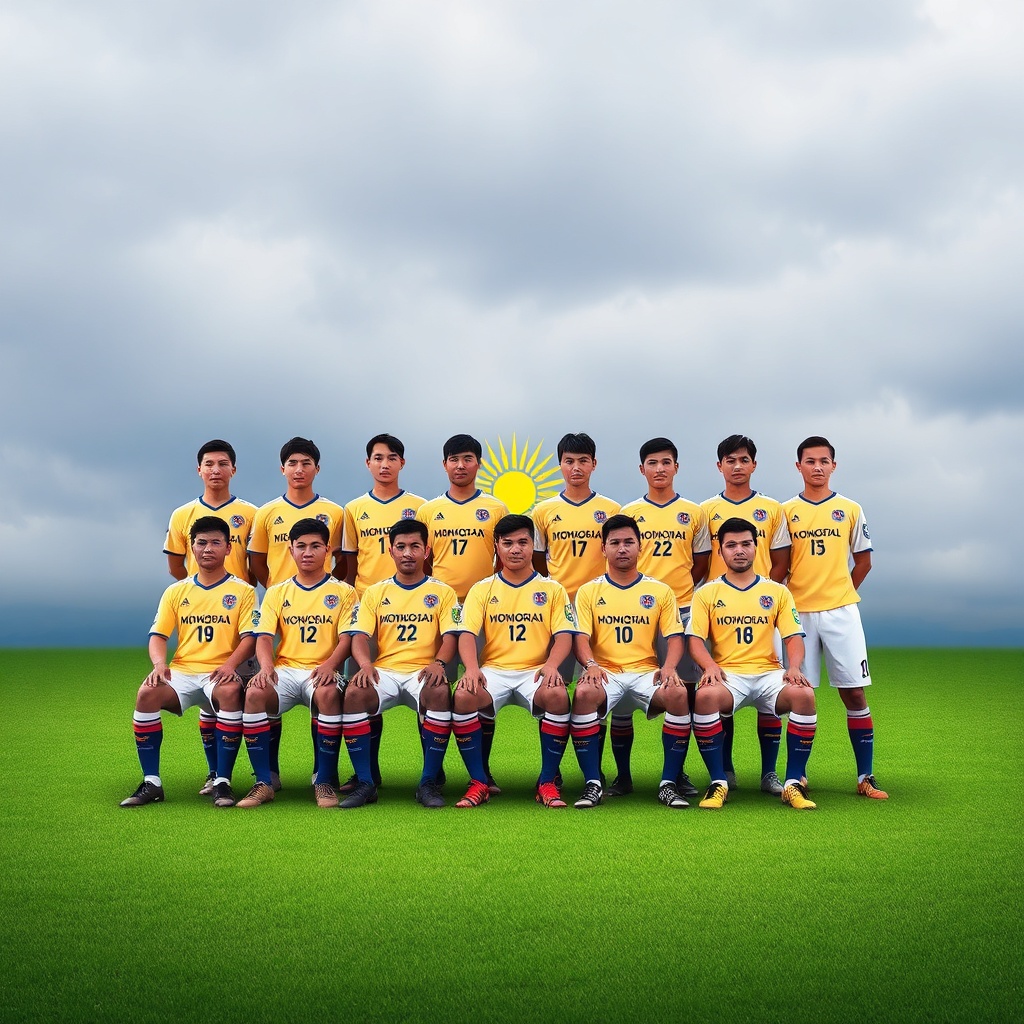
In the heart of Central Asia, where endless steppes meet the Gobi Desert and temperatures plummet to a frigid minus forty degrees during winter, football is waging a silent and heroic battle for survival and recognition. Mongolia, historically revered for the territorial conquests of Genghis Khan and its ancestral nomadic culture, seeks today to write a different narrative—not based on military conquest, but on the affirmation of its identity through the world's most popular sport. Affiliated late with FIFA only at the end of the 20th century, the Mongolian national team—affectionately nicknamed "The Blue Wolves"—carries the weight of representing a nation of just 3.4 million inhabitants spread across a colossal territory. This dossier dives into the depths of a football culture that defies geography, politics, and climate, revealing how an isolated federation structured its professional league, overcame systemic corruption scandals, and now exports its first talents to the international stage, sketching a tactically organized and ambitious future that aims, in the long term, to break the siege of East Asian powerhouses.
1. Origins and Formation of National Identity
The genesis of football in Mongolia is a direct reflection of the geopolitical transformations that shaped Eurasia throughout the 20th century. Before the leather ball officially rolled on the dirt pitches of Ulaanbaatar, the country lived under the strong influence of its northern neighbor, the Soviet Union. It was through diplomatic, military, and commercial channels with the Soviets in the 1910s and 1920s that the first notions of Western team sports penetrated Mongolian society, which was traditionally shaped by the "Three Manly Arts" of Naadam: archery, wrestling, and horse racing. Football, therefore, emerged not as a bourgeois pastime, but as a tool for physical and social modernization promoted by the communist regime that took hold in the country with the proclamation of the Mongolian People's Republic in 1924.
The Mongolian Football Federation (MFF) was formally founded in 1959, a period when the country sought to consolidate its national institutions and gain international recognition. However, affiliation with the Asian Football Confederation (AFC) and FIFA was not immediate. For nearly four decades, Mongolian football operated in semi-isolation, limited to friendly matches against other nations of the socialist bloc, such as North Korea, North Vietnam, and regional teams from Soviet Siberia. The first record of an international match for the Mongolian national team dates back to October 3, 1960, a clash against North Vietnam in Hanoi, which ended in a 3-1 defeat. This formative period was characterized by Spartan amateurism; players were factory workers, soldiers of the people's army, or university students who saw football as a rare opportunity to travel beyond the country's strictly controlled borders.
The great historical turning point occurred in the wake of the 1990 Democratic Revolution, which ended the single-party regime and opened Mongolia to the market economy and the Western world. With the political transition, the MFF understood that the sport's survival depended on global integration. In 1998, under the leadership of new officials seeking to modernize the country's sports structures, Mongolia was finally admitted as a full member of FIFA and the AFC. This milestone was not merely bureaucratic; it represented the international birth certificate of the "Blue Wolves." From that moment on, the red, blue, and yellow flag, bearing the sacred symbol of the Soyombo, would flutter on the pitches of World Cup and Asian Cup qualifiers, transforming football into a new vector of national pride and sovereignty.
The construction of this footballing identity, however, immediately ran into the harsh geographical realities of Mongolia. Ulaanbaatar is recognized as the coldest national capital in the world, where winter extends from October to April. Playing football under such conditions required a unique cultural adaptation. The sport, which in Brazil or Europe is synonymous with green grass and human warmth, was shaped in Mongolia on surfaces of frozen earth, packed snow, and, later, low-tech synthetic grass fields. This climatic resilience forged the character of the Mongolian player: physically vigorous athletes, accustomed to thermal suffering and endowed with a stoic determination that compensated for the historical lack of technical and tactical refinement.
The Impact of Climate on the Game's Culture
To understand Mongolian football, one must understand the winter of the steppes. The impossibility of maintaining usable natural grass for most of the year made the country a laboratory of endurance. The first clubs, such as the pioneer Soyol and Erchim (linked to the Ulaanbaatar thermal power plant), trained in extreme conditions, often clearing snow from the pitch before training sessions. This reality drastically limited the national competitive calendar, which had to be squeezed into a few summer months. Consequently, the technical development of athletes was fragmented, preventing the creation of a fluid, short-passing style of play, and prioritizing direct football, long balls, and intense physical combat.
2. Golden Era, Great Campaigns, and Eternal Idols
Speaking of a "Golden Era" for a national team that historically occupies the most modest positions in the FIFA Rankings requires an exercise in contextualization and journalistic sensitivity. For Mongolia, glory is not measured in World Cup trophies, but in historic goals, unprecedented stage qualifications, and hard-fought victories against theoretically superior opponents. The first great moment of collective ecstasy occurred on February 19, 2001, during the qualifiers for the 2002 World Cup. Playing in Damascus, Syria, Mongolia earned its first official point in FIFA competitions by drawing 1-1 with Bangladesh. The goal by Boldyn Buman-Uchral in the 22nd minute of the first half is revered to this day as the moment the country proved to itself that it belonged on the international stage.
The true competitive evolution of the national team began to take shape in the second decade of the 21st century, driven by the arrival of foreign coaches who brought tactical rigor and modern training methodologies. German coach Michael Weiß, who took command of the Blue Wolves in 2017, was the great architect of the most consistent period in the national team's history. Under his tutelage, Mongolia ceased to be an easy target and became a defensively solid team, dangerous in quick transitions. The peak of this era occurred in June 2019, during the first round of the Asian qualifiers for the 2022 World Cup. Mongolia faced Brunei in a two-legged tie that brought the country to a standstill. In the first leg in Ulaanbaatar, a 2-0 victory ignited the fans; in the return leg in Bandar Seri Begawan, the 2-1 defeat was enough to secure a historic qualification for the second round of the qualifiers for the first time in its history.
In the following round, drawn into a group that included powerhouses Japan, Tajikistan, Kyrgyzstan, and Myanmar, Mongolia experienced its most glorious moment and, paradoxically, its greatest lesson. On June 7, 2021, playing in Osaka due to COVID-19 pandemic restrictions, the Blue Wolves shocked Asia by defeating the Kyrgyzstan national team 1-0, with a header from defender Oyunbaataryn Mijiddorj. This victory against a team ranked more than a hundred places higher in the FIFA rankings represented the technical peak of a generation that refused to be just a supporting act. Obviously, the same campaign recorded painful defeats, such as the crushing 14-0 loss to Japan, a result that exposed the abyss that still separates the top of Asian football from the developing reality of Mongolia.
In the pantheon of Mongolian football idols, some names shine with singular intensity. Striker Naranbold Nyam-Osor is, without a doubt, the greatest goalscorer and the most emblematic figure of local football. With an imposing presence in the box and a refined nose for goal in domestic competitions for Athletic 220 and Khoromkhon, Naranbold became the symbol of the player who, despite not having had a European education, managed to perform at a high level in the Asian context. Another legendary name is Tsedenbal Norjmoo, a left-back and masterful free-kick taker, whose free-kick goal against Brunei in the 2019 qualifiers sealed his name in the country's sporting eternity. More recently, young midfielder Ganbayar Ganbold took up the baton as the nation's greatest technical hope, being the first Mongolian player to sign a professional contract in Europe, with Puskás Akadémia of Hungary, opening paths previously unimaginable for his country's youth.
The Historic Night in Osaka
The triumph over Kyrgyzstan in 2021 deserves a separate chapter in the Mongolian sports chronicle. Under the interim command of local coach Shuichi Mase, the team entered the pitch worn down by strict sanitary bubbles and the lack of competitive rhythm due to the cancellation of the local league by the pandemic. The game plan was a masterpiece of defensive resistance: two extremely compact lines of four, blocking the central corridor and forcing the opponent into ineffective crosses. When Mijiddorj took advantage of a corner kick in the 34th minute to head firmly into the net, Mongolia began a defensive siege that lasted nearly an hour. The final whistle triggered emotional celebrations in Ulaanbaatar, proving that the country's football had acquired competitive maturity.
3. Rivalries, Crises, and Behind-the-Scenes Power
Football in Mongolia does not develop in a vacuum; it is deeply influenced by the geopolitical tensions of its geographical location and the complex internal power dynamics of its federation. Geopolitically, squeezed between Russia and China, Mongolia has always sought in sport a way to assert its sovereignty and cultural independence against its giant neighbors. However, in the realm of football, the most intense rivalries are not against political superpowers, but against the island nations and microstates of East Asia and Southeast Asia, within the East Asian Football Federation (EAFF). Clashes against Guam, Macau, and the Northern Mariana Islands are treated as true regional classics of affirmation, where each victory is celebrated as a crucial step to emerge from the depths of continental football.
However, the trajectory of Mongolian football was severely delayed by deep administrative crises and corruption scandals that shook the structures of the MFF. The darkest episode occurred in 2014, when the then-president of the Mongolian Football Federation, Ganbold Buyannemekh, was banned by the FIFA Ethics Committee from all football-related activities for a period of five years. Buyannemekh was found guilty of accepting bribes from Mohamed bin Hammam, former president of the AFC, during the election campaigns for the FIFA Executive Committee in 2009 and 2011. This scandal tarnished the country's reputation, temporarily froze development fund transfers from the FIFA Goal program, and exposed how the power structures of Mongolian football were vulnerable to patronage and a lack of transparency.
The leadership crisis created a power vacuum that paralyzed the development of the national league for several years. Local clubs, devoid of subsidies and facing extremely high operating costs due to long travel and the need to maintain thermal structures, operated on the verge of bankruptcy. The lack of governance was also reflected in the national team, which often went long periods without playing a single official friendly match, wasting FIFA dates and plummeting in the world rankings. The reconstruction of the MFF began only after rigorous external audits imposed by FIFA, which forced the implementation of new statutes, compliance mechanisms, and the election of a new board committed to the professionalization of management.
Another recurring controversy behind the scenes of Mongolian football concerns the naturalization of athletes and the eligibility of diaspora players. In a country with a small population, the temptation to seek athletes with Mongolian ancestry in European or American leagues, or even to naturalize foreign players who have been playing in the local league for years, has always been a subject of intense tactical and philosophical debate. While some officials advocated for rapid naturalization to raise the immediate competitive level of the national team, more nationalist currents within the federation and public opinion argued that the team should be composed exclusively of athletes trained on the steppes, at the risk of distorting the national identity and discouraging the development of local youth categories.
Post-Crisis Restructuring
Overcoming the corruption scandals required an ethical refounding of the MFF. The new management that took over the federation established as a priority the decentralization of football, which historically had been concentrated almost exclusively in the capital, Ulaanbaatar. Development programs supported by the AFC were directed to distant provinces (the so-called aimags), seeking to integrate young nomads into the federation's talent monitoring system. This change in focus not only democratized access to the sport but also began to clean up the MFF's image with local corporate sponsors, vital for the financing of the Mongolian Premier League.
4. The Current Moment: Tactics, Generation, and Challenges
The contemporary moment of the Mongolian national team is marked by a profound tactical and generational transition. Under the technical command of experienced Japanese coach Otsuka Ichiro, hired in 2021 as part of a long-term technical cooperation agreement between the MFF and the Japan Football Association (JFA), the Blue Wolves are gradually abandoning the reactive and purely physical style of play of the past to adopt a philosophy based on collective organization, intelligent defensive compaction, and speed of thought in offensive transition. Ichiro brought the Japanese obsession with tactical discipline, millimeter positioning, and the appreciation of ball possession under pressure, concepts that are revolutionizing the mentality of Mongolian players.
Tactically, Mongolia has been structured predominantly in a variation of the classic 4-4-2 or a modern 5-4-1 in a low block when facing the continent's powerhouses. Goalkeeper Enkhtaivan Munkh-Erdene has established himself as one of the most secure pieces of the defensive sector, demonstrating great evolution in his footwork, a direct requirement of the modern game model implemented by the Japanese coaching staff. The defensive line is led by the leadership and physical vigor of defenders like Oyunbaataryn Munkh-Orgil, a center-back with excellent aerial positioning and anticipation skills, vital for neutralizing opposing attacks that try to exploit physical strength.
In midfield, the great engine and technical reference is the young Ganbayar Ganbold. Acting as a link midfielder or a modern "number 10," Ganbold possesses refined vision, dribbling ability in tight spaces, and passing precision that dictates the team's rhythm. His experience in European football raised the national team's competitive level, serving as a technical reference for his teammates. Alongside him, the energy and tackling power of athletes like Tsend-Ayush Khurelbaatar ensure the defensive balance necessary so that the team is not exposed during defensive transitions. In attack, transition speed is the team's main weapon, exploiting the quickness of sharp wingers to supply the target center-forward.
The current challenges, however, are immense. Mongolia still suffers from a lack of competitive intensity in its domestic league compared to the more developed centers in Asia. The Mongolian National Premier League, although professionalized, has a limited number of teams and a calendar that still suffers from climatic interruptions. This causes local players to enter international clashes with a lower game rhythm than their opponents. Furthermore, the transition from a purely defensive game model to a more proactive style requires time and patience, generating inevitable fluctuations in results during the maturation process of the young generation.
Otsuka Ichiro's Game Model
Ichiro's philosophy is based on the Japanese concept of organizational discipline. In exhaustive training sessions at the MFF Football Centre, the coach emphasizes the importance of defensive cover and the "trigger" of pressure to regain the ball. Instead of simply retreating and waiting for the opponent in their own box, Ichiro's Mongolia tries to bite the ball carrier in specific zones of the midfield, using the speed of its wingers to initiate vertical counter-attacks of no more than three or four passes before finishing. It is a pragmatic football, perfectly designed for the current physical and technical characteristics of the squad.
5. Talent Development, Structure, and Future
The future of football in Mongolia depends umbilicaly on the structuring of its youth categories and the modernization of its sports infrastructure. For decades, the training of athletes in the country was neglected, operating in an unsystematic way and dependent on the natural talent of young people who played in the streets or in public futsal courts during the winter. The perception that the country needed a professional training structure led the MFF to seek strategic international partnerships, the most successful of which is with the JFA (Japan Football Association), which, in addition to sending coaches, assists in structuring training curricula for local coaches and athletes.
The jewel in the crown of this new infrastructure is the MFF Football Centre, located in Ulaanbaatar. Equipped with state-of-the-art synthetic grass approved by FIFA, the center serves as headquarters for all national teams, from the under-15 categories to the main team. The site has modern medical facilities, tactical analysis rooms, and accommodations that allow for intensive concentration regimes. In addition, professional clubs in the local league, such as FC Ulaanbaatar, Deren FC, and SP Falcons, have begun to invest heavily in their own youth academies, following strict licensing standards imposed by the AFC.
The case of Deren FC is particularly emblematic for Mongolian football. Founded with a vision focused almost exclusively on the development of young talent, the club established partnerships with European coaches to implement elite training methodologies. Deren has become the country's main export academy for players, providing the backbone of athletes for Mongolia's youth national teams. This approach focused on the base is beginning to bear fruit, with young athletes demonstrating a level of technical refinement, ball control, and tactical understanding far superior to past generations, who did not have access to a structured education in childhood.
The export of players is seen by the MFF as the next crucial step for the national team's leap in quality. The pioneering success of Ganbayar Ganbold in Europe serves as a beacon of hope and a viable business model. The federation has encouraged agents and local clubs to build bridges with intermediate-level leagues in Asia, such as the K-League 2 (South Korea), the J2 League (Japan), and the Singapore league, places where young Mongolians can develop professionally in high-competitive environments. In the medium and long term, Mongolia's goal is to consolidate itself as a second-tier competitive force in Asia, capable of fighting on equal terms for spots in advanced stages of the Asian Cup and, perhaps, dreaming of even higher flights in the World Cup qualifiers.
- Strategic Partnership with Japan: The long-term agreement with the JFA guarantees the exchange of training methodologies and the arrival of elite professionals to work in the training of local coaches.
- Futsal as a Technical Base: Due to the harsh winter, the practice of futsal in indoor gyms for six months of the year has become a crucial tool for the development of ball control in tight spaces for young Mongolian athletes.
- AFC Club Licensing: The requirement for strict professional management and infrastructure criteria for participation in the national league is forcing the administrative modernization of local clubs.
- Focus on Decentralization: The creation of regional training centers funded by FIFA aims to discover talent outside the capital Ulaanbaatar, integrating young people from nomadic communities into federated football.
The path to be traveled by the "Blue Wolves" is still long and full of geographical, economic, and structural obstacles. However, the silent determination that emanates from the frozen steppes, now combined with modern sports science and professionalized management, signals that Mongolia no longer accepts being just a footnote in the book of world football. The howl of the Blue Wolves is beginning to echo with more strength and respect across the pitches of Asia.





