



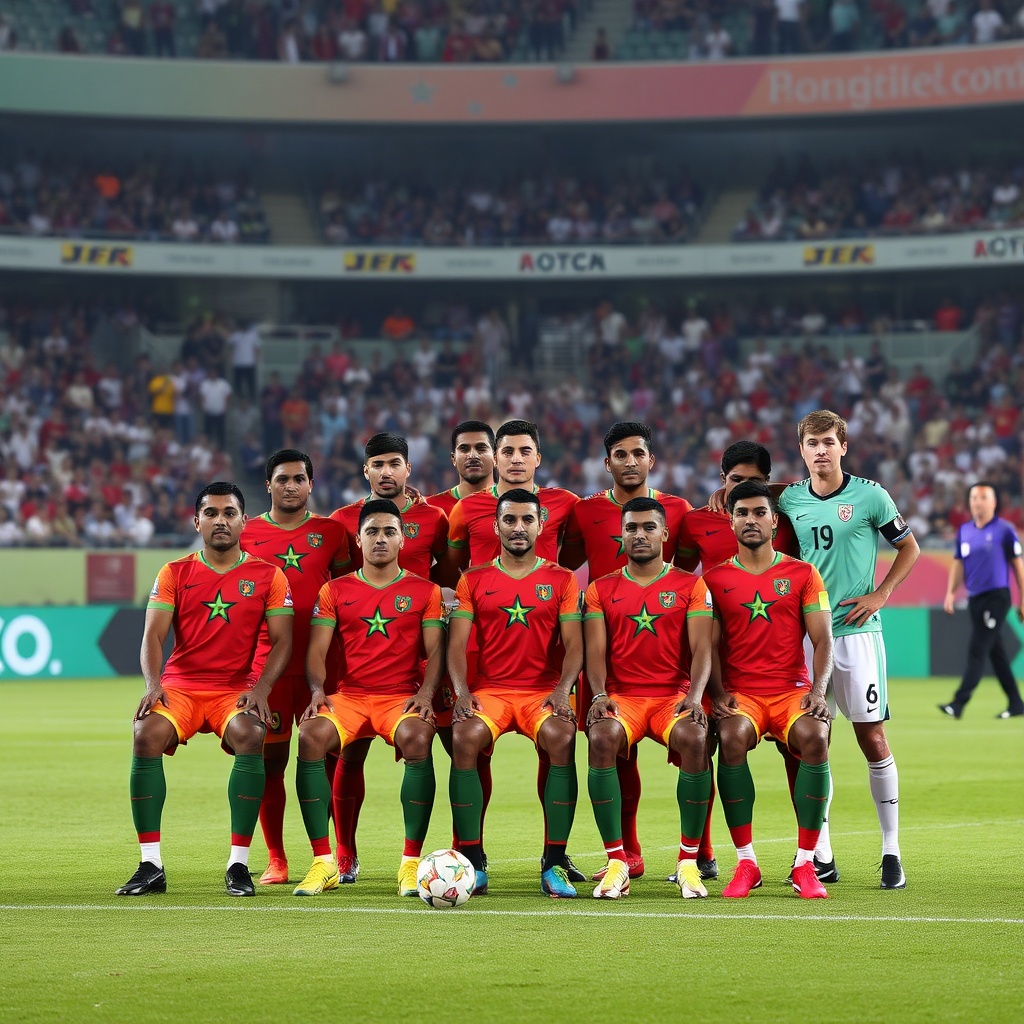
Football, in its deepest essence, operates as a mirror of a nation's geopolitical, social, and cultural complexities. In the case of the Kingdom of Morocco, this maxim is not only confirmed but elevated to a level of sociological study. The Moroccan national team, historically known as the "Atlas Lions," has transcended the mere status of a sports team to become a powerful instrument of cultural diplomacy, identity affirmation, and national unification. The historic campaign at the 2022 Qatar World Cup, where they became the first African and Arab team to reach the semifinals, was not a fluke or an ephemeral miracle. It was, in truth, the culmination of a long-term project structured at the intersection of massive state investment, reconciliation with its vast European diaspora, and the sophistication of its sports infrastructure. This dossier analyzes the trajectory of Moroccan football, from its origins under the French protectorate to its contemporary role as an emerging power on the global stage, dissecting its tactical nuances, political tensions, regional rivalries, and the complex mosaic of its player development.
1. Origins and the Formation of National Identity
The genesis of football in Morocco is intrinsically linked to the period of the French and Spanish protectorate, formally established in 1912. The sport was introduced to Moroccan soil by military forces and European colonizers, initially functioning as a tool for social exclusion and the assertion of civilizational superiority. The first clubs founded in the country were for the exclusive use of the colonial population. However, the local population quickly appropriated the game, transforming it into a space for cultural and political resistance against foreign domination. Football thus became one of the first arenas where Moroccans could face the colonizers on equal terms, under universal rules that did not discriminate based on skin color or social origin.
In this scenario of social effervescence, the figure of Larbi Benbarek emerged as the first great icon of Moroccan and African football. Born in Casablanca in 1917, Benbarek, known as the "Black Pearl," possessed refined technique, unparalleled vision, and a physical capacity that stunned Europe in the 1930s and 1940s. By moving to Olympique de Marseille and, later, Atlético de Madrid, Benbarek not only became one of the greatest players of his era but also a symbol of pride for the Moroccan people. His genius was such that Pelé himself uttered the famous phrase: "If I am the King of Football, then Benbarek is the God." However, due to the colonial context, Benbarek was forced to play for the French national team, a historical contradiction that highlighted the loss of sovereignty of his home country.
Parallel to Benbarek's individual success, Moroccan sports associations began to organize as an armed wing of the nationalist movement. The founding of the Wydad Athletic Club (WAC) in 1937, in Casablanca, is the most emblematic example of this dynamic. Originally created as a swimming club by nationalist militants led by Mohamed Benjelloun Touimi, Wydad expanded its activities to football in 1939. The club became a bastion of anti-colonial resistance; its matches against teams of French settlers were treated by the local population as true battles for national dignity. Wydad's historical rival, the Raja Club Athletic, founded in 1949 by intellectuals and unionists in the working-class neighborhood of Derb Sultan, was also born under the aegis of social contestation, consolidating Casablanca as the epicenter of football and politics in the country.
With the achievement of independence in 1956, under the leadership of King Mohammed V, the creation of a national football team became a state priority. The Royal Moroccan Football Federation (FRMF) was founded in 1955 and formally affiliated with FIFA in 1960. Football was instrumentalized by the Alaouite monarchy as a social cement to unify a country fragmented by tribal and regional divisions, in addition to serving as an international calling card for the new sovereign state. The transition from resistance football to state-representative football marked the beginning of an incessant search for continental and global recognition, establishing the foundations of an identity that oscillates between refined technical heritage and the need for physical and tactical rigor.
The Role of the Monarchy in Consolidating the Sport
The relationship between the Alaouite dynasty and Moroccan football is deep and structural. Since independence, Moroccan monarchs have understood the power of football as a mass catalyst. King Hassan II, who ruled from 1961 to 1999, was a fervent sports enthusiast, frequently intervening in the team's technical decisions and directly financing clubs and athletes. Hassan II saw the national team's success as a way to legitimize his authoritarian regime during the so-called "Years of Lead." The current monarch, Mohammed VI, has maintained this tradition of royal patronage but shifted the focus toward institutional and infrastructure modernization, understanding that sports diplomacy is a vital element of Moroccan soft power in the 21st century.
2. Golden Era, Great Campaigns, and Eternal Idols
The trajectory of the Moroccan national team on the international stage is marked by moments of pioneering that paved the way for the entire African continent. The first major milestone occurred at the 1970 World Cup in Mexico. Morocco was the first African team to secure a spot in the tournament through a direct qualifying process (in 1966, African countries boycotted the World Cup in protest against FIFA's decision not to grant a direct spot to the continent). Under the command of Yugoslav coach Blagoje Vidinić, the Atlas Lions surprised the world by opening the scoring against the powerful West Germany in the group stage, although they ended up losing 2-1. The campaign, which ended with a historic 1-1 draw against Bulgaria, proved that African football had the competitiveness to face European powers.
The maturation of that generation resulted in the country's greatest continental glory: winning the 1976 Africa Cup of Nations (AFCON), held in Ethiopia. Led by legendary striker Ahmed Faras, named African Footballer of the Year in 1975, the Moroccan team played attractive and balanced football. The tournament, played in an unprecedented final group format, was decided in a dramatic match against Guinea, where a 1-1 draw, with a saving goal by Ahmed Makrouh "Baba" in the 86th minute, secured the only continental title in Morocco's history. Faras, still the team's all-time top scorer with 36 goals, personified the elegance and tactical intelligence of that team.
A decade later, Morocco would make history again in Mexico at the 1986 World Cup. Under the tactical direction of Brazilian José Faria, who implemented an extremely rigorous defensive system and fast transitions, the Atlas Lions shocked the planet by leading a group that included England, Poland, and Portugal. After goalless draws against the Poles and the English, the Moroccan team secured a resounding 3-1 victory over Portugal, with two goals from Abderrazak Khairi and one from Abdelkrim Merry "Krimau." With this result, Morocco became the first African team to advance to the second round of a World Cup. In the round of 16, the team fell with dignity against West Germany, conceding a free-kick goal by Lothar Matthäus in the 88th minute. That team featured goalkeeper Badou Zaki, whose spectacular saves earned him the African Golden Ball that year, and the brilliant midfielder Mohamed Timoumi.
After a transition period in the 1990s, marked by an early elimination in the 1994 World Cup, Morocco assembled one of its most talented teams for the 1998 World Cup in France. Coached by Frenchman Henri Michel, the team featured the class of Mustapha Hadji, the speed of Salaheddine Bassir, and the defensive solidity of Noureddine Naybet. The Atlas Lions played offensive and enchanting football, drawing with Norway (2-2), losing to Ronaldo's Brazil (3-0), and thrashing Scotland 3-0. However, qualification for the round of 16 was dramatically frustrated in the final minutes of the match between Norway and Brazil, where a controversial penalty converted by the Norwegians eliminated the Moroccans in the group stage. The image of Hadji crying on the Saint-Étienne pitch became one of the most melancholic moments in the country's football, marking the beginning of a long winter for the national team.
The definitive resurgence occurred at the 2022 World Cup in Qatar. Under the leadership of coach Walid Regragui, hired just three months before the tournament began, Morocco carried out a campaign that redefined the limits of African football. Adopting an extremely compact low defensive block strategy, impeccable coverage, and surgical counter-attacks, the team eliminated European giants consecutively. In the group stage, they drew with Croatia (0-0), beat Belgium (2-0), and Canada (2-1). In the knockout stages, they dispatched Spain on penalties after a goalless draw, with a monumental performance by goalkeeper Yassine Bounou, and beat Cristiano Ronaldo's Portugal 1-0 in the quarterfinals, with a historic header by Youssef En-Nesyri. Although eliminated by France in the semifinals (2-0), the 2022 team, led by Achraf Hakimi and Sofyan Amrabat, etched its name into the eternity of world football.
- 1970: First African team to score points in a World Cup in the modern era.
- 1976: Won the country's only Africa Cup of Nations, in Ethiopia.
- 1986: Pioneered by qualifying for the round of 16 of a World Cup, leading Group F.
- 1998: Mustapha Hadji's golden generation enchanted France but fell tragically in the first round.
- 2022: Historic campaign in Qatar, reaching fourth place and unifying the support of the Arab and African world.
3. Rivalries, Crises, and Behind-the-Scenes Power
Football in North Africa, a region known as the Maghreb, is inseparable from the geopolitical tensions that shape diplomatic relations between local nations. Morocco's greatest and most intense rivalry is with Algeria. The clash, known as the "Maghreb Derby," goes beyond the four lines and reflects the historical conflict over the sovereignty of Western Sahara, a territory that Morocco claims as its own and whose liberation front (Polisario Front) is financially and politically supported by the Algerian government. Since the Sand War in 1963, diplomatic relations between Rabat and Algiers have been marked by hostilities, resulting in the definitive closure of their land borders in 1994. On the pitch, every match is played with warlike intensity, where victory is treated as an assertion of national and ideological supremacy.
In addition to the rivalry with Algeria, Morocco maintains fierce disputes with other North African powers, such as Egypt and Tunisia. Against the Tunisians, the rivalry reached its peak in the 2004 Africa Cup of Nations final, held in Radès, where Tunisia won 2-1 in an atmosphere of extreme hostility. Administratively, the behind-the-scenes of Moroccan football were historically dominated by power struggles between factions loyal to the federation and the major clubs of Casablanca (Wydad and Raja). For decades, the FRMF was criticized for its lack of transparency, nepotism, and the absence of coherent technical planning, which resulted in a severe decline of national football between 2006 and 2016, a period in which the national team failed to qualify for World Cups consecutively and accumulated embarrassing eliminations in the early stages of the AFCON.
The turning point in the governance of Moroccan football occurred with the rise of Fouzi Lekjaa to the presidency of the FRMF in 2014. Lekjaa, a high-ranking technocrat who also serves as the Minister of the Budget in the Moroccan government, completely restructured the federation. With direct access to the royal palace and unusual political skill, Lekjaa cleaned up the entity's finances, attracted major sponsors, and initiated a process of power centralization that neutralized internal disputes. Under his management, Morocco drastically increased its influence behind the scenes of the Confederation of African Football (CAF), directly rivaling Egypt for political control of the entity. However, Lekjaa's management is not without controversy; critics accuse him of using football as a platform for personal promotion and exerting undue influence over continental refereeing.
Another point of constant tension behind the scenes of the Moroccan national team is the delicate cultural balance between players born in the country ("locals") and those belonging to the vast Moroccan diaspora in Europe (known as "MRE" - Marocains Résidant à l'Étranger). This cultural and linguistic division often generated friction within the locker room. The most recent and notorious crisis occurred during the tenure of Bosnian coach Vahid Halilhodžić, who managed the team between 2019 and 2022. Known for his autocratic style and inflexible discipline, Halilhodžić clashed with the team's main stars born in Europe, notably midfielder Hakim Ziyech (born in the Netherlands) and full-back Noussair Mazraoui. The Bosnian coach accused Ziyech of faking injuries and lacking commitment, banning him from the national team.
Ziyech's exclusion generated an unprecedented institutional crisis. The Moroccan fans and public opinion massively supported the player, while Fouzi Lekjaa realized that Halilhodžić's rigidity threatened to ruin the preparation for the 2022 World Cup. In a decision of enormous political risk, Lekjaa fired Halilhodžić in August 2022, just three months before the World Cup, even after the coach had brilliantly secured the team's qualification in the qualifiers. The appointment of Walid Regragui, a young coach born in France but with a deep identification with Moroccan culture, was a masterstroke that pacified the locker room, reintegrated the exiled stars, and unified the group under a common cause, paving the way for the historic campaign in Qatar.
4. The Current Moment: Tactics, Generation, and Challenges
Morocco's success at the 2022 World Cup set a new tactical and performance standard for the national team, but it also generated unprecedented pressure on the coaching staff led by Walid Regragui. The style of play that stunned the world in Qatar was based on a tactical system structured primarily in a 4-1-4-1 or 4-3-3 with a strong defensive vocation. The main characteristic of this team was the compaction of its lines in a mid-low block, reducing space between sectors as much as possible and forcing opponents to play down the flanks, where the Moroccan wingers performed heroic defensive work to assist the full-backs.
The tactical backbone of that team relied on very well-defined pillars:
- Yassine Bounou: A world-class goalkeeper with exceptional positioning, elasticity, and coolness in ball distribution and penalty shootouts.
- Achraf Hakimi: One of the best right-backs in the world, combining frightening speed in offensive transitions with notable evolution in defensive reading and tactical positioning.
- Sofyan Amrabat: The true engine of the team. Acting as a defensive midfielder, Amrabat stood out for his impressive physical capacity for coverage, ball recovery, and precision in short passes to initiate transitions.
- Azzedine Ounahi: The tournament's great technical revelation. An elegant midfielder capable of holding the ball under pressure, dribbling in tight spaces, and dictating the rhythm of defense-to-attack transitions.
- Youssef En-Nesyri: A center-forward of immense tactical sacrifice, fundamental in the first line of defensive pressure and lethal in the air.
However, the post-2022 World Cup period exposed the limits of this reactive model. When Morocco became the undisputed favorite in continental clashes, the team encountered serious difficulties in dictating play against opponents who adopted a defensive stance similar to the one the Moroccans themselves used in Qatar. This limitation was evident in the 2023 Africa Cup of Nations (played in early 2024 in Ivory Coast), where Morocco was eliminated early in the round of 16 by South Africa (2-0). The inability to break through deep defensive lines and the slowness in ball circulation highlighted the urgent need for tactical evolution.
To solve this dilemma, Regragui initiated a process of tactical transition, seeking to rejuvenate the team and add more creativity and offensive repertoire to the midfield. The big news of this cycle was the decision of Brahim Díaz, a Real Madrid attacking midfielder, to play for the Moroccan national team instead of Spain. Díaz brought to the Moroccan scheme a capacity for vertical dribbling, acceleration in the final third, and creativity that the team previously lacked. The coach has also been integrating young talents of the highest technical level, such as attacking midfielder Eliesse Ben Seghir (Monaco) and forward Amine Adli (Bayer Leverkusen), seeking to transition from essentially reactive football to a model of greater ball possession, high pressure, and game control.
Regragui's main tactical challenge in this new cycle is to find the balance between the defensive solidity that made the team world-famous and the need for offensive creativity imposed by their new status as a powerhouse. The team needs to learn to live with the pressure of being the team to beat on the African continent, especially with the proximity of the 2025 Africa Cup of Nations, which will be hosted on Moroccan soil, and the preparation for the 2030 World Cup, where the country will be a co-host alongside Spain and Portugal.
5. Talent Development, Structure, and Future
The sustainable success of Moroccan football in recent years is not the result of chance, but of a structural revolution planned in the offices of the Royal Moroccan Football Federation, with direct financial support from King Mohammed VI. The initial milestone of this transformation occurred in 2009, with the inauguration of the Mohammed VI Football Academy, located in Salé, on the outskirts of Rabat. Built with an initial investment of approximately 15 million dollars, the academy is a state-of-the-art complex that combines European-standard sports facilities with a complete educational structure for young talents selected from across the country.
The importance of the Mohammed VI Academy to contemporary Moroccan football is immeasurable. It broke the monopoly on development that belonged to the Casablanca clubs and implemented a modern methodology for technical, physical, and tactical development. Players trained at the academy were fundamental in the historic 2022 campaign, such as defender Nayef Aguerd (West Ham/Real Sociedad), midfielder Azzedine Ounahi, and forward Youssef En-Nesyri. The success of this model inspired the federation to require all first-division clubs (Botola Pro) to develop their own youth development structures, under penalty of losing their professional license.
In addition to investment in domestic development, the Moroccan federation has developed one of the most sophisticated talent scouting and recruitment networks in the world in Europe. Coordinated by professional scouts spread across countries with large Moroccan immigrant communities—such as France, the Netherlands, Belgium, Spain, and Germany—this network monitors young players with dual nationality from the youth categories. The argument used by Morocco to convince these athletes to defend the Atlas Lions goes far beyond the sporting aspect; it involves a strong appeal to cultural identity, family roots, and the promise of a world-class elite sports project.
This strategy of recruiting diaspora talent, combined with local development, created a unique symbiosis that enriched the country's football. Players with the rigorous tactical training of the Dutch (like Ziyech and Amrabat), Spanish (like Hakimi and Brahim Díaz), and French (like Regragui and Boufal) schools joined talents polished locally at the Mohammed VI Academy. This cultural and technical amalgam generated a style of play characterized by European tactical intelligence combined with the passion, refined technique, and physical resilience typical of African football.
Aiming for the long-term future, Morocco is preparing to consolidate its position as the main sports hub in Africa. The country will host the 2025 Africa Cup of Nations and, in a historic feat for national diplomacy, was chosen to host the 2030 World Cup in a joint bid with Spain and Portugal. To meet these monumental commitments, the Moroccan government has initiated a multi-billion dollar investment plan in the modernization and construction of stadiums, such as the grandiose Grand Stade de Casablanca, designed to be the largest football stadium in the world, with a capacity for 115,000 spectators. This project aims not only at immediate sporting success but at the consolidation of Morocco as an indispensable cultural and economic bridge between Africa, Europe, and the Arab world.
The Excellence Structure of the Maâmora Complex
The operational heart of all Moroccan national teams is the Mohammed VI Football Complex in Maâmora, reopened in 2019 after a complete renovation that cost more than 60 million dollars. The training center is widely considered one of the most modern in the world, surpassing the facilities of many traditional European federations. The complex has four five-star hotels, eight FIFA-standard football pitches (including natural, synthetic, and hybrid grass), a state-of-the-art sports medical center equipped with cryotherapy and advanced physiotherapy, as well as an indoor Olympic swimming pool. This structure ensures that all Moroccan national teams—from the U-15 to the senior team, including women's football, which is also experiencing historic growth—have access to the best in high-performance sports.





