



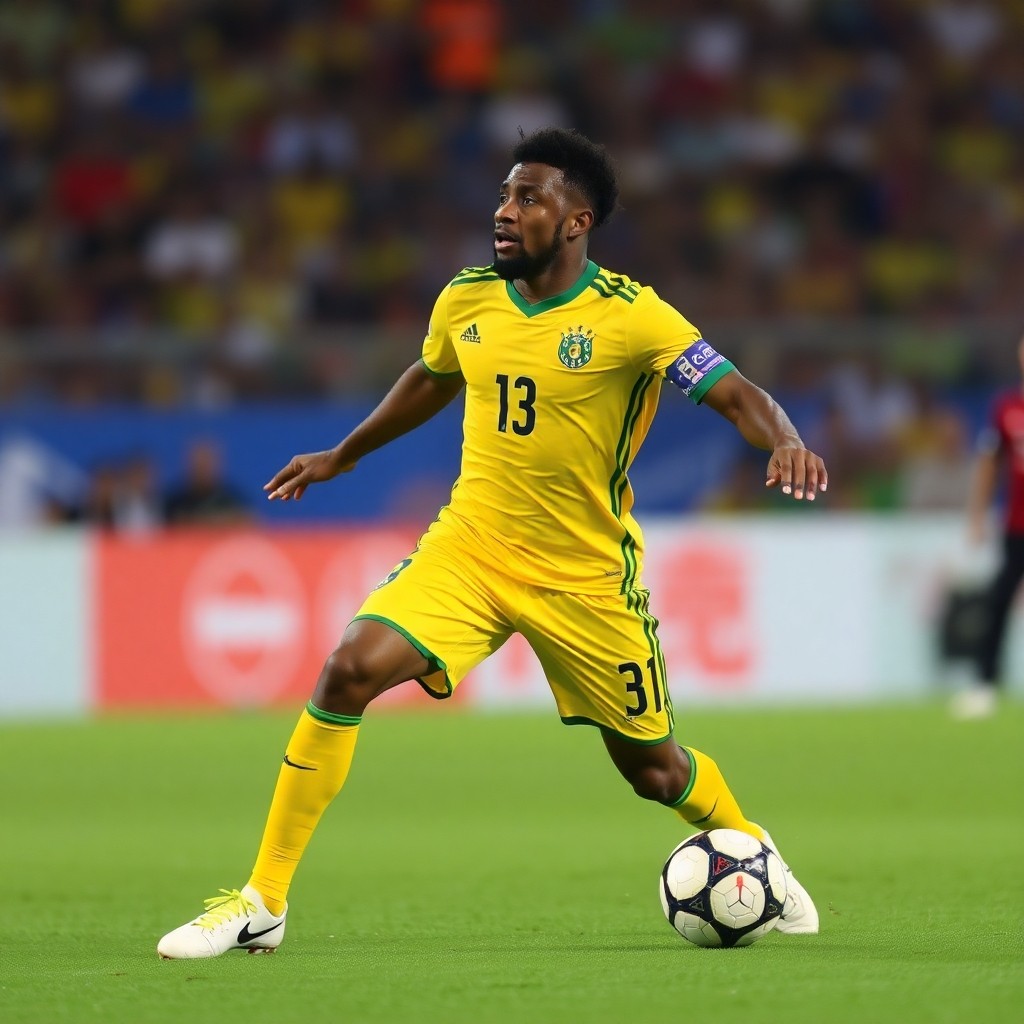
In the heart of West Africa, where the waters of the Niger River begin to trace their first curves in the Fouta Djallon mountains, football is not just a sport; it is a chronicle of emancipation, resistance, and systematically deferred promises. The Guinea national football team, affectionately nicknamed Syli National (The National Elephant, in the Soussou language), carries on its tricolor uniform—red, yellow, and green—the weight of one of the most unique histories on the African continent. A pioneer in asserting its political sovereignty by saying a historic "no" to French colonialism in 1958, the Guinean nation has mirrored its search for identity and global respect on the pitch. However, the trajectory of Guinean football is a mirror of its own socioeconomic reality: a territory of immeasurable mineral wealth, blessed with gigantic reserves of bauxite and iron, yet frequently entangled in infrastructure crises, administrative instability, and a painful sense of underutilized potential. This dossier delves into the depths of a football school characterized by refined technique, the feverish passion of its fans in Conakry, and the eternal tactical and political challenges that prevent Africa's sleeping giant from reaching the pinnacle of world football.
1. Origins and Formation of National Identity
To understand the genesis of football in Guinea, it is imperative to go back to 1958, a watershed year in the geopolitical history of the 20th century. Under the charismatic and uncompromising leadership of Ahmed Sékou Touré, Guinea was the only French colony in Sub-Saharan Africa to reject the proposal for a Franco-African community presented by General Charles de Gaulle. The Guinean "no" resulted in immediate independence, but also in severe retaliation from the metropole, which withdrew technical staff, archives, and destroyed basic infrastructure. Sékou Touré, understanding the urgent need to forge a national identity from a mosaic of ethnicities—mainly Fulas, Mandinkas, and Soussous—identified culture and sport as the pillars of his socialist revolution.
Football, therefore, was nationalized. Sékou Touré's revolutionary regime saw football clubs as cultural embassies of the new republic. The process of "sporting decolonization" began with the dissolution of old colonial-based clubs and the creation of state associations linked to districts and ministries. It was in this context that the Hafia Football Club (initially known as Conakry II) was born, a team that transcended the country's borders to become the first great dinosaur of club football in Africa. Financed directly by the State and used as a tool for diplomatic propaganda, Hafia FC became the backbone of the national team.
During the 1960s and 1970s, playing for the Syli National was an act of patriotic civil service. The athletes were not professionals in the Western sense of the term; they were state employees, soldiers of a revolution that used the leather ball to demonstrate the superiority and dignity of the emancipated Black man. The Stade du 28 Septembre, built in Conakry and named in honor of the day of the historic independence referendum, became the temple of this political and sporting liturgy. There, under the humid heat of the Atlantic and before a crowd in a trance, Guinea developed a style of play characterized by patient ball possession, short dribbling, and an anarchic creativity that contrasted with European tactical rigidity. Guinean football was, essentially, an expression of freedom and nationalist pride.
2. Golden Era, Great Campaigns, and Eternal Idols
The technical peak of Guinean football is synonymous with the 1970s, a period when the country came very close to becoming continental champion. The great epic of the Syli National occurred in the 1976 Africa Cup of Nations (AFCON), held in Ethiopia. In that edition, played in a single final group format instead of direct knockouts, Guinea reached the final round needing to beat Morocco to win the title. In Addis Ababa, under an altitude that tested the physical limits of the athletes, Guinea opened the scoring with a goal from the legendary midfielder Papa Camara. However, with just four minutes left on the clock, Moroccan Ahmed Baba equalized the match at 1-1, frustrating the Guinean dream and relegating the country to the runner-up spot—which remains, to this day, the best result in the history of the senior national team.
That golden generation was led by figures who acquired almost mythological status in Guinea. The greatest exponent of this period was Cherif Souleymane, a midfielder with aristocratic vision and surgical precision in his passing, who remains the only player in the country's history to win the African Footballer of the Year award (in 1972). Alongside him shone strikers like Ibrahima Sory Keita, nicknamed "Petit Sory," whose speed on the wings dismantled opposing defenses, and the aforementioned Papa Camara, a cerebral leader on and off the field. These athletes formed the core of the Hafia FC that won the African Cup of Champions in 1972, 1975, and 1977, establishing a continental dynasty that projected Guinea's name beyond the continent's borders.
After the decline of that generation and the death of Sékou Touré in 1984, which led to the end of massive state funding for sports, Guinea faced a long period of ostracism. The resurrection of the country's footballing pride would only occur at the turn of the millennium, driven by a new lineage of talents who found their development stage in European football. The main symbol of this transition was Aboubacar "Titi" Camara. A striker of uncommon grit and overwhelming charisma, Titi Camara shone in French football (Lens, Marseille) and became a cult icon at Liverpool in England. His devotion to the national team was such that, in 1999, he played and scored goals for Guinea just days after his father's death, cementing his image as the ultimate warrior of the Syli National.
Soon after, Pascal Feindouno emerged, considered by many analysts to be the most technically gifted player Guinea has produced since Cherif Souleymane. An attacking midfielder with baffling dribbles, playful creativity, and an excellent free-kick taker, Feindouno was the maestro of a team that reached the quarterfinals of the Africa Cup of Nations consecutively in 2004, 2006, and 2008. Under his command, Guinea played attractive, offensive football, capable of going toe-to-toe with the continent's superpowers, although it often faltered due to chronic defensive fragility and a lack of focus in decisive moments. More recently, the torch of leadership was carried by Naby Keïta, a midfielder who reached the top of world football by wearing Liverpool's number 8 shirt and winning the Premier League and the UEFA Champions League, although his national team career has been constantly hampered by recurring injuries.
3. Rivalries, Crises, and Behind-the-Scenes Power
The history of Guinean football cannot be dissociated from the complex geopolitical webs of West Africa and the chronic governance crises that plague the Guinean Football Federation (Feguifoot). On the sporting front, Guinea's greatest rivalry is against Senegal. The classic against the "Lions of Teranga" transcends the four lines; it is a cultural and socioeconomic clash between two neighbors who share deep historical ties but also latent rivalries. While Senegal often positioned itself as the Francophone intellectual and economic showcase of the region, Guinea prided itself on its revolutionary and sovereign stance. The clashes between the Syli National and Senegal are marked by extreme electricity, where geopolitical tension often spills onto the field in intense physical disputes. Another high-voltage rivalry is the "Niger River Derby" against Mali, a regional duel that mobilizes crowds and paralyzes the capitals of Conakry and Bamako.
However, the greatest adversaries of Guinean football have historically resided within its own administrative borders. Feguifoot has been, for decades, a den of political instability, ego clashes, and financial corruption scandals. Government interference in sporting affairs is a constant that has already earned the country severe punishments and suspensions from FIFA. One of the most dramatic episodes of this dysfunction occurred in the early 2000s, when the federation was dissolved by the government, resulting in Guinea's exclusion from the 2002 World Cup qualifiers and that year's AFCON, just at the moment when a talented generation was emerging.
The relationship between football and Guinean politics also has dark chapters. The Stade du 28 Septembre, once the temple of the glories of Hafia FC and the national team, became the scene of one of the greatest humanitarian tragedies in the country's recent history. On September 28, 2009, during a peaceful opposition demonstration against the military junta led by Moussa Dadis Camara, security forces invaded the stadium and perpetrated a massacre that resulted in the deaths of over 150 civilians and systematic human rights abuses. The trauma of that gray afternoon stained the sacred soil of national football with blood, creating a psychological scar that associated the country's main sporting stage with unspeakable horror, driving away for years the celebratory atmosphere that traditionally surrounded national team matches.
More recently, Guinean football has continued to be shaken by behind-the-scenes turmoil. Disputes over the federation's financial control, accusations of embezzlement of prize bonuses intended for players during the final stages of the AFCON, and the constant changing of coaching staffs have created an environment of permanent distrust. Foreign and local coaches, such as former player Kaba Diawara, have faced enormous resistance from internal factions of the federation, logistical sabotage, and smear campaigns in the local press, evidencing that the development of football in the country is often held hostage by parochial and short-term political interests.
4. The Current Moment: Tactics, Generation, and Challenges
Contemporary Guinea presents itself as a fascinating, yet highly unstable, tactical laboratory. In the 2023 Africa Cup of Nations (played in early 2024 in Ivory Coast), the Syli National managed to break a historical taboo by winning a knockout stage match for the first time in the modern era of the tournament, defeating Equatorial Guinea in the round of 16, before being eliminated by the Democratic Republic of the Congo in the quarterfinals. This campaign exposed both the technical virtues of a new generation and the structural limits of the game model implemented in the country.
From a tactical point of view, Guinea has sought a transition between the traditional football of possession and improvisation and a more pragmatic style, based on fast offensive transitions and defensive solidity in a mid-low block. Under the command of Kaba Diawara, the team was often structured in a 4-2-3-1 or 4-3-3 system, which prioritized protecting the penalty area with two defensive midfielders with strong marking power and releasing the flanks for fast wingers. However, the crown jewel of the current generation is center-forward Serhou Guirassy. The striker, who haunted Europe with a spectacular season for VfB Stuttgart before moving to Borussia Dortmund, represents the prototype of the modern number 9: physically strong, intelligent in front-line support, and lethal inside the box.
The integration of Guirassy into the Syli National's game system, however, has been a complex challenge. In the national team, he often finds himself isolated due to the scarcity of a creative midfield that can feed the attack with consistency. With the physical decline of Naby Keïta, the responsibility for articulation has fallen on young players like Aguibou Camara, a dynamic player with great intensity in pressing, but who has characteristics more of infiltration than of game organization. Another crucial name in this gear is Ilaix Moriba, a former Barcelona prospect, whose club career has been irregular, but who in the national team assumes a role of technical leadership in the midfield, trying to dictate the pace of the game with his long stride and quality in long passing.
Guinea's defensive line, historically the team's Achilles' heel, gained greater respectability with the emergence of defenders playing in competitive European leagues, such as Mouctar Diakhaby (Valencia)—whose serious knee injury in 2024 was a heavy blow to the team—and Julian Jeanvier. Despite this, the Guinean defensive system still suffers from moments of collective lack of concentration and vulnerability in defending set pieces, a chronic defect that has cost dearly in decisive moments of continental tournaments. The great tactical challenge for the immediate future is to find the balance between the Guinean player's natural vocation for dribbling and individual creativity and the need for positional rigor required by elite international football.
5. Talent Development, Structure, and Future
The future of football in Guinea rests on a profound structural contradiction. On one hand, the country is an inexhaustible reservoir of raw talent. The streets of Conakry, the dirt pitches of Labé, Kankan, and Nzérékoré are full of young people who display an intimate and natural relationship with the ball. On the other hand, the local infrastructure for the detection, training, and transition of these athletes to professionalism is precarious, depending almost exclusively on private initiatives or the early export of talent to Europe.
Historically, the local football league, the Ligue 1 Guinéenne, has been dominated by Horoya AC, a club financed by businessman Antonio Souaré. Horoya has managed, over the last decade, to structure itself as a regional force in Africa, reaching advanced stages of the CAF Champions League and offering decent professional contracts to local athletes and those from neighboring countries. However, Horoya's hegemony exposes the fragility of other clubs, which survive in conditions of extreme financial precariousness, without adequate training pitches, modern medical departments, or structured youth categories.
Given the weakness of the local league, the salvation of Guinean football has been the model of private academies. The most successful example is the Académie KPC, built by construction magnate Kerfalla Person Camara in Khorira. Inspired by the models of European training centers, the academy offers formal education and high-performance sports training for young talents, serving as a direct bridge to the international market. In addition, Guinea has benefited enormously from its vast diaspora in Europe, especially in France. The federation has intensified efforts to recruit dual-national players who were trained in prestigious French youth academies but choose to defend the colors of their parents' homeland. Cases like those of Guirassy, Diakhaby, and Moriba illustrate this trend that raises the immediate technical level of the national team, although it does not solve the structural problem of domestic football.
For Guinea to finally consolidate itself as a continental power and realize the unprecedented dream of qualifying for a FIFA World Cup—a viable goal with the expansion of the tournament to 48 teams—the country urgently needs to modernize its sports management. The completion of the Stade Général Lansana Conté in Nongo was an important step to provide the capital with a modern arena, but the country still lacks decentralized technical development centers. Without serious investment in the training of local coaches, the improvement of playing surfaces throughout the national territory, and the creation of sustainable youth competitions, the Syli National will continue to be a team of brilliant individual flashes, a beautiful elephant that, despite its monumental strength, remains chained to its own structural contradictions.
-
Main Achievements and Historical Milestones:
- Africa Cup of Nations Runner-up (1976)
- Three-time African Cup of Champions winner with Hafia FC (1972, 1975, 1977)
- Best FIFA Ranking: 22nd place (August 2006)
- First knockout stage victory in the AFCON in the modern era (2023, against Equatorial Guinea)





