



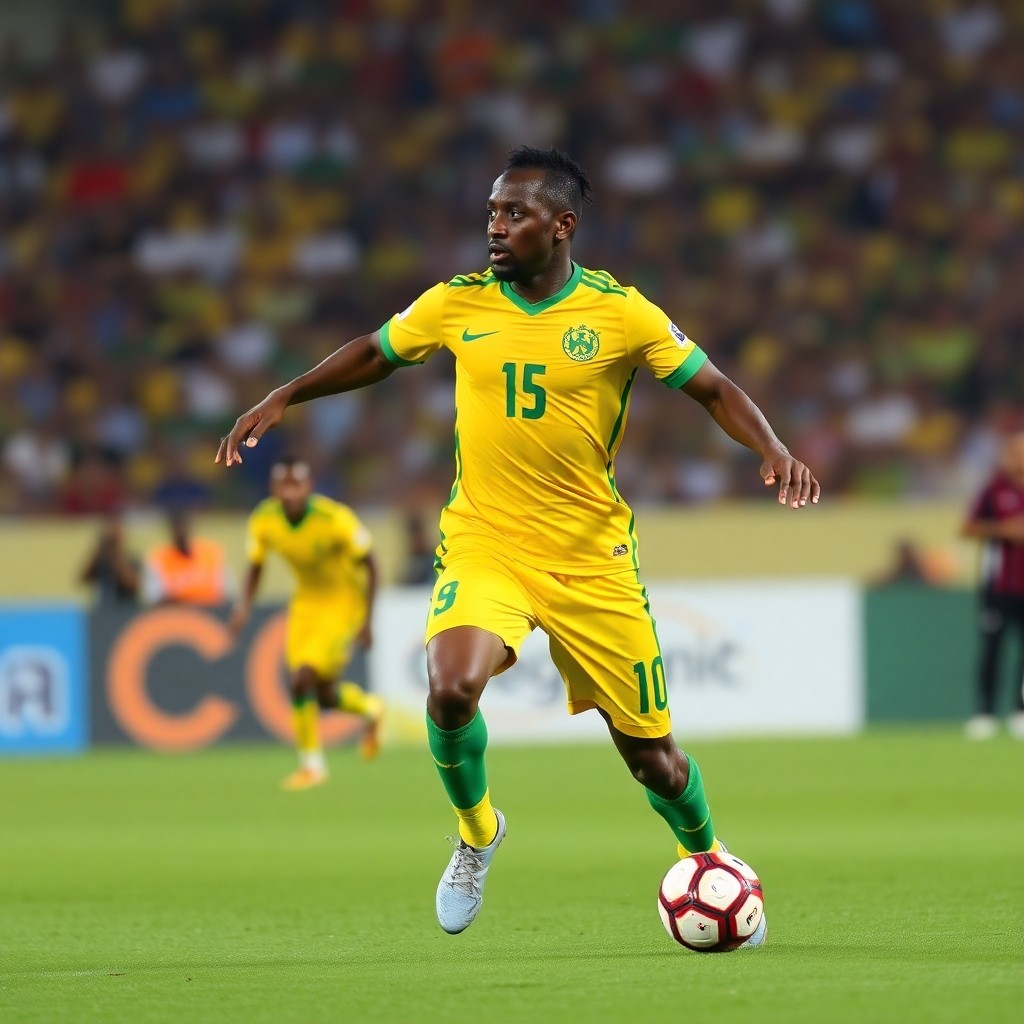
In the vast and complex landscape of African football, few stories are as rich in resilience, paradoxes, and overcoming adversity as that of the Guinea-Bissau national team. Known as the "Djurtus" — a term in the Creole language for the African wild dog, a predator known for its tactical intelligence, persistence, and pack-hunting ability — the Bissau-Guineans emerged from decades of sporting isolation and political instability to become a constant presence in the Africa Cup of Nations (AFCON). This feat, in itself, defies the macroeconomic and infrastructural logic of modern sports. In a country plagued by successive coups d'état, chronic institutional crises, and a glaring shortage of grass pitches and high-performance academies, the national football team has become the primary catalyst for social cohesion and national pride. Guinean football is not limited to ninety minutes of play; it is a mirror of a diaspora spread across Europe, a complex colonial heritage, and a constant struggle to assert sovereignty through the ball. To understand the Djurtus is to dive into a narrative where geopolitics, the history of Portuguese decolonization, and the unconditional passion of a people intersect with every pass, every call-up, and every goal scored against the continent's powerhouses.
1. Origins and Formation of National Identity
The genesis of football in Guinea-Bissau is intrinsically linked to the Portuguese colonization process and, subsequently, the national liberation struggle led by the African Party for the Independence of Guinea and Cape Verde (PAIGC), under the intellectual and political guidance of Amílcar Cabral. During the colonial period, football was used by the Portuguese overseas administration as an instrument of social pacification and an attempt at cultural assimilation. Clubs such as Sporting Clube de Bissau (founded in 1936) and Sport Bissau e Benfica (founded in 1944) were created as direct branches of the Lisbon giants, reproducing the rivalries and sporting structure of the metropolis in the African territory. However, the pitch quickly became a space of silent resistance. Young Guineans, by demonstrating refined technical skill and remarkable athletic ability, used the sport to challenge the supposed superiority of the colonizer.
With the unilateral proclamation of independence on September 24, 1973, in the Boé hills, and its subsequent recognition by Portugal in 1974 after the Carnation Revolution, the newly born Republic of Guinea-Bissau faced the herculean challenge of building a national identity from a mosaic of over twenty ethnic groups, including the Fula, Mandinka, Balanta, and Papel. Football was immediately identified by post-independence leaders as a vital tool for national unification. The Football Federation of Guinea-Bissau (FFGB) was founded in 1974, but the path to international affiliation was long and tortuous, reflecting the economic difficulties of a state trying to rise from the ashes of a liberation war that lasted over a decade.
The FFGB's affiliation with the Confederation of African Football (CAF) and FIFA occurred only in 1986. During the first decades after independence, the national team, nicknamed the Djurtus, lived in near-competitive anonymity. The country lacked the financial resources to compete in the qualifying stages for the World Cup or the Africa Cup of Nations, limiting its participation to regional friendly tournaments or minor events, such as the Amílcar Cabral Cup, organized for nations in Zone 2 of the CSSA (Supreme Council for Sport in Africa). In these regional tournaments, Guinea-Bissau began to shape its competitive identity: a style of football characterized by individual creativity, stunning speed, and formidable physical resilience, though tactically anarchic due to the absence of qualified coaches and a systematized training structure.
The 24 de Setembro Stadium, inaugurated in Bissau with international cooperation support, became the sacred temple of national football. However, the lack of proper maintenance, coupled with the political instability that plagued the country in the 1990s and 2000s — culminating in the devastating 1998-1999 civil war — left the national sport in a state of suspended animation. For years, the national team played only sporadic matches, often funded at the last minute by the government or private donations, without any long-term development plan. The "Djurtu," the wild dog that symbolized the team, seemed doomed to wander the fringes of African football, forgotten by the continent's elite.
The Role of Amílcar Cabral and Sport as Liberation
One cannot understand the soul of Guinean sport without analyzing the thought of Amílcar Cabral. The revolutionary leader viewed culture and sport not as mere entertainment, but as crucial elements for the "reconnection of the Guinean man with his own history." Cabral argued that sports practice should be democratized, serving to break down the ethnic and regional barriers that colonialism sought to exploit. Although Cabral was assassinated before seeing an independent Guinea-Bissau, his guidelines influenced the country's first generation of sports leaders, who saw in every international match an opportunity to hoist the red, yellow, and green flag with the black star, asserting the nation's sovereign existence before the world.
2. Golden Era, Great Campaigns, and Eternal Idols
The 21st century brought a radical transformation to the fate of Guinean football. After decades of obscurity, Guinea-Bissau began a meteoric rise that would culminate in its historic qualification for the 2017 Africa Cup of Nations, held in Gabon. This period, widely considered the "Golden Era" of the Djurtus, was driven by a combination of factors: the consolidation of a recruitment network in the European diaspora (mainly in Portugal), the minimal stabilization of federation structures, and, above all, the charismatic and pragmatic leadership of national coach Baciro Candé.
Baciro Candé, an almost mythical figure in local football, took charge of the national team in 2016 for his second stint in the role. With a deep understanding of the Guinean players' mentality and a unique ability to motivate athletes playing in secondary European leagues, Candé built a hardworking, tactically disciplined team that was extremely dangerous in quick transitions. The qualifying campaign for the 2017 AFCON was a footballing fairy tale. Drawn into a theoretically impossible group alongside the colossus Zambia (2012 African champion), Congo, and Kenya, Guinea-Bissau was labeled the "perfect victim."
However, the Djurtus defied all odds. Historic victories against Kenya and, crucially, a 3-2 triumph over Zambia in Bissau, in a 24 de Setembro Stadium packed to the point of physical danger, sealed the unprecedented qualification. The winning goal against the Zambians, scored by Toni Silva in the final minutes, triggered one of the greatest popular celebrations in Guinea-Bissau's history, with thousands of people flooding the streets of Bissau, forgetting, even if temporarily, the daily economic hardships and political tensions.
The debut in the 2017 AFCON, in the opening match against host Gabon led by superstar Pierre-Emerick Aubameyang, was the zenith of this era. Facing a hostile stadium in Libreville, Guinea-Bissau displayed unwavering courage. After conceding a goal to Aubameyang, the Djurtus did not capitulate, and in the 91st minute, defender Juary Soares headed the ball into the back of the net, securing a historic 1-1 draw. Although the team did not advance past the group stage, Guinea-Bissau earned the respect and admiration of the entire African continent.
What many analysts considered an isolated stroke of luck turned into a dynasty of competitive consistency. Under Baciro Candé's command, Guinea-Bissau qualified consecutively for the 2019 (Egypt), 2021 (Cameroon), and 2023 (Ivory Coast) editions. This sequence of four consecutive qualifications placed the country on a level of respect in West African football. During this golden journey, several players inscribed their names in golden letters in the history of national sport:
- Jonas Mendes: The legendary goalkeeper and team captain, whose vocal leadership and acrobatic saves were the backbone of the team for over a decade. Mendes personified commitment to the national jersey, often traveling in precarious conditions to represent his country.
- Zezinho (José Luís Mendes Lopes): The number 10 and brain of the team during the first AFCON campaigns. Gifted with sharp vision and an unusual ability to dictate the pace of the game, Zezinho was the link between defense and attack.
- Piqueti Djassi: The speedy winger whose memorable goal against Cameroon in the 2017 AFCON — a box-to-box run, outpacing several opponents before finishing with class — continues to be shown in the historical highlights of the Confederation of African Football.
- Frédéric Mendy: The powerful forward who provided the team with a crucial physical reference in attack, allowing the Djurtus to exploit aerial play and hold the ball under pressure against theoretically stronger defenses.
Despite the success in reaching the final stage of the continental tournament, Guinea-Bissau faced a persistent psychological and technical barrier: the inability to record a single victory in the AFCON final stage. In four appearances, the Djurtus accumulated heroic draws and narrow defeats, but a triumph in the group stage remained an elusive goal, highlighting the distance that still separates the middle class of African football from the continent's historical powerhouses.
3. Rivalries, Crises, and Behind-the-Scenes Power
The trajectory of football in Guinea-Bissau is not written only with goals and celebrations; it is also a chronicle of intense geopolitical rivalries, deep administrative crises, and battles behind the scenes of power that, several times, threatened to derail the country's sporting progress. On the regional level, Guinea-Bissau's greatest and most complex rivalry is with the Republic of Cape Verde. This rivalry goes beyond the limits of the pitch, diving into the deep waters of shared history and subsequent political separation.
Originally, Amílcar Cabral's project envisioned the union of the two territories into a single sovereign state. However, the 1980 coup d'état in Guinea-Bissau, led by João Bernardo "Nino" Vieira, which deposed President Luís Cabral (Amílcar's half-brother), caused the definitive rupture between the two nations and the dissolution of the unification plans. Since then, football clashes between the Djurtus and the Blue Sharks (the Cape Verde team) are played with dramatic intensity. It is not a violent rivalry, but rather a dispute of cultural and sporting prestige between two "brothers" who followed distinct historical paths. While Cape Verde developed a more stable economy and modern sports infrastructure, Guinea-Bissau prides itself on a supposedly greater "genuineness" and natural talent of its players, generating passionate debates in the Lusophone community.
Another geographical neighbor that shapes the Guinean sporting reality is Senegal. The relationship with the Francophone giant is marked by the asymmetry of power and the complexity of the Casamance region, geographically and culturally close to Guinea-Bissau. Sportingly, facing Senegal is always a trial by fire for the Djurtus, an opportunity to assert their independence and value before one of the greatest football powers in the world. Matches against the Lions of Teranga are characterized by a huge physical and tactical load, serving as a barometer for the real level of Guinean football.
However, the greatest adversaries of the Guinea-Bissau team have often been within its own borders. The Football Federation of Guinea-Bissau has historically been a reflection of the country's institutional instability. Financial scandals, accusations of embezzlement of funds intended for youth football development, and power struggles for control of the federation have been a constant. The tenure of Manuel Lopes Nascimento, former president of the FFGB, was marked by intense controversy, culminating in investigations and a suspension imposed by the FIFA Ethics Committee in 2020 for alleged complicity in incidents of political violence, although the official always denied the accusations.
These administrative crises had a direct and harmful impact on the players. Before almost every participation in the AFCON, the team's preparation was disrupted by player strikes and threats of boycotts due to the non-payment of match bonuses and daily allowances promised by the federation and the government. On several occasions, athletes refused to train in protest against accommodation and travel conditions, exposing the logistical disorganization that reigned behind the scenes. The image of professional players who played in Europe having to carry their own equipment or facing commercial flights with multiple layovers and grueling wait times before decisive matches became a sad cliché of national football.
The issue of sports infrastructure is another open wound. The 24 de Setembro Stadium has been repeatedly failed by CAF inspections due to poor pitch conditions, lack of safety in the stands, and obsolete locker rooms. This situation has forced the national team to play its home games on neutral ground several times, in neighboring Guinea-Conakry or Morocco. Playing away from Bissau deprives the Djurtus of their greatest asset: the fervent and intimidating support of their public, which transforms the stadium into an authentic cauldron of psychological pressure on opponents.
The 2021 Crisis and the Mysterious Poisoning
One of the most bizarre and dramatic episodes behind the scenes of Guinean football occurred in October 2021, on the eve of a crucial World Cup qualifying match against Morocco in Rabat. The entire Guinean delegation — including players and coaching staff — suffered severe food poisoning after dinner at the official hotel. Several athletes showed serious symptoms of vomiting and diarrhea, requiring urgent medical assistance and hospitalization. The Guinean federation even considered refusing to take the field, raising suspicions of sabotage, although subsequent investigations pointed to a tragic negligence in the hotel's food hygiene. The match took place under protest, and a physically weakened Guinea-Bissau ended up being thrashed 5-0, in an episode that left deep marks on the federation's relationship with international bodies.
4. The Current Moment: Tactics, Generation, and Challenges
Guinea-Bissau football is currently experiencing a period of profound transition and redefinition of its sporting identity. After the departure of the historic coach Baciro Candé, whose cycle of almost eight years ended after the 2023 AFCON in Ivory Coast — where the team failed to score in an extremely strong group that included Nigeria and host Ivory Coast —, the FFGB made a bold decision by hiring former Portuguese international Luís Boa Morte to take command of the Djurtus in 2024.
The arrival of Boa Morte, a coach with vast experience in English football (having worked as an assistant at Fulham and Everton) and a prestigious career as a player in the Premier League, represented a clear break with the past. While Baciro Candé based his game model on ultra-pragmatic defensive organization, betting on a low block, aggressiveness in individual duels, and direct transitions to exploit the speed of the wingers, Boa Morte tries to implement a more modern philosophy, based on ball possession, built-up play from the back, and high, coordinated pressure.
Tactically, Guinea-Bissau has evolved from the classic rigid 4-3-3 or 4-5-1 of the Candé era to a dynamic 4-2-3-1 under Boa Morte's leadership. The new coach seeks to enhance the technical quality of the Guinean midfielders, demanding that the team not just defend and kick the ball forward, but take the initiative of the game, even against opponents of higher pedigree. However, this tactical transition has faced evident growing pains. The players, accustomed to a more reactive style of play, sometimes make serious individual errors in the build-up phase, exposing the defense to quick transitions from opponents.
At the squad level, there is a generational passing of the torch. The old glories that sustained the Golden Era are giving way to a new crop of talents who play in top-tier European leagues. The main pillars of this new generation are:
- Franculino Djú: The young forward who exploded while playing for Midtjylland, in Denmark. Gifted with a refined goal-scoring instinct, excellent mobility, and finishing ability with both feet, Franculino is seen as the great hope to solve the national team's historical lack of offensive efficiency.
- Mama Baldé: The versatile Lyon attacker, whose physical strength, top speed, and ability to play in any attacking position make him the most dangerous and unbalancing player for the Djurtus on the international stage.
- Alfa Semedo: The defensive midfielder who plays in Saudi Arabian football. Semedo is the team's metronome, responsible for providing tactical balance, recovering balls, and initiating offensive transitions with precise vertical passes.
- Fali Candé: The left-back from Metz, France, who offers defensive solidity and excellent crossing ability, being fundamental to providing width to the team's attack.
The great challenge for Luís Boa Morte and his coaching staff is to find the balance between European tactical sophistication and the essence of the Guinean player, characterized by intuition, creativity, and passion. Furthermore, the team faces the immediate challenge of qualifying for the 2025 AFCON and competing with dignity in the qualifiers for the 2026 World Cup, where the increase in the number of spots for the African continent has ignited the flame of hope for a historic qualification, although the path remains extremely competitive.
Tactical Analysis: Defensive Transition under Boa Morte
One of the most debated aspects in the Guinean sports press is the team's vulnerability in defensive transition. Under Boa Morte's leadership, the full-backs have orders to move up the pitch simultaneously to support the attack. When the team loses possession in the opponent's midfield, the center-backs are often exposed to situations of numerical equality or inferiority. Correcting this positioning, ensuring that one of the defensive midfielders (usually Alfa Semedo or Janio Bikel) drops back to form a three-man defensive line during the offensive phase, has been the main priority in the team's training, aiming to stem the goals conceded on the counter-attack.
5. Talent Development, Structure, and Future
The future of football in Guinea-Bissau is intrinsically linked to one of the most fascinating and complex phenomena in global sport: the migratory and sporting bridge between Bissau and Lisbon. Due to historical, linguistic, and family ties, Portugal has been the main destination for young Guineans who dream of a career in professional football. This relationship created an authentic "talent highway," but also generated deep ethical and sporting debates about the loss of talent to the youth and senior national teams of Portugal.
For decades, some of the greatest talents born in Guinea-Bissau or of Guinean descent chose to represent the Portuguese national team after passing through the prestigious academies of Benfica, Sporting, and Porto. Cases like Danilo Pereira (midfielder and European champion for Portugal in 2016), Éder (the hero of the Euro 2016 title goal against France, born in Bissau), and, more recently, Ansu Fati (who was born in Bissau but chose to represent the Spanish national team after moving to Seville as a child) perfectly illustrate this "footballing brain drain." For Guinea-Bissau, seeing these players shine at the highest world level in other jerseys is a mixture of national pride and sporting frustration, knowing that, with them, the Djurtus could aspire to win continental titles.
However, in recent years, there has been an inverse phenomenon. Dual-nationality players, trained in Portugal, France, or England, who realize that their chances of reaching European senior national teams are slim, are choosing earlier and earlier to represent Guinea-Bissau. This surgical recruitment in the diaspora has been the salvation of the national team, allowing it to remain competitive without depending exclusively on an internal training structure that is, unfortunately, almost non-existent.
In Guinea-Bissau, youth football survives in a state of pure precariousness. There are no state-run high-performance academies, and local clubs in the national championship (the "Guines-Liga") operate on amateur budgets. Dirt pitches, lack of basic sports equipment (such as proper balls, training cones, and boots), and the absence of adequate medical and nutritional care are the daily reality for thousands of young people who play in the neighborhoods of Bissau, such as Cupelum, Bandim, or Mindará.
Despite these adverse conditions, the raw talent that emerges from these streets is astonishing. Private projects and informal academies, often managed by former players or local businessmen in partnership with European scouts, try to channel this talent. The "Academia Fidjus di Bula" and the "Academia de Futebol de Bissau" are examples of initiatives that try to provide some structure to the development of young players, serving as a springboard for trials in Portuguese clubs in secondary divisions, from where players try to begin their climb toward professionalism.
To ensure a sustainable future and prevent the recent Golden Era from being just a parenthesis in the history of national sport, Guinea-Bissau urgently needs:
- Investment in Infrastructure: The construction of at least two modern training centers with FIFA-standard synthetic and natural grass pitches, allowing youth male and female national teams to train systematically in the country.
- Reform of the Guines-Liga: Professionalize the local league, attracting private sponsors and ensuring that local clubs have the financial conditions to pay decent salaries to players, reducing the desperate need for early emigration.
- Coach Training: Organize training courses in partnership with CAF and UEFA to certify local coaches, ensuring that young players receive correct tactical and technical instructions from the early stages of their development.
- Consolidation of Talent Transition: Create a continuous communication channel with diaspora players, offering them a serious, organized, and ambitious sporting project that motivates them to choose the Djurtus at the beginning of their careers, and not as a last resort.
Guinea-Bissau football is at a crossroads. Natural talent is inexhaustible, a perennial source that continues to sprout on the dusty streets of Bissau. However, without an urgent transition from voluntary amateurism to structured professionalism, the country runs the risk of seeing its competitive advantage eroded by neighboring nations that are investing heavily in training. The "Djurtu" has proven that it knows how to survive and hunt in the most adverse conditions; the challenge now is to build a habitat where it can thrive sustainably and definitively at the top of African football.





