



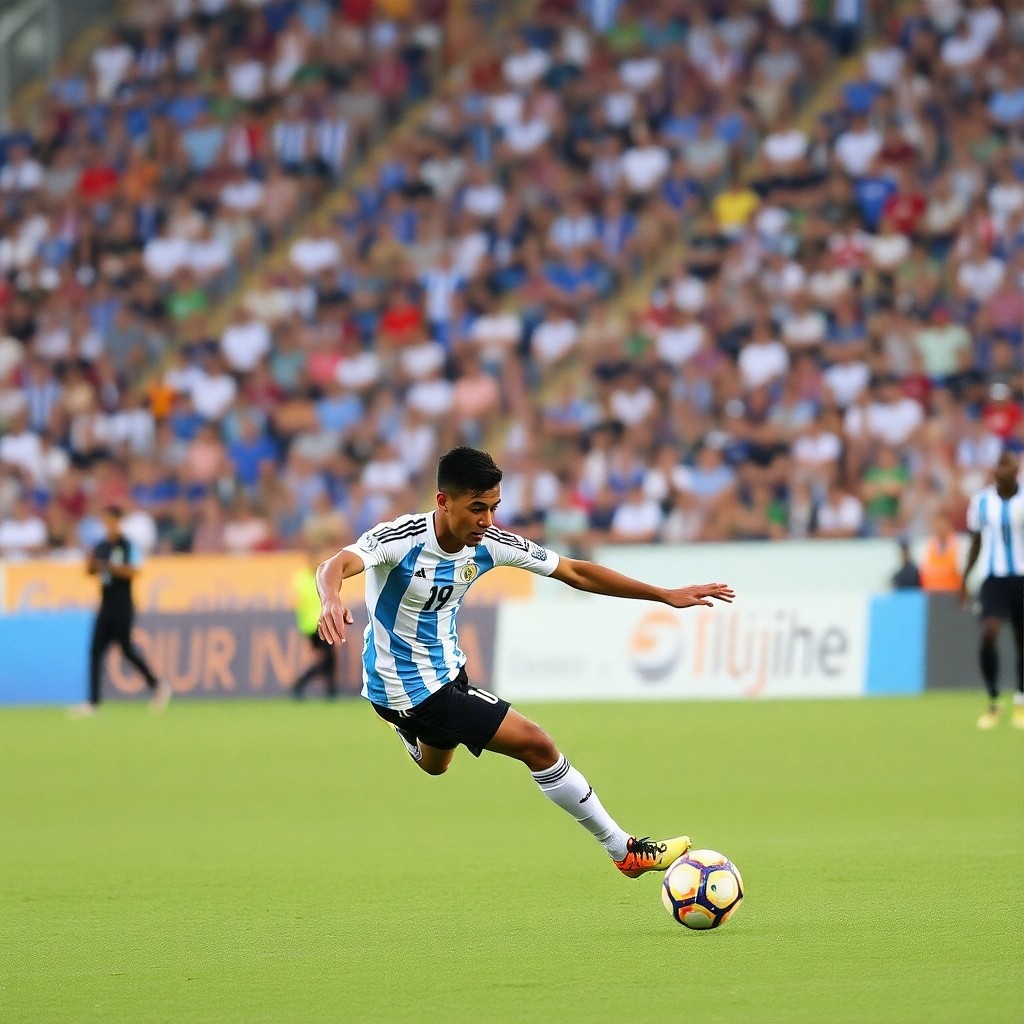
Club Social y Deportivo Guillermo Brown, affectionately known as "La Banda," is the historical bastion of football in the Argentine Patagonia. Based in the coastal city of Puerto Madryn, in the province of Chubut, the club currently competes in the Primera Nacional (the second division of Argentine football), establishing itself as one of the greatest sporting ambassadors of the country's south, facing the geographical and economic challenges imposed by the isolation of its region.
Club History
1. Origins and Foundation: The Port Cradle and the Admiral of the Nation
To understand the genesis of Club Social y Deportivo Guillermo Brown, one must travel back in time to the Puerto Madryn of the mid-1940s. At that time, the coastal town in Central Patagonia was a growing settlement, marked by the strong influence of Welsh immigrants, railway workers, and dockers. Football, which had already taken root in Argentina, was the main social catalyst for the local youth.
On January 14, 1945, a group of enthusiasts and prominent citizens gathered with the firm purpose of founding an institution that would integrate the community through sports and culture. The chosen name paid a tribute with strong patriotic appeal: Guillermo Brown, the Irish-born admiral who became the father of the Argentine Navy and a hero of the wars of independence. The choice was not merely nominal; it represented the spirit of bravery, resilience, and the city's close connection to the sea.
From its early years, the club adopted the blue and white colors. The official jersey, characterized by a blue diagonal stripe on a white background, earned the club its most famous and enduring nickname: "La Banda". In its beginnings, Guillermo Brown competed in the Liga de Fútbol del Valle del Chubut, a regional league of extreme physical toughness, where the team's competitive character was forged on dirt pitches whipped by the incessant winds of the Patagonian steppe.
---2. Golden Eras and Historical Campaigns
For decades, Guillermo Brown was limited to the regional scene of Chubut, collecting local titles but facing the insurmountable barrier of geographical distances to reach the national stage. The great institutional and sporting turning point began to take shape at the turn of the 21st century.
The National Rise (2002-2003)
Under the technical direction of the experienced Luis "Piti" Murúa, the club structured itself professionally to compete in the Torneo Argentino B (the fourth division for interior teams). In the 2002/2003 season, "La Banda" had a memorable campaign, culminating in the title and an unprecedented promotion to the Torneo Argentino A. The feat put Puerto Madryn firmly on the map of Argentine federal football.
The Epic 2011 Promotion and the "Monumental Impact"
The club's true "Golden Era" peaked in the 2010/2011 season. With a balanced team led by Arnaldo "Cacho" Sialle, Guillermo Brown was crowned champion of the Torneo Argentino A in an indisputable manner, securing direct promotion to the Primera B Nacional (the national second division).
Destiny reserved a historical baptism of fire for the club in the 2011/2012 season. Due to the unprecedented relegation of the giant River Plate, Guillermo Brown shared the country's spotlight with one of the biggest clubs on the planet. On November 19, 2011, the most celebrated moment in the club's history occurred: at the legendary Estadio Monumental de Núñez, the modest Guillermo Brown of Puerto Madryn drew 2-2 with River Plate. The goals by Gastón Bottino and the historic equalizer by Hernán Zanni in the 90th minute silenced over 60,000 spectators and entered the folklore of Argentine football as one of the greatest feats by a Patagonian club.
| Date | Opponent | Score | Venue | Brown's Goals |
|---|---|---|---|---|
| 11/19/2011 | River Plate | 2 - 2 | El Monumental (Buenos Aires) | Gastón Bottino, Hernán Zanni |
The Near-Miracle of the First Division (2016/2017)
In the 2016/2017 transition season, under the tactical command of Gastón Esmerado, Guillermo Brown was on the verge of achieving the greatest miracle in Argentine interior football: promotion to the First Division (Liga Profesional). With a squad assembled on a tight budget, the team led a good part of the 44-round tournament. In the final stretch, after a dramatic point-by-point battle with Chacarita Juniors, Brown finished in an honorable, yet painful, third place with 75 points (only two points behind Chacarita), missing the direct promotion spot in the final round.
---3. Context and Current Moment
Currently, Guillermo Brown has consolidated its reputation as a resilient team in the Primera Nacional. Modern football imposes severe logistical difficulties for clubs in the south: every away match requires land or air travel of thousands of kilometers to Buenos Aires, Córdoba, Santa Fe, or the north of the country.
In the recent season, the club has focused its efforts on maintaining its category and developing local athletes, in addition to serving as a showcase for loan players from major clubs in the Argentine elite. The board has been investing continuously in the modernization of the club's facilities and youth divisions, seeking to shield the institution against the constant economic crises that affect the country.
---4. Main Idols and Coaches Who Defined an Era
The rich historical tapestry of "La Banda" was woven by personalities who demonstrated grit, technique, and a deep sense of belonging.
- Gastón Bottino: The tireless midfielder immortalized himself in the club's memory by scoring the first goal against River Plate at the Monumental in 2011, in addition to being a key piece in the team's transition dynamics for several seasons.
- Diego Giménez: Known as "El Tanque," he is one of the greatest goalscorers in the club's history in federal football, a symbol of firepower and Patagonian grit in the opposing box.
- Mauro Fernández: A fast forward who emerged from the club's youth system and played a crucial role in the 2011 promotion. His speed caught the attention of elite and foreign football (having stints in Mexican football), later returning to lead the club with his experience.
- Arnaldo "Cacho" Sialle (Coach): The strategist of the 2011 promotion. Sialle built a team that played vertically and aggressively, being considered the tactical architect of the institution's most victorious period.
- Gastón Esmerado (Coach): The coach who extracted maximum performance from the squad in the historic 2016/2017 campaign. Under his command, the team stood out for its defensive solidity and surgical counter-attacks.
5. Major Rivalries: Blood Boils in Patagonia
Patagonian football is marked by visceral rivalries, based on territorial disputes and distinct social identities.
The Madrynense Derby (Guillermo Brown vs. Deportivo Madryn)
This is the biggest derby in the province of Chubut and one of the hottest in all of Argentine football. The rivalry with Club Social y Deportivo Madryn (founded in 1924) divides the city of Puerto Madryn absolutely.
Historically, the rivalry has social and geographical roots. While Deportivo Madryn represented the more traditional and commercial sectors of the city center, Guillermo Brown was born with a strong popular and working-class appeal, closely linked to the port area and growing peripheral neighborhoods. For decades, the clashes were limited to the local league. However, with Deportivo Madryn's rise to the Primera Nacional in 2022, the "Clásico del Golfo" reached the national professional level, stopping the city and mobilizing a massive police contingent due to the extreme passion and animosity between the fanbases.
The Provincial Rivalry: Huracán de Trelew and Germinal de Rawson
Before Deportivo Madryn's national projection, Guillermo Brown's great adversaries were the neighboring teams of the Chubut River Valley. The duels against Huracán de Trelew and Germinal de Rawson (from the provincial capital) represented regional battles for the political-sporting dominance of the region. The games were characterized by strong pressure from local fans and controversial refereeing.
---6. Titles, Cups, and Notable Medals
Throughout its nearly eight-decade journey, Guillermo Brown has established itself as the most decorated trophy cabinet in Chubut football at the national level.
- Torneo Argentino A (National Third Division): 2 titles
- 2010/2011 Season (Direct promotion to Primera B Nacional)
- Torneo Federal A 2014 (Zone 1 Champion - Promotion to Primera B Nacional)
- Torneo Argentino B (National Fourth Division): 1 title
- 2002/2003 Season (Promotion to Torneo Argentino A)
- Liga de Fútbol del Valle del Chubut: 13 regional titles
- Historical achievements that consolidated local sovereignty before joining the AFA (Argentine Football Association) league system.
7. The Temple of the Wind: The Raúl Conti Stadium
One cannot write the chronicle of Guillermo Brown without dedicating lines of reverence to its stronghold: the Raúl Conti Stadium. Inaugurated in 1967 and expanded over the years to currently house about 15,000 spectators, the stadium is feared by opponents who travel south.
The greatest adversary for those playing at the Raúl Conti, besides the grit of the local players, is the climatic factor. Puerto Madryn is plagued by constant Patagonian winds that routinely exceed 60 km/h. Guillermo Brown has learned to use the physics of the wind to its advantage: long balls, inswinging corners, and long-range shots are calibrated according to the gusts coming from the Atlantic Ocean, turning the Conti into a true impregnable fortress.
---Research Sources
- Diario Jornada (Chubut): Historical archives on Chubut Valley football campaigns and coverage of the 2011 promotion.
- Asociación del Fútbol Argentino (AFA): Official bulletins, historical league tables of the Primera B Nacional and Torneo Argentino A.
- Diario Olé: Coverage of the historic 2011 match at the Monumental de Núñez between River Plate and Guillermo Brown.
- Solo Ascenso: Technical data, signings, and match reports of Guillermo Brown in the Primera Nacional.
- Promiedos: Statistical history of head-to-head matches, match sheets, and club goalscoring data.





