



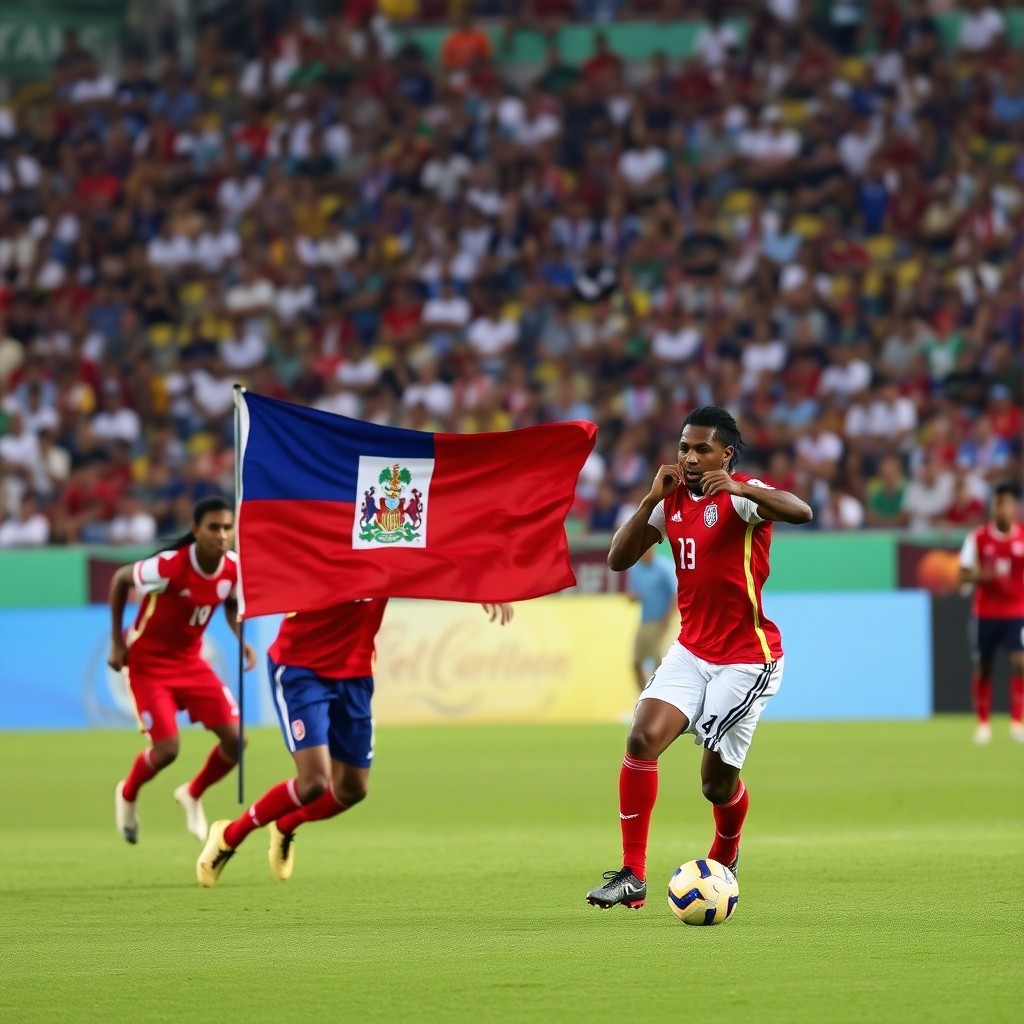
Football, in its purest essence, acts as both a distorted mirror and an ultra-realistic reflection of the society that practices it. In the case of Haiti, this maxim ceases to be an academic cliché and becomes a chronicle of survival, resistance, and paradox. Historically known as the world's first independent Black republic, the fruit of a slave revolution that challenged Napoleon Bonaparte's empire in 1804, the Caribbean nation carries in its footballing trajectory the same DNA of insurrection and tragedy that marks its political history. The Haiti national football team, affectionately nicknamed Les Grenadiers (The Grenadiers), is not just a sports team; it is one of the most resilient institutions of a state constantly battered by natural disasters, foreign interventions, deep institutional crises, and urban violence that, in recent years, has made daily life in its capital, Port-au-Prince, virtually impossible. Analyzing Haitian football is to dive into a narrative that crosses the mythical glory of the 1974 World Cup, the barbarity of the Duvalier dynastic dictatorships, the devastating impact of the 2010 earthquake, and the current, complex phenomenon of the diaspora, which today sustains the national team's competitiveness on international pitches while the country of origin struggles to avoid collapse.
1. Origins and Formation of National Identity
To understand the genesis of football in Haiti, one must go back to the early 20th century, a period when the island of Hispaniola lived under the shadow of constant political upheaval and the imminent military occupation by the United States (which would take place between 1915 and 1934). The "beautiful game" arrived on Haitian shores not at the hands of American Marines—who preferred baseball, a sport that ironically took deep root in the neighboring Dominican Republic—but through the Haitian intellectual and commercial elite who maintained close ties with Europe, particularly France. In 1904, the same year the International Federation of Association Football (FIFA) was founded in Paris, football took its first formal steps in Haiti. The Fédération Haïtienne de Football (FHF) was founded in 1904, although its official affiliation with the world's governing body only materialized three decades later, in 1934.
In its early years, Haitian football was an eminently aristocratic activity, restricted to the social clubs of the mulatto bourgeoisie in Port-au-Prince. Clubs like the Violette Athletic Club (founded in 1918) and the Racing Club Haïtien (founded in 1923) became the epicenters of this practice. Violette AC, sporting blue and white colors, represented the traditional elite, while the Racing Club, in blue and yellow, soon began to attract a more popular fan base, starting one of the oldest and fiercest rivalries in the Caribbean, the so-called Port-au-Prince Derby. As the sport became more popular, it broke the class and color barriers that historically divided Haitian society. The dirt pitches of urban peripheries and rural areas began to produce players with refined technique, impressive speed, and physical endurance forged in the country's harsh living conditions.
The consolidation of football as an element of national identity occurred in the mid-20th century, under the impact of profound political transformations. With the rise of François "Papa Doc" Duvalier to power in 1957, football began to be viewed by the dictatorial regime as a tool for social control and political propaganda. Duvalier, a populist who used the concept of noirisme (the exaltation of the Black majority in opposition to the mulatto elite) to consolidate his autocratic power, realized that the success of popular clubs and the national team could legitimize his dictatorship. It was under state sponsorship—and under the constant surveillance of the feared Tontons Macoutes, the regime's paramilitary militia—that the country's sports infrastructure received its largest investments, culminating in the renovation of the Stade Sylvio Cator, named after the legendary Haitian athlete who won the silver medal in the long jump at the 1928 Amsterdam Olympic Games.
In this scenario of oppression and passion, the Haitian style of play began to define its characteristics. Influenced by the flair and plasticity of South American football—especially Brazil, which has always been a mythical reference for local fans—and the physical strength of African football, the Haitian player developed a relationship with the ball based on improvisation and verticality. There was no room for European tactical academicism; the football of the streets of Port-au-Prince, Cap-Haïtien, and Gonaïves was a game of survival, where speed and short dribbling were the weapons to overcome opposing defenses and, metaphorically, the adversities of daily life. The national team, therefore, was born not just as a football team, but as the ultimate representation of the dignity of a people who, despite being geopolitically isolated and impoverished by historical colonial debts and blockades, found in the pitches a territory of equality and sovereignty.
2. Golden Era, Great Campaigns, and Eternal Idols
The peak of Haitian football history occurred in the 1970s, a golden period that coincided with the transition of power from Papa Doc to his son, Jean-Claude "Baby Doc" Duvalier. Eager to improve the international image of his regime, which was widely condemned for human rights violations, Baby Doc poured financial resources into the national team. The goal was clear: to qualify Haiti for the 1974 World Cup in West Germany. The road to the World Cup went through the organization of the 1973 CONCACAF Championship (which served as the World Cup qualifier), held entirely at the Stade Sylvio Cator in Port-au-Prince. Under the leadership of local coach Antoine Tassy, the Grenadiers carried out a memorable campaign, defeating regional powers like Honduras and Mexico, the latter under dramatic circumstances and surrounded by accusations of intimidation by Haitian authorities.
Winning the 1973 CONCACAF title guaranteed Haiti its first—and to this day only—participation in a FIFA World Cup. The team that traveled to West Germany was composed almost entirely of athletes playing in the local league, figures who would become immortal legends in the country's popular imagination. Among them were goalkeeper Henri Francillon, whose elastic saves impressed European observers; the elegant midfielder Philippe Vorbe, one of the few white players on the team, heir to a traditional family but adored by the people for his extraordinary vision; and, above all, striker Emmanuel "Manno" Sanon, a lethal sprinter gifted with an implacable goal-scoring instinct.
The 1974 World Cup group draw placed debutant Haiti in Group 4, alongside three giants of world football: Italy, the 1970 World Cup runners-up; Poland, who would finish that tournament in third place with a brilliant generation; and the Argentina of René Houseman and Yazalde. The opening match, played on June 15, 1974, at the Olympiastadion in Munich against Italy, entered the anthology of world football. The Italian team featured the legendary goalkeeper Dino Zoff, who boasted a record unbeaten streak of 1,143 minutes without conceding a goal in official international matches. The first half ended in a tense 0-0, with Haiti bravely resisting the Azzurri's pressure.
Early in the second half, in the 46th minute, the unthinkable happened. Philippe Vorbe received the ball in midfield and delivered a millimeter-perfect through ball, tearing through the Italian defense. Emmanuel Sanon used his stunning speed to overcome defender Francesco Morini, dribbled past Dino Zoff with surgical coolness, and pushed the ball into the empty net. The goal shocked the football world and ended Zoff's mythical unbeaten streak. Although Italy reacted and won the match 3-1, that Sanon goal was celebrated in Port-au-Prince as if it were the world title itself. Haiti would still lose to Poland 7-0 and to Argentina 4-1 (with another goal from Sanon), but the dignity shown on the pitch guaranteed that generation a permanent place in history.
However, the 1974 campaign was also marked by the shadows of the Duvalier regime. Defender Ernst Jean-Joseph tested positive in a doping test after the match against Italy (the first doping case in World Cup history). Upon learning of the result, the Haitian delegation officials, fearing Baby Doc's fury, allowed state security agents (the Tontons Macoutes) to forcibly remove Jean-Joseph from the team hotel. The player was beaten and taken back to Haiti under custody, a dark episode that revealed to the world the brutal face of the dictatorship that controlled the country's football behind the scenes. Despite this trauma, the '74 generation remained the gold standard by which all subsequent generations of Haitian footballers are measured.
3. Rivalries, Crises, and Power Behind the Scenes
Football in the Caribbean is inseparable from regional geopolitical tensions, and Haiti's greatest rivalry reflects one of the most complex and tragic borders in the Western Hemisphere: the land border with the Dominican Republic. The so-called Clásico Caribeño between Haiti and the Dominican Republic goes beyond the four lines. Historically, relations between the two countries that share the island of Hispaniola are marked by sovereignty conflicts, structural racism, mass immigration, and the trauma of the 1937 Parsley Massacre, ordered by Dominican dictator Rafael Trujillo. In football, this rivalry is asymmetric. While the Dominican Republic has historically prioritized baseball, Haiti has always had football as its absolute national passion. In direct clashes, the Grenadiers hold a wide historical advantage, but recent duels have taken on extreme tension due to the migration crisis and the Dominican government's mass deportation policies of Haitians.
Another intense regional rivalry occurs against Jamaica. The duels against the Reggae Boyz often decide supremacy in the Anglo-French Caribbean. While Jamaica relies on a physical structure and the influence of English football, Haiti bets on technique and speed. These clashes in the CONCACAF Gold Cup and the Caribbean Cup are characterized by extreme physical intensity and a "cauldron" atmosphere, regardless of where the match is held.
However, the greatest adversaries of Haitian football in recent decades have not been on the pitch, but in the federation's own offices and the country's chronic instability. The administration of football in Haiti was, for more than twenty years, the personal fiefdom of Yves "Dadou" Jean-Bart. President of the FHF from 2000 to 2020, Jean-Bart was an influential figure in CONCACAF and FIFA, but his reign collapsed in 2020 after an international journalistic investigation led by the British newspaper The Guardian. Jean-Bart was accused of sexually abusing dozens of players from the women's youth national teams at the federation's national training center, the Ranch de la Croix-des-Bouquets. The scandal revealed a system of coercion and abuse of power that shocked the international community. Although FIFA banned Jean-Bart from football for life, the decision was later overturned by the Court of Arbitration for Sport (CAS) in 2023 due to alleged insufficient evidence, a resolution that sparked immense outrage among human rights activists and Haitian athletes, keeping the federation in a state of deep division and moral crisis.
In addition to political and moral crises, Haitian football has been repeatedly devastated by forces of nature. The earthquake of January 12, 2010, which destroyed Port-au-Prince and claimed more than 200,000 lives, dealt an almost fatal blow to the country's sport. The FHF headquarters collapsed, killing more than thirty federation officials, coaches, and staff, including the U-17 national team coach. The Stade Sylvio Cator turned into an improvised camp for thousands of homeless people. Recovery was slow and depended almost exclusively on international humanitarian aid and donations from FIFA and partner federations. When local football was finally attempting a comeback, the escalation of armed gang violence starting in 2021—following the assassination of President Jovenel Moïse—plunged the country into an unprecedented security crisis. The national championship was suspended indefinitely, local clubs lost their revenue sources, and the national team was forced to play all its matches outside the country, usually in the Dominican Republic or the United States, depriving Haitian fans of the right to see their team play at home.
4. The Current Moment: Tactics, Generation, and Challenges
Faced with the collapse of the local league due to the violence of the gangs that control much of Port-au-Prince, the Haiti national team has undergone a tactical and demographic metamorphosis. Currently, the Grenadiers are a team composed almost entirely of athletes playing abroad. This transition to a diaspora-based national team has brought a new level of professionalism and tactical rigor, but it has also imposed complex challenges of cohesion and identity. Under the command of recent foreign coaches, such as Frenchman Marc Collat, former Haitian player Jean-Jacques Pierre, and, more recently, Frenchman Sébastien Migné, the team has sought to modernize its style of play, moving away from the purely intuitive style of the past to adopt more structured systems.
Tactically, the current Haitian team usually structures itself in a solid 4-2-3-1 or a dynamic 4-3-3, prioritizing rapid offensive transition and the exploitation of the flanks. The team relies heavily on the physical power and speed of its forwards to surprise opponents in vertical counter-attacks. The backbone of this generation features players who have gained experience in competitive leagues in Europe and Major League Soccer (MLS). The great symbol of this offensive strength is center-forward Frantzdy Pierrot. With his imposing stature and excellent aerial game, Pierrot stood out at Maccabi Haifa in Israel—where he played in the UEFA Champions League and scored goals against European giants—before transferring to AEK Athens. He is the reference point in the box, the player capable of holding the ball with his back to the defense and creating space for the wingers to arrive.
Alongside Pierrot, striker Duckens Nazon, known as "Le Duc" (The Duke), is another fundamental piece. Nazon, who has a long career in clubs in Europe (such as Coventry City and CSKA Sofia) and Asia, is a mobile striker capable of playing both centrally and drifting to the wings. In midfield, defensive solidity and quality in ball distribution pass through the feet of Danley Jean Jacques, a defensive midfielder who stood out at Metz in France before transferring to the Philadelphia Union of MLS. Jean Jacques represents the prototype of the modern Haitian midfielder: strong in individual duels, tactically disciplined, and with good game distribution capacity.
Despite the individual talent of this offensive sector, the Achilles' heel of the Haitian team lies in its defensive consistency and the lack of time for collective training. As the players are spread across clubs in France, the United States, Canada, Israel, and other smaller leagues, and due to the impossibility of holding training sessions or friendlies in Port-au-Prince, the coaching staff faces Herculean difficulties in consolidating a cohesive defensive system. In official competitions, such as the CONCACAF Gold Cup and the CONCACAF Nations League, Haiti often displays moments of offensive brilliance but ends up penalized by defensive positioning errors and a visible drop in physical performance in the final minutes of matches, the result of the wear and tear of long trips and the lack of refined tactical chemistry.
Main Pillars of the Current Generation
- Frantzdy Pierrot (Striker): Physical strength, presence in the box, and experience in high-level European competitions.
- Duckens Nazon (Striker): Offensive versatility, technical leadership, and one of the greatest goalscorers in the national team's recent history.
- Danley Jean Jacques (Midfielder): Tactical balance, defensive transition, and experience in the French Ligue 1 and MLS.
- Carlens Arcus (Defender): Right-back of great defensive consistency, with a long stint at Auxerre in France, and currently at Vitesse in the Netherlands.
5. Talent Development, Structure, and Future
The future of Haitian football is an enigma that balances between the scarcity of internal resources and the abundance of talent in the diaspora. Historically, the main center for athlete development in the country was the Ranch de la Croix-des-Bouquets, a sports complex built with the support of FIFA's Goal program. For years, the Ranch functioned as a residential academy for young talents of both sexes, coming from all provinces of the country. From this center of excellence emerged players who now shine on the world stage, such as the young star Melchie "Dumornay" Corventina, currently at Olympique de Lyon and considered one of the best female football players on the planet. However, the territorial control exercised by armed gangs in the Port-au-Prince metropolitan region made the Ranch inaccessible, forcing its temporary closure and interrupting the flow of athlete development on national soil.
Faced with the collapse of local infrastructure, the FHF and the national team coaching staffs have turned their eyes systematically to the immense community of Haitians and Haitian descendants living abroad, particularly in France, Canada, and the United States. The process of recruiting "dual-national" athletes has become the lifeline of the Grenadiers. Players born or raised in the suburbs of Paris, Montreal, Miami, or New York, who received their basic training in elite academies of Ligue 1 or MLS clubs, are tracked and invited to defend the land of their parents or grandparents. This strategy has allowed Haiti to maintain a surprising level of international competitiveness, even without an active national championship.
However, this recruitment policy in the diaspora generates complex debates about the identity and future of local football. There is a latent concern that excessive dependence on athletes trained abroad will end up further stifling the development of football within Haiti itself. Without an active professional league and without safe training centers, young people living in the slums of Cité Soleil or Carrefour lose football as one of the few paths for social mobility and escape from urban violence. The country's historic clubs, such as Violette AC, Racing Club Haïtien, FICA (from Cap-Haïtien), and Baltimore SC (from Saint-Marc), survive in a state of suspended animation, awaiting a political pacification that seems distant on the horizon.
Despite all the adversities, football continues to be one of the rare elements of national cohesion and collective pride in Haiti. When the Grenadiers take the field, political and social divisions are temporarily suspended, and the country unites around a common passion. The great medium-term goal is the qualification campaign for the 2026 World Cup, which will be held in North America (United States, Canada, and Mexico). With the increase in the number of spots for CONCACAF and the automatic qualification of the three host countries, a historic opportunity opens for Haiti to return to the biggest stage of world football after more than half a century of absence. An eventual qualification would not solve the country's deep structural problems, but it would be the definitive proof that, even in the most adverse circumstances, Haitian football possesses a capacity for rebirth and resilience that defies logic itself.





