



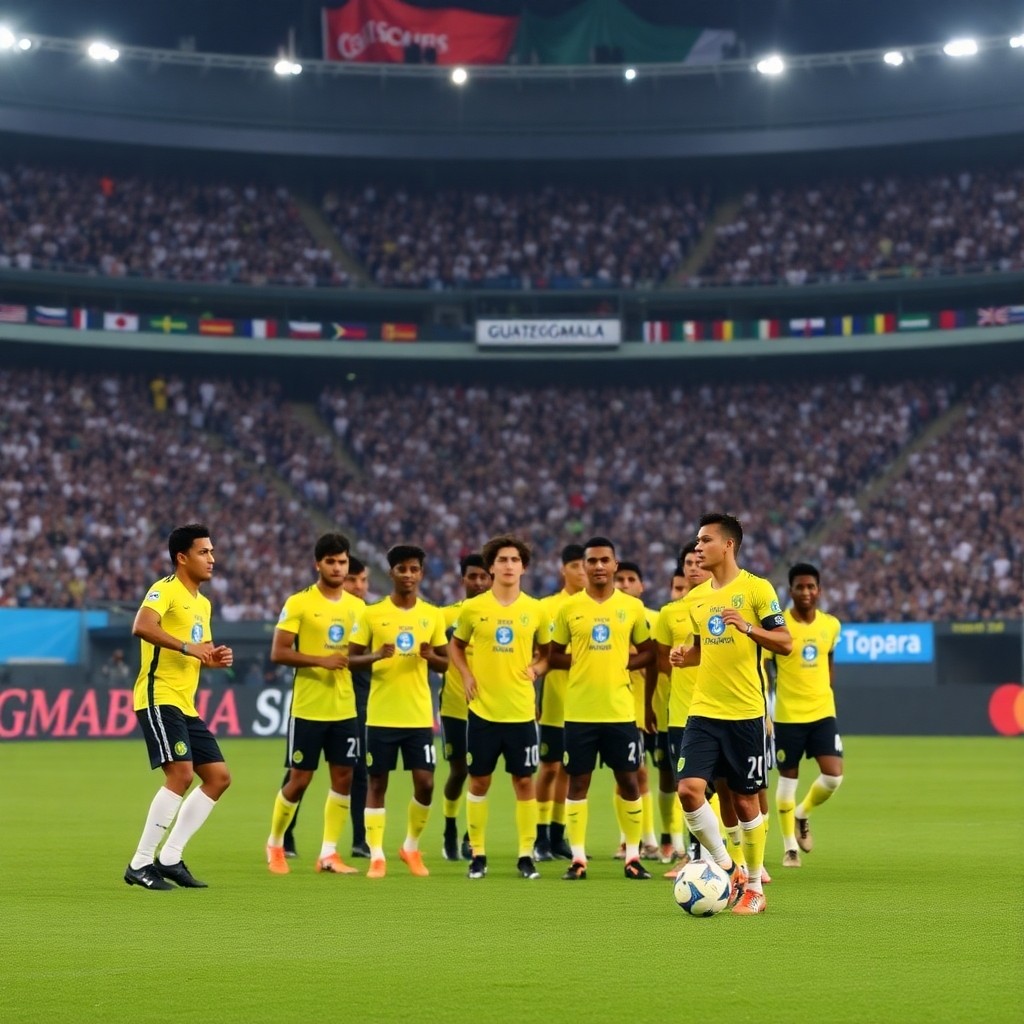
Football in Guatemala is not just a sport; it is a perpetual exercise of hope against the tide of history. In the heart of Central America, where Mayan heritage and the scars of decades of internal conflict shape the national identity, the national football team—affectionately known as "La Azul y Blanco"—walks like a sleeping giant that insists on not fully waking up. While neighbors with smaller demographic or economic footprints, such as Honduras, El Salvador, and Costa Rica, have already experienced the glory of competing in the FIFA World Cup, Guatemala remains the most populous nation on the isthmus never to have crossed that sacred threshold. It is a sociopolitical and sporting paradox: a country with overwhelming passion, fervent stadiums, and a rich regional tradition, but whose trajectory is systematically sabotaged by institutional crises, endemic corruption, and a chronic inability to transform raw talent into high-performance structures. Currently, under the tactical leadership of experienced Mexican coach Luis Fernando Tena, Guatemala is undergoing a reconstruction process that blends tactical pragmatism with an incessant search for dual-nationality players in the North American diaspora. This dossier dives into the depths of a football culture that oscillates between the lyrical beauty of its rare moments of glory and the tragedy of its missed opportunities, revealing the complex machinery that drives the footballing quetzal.
1. Origins and Formation of National Identity
The genesis of football in Guatemala dates back to the final years of the 19th century, fitting into the classic pattern of the sport's dissemination across Latin America: the arrival of young local aristocrats returning from their studies in Europe and the influence of British engineers and sailors associated with railway construction and the coffee trade. Officially, the "zero hour" of Guatemalan football is established in 1902, with the founding of the Club de Fútbol Guatemala by the brothers Jorge and Carlos Aguirre, members of a coffee elite who saw sports as a symbol of modernity, social hygiene, and European cosmopolitanism. Initially, the game was an exclusive privilege of the wealthy classes in Guatemala City, played on improvised fields in the historic center, such as the iconic Plaza de la Constitución.
As the first decades of the 20th century progressed, football quickly broke through the barriers of aristocratic exclusivity. The sport proved to be a powerful social catalyst, being adopted by urban working classes, artisans, and, gradually, by the populations of indigenous and mestizo origin who made up the country's demographic backbone. In 1919, the Federación Nacional de Fútbol de Guatemala (FEDEFUT) was founded, a crucial step for the institutionalization of the sport, which would culminate in affiliation with FIFA in 1946 and the subsequent founding of CONCACAF in 1961. However, this sporting expansion occurred in parallel with a turbulent political landscape, marked by military dictatorships, foreign interventions, and deep social divisions.
The role of football as an element of national cohesion and political propaganda reached its first major peak during the governments of the so-called "Democratic Spring" (1944-1954), led by Juan José Arévalo and Jacobo Árbenz. From the reformist perspective of this period, the sport was seen as a tool for social integration and the affirmation of Guatemalan sovereignty in the face of imperialist influence. It was in this atmosphere of nationalist fervor that the construction of the Estadio Nacional Olímpico de la Revolución (now known as Estadio Doroteo Guamuch Flores) began, inaugurated in 1950 to host the VI Central American and Caribbean Games. The stadium, built in a natural ravine in the center of the capital, became the sacred temple of Guatemalan football and a physical symbol of the State's modernization.
However, the violent interruption of the democratic process in 1954, through a US-backed coup d'état, plunged Guatemala into a prolonged civil war that would last 36 years (1960-1996). During this dark period, football functioned simultaneously as a pressure valve for a population battered by state violence and guerrilla warfare, and as a terrain for ideological dispute. The identity of the national team, molded under the nickname "La Azul y Blanco" (in reference to the colors of the national flag, which in turn symbolize the country's location between the Pacific and Atlantic oceans), consolidated itself as one of the rare symbols of unity in a country deeply fragmented by ethnic and class lines. The typical Guatemalan player of this period was characterized by refined technique, short stature, and remarkable physical resilience, a reflection of a formation molded in street football and on dirt fields known as "campos de la periferia."
Despite popular passion, political and economic centralization in Guatemala City created a structural abyss between the capital's clubs (notably Comunicaciones FC and CD Municipal) and the teams from the interior of the country, known as "provincianos." This geographic and social division historically limited the national team's recruitment capacity, which for decades ignored the vast potential of talent in Mayan-majority regions, such as the western highlands. Guatemalan football, therefore, developed under the constant tension between the desire for modernity and the shackles of an exclusionary social reality, a duality that still reverberates today in the organizational structure of the sport in the country.
2. Golden Era, Great Campaigns, and Eternal Idols
The most glorious period of Guatemalan football occurred between the late 1960s and the late 1970s, a time when the national team not only competed on equal footing with CONCACAF powers but also achieved significant international projection. The pinnacle of this golden era was, without a doubt, the conquest of the 1967 CONCACAF Championship (the predecessor to the current Gold Cup), held in Honduras. Under the tactical command of the legendary Uruguayan coach Rubén Amorín — one of the most influential figures in the history of Central American football — Guatemala became undefeated champions, overcoming regional powers such as Mexico and Trinidad and Tobago.
The 1967 campaign was a masterpiece of collective organization and individual talent. The team featured a formidable defensive line led by Alberto López Oliva and Henry Stokes, as well as a creative midfield orchestrated by Jorge "El Grillo" Roldán, considered by many to be the most elegant player the country has ever produced. The attack was lethal, fueled by the goals of Manuel "Escopeta" Recinos and Hugo "Tin Tan" Peña. The 1-0 victory over Mexico at the Estadio Nacional in Tegucigalpa, with a historic goal by Recinos, sealed the title and placed Guatemala at the top of North, Central American, and Caribbean football. To this day, this achievement remains the only official top-level title for the Guatemalan national team in CONCACAF.
The consistency of this golden generation was confirmed by qualification for three editions of the Olympic Games: Mexico City 1968, Montreal 1976, and Seoul 1988. In the 1968 edition, Guatemala had a memorable campaign, reaching the quarterfinals after beating Czechoslovakia 1-0 and Thailand 4-1 in the group stage. The elimination against Hungary (which would go on to win the gold medal) by a narrow 1-0 did not diminish the historic feat of a team composed entirely of amateur players who challenged the superpowers of the Soviet bloc. In 1976, in Montreal, "La Azul y Blanco" snatched historic draws against Israel and France (which featured a young Michel Platini), consolidating international respect for the country's football.
As the 1967 generation aged, Guatemalan football saw the emergence of new talents who would keep the flame of competitiveness alive. Among them, Juan Carlos "El Pin" Plata stands out, a striker with an incomparable nose for goal who dedicated his entire professional career to CD Municipal. Plata became a symbol of loyalty and efficiency, scoring 35 goals for the national team, including the historic equalizer against Brazil (1-1) in the 1998 Gold Cup, a result that shocked the football world and is still remembered with almost religious reverence in Guatemala.
However, no name shines as intensely in the constellation of Guatemalan football as that of Carlos Humberto Ruiz Gutiérrez, known worldwide as "El Pescadito" Ruiz. Emerging from the youth ranks of Municipal, Ruiz transcended his country's borders to become one of the most feared and respected strikers in the history of CONCACAF and Major League Soccer (MLS). With his refined technique, impeccable positioning in the box, and a fiercely competitive temperament, "El Pescadito" led the national team for nearly two decades.
Ruiz holds a truly extraordinary record on the global stage: he is the all-time leading scorer in FIFA World Cup Qualifiers, with 39 goals scored in five different qualifying cycles (2002 to 2018), surpassing legends like Cristiano Ronaldo, Lionel Messi, and Ali Daei. Throughout his time with the national team, Ruiz played 133 matches and scored 68 goals, establishing himself as the top scorer and the most-capped player in the history of "La Azul y Blanco." Despite his herculean efforts — which often carried tactically limited teams on his back — Ruiz never managed to achieve his greatest dream: playing in a World Cup. His farewell to the national team in September 2016, scoring five goals against Saint Vincent and the Grenadines, marked the end of an era and left a leadership void that Guatemala is still struggling to fill.
3. Rivalries, Crises, and Behind-the-Scenes Power
The history of football in Guatemala is inseparable from the intense regional rivalries in Central America, a territory where geographic borders often turn into sporting trenches loaded with geopolitical and historical tensions. Guatemala's main rival is the El Salvador national team, in a clash known as the "Clásico Centroamericano." This rivalry, which now spans over a century of matches, transcends the field of play; it reflects the historical struggle for economic and cultural hegemony on the isthmus, in addition to being deeply marked by mutual migrations and the political conflicts that plagued both nations during the 20th century. Matches between Guatemalans and Salvadorans are characterized by an atmosphere of extreme hostility in the stands and by physical, nervous, and high-voltage football on the pitch.
Another high-intensity rivalry is against Honduras. Although the Hondurans have achieved greater success in terms of World Cup qualifications, the head-to-head matches are historically balanced and full of controversial episodes. The rivalry with Costa Rica, in turn, carries a tone of sporting resentment: the Costa Ricans are often seen by Guatemalans as the "aristocrats" of Central American football, and beating them is considered the ultimate test of affirmation for "La Azul y Blanco."
However, the greatest adversaries of Guatemalan football have not been the rivals in cleats, but rather the officials who occupied the offices of the Federación Nacional de Fútbol de Guatemala (FEDEFUT). The recent history of the federation is a compendium of corruption scandals, money laundering, match-fixing, and power struggles that culminated in the darkest period of the sport in the country: the suspension imposed by FIFA between October 2016 and May 2018.
The institutional crisis reached its breaking point in December 2015, in the wake of the global scandal known as "FIFA Gate." The then-president of FEDEFUT, Brayan Jiménez, and FIFA executive committee member Héctor Trujillo were indicted by the United States justice system for crimes of conspiracy, wire fraud, and money laundering, related to the receipt of millions in bribes in exchange for granting television broadcasting and marketing rights for World Cup qualifiers. Jiménez fled justice, later being captured in an apartment in Guatemala City in degrading conditions, a melancholy reflection of the moral decay of local football leadership.
Faced with administrative collapse, FIFA appointed a Normalization Committee to take control of FEDEFUT and align its statutes with international guidelines. However, the resistance of local officials and national league clubs to accept the proposed reforms — which included greater financial transparency and the loss of political privileges — led FIFA to suspend the Guatemalan federation from all international competitions on October 28, 2016. This suspension had devastating consequences for the country's football:
- The senior national team was excluded from the 2017 Gold Cup qualifiers and the newly created CONCACAF Nations League, falling to the lowest division (League C) due to forced inactivity.
- Guatemalan clubs (such as Comunicaciones, Municipal, and Antigua GFC) were prohibited from participating in the CONCACAF Champions League, interrupting their sporting and financial development.
- Men's and women's youth national teams were prevented from playing in qualifying tournaments for World Cups and Olympics, sabotaging the transition of an entire generation of young talent.
- Guatemala's FIFA ranking plummeted beyond the 140th position, destroying the international prestige that the national team had built with great difficulty.
The suspension was finally lifted on May 31, 2018, after the approval of new statutes by the FEDEFUT General Assembly under intense pressure from the football community and fans. However, the scars of this period of isolation are still visible. The loss of nearly two years of competitive development delayed the tactical and structural modernization of Guatemalan football, leaving the country at a disadvantage compared to neighbors who knew how to take advantage of the period to structure themselves, such as Panama and Canada.
In addition to administrative corruption, Guatemalan football was also shaken by serious allegations of match-fixing. In 2012, three of the national team's main players — Guillermo "El Pando" Ramírez, Yony Flores, and Gustavo Cabrera — were banned for life from football by FIFA after investigations proved their involvement in bribery to manipulate the results of friendly matches for the national team against South Africa, Honduras, and Costa Rica, as well as Municipal club matches in the CONCACAF Champions League. This scandal fractured fans' trust in the integrity of their idols and exposed the vulnerability of a sporting system where low wages and a lack of professionalism created fertile ground for organized crime.
4. The Current Moment: Tactics, Generation, and Challenges
After years of ostracism and painful reconstruction, the Guatemalan national team is currently experiencing a period of technical stability and renewed hope. The major turning point occurred with the hiring, in December 2021, of renowned Mexican coach Luis Fernando Tena. Known for his tactical intelligence and group management skills, Tena boasts in his resume the historic conquest of the Olympic gold medal with the Mexico U-23 team at the London 2012 Games. His arrival brought a level of professionalism, methodological rigor, and international prestige that FEDEFUT had long been unable to attract.
Under Tena's command, Guatemala has adopted a tactical system predominantly structured in a 4-2-3-1, which occasionally transforms into a 4-3-3 depending on the opponent's demands. Tena's playing philosophy prioritizes defensive solidity, compact lines, and a fast, pragmatic offensive transition. Unlike past generations, which often sinned with sterile ball possession and slow circulation, the current Guatemalan national team seeks to be vertical and aggressive down the flanks. Goalkeeper Nicholas Hagen, who plays for the Columbus Crew in MLS, has established himself as one of the team's defensive references, standing out for his reach, sharp reflexes, and quiet leadership from his penalty area.
The great innovation of Tena's management and the current FEDEFUT board has been the systematic search for dual-nationality players in the Guatemalan diaspora, especially in the United States. Given the chronic technical limitations of the local league, this international recruitment strategy has transformed the competitive physiognomy of the national team. The three main exponents of this policy are:
- Aaron Herrera: A right-back born in the United States, with a solid career in MLS (playing for Real Salt Lake, Montreal, and currently D.C. United). Herrera brought international-level technical quality to the defensive line, standing out both in individual marking and in offensive support with precise crosses.
- Rubio Rubin: A striker born in Oregon, with stints in Dutch, Mexican, and MLS football. Rubin chose to represent Guatemala (his mother's country of origin) and quickly assumed the responsibility of being Luis Fernando Tena's reference "number 9," offering mobility, hold-up play, and presence in the box.
- Nathaniel Mendez-Laing: Perhaps the most surprising signing from the diaspora. Born in England and with vast experience in the English Football League (standing out at Derby County), Mendez-Laing qualified to represent Guatemala due to his maternal grandparents' nationality. His physical power, extreme speed on the wings, and ability to dribble in one-on-one situations gave the national team a dimension of danger in fast transitions that the team historically lacked.
This blend of players trained abroad with local talents — such as the talented midfielder Oscar Castellanos and the experienced defender José Carlos Pinto — produced immediate and encouraging results. The great test of this new identity occurred in the 2023 CONCACAF Gold Cup. Hosted in the United States, the competition witnessed a memorable campaign by Guatemala.
In the group stage, "La Azul y Blanco" finished at the top of their group, overcoming the favorite Canada team with a 0-0 draw and defeating Cuba (1-0) and Guadeloupe (3-2) in an epic match at Red Bull Arena, where Guatemalan fans showed up in droves, turning the stadium in New Jersey into a branch of the Doroteo Guamuch Flores. In the quarterfinals, Guatemala faced the strong Jamaica team. Despite the 1-0 elimination in an extremely balanced game, the team was given a standing ovation by their fans and the international press, who recognized the tactical evolution and competitiveness demonstrated under Tena's command.
Currently, Guatemala's major goal is qualification for the 2026 FIFA World Cup, which will be jointly hosted by the United States, Mexico, and Canada. With the automatic qualification of the three CONCACAF superpowers as host countries, three additional direct spots and two for the intercontinental playoff were opened for the other nations in the region. For Guatemala, this represents the best historical opportunity to break the taboo of never having played in a World Cup. However, the path is arduous: the team needs to demonstrate consistency in away games in the hostile environment of Central American qualifiers and overcome direct competitors who have also strengthened, such as Panama, Jamaica, Costa Rica, Honduras, and El Salvador.
5. Talent Development, Structure, and Future
Despite the optimism surrounding the senior national team under Luis Fernando Tena, Guatemalan football faces deep structural challenges that threaten the sustainability of this growth in the medium and long term. The main bottleneck lies in the fragility of the youth categories and the lack of adequate infrastructure for the development of high-performance athletes in the country.
The Liga Nacional de Fútbol de Guatemala is historically dominated by two giants: Comunicaciones FC (known as "Cremas") and CD Municipal (known as "Rojos"). Together, these two clubs concentrate the overwhelming majority of national titles, financial resources, and media attention. However, this bipolar hegemony has not translated into excellent training academies. For decades, Comunicaciones and Municipal prioritized the signing of veteran foreign players — often South Americans or Mexicans at the end of their careers — to the detriment of systematic investment in their youth divisions. As a result, the transition of young talent to professional football is slow, irregular, and often late.
Training infrastructure in most national league clubs is precarious. Few teams have their own professional-level training centers, and the prevalence of low-quality synthetic turf in several stadiums in the country negatively affects the technical development of athletes and increases the incidence of serious injuries. Furthermore, the local league suffers from a lack of physical and tactical intensity, a reflection of excessively stopped officiating and a sporting culture that still lacks the full professionalism seen in more advanced leagues.
Faced with this deficient internal scenario, Major League Soccer (MLS) in the United States has emerged as the main engine of development and export for Guatemalan players. The geographic proximity, the strong presence of the Guatemalan immigrant community in the US, and the technical growth of the North American league have turned MLS into an ideal destination for young talents who manage to stand out in the local championship. Cases like that of midfielder Alejandro Galindo or defender Aaron Herrera serve as inspiration for a new generation of athletes who see international football as the only way to achieve competitive excellence.
However, there are signs of change on the domestic horizon. FEDEFUT, driven by post-FIFA suspension reforms, has initiated projects to decentralize football and create High-Performance Development Centers (CEFARD) in different regions of the country. The goal is to map and recruit talent in historically marginalized areas, such as the indigenous-majority communities in the western highlands and coastal regions, where there is a physical biotype conducive to high-intensity sports.
Another point of hope lies in the recent performance of the youth national teams. Under the technical direction of Mexican coach Rafael Loredo, the Guatemala U-20 team achieved a historic feat by qualifying for the 2023 FIFA U-20 World Cup, held in Argentina. To achieve this qualification, the team eliminated powers like Canada and Mexico in the 2022 CONCACAF U-20 Championship, demonstrating extraordinary defensive resilience and a competitive mentality refined in penalty shootouts. Although the campaign at the World Cup in Argentina was difficult — with group stage eliminations against physically superior teams like New Zealand, Argentina, and Uzbekistan — the international experience gained by young players like Arquímides Ordóñez (a striker with great technical potential who plays in North American football) is vital for the future of the senior national team.
To consolidate this evolution process and ensure that Guatemala is not just a spectator in future World Cups, the country's football needs to decisively face its structural reforms:
- Professionalization of Youth Categories: Imposition of strict club licensing requirements by FEDEFUT, forcing all first-division teams to maintain structured academies with qualified coaches and specialized medical departments.
- Infrastructure Improvement: Public and private investment in the modernization of stadiums and, fundamentally, in the progressive replacement of synthetic turf with high-quality natural grass.
- Strengthening the National League: Creation of financial control mechanisms to ensure the salary stability of players, avoiding payment delays that historically undermine sporting performance and open room for corruption.
- Integration of the Diaspora with the Local Base: Creation of a hybrid system that continues to recruit talent trained in the United States and Europe, but that uses these players as references to raise the competitive level of athletes playing in the domestic championship.
The future of Guatemalan football is wide open. Between the weight of a past marked by wasted opportunities and the promise of a tomorrow led by serious technical management and a generation of players more exposed to international football, Guatemala is heading toward its ultimate test. If it can align the unwavering passion of its people with administrative seriousness and tactical modernization, "La Azul y Blanco" will finally cease to be the sleeping giant of Central America to take its rightful place at the banquet of world football.





