



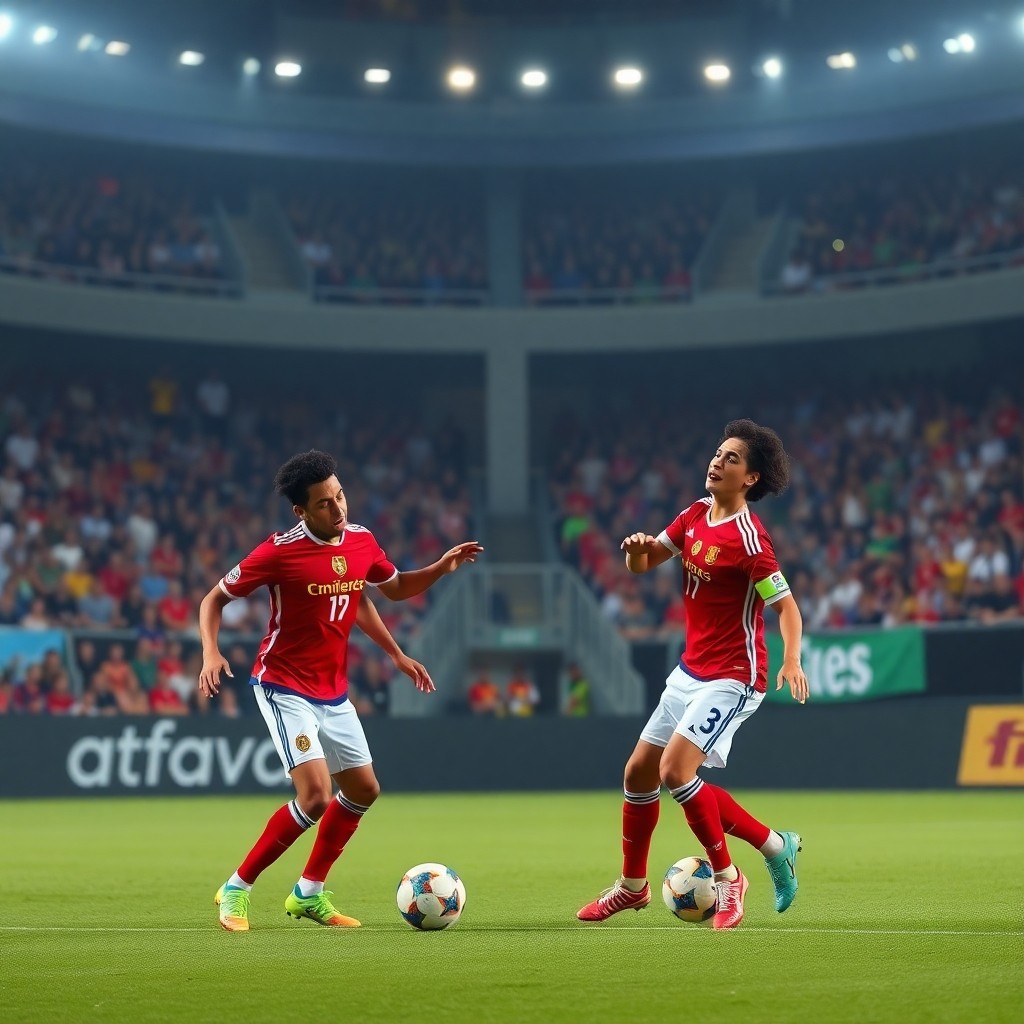
On the vast chessboard of global football, few national teams embody the contradictions, traumas, and splendor of modernity as clearly as the French national football team. Known worldwide as Les Bleus, the French squad has transcended the mere role of a sporting representation to become a sociopolitical mirror of its own Republic. From the multicultural utopia of "Black-Blanc-Beur" in 1998 to the surgical and imperial pragmatism of the Didier Deschamps era, French football has developed a unique identity, characterized by an almost inexhaustible capacity to produce generational talents and, simultaneously, by an internal volatility capable of imploding entire campaigns in the public eye. This dossier analyzes the historical, tactical, political, and structural gears that have transformed France into the planet's greatest talent-producing powerhouse and a colossus that dictates the direction of contemporary football.
1. Origins and Formation of National Identity
The history of football in France is intrinsically linked to the construction of its sporting bureaucracy and its global diplomatic projection. Unlike other European powers that imported the British sport in an organic and decentralized manner, France played a fundamental institutional role. It was on French soil, under the leadership of visionaries like Robert Guérin and, fundamentally, Jules Rimet, that the administrative foundations of world football were laid. The founding of FIFA in Paris in 1904 and the subsequent creation of the World Cup are direct fruits of a French Enlightenment mentality applied to sport: the belief in universality, centralized organization, and the codification of human passions through precise regulations.
However, on the pitch, the first steps of the French national team were marked by a tentative search for a technical identity. In the early decades of the 20th century, French football was fragmented, disputed between regional leagues and associations with different worldviews—from Catholic amateurism to secular professionalism. The professionalization of the sport in France, consolidated only in 1932, opened the doors to the first major demographic transformation of the national team. The country, which needed labor for its industrial reconstruction in the interwar period, began to integrate immigrants of diverse origins into its sporting ranks. Italians, Poles, and Spaniards began to wear the blue jersey, anticipating the multicultural character that would define the team decades later.
The first major technical and competitive milestone of this evolution occurred at the 1958 World Cup in Sweden. Under the tactical command of the revolutionary coach Albert Batteux, who advocated for a football of quick passing, collective intelligence, and creative freedom—the so-called "French-style game"—France stunned the world. That team featured the genius of Raymond Kopa, the son of Polish immigrants and the maestro of Real Madrid, and the incomparable goal-scoring instinct of Just Fontaine, born in Marrakech, then a French protectorate. Fontaine set a record that remains unreachable to this day: 13 goals in a single World Cup edition. The 1958 campaign, which ended with a bronze medal after an epic semifinal against Pelé and Garrincha's Brazil, established the first aesthetic standard of French football: an offensive, refined game that lacked the defensive solidity and pragmatism necessary to lift the trophy.
The transition between this initial romanticism and the consolidation of a truly competitive mentality took decades. During the 1960s and 1970s, France plunged into technical ostracism, failing to qualify for several major tournaments. It was during this fallow period that the French Football Federation (FFF) understood that national identity could not depend solely on the spontaneous emergence of talent. It was necessary to structure football from the State level. The creation of the centralized training system, which would culminate in the inauguration of the Clairefontaine center of excellence in 1988, began to be designed in the 1970s under the technical leadership of Georges Boulogne. French football became a matter of public policy, uniting the scientific precision of physical preparation with the technical refinement that had always been dear to the country's sports intellectuals.
2. Golden Era, Great Campaigns, and Eternal Idols
The history of French football is punctuated by three great dynasties, each captained by an unquestionable genius who redefined not only how France played, but how the country saw itself in the mirror of history.
The first great golden era materialized in the 1980s, under the intellectual leadership of Michel Platini. The Juventus number 10 was the brain of a team that enchanted the world with the famous "Carré Magique" (Magic Square) in midfield, composed of Platini, Jean Tigana, Alain Giresse, and Luis Fernandez. Under the baton of Michel Hidalgo, this quartet united the physical endurance and tackling ability of Tigana and Fernandez with the technical clairvoyance and creativity of Giresse and Platini. The pinnacle of this generation was the victory at the 1984 European Championship on French soil, where Platini scored an astonishing 9 goals in 5 matches, a historical record for the tournament. However, this same generation experienced tragic pain in the semifinals of the 1982 and 1986 World Cups, both lost to West Germany. The 1982 semifinal in Seville, marked by goalkeeper Harald Schumacher's violent collision with Patrick Battiston and the loss of a lead in extra time, was etched into the French collective unconscious as a "beautiful defeat"—an epic of suffering that shaped the resilient character the national team would need to develop in the future.
This resilience found its Messiah in Zinedine Zidane. The end of the 20th century witnessed the coronation of France as a global superpower. The 1998 World Cup, played at home, was the stage for a national catharsis. With a legendary defense composed of Lilian Thuram, Laurent Blanc, Marcel Desailly, and Bixente Lizarazu, protected by captain Didier Deschamps, France advanced to the final at the Stade de France. On the night of July 12, 1998, Zidane, the son of Algerian immigrants from the outskirts of Marseille, headed the ball into the back of Brazil's net twice, sealing a 3-0 victory and France's first world title. That achievement generated the myth of the "Black-Blanc-Beur" (Black, White, and Arab) France, a utopian celebration of social integration through sport. Two years later, this same generation would win Euro 2000, with an even more refined and dominant style of football, consolidating Zidane as the greatest player of his generation.
After years of transition and the painful defeat in the 2006 World Cup final—marked by Zidane's melancholic farewell after the headbutt on Marco Materazzi—France rebuilt its foundations to begin the third golden era, the contemporary era led by Kylian Mbappé and managed by the pragmatism of Didier Deschamps. Under the command of the 1998 captain, now on the bench, Les Bleus developed a lethal style of play based on defensive solidity, high-speed transitions, and surgical efficiency from set-pieces.
The consecration of this philosophy occurred at the 2018 World Cup in Russia. With a dynamic midfield formed by Paul Pogba and N'Golo Kanté, and the tactical intelligence of Antoine Griezmann serving as a bridge to the explosive speed of young Mbappé, France won its second world title. The final against Croatia (4-2) was the perfect exhibition of a team that did not need to dominate possession to control the fate of the match. Four years later, in Qatar in 2022, France participated, alongside Argentina, in what is widely considered the greatest final in World Cup history. Despite being decimated by injuries before the tournament and trailing 2-0 until the 80th minute, the French team was rescued by a historic hat-trick from Mbappé. The defeat on penalties did not diminish France's status as the dominant force in international football in the 21st century, reaching its fourth World Cup final in a 24-year period.
3. Rivalries, Crises, and Power Struggles
The success of the French national team has never been a linear path; it has always been flanked by self-destructive internal crises and rivalries that transcend the four lines, reflecting deep geopolitical tensions and social fractures.
France's greatest and most visceral rivalry is against Italy. It is a duel that mixes geographical proximity, cultural similarities, and a deep dispute for tactical hegemony. If the Italians have always prided themselves on their defensive rigor and tactical cunning (the catenaccio), the French countered with a search for aesthetic elegance. The clashes between the two nations have defined historical destinies:
- The French elimination in the quarterfinals of the 1938 World Cup, on French territory, under the shadow of Benito Mussolini's fascist regime.
- The Euro 2000 final, decided dramatically with David Trezeguet's "golden goal" in extra time.
- The 2006 World Cup final in Berlin, which marked the end of the Zidane era and the consecration of Italian pragmatism on penalties.
However, France's worst enemies have often been inside its own dressing room. The French propensity for heated debate and the questioning of authority—deeply republican cultural traits—often devolved into anarchic insubordination. The lowest point of this dynamic occurred at the 2010 World Cup in South Africa, in the episode known as the "Knysna Fiasco." Under the command of the eccentric and unpopular coach Raymond Domenech, the dressing room imploded. After striker Nicolas Anelka was expelled from the delegation for insulting the coach at halftime of a match against Mexico, the players, led by captain Patrice Evra, refused to train. The image of the athletes locked inside the official team bus, while the coach himself read the players' strike manifesto to the world press, shocked the nation. The episode became a State crisis, debated in the French National Assembly, with ministers demanding structural reforms and severe punishments for those involved. Knysna destroyed the illusion of the 1998 utopia and exposed the social and racial divisions plaguing the country, with far-right politicians using the athletes' behavior to question the patriotism of players from the suburbs (banlieues).
Years later, another crisis of tectonic proportions shook the structures of the FFF: the "Valbuena Case." In 2015, striker Karim Benzema was accused of complicity in an attempted blackmail against his teammate Mathieu Valbuena, involving an intimate video. The scandal resulted in Benzema's exclusion from the national team for more than five years by the decision of Didier Deschamps and FFF president Noël Le Graët. The case divided French public opinion and took on political contours, with the Prime Minister at the time, Manuel Valls, declaring that an exemplary athlete should not wear the national team jersey. Benzema accused Deschamps of having "bowed to the pressure of a racist part of France" by leaving him out of Euro 2016. Although Benzema returned in 2021 and won the Ballon d'Or in 2022, his relationship with the national team remained marked by a latent tension that culminated in his final exclusion on the eve of the Qatar World Cup.
The governance of the French Football Federation itself has been fertile ground for power scandals. The long presidency of Noël Le Graët, which began in 2011, ended melancholically in 2023. Le Graët, who had been the architect of the FFF's financial and sporting stability, was forced to resign after a series of accusations of moral and sexual harassment, in addition to disrespectful statements about Zinedine Zidane that generated public outrage, including a strong public rebuke from star Kylian Mbappé, who declared: "Zidane is France, you don't disrespect a legend like that."
4. The Current Moment: Tactics, Generation, and Challenges
The current cycle of the French national team is defined by the longevity and unwavering pragmatism of Didier Deschamps. In the job since 2012, Deschamps has survived storms that would have toppled any other coach in world football, building a dynasty based on a simple premise: the national team does not exist to produce aesthetic spectacle, but to win. His tactical philosophy is a direct heir to the Italian school where he played as a player (in Marcello Lippi's Juventus): uncompromising defensive solidity, compact lines, space control, and extremely fast vertical offensive transitions.
Tactically, Deschamps' France is a chameleon-like team, capable of adapting to the opponent's strengths without losing its competitive essence. During the 2018 World Cup, the tactical design was based on a hybrid 4-2-3-1, where midfielder Blaise Matuidi played wide on the left as a "false winger," offering defensive balance so that Paul Pogba could launch and Kylian Mbappé could exploit the space behind the defenders. In the 2022 World Cup, given the absence of Pogba and Kanté due to injury, Deschamps reinvented the team by moving Antoine Griezmann back to act as a linking and recovery midfielder (an authentic box-to-box with refined tactical intelligence), supported by the physical strength and precision of Aurélien Tchouaméni and Adrien Rabiot.
The Rapid Transition Tactical Model
Contemporary French football voluntarily abdicates sterile possession control. Deschamps prefers to lure the opponent into his own half, compacting his two lines of four defenders, to then trigger the rapid transition. This model relies on fundamental pillars:
- The speed of Kylian Mbappé: The most lethal player in the world in open space, whose mere presence conditions the height of the opposing defensive line.
- The spatial intelligence of Antoine Griezmann: The team's thermometer, responsible for dictating the pace of the game, connecting defense to attack, and covering defensive gaps.
- The solidity of the center-back pairing: Currently led by William Saliba (Arsenal) and Dayot Upamecano (Bayern Munich) or Ibrahima Konaté (Liverpool), defenders capable of winning individual duels in open space and initiating play construction with vertical passes.
However, this pragmatism has been the target of harsh criticism from the specialized French press (such as the prestigious newspaper L'Équipe) and international analysts. During Euro 2024, France presented bureaucratic football, with extreme difficulty in creating goal-scoring chances in positional attack situations against closed defenses. The excessive dependence on Mbappé's individual brilliance and the lack of a classic creative midfielder—a role that Griezmann, physically worn out, had difficulty performing—exposed the creative limits of Deschamps' system. The elimination to Spain in the semifinals laid bare the contrast between the dynamic, modern, and positional possession football of the Spaniards and the reactive and physical model of the French.
The great tactical challenge for the 2026 World Cup cycle is the renewal of the midfield and the transition of leadership. With the international retirement of historical figures like Olivier Giroud, Hugo Lloris, and Raphael Varane, and the physical decline of Griezmann, France needs to integrate a new generation of midfielders who combine the traditional physical power of French football with greater technical refinement and the ability to dictate the pace of the game through passing. Names like Warren Zaïre-Emery (PSG), Eduardo Camavinga (Real Madrid), and Youssouf Fofana (Milan) represent the future of this transition, offering Deschamps—or his eventual successor—the tools to design a team less dependent on pure counter-attacks and more capable of controlling the rhythms of the match.
5. Talent Development, Structure, and Future
To understand France's competitive hegemony in world football, it is necessary to shift the gaze from the great stadiums and focus on the social and sporting engineering that occurs in its training academies. France has transformed into an authentic talent factory, an exporting powerhouse whose efficiency only finds a historical parallel in Brazilian football. The epicenter of this phenomenon is the Île-de-France region, the Paris metropolitan area.
Sociologists and sports analysts point to the Parisian suburbs (the banlieues) as the greatest breeding ground for football talent in the world today. Neighborhoods like Seine-Saint-Denis, from which players like Kylian Mbappé, Paul Pogba, N'Golo Kanté, Riyad Mahrez, and Christopher Nkunku emerged, have a young, multicultural demographic density with a strong street football culture (the foot de rue). This football practiced on concrete courts (the city-stades) develops in young athletes a refined technique in tight spaces, short dribbling, improvisation, and extremely high physical competitiveness.
However, the raw talent of the suburbs would be insufficient without the scientific infrastructure for scouting and development created by the French State. The model is based on a network of regional training centers, known as Pôles Espoirs, funded by the French Football Federation. The most famous of them is INF Clairefontaine (Institut National du Football), located on the outskirts of Paris. The selection process for Clairefontaine is one of the most rigorous in the world:
- Thousands of young people aged 13 to 15 are evaluated annually.
- Only a select group of about 20 to 25 athletes is chosen to reside and train at the center during the week, while continuing to play for their local clubs on weekends.
- The focus of training at Clairefontaine is not tactical, but rather individual technical improvement, motor coordination, rapid decision-making, and psychological preparation to deal with the pressure of professional football.
At age 15, these young people are integrated into the academies of professional clubs in Ligue 1 and Ligue 2. Clubs like Lyon, Rennes, Monaco, Paris Saint-Germain, and Toulouse have world-class training structures, constantly certified and audited by the FFF. French legislation protects and encourages this model, forcing professional clubs to invest a significant percentage of their revenues in athlete development and facilitating the transition of young players to the first team through protected training contracts.
This structure has generated a highly profitable economic model for French football. Due to the financial disparity between Ligue 1 and richer leagues like the English Premier League, the Spanish La Liga, and the German Bundesliga, French clubs have assumed the role of elite exporters. They train the athlete, offer them minutes of play in professional football at an early age, and sell them for multimillion-dollar amounts to European giants. Although this dynamic technically weakens the local championship, it directly benefits the national team. Young French players complete their competitive training in the most demanding contexts of world football (Champions League, Premier League), under the tutelage of the best coaches on the planet (such as Pep Guardiola, Carlo Ancelotti, and Mikel Arteta), without the FFF needing to spend resources on this final stage of development.
The future of the French national team, therefore, seems guaranteed by the uninterrupted gear of its production line. The next generation is already knocking at the door, led by generational talents such as:
- Bradley Barcola: Winger with disconcerting dribbling and vertical speed.
- Michael Olise: Creative midfielder with refined technique honed in English football and polished at Bayern Munich.
- Leny Yoro: Central defender of elegance and early maturity signed by Manchester United.
- Warren Zaïre-Emery: The PSG midfield prodigy who breaks records for physical and tactical precocity.





