



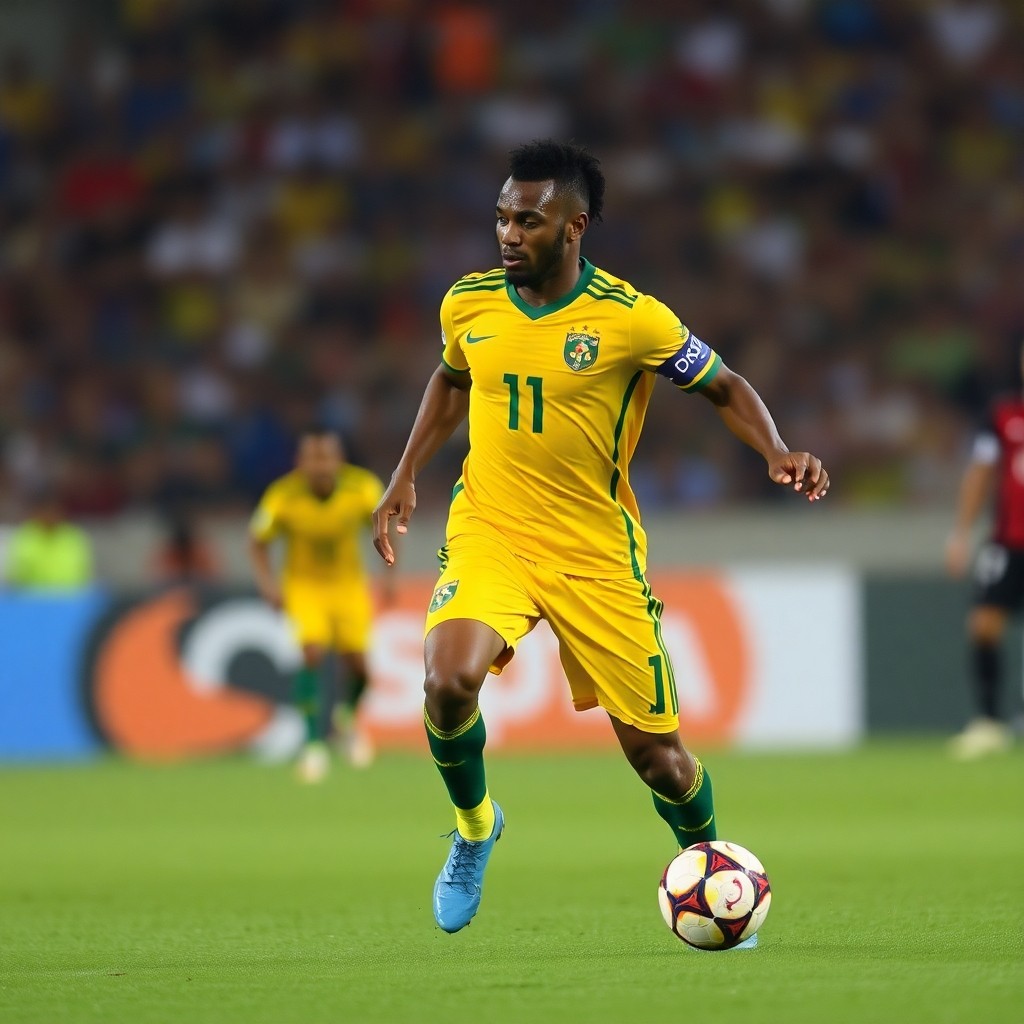
In the vast and complex mosaic of African football, few stories are as fascinating, contradictory, and dramatically rich as that of the Equatorial Guinea national team. Popularly known as Nzalang Nacional (The National Thunder), the team represents a nation of just 1.6 million inhabitants that, over the last two decades, has transformed from an insignificant participant on the continental stage into a "pocket giant" capable of haunting Africa's greatest powers. As the only Spanish-speaking country in the Confederation of African Football (CAF), Equatorial Guinea mirrors in its football the profound transformations of its own recent history: the transition from a neglected colony to an autocracy fueled by the oil boom, the search for a national identity divided between the continent of origin and the European diaspora, and the use of sport as a tool for geopolitical legitimacy. Far from being just a football team, the Nzalang Nacional is a social and political laboratory where the geopolitics of natural resources, the demographic engineering of player naturalization, and the tactical resilience of a generation that learned to compete against a lack of infrastructure through almost religious collective organization intersect.
1. Origins and Formation of National Identity
To understand the uniqueness of football in Equatorial Guinea, it is imperative to decipher the historical labyrinth that shaped the country. The territory, composed of a continental part (Rio Muni) and several islands (with Bioko, where the capital Malabo is located, being the most prominent), was colonized by Spain after the Treaty of El Pardo in 1778, when Portugal ceded the region in exchange for territories in South America. This Spanish colonial heritage linguistically isolated Equatorial Guinea from its Francophone (Cameroon and Gabon) and Anglophone (Nigeria) neighbors, creating a cultural barrier that would directly reflect on the development of its sports institutions.
Silence under the Macías Nguema Dictatorship
After independence in 1968, the country plunged into one of the darkest periods of modern history under the dictatorship of Francisco Macías Nguema. The Macías regime, characterized by extreme isolation, political paranoia, and brutal persecution of intellectuals and minorities, virtually annihilated the country's public and cultural life. Sport, viewed with suspicion by the regime as a potential source of dissent or external influence, was relegated to absolute abandonment. During the 1970s, while other newly independent African nations used football as a tool for building national identity and pan-African pride, young Equatoguineans played on improvised fields without any institutional support or international exchange. The Equatoguinean Football Federation (FEGUIFUT) was founded only in 1975, but remained an empty shell, without resources or active international affiliation.
The 1979 Turning Point and the Discovery of Oil
The deposition of Macías Nguema in 1979 by his nephew, Teodoro Obiang Nguema Mbasogo — who remains in power today, constituting the longest-serving non-monarchical government in the world — initiated a slow process of opening up. FEGUIFUT joined FIFA and CAF in 1986, allowing the national team to finally make its first official appearances. However, the true catalyst for the transformation of football in the country did not come from training grounds, but from offshore drilling platforms. In the mid-1990s, the discovery of massive oil reserves in Equatoguinean territorial waters transformed the country's economy, generating a GDP per capita that, on paper, rivaled that of European nations.
With public coffers flooded by petrodollars, the Obiang regime identified football as a golden opportunity to improve its international image, frequently tarnished by reports of human rights violations and corruption. Football ceased to be a mere pastime and became a State project. Ultramodern stadiums were designed for Malabo and Bata, and the government began to directly fund the hiring of foreign coaching staffs and the search for talent beyond its borders, laying the foundations for the complex and controversial identity that the Nzalang Nacional boasts in the 21st century.
2. Golden Era, Great Campaigns, and Eternal Idols
Equatorial Guinea's sporting trajectory in the 21st century is divided between the period of technical anonymity and the sudden rise as an emerging power, driven by the organization of major tournaments and the consolidation of a generation of players of rare combativeness.
The Baptism of Fire: Restoring Self-Esteem in 2012
Equatorial Guinea's true debut on the big stage of African football occurred in 2012, when the country co-hosted the Africa Cup of Nations (AFCON) alongside Gabon. Until then, the Nzalang Nacional had never qualified for the final phase of the tournament on sporting merit. Under the command of Brazilian coach Gilson Paulo, the team entered the tournament under the general skepticism of the international press, which pointed to them as the weakest team in the competition.
What followed in the coming weeks in Malabo and Bata entered the country's sporting mythology. In the opening match in Bata, Equatorial Guinea defeated Libya 1-0, with a historic goal by former Real Madrid midfielder Javier Balboa in the 86th minute. The collective delirium in the stadium was the spark for a surprising campaign. In the following round, an epic 2-1 victory against Senegal, one of the continent's powerhouses, guaranteed early qualification for the quarterfinals. Although they were later eliminated by Didier Drogba's Ivory Coast, the 2012 campaign proved that the country could compete at a high level.
The 2015 Miracle: Redemption under Pressure
If the 2012 campaign was planned years in advance, the 2015 one was an exercise in improvisation and courage. A few months before the start of the tournament, Morocco withdrew from hosting the AFCON due to the Ebola outbreak in West Africa. In an audacious political move, President Teodoro Obiang took the responsibility of hosting the tournament alone, with only two months of preparation. The Nzalang Nacional, which had been disqualified in the qualifiers for fielding an ineligible player, was reinstated as the host country.
Under the leadership of Argentine coach Esteban Becker, who had won the Women's AFCON title with the country's women's team in 2008 and 2012, the men's team performed a tactical miracle. With a squad assembled in a hurry, Equatorial Guinea advanced from the group stage after drawing with Congo and Burkina Faso and defeating Gabon 2-0. In the quarterfinals, they faced Tunisia in one of the most dramatic and controversial matches in the competition's history. Trailing 1-0 until stoppage time in the second half, the team equalized with a controversial penalty converted by Javier Balboa. In extra time, Balboa scored a masterful free-kick into the top corner, sealing a 2-1 victory and taking the country to an unprecedented semifinal. Equatorial Guinea would finish the tournament in a historic fourth place, definitively consolidating its continental relevance.
Competitive Maturity: 2021 and the 2023 Epic
Unlike previous campaigns, the participations in the 2021 AFCON (played in 2022 in Cameroon) and 2023 (played in 2024 in Ivory Coast) did not depend on the home-field advantage. Under the leadership of local coach Juan Micha, the Nzalang Nacional demonstrated impressive tactical maturity.
In 2021, the team shocked the continent by defeating the then-champion Algeria 1-0 in the group stage, breaking the Algerians' 35-match unbeaten streak. The team advanced to the quarterfinals, being eliminated by the eventual champion, Senegal. However, the pinnacle of Equatoguinean football would occur in January 2024, in Ivory Coast. Drawn into an extremely difficult group with the hosts and Nigeria, Equatorial Guinea not only qualified in first place but also delivered a historic 4-0 thrashing of Ivory Coast at the Alassane Ouattara Stadium in Abidjan. Striker and captain Emilio Nsue became the competition's top scorer with 5 goals, becoming the oldest player to win the AFCON Golden Boot at 34 years old.
Eternal Idols: The Pillars of the Nzalang
- Juvenal Edjogo-Owono: The brain of the Equatoguinean midfield during the transition from amateurism to professionalism. Born in Spain but to an Equatoguinean father, Juvenal was the captain who dictated the team's rhythm in the 2012 AFCON, serving as the crucial link between European discipline and African passion.
- Javier Balboa: Formed in the youth divisions of Real Madrid, Balboa was the first world-class player to wear the Equatorial Guinea shirt. His decisive performances in the 2012 and 2015 editions, especially the free-kick goal against Tunisia, place him in the pantheon of the nation's greatest sporting heroes.
- Emilio Nsue: The greatest goalscorer in the national team's history. Nsue, who was a European U-19 and U-21 champion for Spain alongside names like David de Gea and Thiago Alcântara, decided to represent his father's homeland in 2013. His versatility — playing as a right-back in Europe and as a prolific center-forward for the national team — and his fierce leadership made him the face of Equatoguinean football for over a decade.
3. Rivalries, Crises, and Behind-the-Scenes Power
The growth of football in Equatorial Guinea did not occur in a vacuum of sporting purity; on the contrary, it was intrinsically linked to regional geopolitical disputes, corruption scandals, and a policy of naturalizing athletes that generated intense ethical debates and FIFA sanctions.
Regional Geopolitics and Local Rivalries
Equatorial Guinea's main rivalry is with Gabon, a neighbor with which it shares land and maritime borders, as well as historical disputes over the sovereignty of potentially oil-rich islands in the Bay of Corisco. In football, the clashes between the two teams transcend the four lines, being treated as matters of national honor. The 2-0 victory over Gabon in the 2015 AFCON was celebrated in Malabo as an informal national holiday, a display of strength by the small nation over its historically more influential neighbor.
Another intense rivalry exists with Cameroon, the giant of the Central African sub-region (UNIFFAC). The clashes against the "Indomitable Lions" are always loaded with political tension, reflecting the demographic and economic asymmetry between the two countries and Equatorial Guinea's struggle to be respected as an autonomous force in the region.
The Mass Naturalization Scandal
During the late 2000s and early 2010s, FEGUIFUT, under strong pressure from the government to deliver quick results, adopted a highly controversial strategy: the systematic naturalization of foreign players, mainly Brazilians and Colombians, who had no family or emotional ties to Equatorial Guinea. Attracted by astronomical salaries paid directly by the government and the promise of playing in World Cup and AFCON qualifiers, dozens of players landed in Malabo.
Names such as goalkeepers Danilo Clementino and Emmanuel Danilo, defender Claudiney Rincón, and midfielders Jônatas Obina and Ricardinho, among others, wore the Nzalang Nacional shirt. This practice generated strong indignation from other African federations, which accused Equatorial Guinea of "buying" a national team. The peak of the crisis occurred in 2013, when FIFA punished FEGUIFUT with the loss of points in the 2014 World Cup qualifiers due to the irregular fielding of Cape Verdean-born player Thierry Fidjeu. Subsequently, CAF also punished the country for similar irregularities. This crisis forced a radical change of direction, compelling the federation to abandon the South American market and focus exclusively on finding players of real Equatoguinean descent in the Spanish diaspora.
The Shadow of Autocracy and the 2024 Crisis
The proximity between political power and the national team is a double-edged sword. While it guarantees funding that many African federations envy, it also subjects the sport to the whims of the regime. Teodorín Nguema Obiang, the country's vice president and the president's son, is an omnipresent figure behind the scenes of the Nzalang. Known for his extravagant lifestyle, Teodorín often promises million-dollar cash prizes in the locker room after important victories, using the team as a personal public relations platform.
However, this promiscuous relationship imploded after the 2023 AFCON. Despite the historic campaign, the post-tournament period was marked by one of the biggest administrative crises in the country's history. In February 2024, FEGUIFUT suspended captain Emilio Nsue and midfielder Iban Salvador indefinitely for alleged "serious episodes of indiscipline" during the competition. Nsue's response was devastating: in a live social media broadcast that brought the country to a standstill, the captain directly accused the federation's board of systemic corruption, alleging that officials had embezzled more than 1 million euros in prize money intended for the players, falsified travel invoices, and left the team without basic training conditions. Nsue also revealed that the federation threatened local players and operated without any financial transparency, exposing the guts of a system where sporting success masked chaotic and authoritarian management.
To make matters worse, in May 2024, FIFA applied a severe punishment to Equatorial Guinea, stripping them of points from victories against Namibia and Liberia in the 2026 World Cup qualifiers. The reason was the fielding of Emilio Nsue, who, according to FIFA, was never legally eligible to play for Equatorial Guinea throughout his 11-year international career, due to bureaucratic issues linked to his former representation of Spain's youth teams. The revelation that the federation neglected this situation for over a decade was the final blow to the credibility of the country's sports management.
4. The Current Moment: Tactics, Generation, and Challenges
Despite the administrative chaos consuming the backstage, on the field, Equatorial Guinea presents one of the most solid and competitive tactical proposals on the African continent. The architect of this modern identity is local coach Juan Micha, who took over as head coach permanently in 2021 after years of working in the youth categories and as an assistant.
Juan Micha's Tactical Model: Pragmatism and Compactness
Unlike many African teams that historically prioritize physical imposition and vertical transition speed, Juan Micha's Equatorial Guinea plays cerebral football, characterized by rigid positional discipline and a strong influence of the Spanish school of ball possession and space occupation. The base formation is a 4-2-3-1, which transforms into an extremely compact mid-low block in the defensive phase.
The strength of the Nzalang Nacional lies in its ability to deny space between the lines and force the opponent to play down the flanks, where pressure is applied collectively. The two defensive midfielders, usually led by the experienced Federico Bikoro and Pablo Ganet, act as the team's anchor. They not only protect the defensive line but also possess excellent passing quality to initiate short offensive transitions, avoiding unnecessary long balls.
When they recover the ball, the team is in no rush. It uses ball circulation to draw out opponent pressure and exploit the speed and dribbling ability of its wingers, such as Josete Miranda and the irreverent Iban Salvador. The latter is a fundamental piece in the tactical design: acting as a creative winger or a false number 10, Salvador is a master at holding the ball under pressure, drawing fouls that relieve the defense, and irritating opposing defenders with his provocative style of play.
The Alavés Wall and the Defensive Line
The team's defensive success in recent years has a proper name in goal: Jesús Owono. The Deportivo Alavés goalkeeper stands out for his impressive agility between the posts and his leadership in communicating with the defensive line. Owono has become a penalty specialist and a national hero in the penalty shootouts of the 2021 AFCON.
In front of him, the center-back duo composed of Saúl Coco (who recently transferred to Torino, in the Italian Serie A) and Esteban Orozco offers an ideal mix of physical imposition, game reading, and quality in playing out from the back. Coco, in particular, represents the modern defender: quick in recovery, strong in the air, and capable of breaking lines with precise vertical passes.
The Void Left by Nsue and the Challenge of Renewal
The biggest immediate tactical challenge for Juan Micha is finding a solution for the absence of Emilio Nsue. The suspension and the imminent end of the captain's cycle have left a void not only in terms of technique but also spiritual leadership. Nsue compensated for the lack of an elite center-forward with his intelligence in attacking spaces, physical presence in the box, and opportunistic goal-scoring instinct.
Without him, Equatorial Guinea lacks a reference point in attack. Players like Luís Nlavo have been tested in the role, but have yet to demonstrate the same decision-making ability in high-pressure moments. The transition to a more mobile attack that is less dependent on a single central figure is the ultimate test for the longevity of Micha's work.
5. Talent Development, Structure, and Future
The sustainability of Equatoguinean football faces a structural paradox that threatens its medium and long-term future. There is a deep abyss between the success of the national team and the precariousness of domestic football in the country.
Dependence on the Spanish Diaspora
Unlike nations such as Senegal, Mali, or Ivory Coast, which have internationally prestigious football academies in their own territory (such as Diambars or Mimosas), Equatorial Guinea produces almost no elite players locally. The national team is, essentially, a product of the Spanish training system.
Almost 90% of the athletes called up for the Nzalang Nacional were born, raised, and trained in the youth categories of Spanish clubs, from giants like Real Madrid, Barcelona, and Atlético de Madrid, to teams in the lower divisions and regional leagues of Spain. Cities like Madrid, Barcelona, Valencia, and Zaragoza are home to large communities of Equatoguinean immigrants who fled the dictatorship or sought better living conditions starting in the late 20th century.
This recruitment model, while extremely efficient for raising the team's immediate technical level, is vulnerable. It depends entirely on FEGUIFUT's ability to convince young people who, in many cases, have little contact with the reality of their parents' country and who, if they demonstrate absolute elite potential, will prefer to represent the Spanish national team. Furthermore, there is the risk of demographic exhaustion of this talent source as generations pass.
The Fragility of the Local League
On Equatoguinean soil, the reality of football is bleak. The National Football League of Equatorial Guinea suffers from a lack of professionalism, unstable calendars, contested refereeing, and almost no media coverage or private sponsorship. Historic clubs, such as Akonangui FC, Deportivo Mongomo, and Cano Sport Academy, operate in precarious conditions.
The Cano Sport Academy, founded in Malabo, is one of the rare exceptions that tries to implement a modern model of athlete training in the country. However, the lack of a strong national competition and the impossibility of retaining young talent due to the economic crisis mean that the best local players emigrate very early to peripheral leagues in Africa or lower divisions in Europe, without adequate technical development.
Future Perspectives: Reform or Decline?
For Equatorial Guinea not to return to footballing ostracism when the current generation of Jesús Owono, Saúl Coco, and Iban Salvador ages, a deep structural reform is urgent. The country needs to channel a fraction of its economic resources into creating basic grassroots infrastructure: quality public fields, training courses for local coaches, and structured school competitions.
Resolving the political crisis between the players and FEGUIFUT is also vital. The loss of points in the 2026 qualifiers due to amateur administrative errors is a red flag that management incompetence can destroy the work done on the field. If the federation can modernize, professionalize its processes, and establish a real bridge between European training and local development, the Nzalang Nacional will continue to be the "Thunder" that haunts the giants of Africa. Otherwise, it risks being remembered only as a bright, but ephemeral, comet in the sky of African football.





