



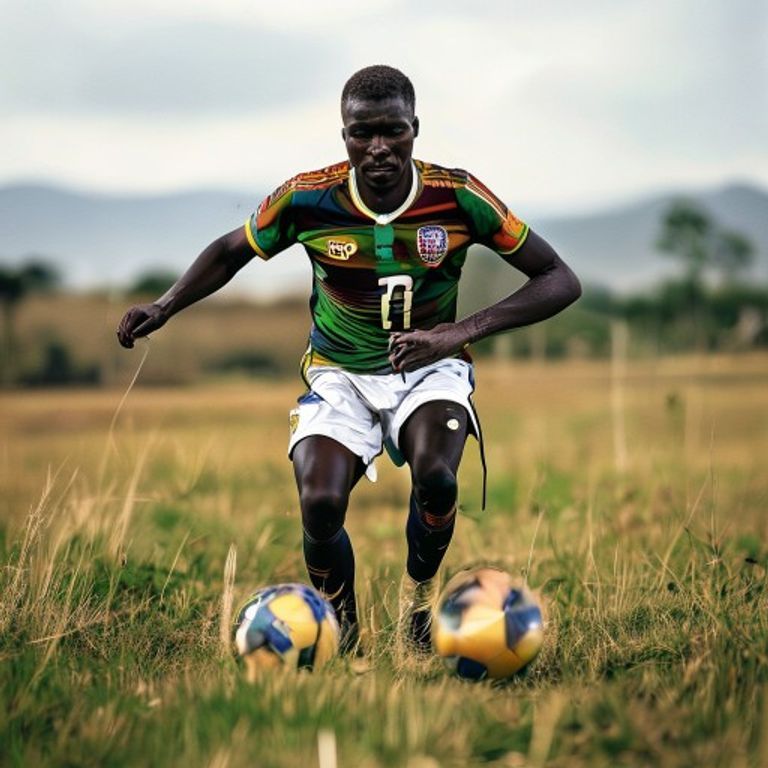
Known in the African football landscape as Intamba mu Rugamba (The Swallows in the Battle), the Burundi national team carries in its trajectory the perfect synthesis of a country that seeks in the passion for the game a respite from its deep historical wounds. Marked by decades of ethnic conflict, geopolitical isolation, and a chronic shortage of resources, the national team is currently undergoing a complex reconstruction process. After touching the sky in 2019 with an unprecedented and thrilling qualification for the Africa Cup of Nations (AFCON), Burundian football now faces the challenge of proving that the feat was not a mere stroke of luck, but the blueprint for a sustainable future—one that currently struggles with banned stadiums, political crises within the federation, and the eternal dilemma between polishing local talent or repatriating its vast and scattered European diaspora.
1. Origins and the Construction of Identity (History and Trajectory)
Football first took root in Burundi during the Belgian colonial period in the first half of the 20th century. Initially restricted to colonial elites and religious missions in the former capital, Bujumbura, the sport quickly became popular among the local population as a form of cultural resistance and identity expression. With the country's independence in 1962, football began to be seen as an element of national cohesion. The Football Federation of Burundi (FFB) was founded in 1948, but official affiliation with FIFA only occurred in 1972, followed by joining the Confederation of African Football (CAF) in 1973. These early years of bureaucratic professionalism, however, coincided with one of the most unstable periods in the country's political history, which severely limited the nation's sporting development.
The national team's kit directly reflects the national identity: red, green, and white, colors taken from the country's flag, symbolize, respectively, the blood shed in the fight for independence, hope for agricultural development, and the peace so yearned for by the population. Tactically, Burundi has historically developed a style of play based on transition speed and the physical strength of its athletes, characteristics shaped by the often adverse conditions of local pitches. However, the lack of tactical exchange and the scarcity of top-tier foreign coaches relegated the team, for decades, to the role of a bystander in continental and world qualifiers.
Until the end of the 20th century, Burundi's campaigns were marked by frequent withdrawals due to financial crises or outbreaks of civil violence. The most tragic point of this period was the civil war that ravaged the country between 1993 and 2005, which paralyzed the local championship and forced dozens of players to seek refuge in neighboring nations or Europe. The sporting rebirth only began to take shape in the 2010s, culminating in the greatest miracle in the country's football history: qualification for the 2019 Africa Cup of Nations, held in Egypt. Under the command of local coach Olivier Niyungeko, Burundi overcame the favoritism of Pierre-Emerick Aubameyang's Gabon by drawing 1-1 in Bujumbura on March 23, 2019, securing a historic spot that brought thousands of people to the streets of the capital in a celebration rarely seen in the Great Lakes region.
2. The Golden Era and Eternal Icons
The 2019 feat and the structuring of Burundian football in the last decade would not have been possible without the figures of athletes who transcended the pitch, becoming true ambassadors of a country made invisible by mainstream media. The greatest symbol of this era is, without a doubt, Saido Berahino. Born in Bujumbura, Berahino fled the civil war at the age of ten, alone, to join his mother in the United Kingdom, where he received political asylum. After shining in the English Premier League for West Bromwich Albion and playing for England's youth teams, the striker made the decision to represent his home country in 2018. His arrival in the Swallows' squad brought not only technical quality and European professionalism but also unprecedented international visibility for the team, of which he became captain and spiritual leader during the historic Egypt campaign.
Another fundamental pillar of this golden generation was striker Fiston Abdul Razak. If Berahino was the international brand, Abdul Razak was the soul of the Burundian attack. During the 2019 AFCON qualifiers, he was the second-highest scorer on the entire African continent with 6 goals, behind only Nigeria's Odion Ighalo. Gifted with explosive speed and a sharp eye for goal, Razak played for several clubs on the continent, such as JS Kabylie in Algeria and Al-Hilal Omdurman in Sudan, proving that a player developed locally in Burundi had the technical substance to compete at the highest level of African football.
Before the emergence of these strikers, the country's technical and leadership reference for over a decade was midfielder Selemani Ndikumana. With stints in Belgian (Lierse) and Norwegian (Molde) football, Ndikumana was the captain who carried the team through the most difficult moments of institutional transition in the 2000s. His refined vision and precision in set-pieces served as inspiration for the generation that would reap the rewards in 2019. Alongside him, defender Valery Nahayo, who stood out at Kaizer Chiefs in South Africa and Gent in Belgium, established the standards of physical imposition and defensive intelligence that defined the identity of the Burundian backline for years.
3. Behind the Scenes, Scandals, and Rivalries
The behind-the-scenes of football in Burundi are inseparable from the country's complex political reality. During the regime of the late president Pierre Nkurunziza (who ruled from 2005 to 2020), football was used as a powerful tool for state propaganda and social control. Nkurunziza, a football fanatic who even founded his own club, Haleluya FC, frequently played as a striker in friendly matches across the country. The level of surrealism during this period reached its peak in March 2018, when two local administrators were arrested for "conspiracy against the Head of State" simply for allowing their defenders to mark the president vigorously and knock him down during a festive game.
The Football Federation of Burundi (FFB) has historically been a ground for power struggles and corruption allegations. The embezzlement of funds allocated by FIFA for the development of youth categories and the failure to pay bonuses to the main team's players are recurring problems. On several occasions, athletes have threatened to boycott decisive matches due to a lack of reimbursement for airfare and hotel expenses. The transition of power in the federation often reflects the political tensions between Gitega (the new political capital) and Bujumbura, with appointments of officials aligned with the ruling party, the CNDD-FDD, to the detriment of technical managers.
In terms of rivalries, no match carries as much geopolitical and cultural tension as the classic against Rwanda, known as the "Great Lakes Derby." Sharing the same ethnic composition (Hutus and Tutsis), extremely similar languages (Kirundi and Kinyarwanda), and a past of colonization and mirrored violence, the clashes between the two teams transcend sport. Each match is played under heavy security and carries the weight of border disputes and mutual accusations of political destabilization between the governments of Bujumbura and Kigali. Another major regional rival is the Democratic Republic of the Congo, against whom Burundi usually plays matches of extreme physical imposition and strong popular appeal due to geographical proximity and the flow of refugees between the borders.
4. The Current Moment: Recent Cycle, Tactics, and Challenges
Currently, the Burundi national team is led by local coach Etienne Ndayiragize. Known for his pragmatic approach and vast experience in East African football (having managed prominent clubs in Tanzania and the Tanzanian national team itself), Ndayiragize took the job with the mission of rejuvenating a worn-out squad and implementing greater tactical discipline. Under his guidance, the team usually structures itself in a flexible 4-2-3-1 formation, which transforms into a defensive 4-5-1 when playing away from home, prioritizing line compactness and the speed of the wingers.
The biggest star and technical pillar of the current generation is midfielder Youssouf Ndayishimiye. Currently playing for OGC Nice in France's Ligue 1, following a multi-million euro transfer from İstanbul Başakşehir, Ndayishimiye is the prototype of the modern player: versatile, capable of playing both as a center-back and as a defensive midfielder, gifted with excellent ball distribution and strong tackling power. He is the technical reference for young prospects starting to carve out space in European football, such as striker Bienvenue Kanakimana, who plays for FK Jablonec in the Czech Republic, and young winger Pacifique Niyongabire, who brings experience from Australian and Canadian football.
Despite having interesting individual talents, the tactical and structural challenges for the 2026 World Cup cycle and the next editions of the AFCON are immense. Burundi suffers from a lack of defensive consistency and the absence of a playmaker in midfield who can supply the attack on a regular basis. In the 2026 World Cup qualifiers, placed in a complex group alongside powerhouses like Ivory Coast and Gabon, the Swallows' realistic goal is to consolidate the team tactically and fight for a respectable spot, aware that direct qualification still belongs to a shelf above their current reality.
5. Infrastructure and the Future of Local Football
The Achilles' heel of football in Burundi lies in its almost non-existent sports infrastructure. The country's main football stage, the Stade du Prince Louis Rwagasore in Bujumbura, is in precarious condition and is frequently banned by CAF and FIFA for failing to meet international standards for safety, lighting, and pitch quality. This humiliating situation forces the national team to host its official qualifying matches in neighboring countries, such as Tanzania (at the Benjamin Mkapa Stadium in Dar es Salaam) or even Morocco. Constantly playing away from home nullifies the home-field advantage and drains the federation's financial resources with travel and logistics.
The local league, the Primus Ligue, is semi-professional and suffers from a lack of interest from private sponsors. Traditional clubs like Vital'O FC (runner-up in the African Cup Winners' Cup in 1992) and Bumamuru FC struggle to keep their payrolls up to date. The meager salaries paid to local athletes trigger an early exodus of young talent to financially healthier neighboring leagues, such as those in Rwanda, Tanzania, Kenya, and South Africa. Rare are the players who manage to make the leap directly from Burundi to European football without passing through an intermediate market on the African continent.
The future of Burundian football depends crucially on a structural reform on two fronts. Firstly, the government needs to fulfill its promises of modernizing the stadiums in Bujumbura and Gitega to return the warmth of its fans to the national team. Secondly, the FFB needs to professionalize its scouting departments to more efficiently map young players of Burundian descent growing up in football academies in Belgium, France, and Scandinavia. Without this symbiosis between investment in local infrastructure and intelligent recruitment of the diaspora, the dream of reliving the glorious afternoons of 2019 will remain a nostalgic memory rather than an achievable goal plan.





