



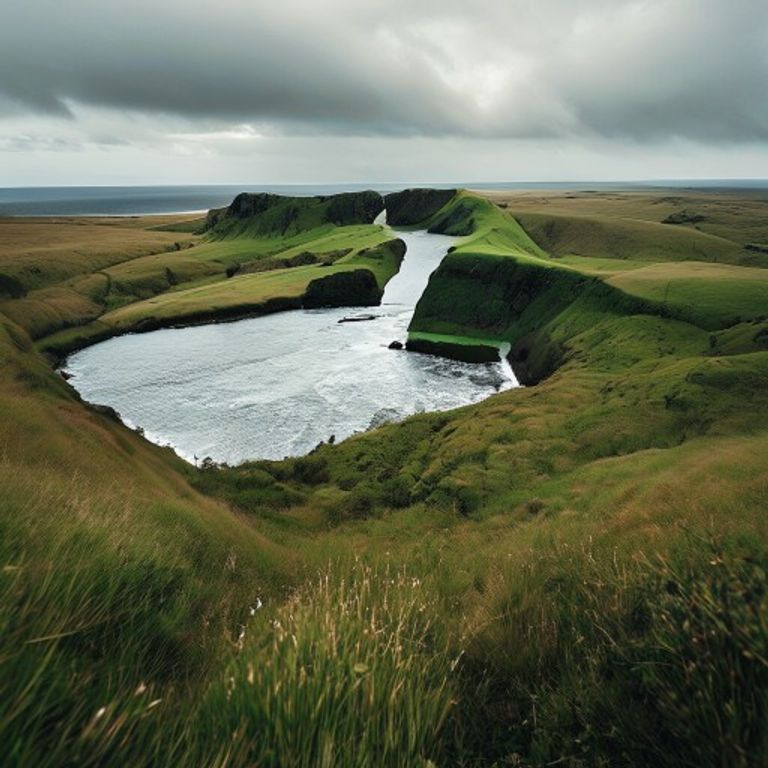
The 'Emerald Isle', Ireland is famous for its green landscapes, folk music, and lively pubs. Home to literary giants like Joyce, Yeats, and Wilde, it has a history of emigration that has spread its culture worldwide. The Irish people are renowned for their humor and storytelling, in a nation that has rapidly modernized as a European tech hub.
⚠️ Research conducted with the aid of Deep Research is subject to referential ambiguity.
🖥️Clean HTML code using a proprietary tool.
👥 Research by Guilherme Felipe, Curation by Sílvio Lôbo
The Resilient Soul of Ireland in Words: A Literary Panorama
Irish literature, intrinsically linked to its tumultuous history, its rich Celtic heritage, and a deep sense of cultural identity, emerges as one of the country's most potent and enduring legacies. From ancient epic sagas to contemporary voices exploring the complexities of modern society, Ireland has been a fertile ground for literary creativity, producing works that resonate globally.
Literary Pillars and Historical Movements
The trajectory of Irish literature is marked by monumental figures who not only defined eras but also shaped the very perception of Ireland to the world. The turn of the 19th and early 20th centuries witnessed the flourishing of the so-called Irish Literary Renaissance, a movement that sought to reclaim and celebrate national identity through art and literature, often in opposition to British rule.
Essential Authors and Their Contributions
- William Butler Yeats (1865-1939): A poet and playwright, Nobel laureate in Literature in 1923, Yeats is the central figure of the Renaissance. His work, imbued with Celtic mythology, folklore, and a deep contemplation of nature and Irish politics, set a new standard for English-language poetry. Plays like Cathleen Ni Houlihan and poems like The Second Coming are emblematic of his vision.
- James Joyce (1882-1941): A revolutionary of modernist prose, Joyce expanded the boundaries of language and narrative. Born in Dublin, his work is a deep dive into the human psyche and the urban tapestry of his hometown. Ulysses, a modern retelling of Homer's Odyssey set over a single day in Dublin, is considered one of the most influential novels of the 20th century. Other crucial works include Dubliners and Finnegans Wake.
- Samuel Beckett (1906-1989): Another Irish literary giant, Beckett, also a Nobel laureate, is one of the pioneers of the Theatre of the Absurd. His work, often stripped down and existential, explores the human condition, boredom, waiting, and the lack of communication. Waiting for Godot is his most famous play, a masterpiece that transcends cultural and temporal barriers.
- Oscar Wilde (1854-1900): Although often associated with his social brilliance and Victorian culture, Wilde was an Irishman by birth and a master of witty prose and social criticism. His plays, such as The Importance of Being Earnest, and his novel The Picture of Dorian Gray, exhibit sharp intelligence and a profound analysis of social hypocrisy.
- Seamus Heaney (1939-2013): An internationally renowned poet and Nobel laureate in 1995, Heaney, from Northern Ireland, brought a lyrical and earthy voice to poetry, exploring his rural roots, memory, and landscape. His work captures the essence of life and death, violence and beauty, with rich and evocative language.
Influential Publications and the Voice of Ireland
Throughout the centuries, various publications have played a crucial role in disseminating Irish literature and articulating its identity. Collections of popular poetry and traditional ballads served as the foundation for many later writers. Literary journalism and literary magazines, such as the influential The Bell, founded by Sean O'Faolain in the 1940s, were vital for the emergence and sustenance of new voices.
The publication of works like J.M. Synge's The Playboy of the Western World (1907), a play that caused outrage for its raw depiction and use of Hiberno-English, demonstrated literature's power to challenge social and cultural norms. Roddy Doyle's novel The Commitments (1987), which portrays working-class life in Dublin and the rise of a soul band, exemplifies how contemporary literature continues to capture the energy and challenges of urban Irish life.
Cultural Identity: Land, Struggle, and Legacy
Irish cultural identity, a complex mosaic of Celtic traditions, Norse and English influences, and a history of colonization and resistance, is a recurring and profound theme in the country's literature. The land, in its wild beauty and ancestral importance, is a character in itself, often present in poetry and prose, connecting characters to their roots and their destiny.
The experience of the diaspora and the feeling of exile, driven by great famines and mass emigration, have shaped a literature of longing and the search for belonging. The struggle for independence and the division of the island in Northern Ireland have left indelible marks, resulting in works that explore conflict, reconciliation, and the complexities of national and personal identity.
Irish literature, therefore, is not merely a record of historical events or an exploration of universal themes; it is the very resilient soul of Ireland finding its voice and echo in the pages of its books, a legacy that continues to inspire and captivate readers worldwide.





