



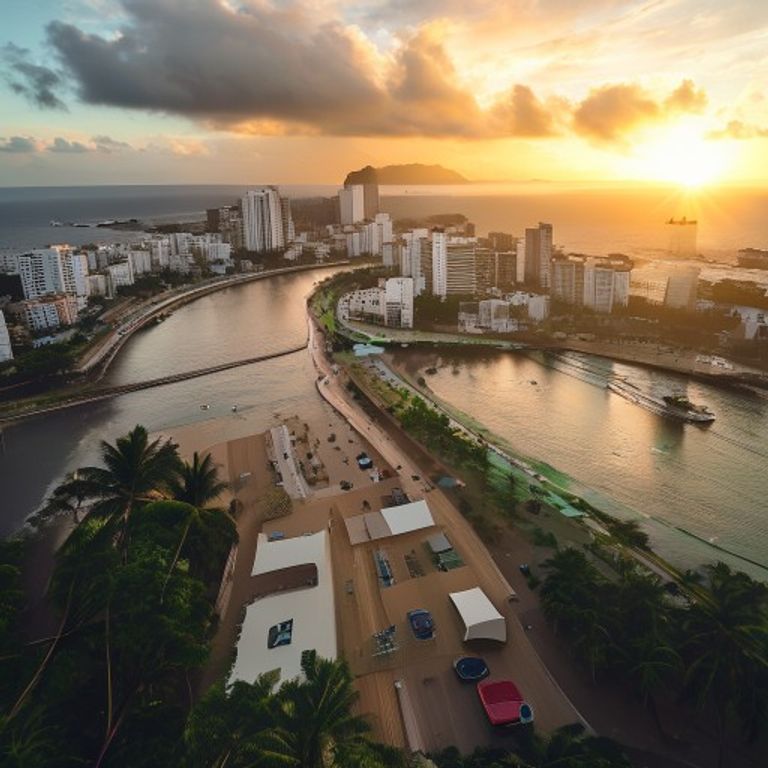
This municipality in the State of Sergipe is the center of the state's intellectual life, the birthplace of the poet Santo Souza, and the setting for works that narrate the modernization of the capital and the transition from riverside traditions to urban life.
⚠️ Research conducted with the aid of Deep Research may be subject to referential ambiguity.
🖥️Clean HTML code using a proprietary tool.
👥 Research by Guilherme Felipe, Curation by Sílvio Lôbo
The Limoeiro City and Its Literary Echoes: An In-depth Look at Aracaju's Literature
Aracaju, the capital of Sergipe, although one of Brazil's youngest planned capitals, boasts a cultural and intellectual richness that is vibrantly reflected in its literary production. Known as the "Limoeiro City" or "Quality of Life City," its grid architecture and proximity to the sea not only shape its landscape but also infuse a particular identity into the texts of its authors. Far from the major publishing centers, Aracaju's literature has forged its own voice, oscillating between the exaltation of its natural beauty, reflection on its condition as a constantly forming urban center, and the retrieval of northeastern and Sergipean roots.
Historical Overview and Literary Movements
The genesis of literature in Aracaju is intrinsically linked to the formation of the state of Sergipe itself and the rise of its capital. In the early 20th century, intellectual effervescence was driven by periodicals and guilds that, although still strongly influenced by Romanticism and Parnassianism, were beginning to make space for new voices. However, it was from the outbreak of Brazilian Modernism that Sergipean, and by extension Aracaju's, literature sought a more autonomous identity.
The impact of Modernism, although late and with its own characteristics in the region, spurred the search for a more national and regionalist language. Authors began to delve into local daily life, legends, folklore, and the idiosyncrasies of the Sergipean people. The post-45 generation saw the emergence of literary groups and magazines that attempted to consolidate this identity. More recently, Aracaju's literature has embraced a diversity of genres and themes, moving from regionalism to the universal, from intimate poetry to prose of social denunciation, always with a keen eye on the complexity of the human experience.
Key Authors: Voices from Aracaju
Aracaju's literary scene is marked by notable figures who, born or based in the city, have contributed significantly to its cultural heritage. It is impossible to speak of Sergipe without mentioning Tobias Barreto; although born in Campos do Brito, his School of Recife and innovative thinking profoundly influenced Sergipean intellect and, consequently, the generations of writers who emerged in the capital. However, focusing on authors directly linked to Aracaju's literary production, we highlight:
- Mário Cabral (1918-1991): One of Sergipe's most important poets and chroniclers. His work, imbued with lyricism and a deep sense of observation of Aracaju's daily life, captures the soul of the city. In "Caminho do Mundo," Mário Cabral offers us a sensitive look at man and his environment.
- Aglaé d'Ávila Fontes (1928-2009): A poet and member of the Sergipean Academy of Letters, Aglaé dedicated much of her work to poetry, with an elaborate language and a strong appeal to introspection and beauty. Her work reflects an Aracaju of memories and feelings.
- Hunald Alencar (1927-2008): A poet, journalist, and active figure in Sergipe's cultural life. His poetry is characterized by sensitivity and a constant exploration of human and social dimensions, often with a touch of melancholy and reflection on existence.
- José Lima Santana (1949-): One of the most prolific contemporary writers, with a vast production of short stories, novels, and chronicles. His work often delves into the complexities of human relationships, existential dilemmas, and social observation, frequently set in a backdrop that evokes Aracaju and its surroundings.
- Conceição Barreto (1946-): A poet with a striking voice, Conceição Barreto explores themes such as the female condition, love, nature, and everyday experiences in her verses, with a language that combines strength and delicacy.
- Antônio Garcia Filho (1917-1988): A historian, essayist, and fiction writer, Antônio Garcia Filho was a highly relevant intellectual whose work contributed to the understanding of Sergipean history and culture, influencing generations of scholars and writers.
Important Publications and Literary Institutions
The consolidation of literature in Aracaju is also due to the work of important publications and institutions. The Sergipean Academy of Letters (ASL), founded in 1929, has been a pillar in preserving literary memory and fostering the production of new authors. Its members, over the decades, have represented the vanguard and tradition of Sergipean intellectualism.
Regarding publications, the capital's newspapers have always played a crucial role as vehicles for poets and prose writers. Literary magazines, although with limited circulation, such as the ASL Magazine and other independent initiatives, have served as platforms for the dissemination of poems, short stories, and essays. More recently, the emergence of small local publishers and the organization of events like the Aracaju International Literary Fair (FLIAracaju) have boosted the scene, offering space for new talents and bringing the public closer to books.
Local Cultural Identity Reflected in Books
Aracaju's literature is a multifaceted mirror of its cultural identity. Thematically, it is possible to identify some central axes:
- The City and the Sea: The proximity of the Atlantic Ocean and the presence of rivers like the Sergipe and Vaza-Barris are recurring elements. The coastal landscape, the mangroves, Atalaia beach, and the fishermen serve as settings and metaphors for life, love, and loss.
- Northeastern Identity and Regionalism: Although Aracaju is a planned and modern capital, its literature does not shy away from exploring the rich northeastern heritage and the particularities of Sergipe. This is manifested in the language, references to popular festivals, cuisine, and the Sergipean way of life, which balances urbanity with rural and riverside roots.
- Everyday Life and Memory: Many Aracaju authors focus on the city's daily life, the nuances of its streets, markets, and people. There is a strong presence of the chronicle, which captures the ephemeral and the significant of everyday life. Memory, both individual and collective, is also a cherished theme, recalling the city's history and its characters.
- Social and Existential Reflection: Beyond the scenic beauty and cultural identity, Aracaju's literature also addresses social issues, inequalities, and existential dilemmas. The search for meaning, loneliness in the city, and the complexities of human relationships are explored in depth.
Conclusion
Aracaju's literature, therefore, is a fertile and constantly evolving field. Far from being merely peripheral, it offers a unique perspective on the human experience from one of the most charming corners of northeastern Brazil. Its authors, whether poets, short story writers, or chroniclers, have known and continue to know how to translate into words the soul of a city that, although young in its founding, possesses a history rich in feelings, reflections, and characters. The vitality of its current production and the legacy of its precursors ensure that Aracaju's literary voice will continue to resonate, enriching the panorama of Brazilian literature with its own colors, scents, and rhythms.





