




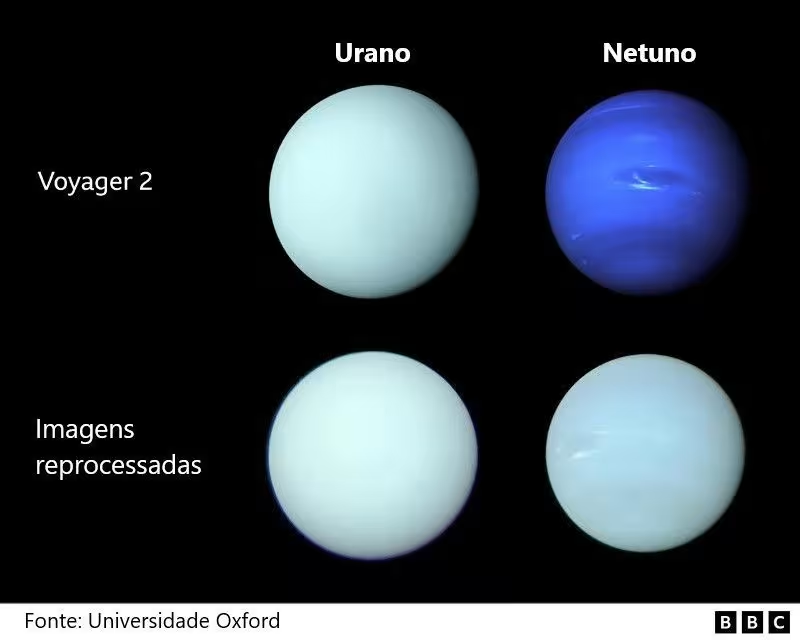
Even though NASA technicians claim it's not a constipation, it's a fact that Neptune photos taken by the Voyager 2 probe were colored to a navy blue hue, when in reality the planet has a light blue identical to Uranus.
When I read the report, I was outraged, but I tried to calm myself down and searched for Neptune in Google images, and indeed today all images of the planet are in a dark blue tone.
Well, we were deceived.
Perhaps in the future an internet user will do the same search, and from now on, images in the true tone will emerge.
But it was a lifetime imagining the planet in one color, and suddenly this happens.
Disappointed!
⚠️ Research conducted with the aid of Deep Research may be subject to referential ambiguity.
🖥️Clean HTML code using our own tool.
👥 Research by Guilherme Felipe, Curation by Sílvio Lôbo
Neptune's Color: A Golden Blue Legend
For decades, the prevailing image of Neptune that populated our imaginations was that of a gas giant of a deep and mesmerizing blue. This representation, as ingrained as the idea that Mars was red, became a visual dogma, shaping textbooks, documentaries, and the public perception of the eighth planet in our solar system. However, as researchers, the pursuit of scientific truth demands a critical look at established narratives, and in Neptune's case, this investigation reveals a story of evolving perception and technological advancements that challenge the long-standing "blue truth."
The Origin of the Blue Myth
The belief in a blue Neptune dates back to the earliest telescopic observations and, more significantly, to the images captured by Voyager 2 during its historic flyby in 1989. These images, processed to enhance the planet's dramatic beauty, presented a vibrant blue hue, often with prominent white clouds and storms. The color was attributed to the presence of methane in the atmosphere, which absorbs red light and reflects blue, a principle similar to what gives our own planet its blue color. Voyager 2 was a milestone, and its images became the definitive reference.
Contradictory Evidence and Technological Advancement
However, as space observation and data analysis technology advanced, discrepancies began to emerge. More sophisticated telescopes, such as the Hubble Space Telescope, and subsequent missions, began to paint a different picture. New observations, using different light filters and processing algorithms, revealed that Neptune's blue was, in fact, less intense and in many areas presented murkier, greenish nuances.
The crucial point of this re-evaluation came with detailed analyses of Voyager 2's images, along with data from other sources. It was realized that the original image processing, while visually striking, may have exaggerated the blue saturation for clarity and scientific impact. Neptune's atmosphere is dynamic and complex, and the color we observe is influenced by a variety of factors, including the distribution of water ice, ammonia, and methane aerosols, as well as seasonal variations and stormy activity.
Neptune's True Colors: A Complex Palette
Neptune's "true" color, or at least the most accurate representation obtained to date, is more subtle and varied than the uniform, deep blue we knew. The latest data suggests that the planet's color varies considerably across different latitudes and altitudes.
- Turquoise and Light Blue Tones: In many regions, Neptune's atmosphere exhibits lighter shades of turquoise and sky blue, especially at lower latitudes.
- Greenish and Grayish Patches: In other areas, such as the polar regions and certain latitude bands, greenish and even grayish hues can be observed. This is attributed to the presence of other compounds in the atmosphere and the way light interacts with them.
- Seasonal Variations: Research indicates that Neptune's color can change over time, reflecting seasonal shifts in its atmosphere, such as increased cloudiness in certain regions.
- The Role of Aerosols: The composition and distribution of atmospheric aerosols, such as ice particles, play a crucial role in the observed color, absorbing and reflecting light in specific ways.
Implications for Science and Outreach
The reinterpretation of Neptune's color raises important questions about how science is communicated to the public. While the blue image was visually appealing and educational, it oversimplified a complex reality. This highlights the importance of:
- Continuous Knowledge Update: Science is a continuous process of discovery. Visual representations and information must be updated as new evidence emerges.
- Transparency about Data Processing: It is crucial that the methods of scientific image processing are understood by the public to avoid misinterpretations.
- The Complexity of Nature: Nature rarely conforms to simplified representations. The true beauty of a planet often lies in its complexity and dynamism.
In summary, the narrative about Neptune's color is not a case of "lying" in a malicious sense, but rather a natural evolution of scientific understanding driven by technological advancements and deeper analysis. The "blue truth" has given way to a richer and more intriguing palette, reminding us that the exploration of the cosmos is a journey of constant learning and rediscovery. Neptune, with its turquoise, greenish, and light blue nuances, is a testament to the complex and ever-changing beauty of our universe.





