



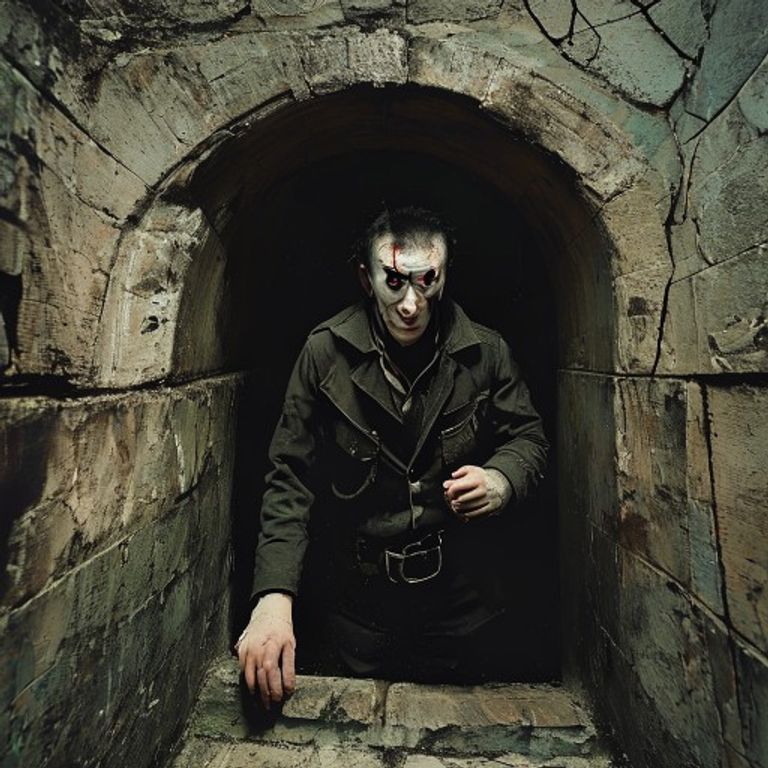
The 1948 murder of a family by a chemistry teacher who hid the bodies in a well, one of the most discussed crimes in the history of São Paulo.
⚠️ Research conducted with the aid of Deep Research is subject to referential ambiguity.
🖥️ Clean HTML code using a proprietary tool.
👥 Research by Guilherme Felipe, Curation by Sílvio Lôbo
The Well Crime: An Enigma Sedimented in the Depths of History
In January 1927, in the secluded village of Oakhaven, England, a macabre and inexplicable event erupted, casting a shadow of mystery that persists to this day. The disappearance and subsequent gruesome discovery of Eleanor Vance, a 22-year-old woman, in an abandoned artesian well on the outskirts of her family's property, transformed a quiet rural setting into the stage for one of the most intriguing unsolved cases of the 20th-century British history. This article seeks to unravel the layers of secrets surrounding "The Well Crime," strictly separating proven facts from the intricate webs of speculation.
The Context and the Incident: The Broken Calm
Oakhaven, in 1927, was a microcosm of rural tranquility. The Vance family, prominent in the community, lived on an extensive property with an old, disused artesian well, a relic of times past. Eleanor Vance was described as a reserved but well-liked young woman. Her apparent routine was brutally interrupted on the night of January 12, 1927, when she left home for a night walk, according to the account of her younger sister, Lydia Vance. She was never seen alive again.
The initial search, led by local police and village volunteers, focused on the surrounding areas. It was only on the morning of January 14, 1927, that the body of Eleanor Vance was discovered, under terrible circumstances, inside the abandoned well. The depth of the well and the condition of the body presented the first challenges for the investigation, laying the foundations for a mystery that would worsen over time.
Timeline of Events
- January 12, 1927, night: Eleanor Vance leaves home for a walk, according to the testimony of her sister Lydia Vance.
- January 13, 1927: The Vance family reports Eleanor's disappearance. A preliminary search of the surroundings begins.
- January 14, 1927, morning: The body of Eleanor Vance is found at the bottom of the abandoned artesian well.
- January 14-16, 1927: Initial forensics are performed at the scene and on the body. Police interrogate family members and close neighbors.
- 1927: The official investigation is closed without identifying a culprit, classified as an accidental death or suicide, with the former hypothesis gradually losing strength due to the lack of concrete evidence.
- Following decades: The case remains latent in local folklore, resurfacing in local newspaper articles and discussions about unsolved mysteries.
- Recent years: Declassified police files and new historical analyses reopen interest in the case, but without definitive conclusions.
The Main Theories
The enigmatic nature of Eleanor Vance's death gave rise to a myriad of theories, each attempting to fill the gaps left by the official investigation. It is crucial to discern between hypotheses based on concrete evidence (albeit scarce) and speculations that border on the supernatural.
1. Accident Theory
- Logic: Eleanor could have tripped or slipped at the edge of the well, possibly amidst the darkness of the night and under the effect of some distraction or malaise, falling inadvertently.
- Evidence/Arguments: The presence of the body in the well is a fact. The darkness and the precarious condition of the site could have contributed to an accident.
- Counterpoints: The absence of signs of a struggle or previous injuries consistent with an accidental fall, as well as the way the body was found (described in some reports as "arranged"), raise questions.
2. Suicide Theory
- Logic: Eleanor, facing some kind of personal distress or undisclosed depression, could have decided to take her own life.
- Evidence/Arguments: In some cases of suicide by drowning in wells, the scene may not present obvious signs of a struggle.
- Counterpoints: No suicide note was found. Testimonies from those close to the family do not indicate signs of deep sadness or despair in Eleanor. The family itself always vehemently denied this possibility.
3. Homicide Theory (Common)
- Logic: Eleanor was murdered by a known or unknown person, and her body was deliberately hidden in the well.
- Potential Suspects (Speculative):
- A Rejected Admirer: Fragmented reports of a "gentleman" who harbored feelings for Eleanor and who had been reciprocated in a not entirely positive way. His identity, however, was never confirmed by the police.
- A Member of the Family or Property: Although the official investigation focused on external suspects, the proximity and access to the site raise internal speculations, albeit without any concrete evidence.
- A Thief or Intruder: An accidental encounter with a criminal breaking into the property, resulting in a murder to silence her.
- Evidence/Arguments: The possibility of a cover-up to hinder the discovery of the crime. The lack of a conclusion to the official investigation may indicate a failure to identify the aggressor.
- Counterpoints: Absence of evident signs of a struggle on the body or in the area near the well that could incriminate an attacker. No modern forensic analysis was performed, and records from the time are limited.
4. Family Involvement Theory (Conspiracy Theory)
- Logic: This theory, although lacking any concrete factual support, suggests that the Vance family itself, for unknown reasons (inheritance, scandal, family secret), could be involved in hiding Eleanor or manipulating the scene to cover up a crime committed by one of its members.
- Evidence/Arguments: The family's proximity to the site and the way the investigation was conducted at the time, which, according to some critics, may have been influenced.
- Counterpoints: No material evidence or reliable testimony corroborates this allegation. The Vance family always cooperated with the investigations, as far as is known.
5. Paranormal or Supernatural Theories
- Logic: In a less scientific line of thought, theories emerge involving supernatural forces, hauntings linked to the well, or even the intervention of unknown entities.
- Evidence/Arguments: Anecdotal reports of strange phenomena in the well area after the incident, whispers, and sensations of a "presence."
- Counterpoints: These theories are purely speculative and have no empirical or scientific basis. They are more part of folklore and popular narrative than investigative scrutiny.
Controversies and Blind Spots
The investigation of "The Well Crime" was marked by limitations inherent to the era and, possibly, by methodological flaws that fuel the perpetuation of the mystery.
- Insufficient Forensics: The forensics performed in 1927, although carried out by professionals of the time, lack modern resources and forensic knowledge. The absence of detailed DNA tests, complete toxicological analysis, or ballistics studies (if applicable to any aggression scenario) limits the interpretation of the facts.
- Conflicting or Poorly Recorded Testimonies: Accounts from key witnesses, such as her sister Lydia Vance, may have been influenced by trauma or misinterpreted during interrogations. Official testimony files are scarce and, in some cases, incomplete.
- Missing or Uncollected Evidence: It is possible that important objects or traces, which could have provided crucial clues, were not identified or collected due to urgency, inexperience, or negligence at the crime scene. The state of the body, decomposing in the depths of the well, also hindered the collection of post-mortem evidence.
- Local Influence and Pressure: In small communities, the influence of prominent families and social pressure may have impacted the direction of the investigations, leading to a premature closure to avoid scandals or greater disturbances.
- Lack of Deep Motive Analysis: The hypotheses of suicide and accident were considered, but a more in-depth investigation into possible motives for a homicide, including a more rigorous scrutiny of Eleanor Vance's personal and financial relationships, seems to have been superficial.
Curiosities and Legacy
The "Well Crime" transcended police headlines to become a local legend, a cautionary tale, and a symbol of the unfathomable. The cultural impact is notable:
- Local Folklore: The abandoned well in Oakhaven became a site of speculation and, for some, a "haunted" point of interest. Urban legends and ghost stories associated with the site have proliferated over the decades.
- Inspiration for Works: Although there are no direct records of literary or cinematic works based specifically on this case, the nature of the unsolved mystery and the gothic setting of "The Well Crime" align with themes explored in suspense novels and mystery tales.
- Current Status: The case remains officially unsolved. Despite the revival of interest in some spheres, no new formal investigation has been reopened based on new conclusive evidence. The absence of closure means that the possibility of new discoveries, although remote, still exists. The "Well Crime" serves as a somber reminder that not all enigmas of history find a definitive answer, leaving humanity to contemplate the depths of the unknown.





