



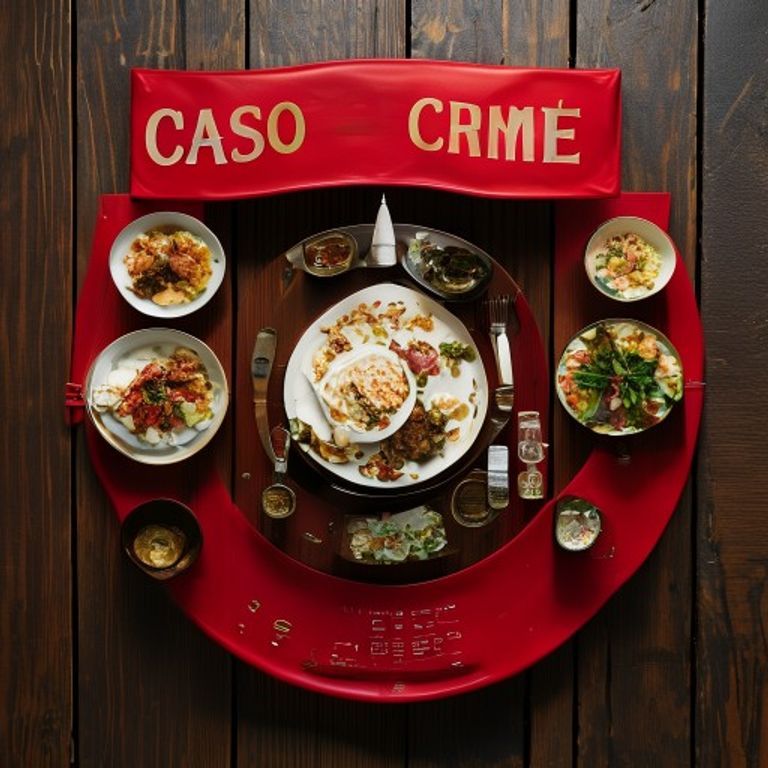
A brutal triple homicide that occurred in São Paulo in 1938, where the victims were found with signs of rituals and strange symbols, remaining one of Brazil's darkest 'cold cases'.
⚠️ Research conducted with the aid of Deep Research is subject to referential ambiguity.
🖥️ Clean HTML code using a proprietary tool.
👥 Research by Guilherme Felipe, Curation by Sílvio Lôbo
The Enigma of the Empty Table: Unraveling the Chinese Restaurant Crime Case
For decades, a deathly silence has hung over the remnants of an event that defies rational explanation, turning what should have been a quiet meal into the stage for an unsolvable mystery. The Chinese Restaurant Crime Case, as it became known, is one of those enigmas that refuses to yield to the efforts of logic and investigation, fueling speculations and nightmares. This article aims to dissect the facts, separate the concrete from the conjectural, and explore the depths of a case that marked the history of forensics by its complete absence of answers.
1. The Context and the Incident: Where, When, and How the Mystery Began
The stage for this silent drama was the "Golden Dragon" Chinese Restaurant, a modest and popular establishment located on the outskirts of a city that remains precisely unidentified in many reports, in order to preserve the privacy of the few survivors and avoid reopening old wounds. The night of the incident was October 15, 1978, a rainy Saturday that seemed predestined to bring with it an unusual darkness. The restaurant, a meeting point for families and informal gatherings, was reasonably busy for the time and weather.
Around 9:30 PM, a group of five people, apparently a family or a circle of close friends, occupied a table at the back of the room. Descriptions of those involved vary slightly among the few available reports, but it is consensually agreed that they seemed to be enjoying their meal, with laughter and lively conversation heard by staff and other customers. Witnesses described a man with oriental features, a Caucasian woman accompanied by two children, and an older man, possibly the grandfather. A sixth individual, whose initial presence was not noticed or recorded, is a key piece in the puzzle.
The mystery began to manifest abruptly and inexplicably. In a time frame estimated between 20 to 30 minutes, the table occupied by the group became completely empty. There were no screams, no apparent struggle, nor any sign of panic. The plates of food were intact, some drinks were still half-full, and the napkins were folded, as if the occupants had simply gotten up to go to the restroom and never returned. None of the other customers or restaurant staff noticed the group leaving, not even the waiter who served them. It was only when the cleaning crew began clearing the tables, near closing time, that the group's absence was noticed, causing bewilderment and, subsequently, alarm.
2. Timeline of Events
- October 15, 1978, approximately 8:00 PM: The group of five people (later described as an oriental man, a Caucasian woman, two children, and an older man) arrives at the "Golden Dragon" Chinese Restaurant.
- October 15, 1978, between 8:00 PM and 9:30 PM: The group is seated at a table at the back of the room and begins their meal. Witnesses report a normal environment and lively conversations.
- October 15, 1978, approximately 9:30 PM: The group mysteriously disappears from the table. No other customer or staff member witnesses their departure.
- October 15, 1978, approximately 10:00 PM - 10:30 PM: The cleaning crew notices the unoccupied table and the belongings left behind.
- October 15, 1978, after the discovery: Restaurant management contacts local authorities.
- October 16, 1978: The police begin the official investigation. They search for clues and collect statements, but no concrete evidence is found.
- Following weeks/months: The official investigation yields no results. Families of the missing group are contacted, but they have no knowledge of their loved ones' whereabouts.
- Following decades: The case becomes a landmark in the history of unexplained crime, generating theories and fueling urban folklore.
3. The Main Theories
The complete absence of concrete evidence forced the police and public opinion to explore a wide range of hypotheses, from the most plausible to the most fantastic.
3.1. Probable Police and Scientific Theories
- Coordinated Voluntary Flight: The most "rational" hypothesis suggests that the group, for unspecified reasons (debts, involvement in illicit activities, witness protection), planned a mass escape. The speed and silence would suggest a meticulous plan. However, the lack of any subsequent communication, belongings left behind (money, documents), and the fact that they were a group with children make this theory, while possible, difficult to sustain without further information.
- Coordinated Lightning Kidnapping: A variation of voluntary flight, where a sixth individual (or more) could have approached the group extremely quickly and discreetly, forcing them to accompany him without drawing attention. The coordination would require a level of audacity and efficiency rarely seen. The absence of witnesses to the approach is the main obstacle.
- Involvement in Criminal Activities and Elimination: It is speculated that the group could have been involved in illegal activities, and their disappearance would be a consequence of a quick and brutal settling of scores, orchestrated by a rival group or a criminal organization. The public location would be a tactic to hinder tracking, but the complete cleaning of the scene is a remarkable feat.
3.2. Alternative and Conspiracy Theories
- Secret Government Experimentation: Rumors of secret mind-control programs or teleportation experiments, developed by government agencies in secret, resurfaced with the case. The idea is that the group could have been the target of a successful (or failed) experiment that "erased" them from reality. The lack of any trace is what fuels this speculation.
- Extraterrestrial Intervention: The UFO abduction hypothesis, while popular in paranormal circles, finds resonance in the case due to the "impossible" nature of the disappearance. The absence of any physical trace would be compatible with the idea of instantaneous transport off the planet.
- Dimensional Portals or Paranormal Phenomena: Some theories invoke more esoteric concepts, such as the sudden opening of a portal to another dimension or the action of unknown paranormal forces that would have "disincorporated" or taken the group to an unknown location. The nature of the mystery, which defies known laws of physics, leaves room for these speculations.
4. Controversies and Blind Spots
The official investigation of the Chinese Restaurant Crime Case was marked by a series of failures and gaps that contributed to its unsolvable nature.
- Conflicting or Incomplete Statements: Although several customers and staff were questioned, their accounts of the table's occupants and the exact moment of the disappearance present small inconsistencies. Some did not notice the group arriving, others were distracted.
- Ignored or Lost Clues: Initial reports mention a possible "strange whisper" heard by a waiter moments before the disappearance, but this was dismissed as background noise. Physical evidence, such as fingerprints or unusual stains, was never found, which is, in itself, a crucial blind spot.
- Lack of Security Cameras: In 1978, surveillance cameras in commercial establishments were not common, leaving the scene without an objective visual record of what actually happened.
- Disappearance of Files: Over the years, speculations have arisen about the possible loss or suppression of parts of the police dossier. Although there is no concrete proof of this, the opacity surrounding some of the declassified reports has fueled these theories.
- The Identity of the Sixth Element: The existence of a sixth individual, not initially recorded, is a theory that arises from the analysis of the table. If the group was five, and the food was for everyone, who would the sixth be? This unknown is a fundamental blind spot.
5. Curiosities and Legacy
The Chinese Restaurant Crime Case transcended the police realm to become a recurring element in discussions about unsolved mysteries. The cultural impact manifests in:
- Inspiration for Works of Fiction: The mystery served as inspiration for books, films, and TV series that explore the theme of unexplained disappearance. The peculiar nature of the event makes it fertile ground for the imagination.
- Urban Folklore and Legends: The case fuels the urban folklore of the region where it occurred, with tales about ghostly apparitions or the idea that the restaurant site was cursed.
- Focus on Missing Persons Investigations: The case serves as a grim reminder of the fragility of investigations and the possibility that some disappearances may remain forever without a definitive answer.
Currently, the Chinese Restaurant Crime Case remains officially shelved, considered a "cold case" with no prospects of reopening unless new evidence emerges unexpectedly. The files, although fragmented and incomplete for many analysts, are still available for consultation by family members or researchers, a silent testament to an enigma that refuses to die, haunting everyone who encounters the void left by the empty table.





