



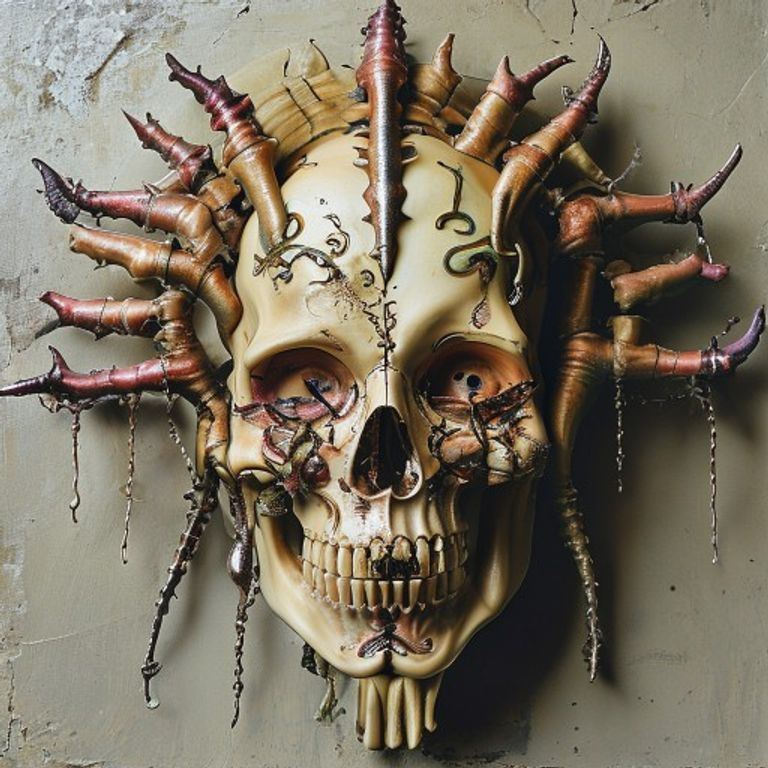
A severely deformed bone skull discovered in Mexico sparked decades of ufological theories due to its physical characteristics that some believed belonged to human hybrids.
⚠️ Research elaborated with the aid of Deep Research is subject to referential ambiguity.
🖥️Clean HTML code using a proprietary tool.
👥 Research by Guilherme Felipe, Curation by Sílvio Lôbo
The Starchild Skull Enigma: A Mystery That Challenges Science and Imagination
In the underworld of unsolved mysteries, few cases capture the imagination and perplexity in the same way as the so-called "Starchild Skull Case." An anomalous relic, found under murky circumstances in Mexico in the early 1930s, this artifact has been the cornerstone of heated debates among scientists, skeptics, and enthusiasts of alternative theories. What at first glance appeared to be just a peculiar skull has, over the decades, transformed into a symbol of profound questions about human evolution, extraterrestrial life, and the very nature of reality.
The Context and the Incident: An Encounter with the Unexplained
The story of the Starchild Skull dates back to 1930, in a small, isolated village near the city of Monclova, in the state of Coahuila, Mexico. According to reports, the skull was discovered in an abandoned mine by a local child. From there, the object passed from hand to hand, eventually reaching the hands of an individual known only as "Clark," who took it to the United States. It was Ray and Marian Ray, a couple of paranormal enthusiasts and amateur researchers, who in 1999 acquired the skull, becoming its most prominent curators and defenders, and naming it "Starchild." The context of its discovery, marked by a lack of official records and the oral transmission of information, already points to the intrinsic difficulties in establishing the absolute veracity of the initial facts.
Timeline of Events: Unraveling the Trajectory of a Mystery
- Early 1930s: Discovery of an anomalous skull in an abandoned mine near Monclova, Coahuila, Mexico. The identity of the original discoverer and the precise location details are obscure.
- Subsequent Decades: The skull passes through various hands, traveling from Mexico to the United States. The history of its possession during this period is fragmented and lacks formal documentation.
- 1999: The couple Ray and Marian Ray acquire the Starchild Skull. They become the main promoters and investigators of the artifact, conducting preliminary tests and publicizing its existence.
- 2003-2010: Various genetic and imaging tests are performed on the Starchild Skull by different laboratories and scientists, generating controversial and often conflicting results.
- Recent Years: The Starchild Skull continues to be the subject of intense debate, with the Rays and their supporters seeking scientific validation for their theories, while the mainstream scientific community remains skeptical, pointing to the limitations and methodological flaws of the studies.
The Main Theories: From Evolutionism to Science Fiction
The unusual nature of the Starchild Skull has given rise to a myriad of theories, each attempting to explain its distinctive characteristics:
Scientific and Forensic Theories (Skeptical Perspective)
- Severe Hydrocephalus in a Human Newborn: This is the hypothesis most accepted by the medical and forensic community. It suggests that the skull belonged to a human infant who suffered from a rare and severe congenital condition of hydrocephalus. This condition causes the excessive accumulation of cerebrospinal fluid in the brain, leading to the enlargement and deformation of the skull. The visual characteristics of the skull, such as the elongated shape, smaller eye sockets, and bone delicacy, could be explained by this pathology. The lack of prominent paranasal sinuses and the thinner bone structure would also be consistent with abnormal development.
- Down Syndrome or Other Chromosomal Anomaly: Some researchers suggest that the skull may represent an individual with a genetic anomaly, such as Down Syndrome, which can present peculiar facial and cranial features. However, the extent of the anomalies observed in the Starchild Skull is significantly more pronounced than what is generally associated with these syndromes.
Alternative, Paranormal, and Conspiracy Theories
- Human-Extraterrestrial Hybrid: This is the most popular theory among the proponents of the Starchild Skull. They believe the skull belonged to a child of a non-terrestrial species, possibly a hybrid between humans and aliens. The unusual shape, the absence of certain human characteristics, and the results of genetic tests interpreted in unconventional ways are used as "evidence." The logic behind this theory rests on the assumption that extraterrestrial life forms could have visited Earth and interacted with humans.
- Unknown Ancient Human Race: Another line of thought suggests that the skull may belong to an ancient and forgotten human race with physical characteristics distinct from those we know. This theory, while less spectacular than the extraterrestrial one, still posits a significant evolutionary divergence.
- Ancient Genetic Engineering: Some speculations involve the possibility that the skull is the result of genetic manipulation by advanced ancient civilizations, which could have altered the human genome or created new life forms.
Controversies and Blind Spots: The Gaps in the Investigation
The Starchild Skull Case is rife with controversies and blind spots that make it difficult to obtain definitive answers:
- Origin and Documentation: The lack of a formal archaeological record and the absence of clear information on how and where the skull was discovered are the main obstacles. The story of "discovered by a child in a mine" is difficult to verify and may have been altered over time. There are no excavation reports, precise discovery dates, or any forensic evidence confirming its original provenance.
- Genetic Test Results: The genetic tests performed on the Starchild Skull have largely been the source of controversy. Proponents of the skull claim that the tests revealed DNA that is not entirely human, with unknown genetic markers. However, the scientific community has criticized the methodology of these tests, pointing to the possibility of contamination, degradation of ancient DNA, and misinterpretations of the data. An independent report by Dr. Melba Ketchum, which claimed to find evidence of non-human DNA, was widely discredited by the scientific community due to methodological flaws and lack of peer review.
- Imaging and Biomechanical Analysis: Although CT scans and other imaging analyses have revealed unusual bone characteristics, the interpretation of these findings varies drastically. Forensic scientists and radiologists often attribute them to known pathological conditions, while alternative theorists see them as evidence of non-human origin.
- Testimonies and Oral Transmission: The lack of reliable eyewitnesses and the reliance on second or third-hand accounts for the skull's origin create fertile ground for speculation and inaccuracies.
- Loss of Samples and Control: The difficulty in obtaining unrestricted access and ensuring full control over the skull samples for independent and replicable analyses is also a concern.
Curiosities and Legacy: A Perpetuated Enigma
The Starchild Skull has transcended the fields of archaeology and anthropology to become a cultural icon, inspiring books, documentaries, and debates in online forums. Its story evokes humanity's fascination with the unknown and the eternal quest for answers about our origins and our place in the cosmos.
- The legacy of the Starchild Skull lies in its ability to challenge the status quo and stimulate critical thinking, even if definitive answers remain elusive.
- It serves as a reminder of the complexity of scientific investigation, especially when dealing with artifacts with questionable provenance histories.
- Currently, the Starchild Skull is under the care of the Rays' heirs and continues to be a focal point for those seeking an explanation for its anomalies beyond conventional science.
- There is no indication that the case has been officially reopened by scientific or legal authorities, but public interest and speculation surrounding it remain vibrant, perpetuating the mystery.
While science clings to explanations based on known pathologies and rigorous methodologies, the Starchild Skull continues to echo at the frontiers of imagination, a silent enigma whispering the possibility that our past, and perhaps our future, may be stranger and more wonderful than we dare to conceive. The truth, as always, may lie somewhere between the obvious and the unimaginable.





