



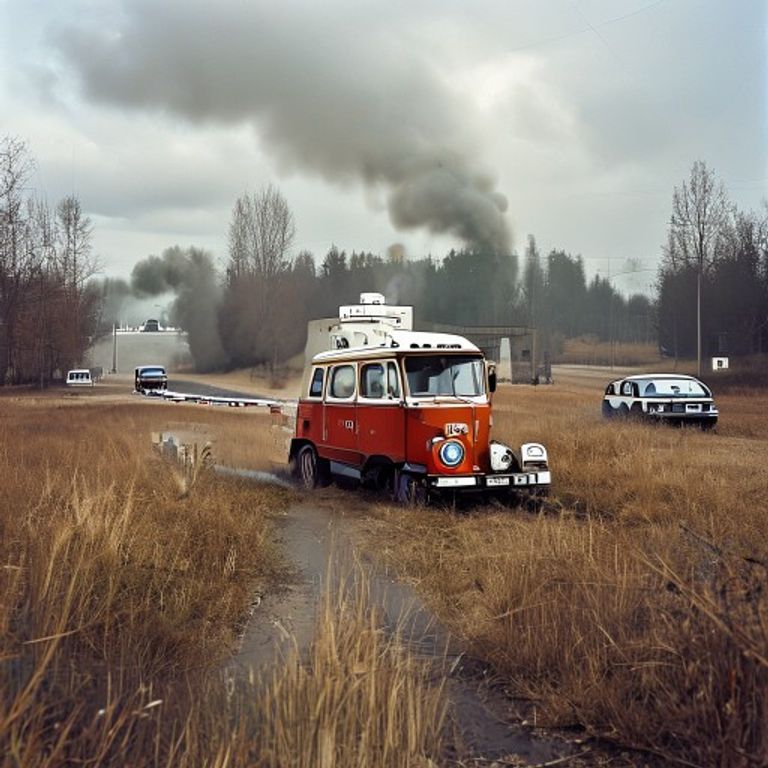
A mass luminous phenomenon that occurred in 1977 over the Soviet Union, where a giant jellyfish-shaped object allegedly emitted rays of light over the city, causing material damage.
⚠️ Research conducted with the aid of Deep Research is subject to referential ambiguity.
🖥️ Clean HTML code using a proprietary tool.
👥 Research by Guilherme Felipe, Curation by Sílvio Lôbo
The Petrozavodsk Incident: The Night the Sky Wept Lights
On September 20, 1977, the Soviet city of Petrozavodsk, in Karelia, became the stage for one of the most intriguing and persistent unsolved mysteries of the Cold War. That night, thousands of citizens reported seeing a massive, silent flying object emitting an intense beam of light that seemed to "melt" or "drip" over the city—a celestial spectacle that defied immediate explanation and left a trail of speculation that persists to this day.
The event, which became known as "The Petrozavodsk Rain of Lights" or simply "The Petrozavodsk Incident," was not an isolated occurrence. Similar reports emerged in other regions of the Soviet Union and neighboring countries, fueling the atmosphere of apprehension and curiosity of the time. However, it was in Petrozavodsk that the phenomenon manifested with the greatest intensity and notoriety, leaving deep marks on the collective memory and the history of Unidentified Aerial Phenomena (UAPs).
The Context and the Incident: The Shadow of the Unknown
The year 1977 was marked by palpable geopolitical tension. The Cold War was reaching one of its peaks, with both ideological blocs in constant mutual surveillance. Any anomaly in the sky could be interpreted as a potential threat, whether of a military nature or of unknown origin. In this scenario, the appearance of a colossal flying object over Petrozavodsk, a city near the border with Finland, took on significant proportions.
According to numerous testimonies collected later, the object appeared around 4:00 AM. Described as a giant "disk" or "jellyfish," it hovered silently in the dark sky. The most shocking and defining point of the incident was the emission of a concentrated beam of light that descended vertically toward the city. Eyewitnesses described the light as intense, blinding, and with a peculiar aspect, as if it were "dripping" or "melting" in the air. There were reports that the streets were illuminated as if it were daytime, and that the atmosphere seemed charged with a strange energy.
Descriptions varied, but the essence was the same: something of gigantic proportions, silent, emitting an unusual and directed light. Panic was not widespread, but perplexity and astonishment dominated the population. The object's lack of sound contributed to the mystery, contrasting with the visual intensity of the phenomenon.
Timeline of Events
Accurately reconstructing the timeline of events for phenomena like the one in Petrozavodsk is inherently challenging due to the unofficial nature and communication limitations of the era. However, based on reports and testimonies compiled over the years, we can outline the following crucial points:
- September 20, 1977, approximately 4:00 AM (Local Time): The unidentified flying object is sighted for the first time over Petrozavodsk. Witnesses report the massive object and the emission of a beam of light.
- Morning Period (September 20): Reports and conversations spread rapidly through the city. Admiration and astonishment are the predominant reactions.
- Subsequent Days and Weeks: The event gains local and, eventually, national attention. Numerous testimonies are collected informally and, later, by investigators.
- First Attempts at Explanation: Soviet authorities begin investigations, seeking scientific and military explanations.
- Subsequent Decades: The case is revisited by ufologists, researchers, and historians, with the partial declassification of some Soviet documents.
The Main Theories: Unraveling the Enigmas
The Petrozavodsk Incident, like many other UAP cases, generated a myriad of theories, from the most scientific and pragmatic to the most fantastic and speculative. It is essential to separate proven facts from hypotheses for a rigorous analysis.
Scientific and Official Theories
- Atmospheric/Meteorological Phenomenon: One of the most widespread explanations suggests that the event could have been an unusual atmospheric phenomenon, such as a rare form of ball lightning or a high-intensity type of aurora borealis. However, the shape of the object and the directed, "dripping" nature of the light beam are difficult to reconcile with these hypotheses. The absence of sound is also a point of contention.
- Secret Military Test: Given the nature of the Soviet Union at the time, the hypothesis of a secret military test of a new weapon or surveillance technology is plausible. The object could have been a prototype of an advanced drone, a satellite in the testing phase, or a type of unconventional aircraft. The silent nature and light emission could be characteristics of such technology. However, the lack of any official acknowledgment or evidence of compatible technology at the time raises questions. Reports from the era mention the search for military explanations, but none were publicly confirmed as the cause.
- Light Projection or Hologram: A less common but considered theory is that the "object" and the "beam of light" could have been the result of complex light projections, perhaps intended for defense tests or psychological operations. This explanation would require extremely advanced technology for the time and a clear motivation for carrying out an event of such magnitude with mass witnesses.
Alternative, Conspiracy, and Paranormal Theories
- Extraterrestrial Visit: This is, without a doubt, the most popular theory among ufology enthusiasts. The object is interpreted as a spacecraft of extraterrestrial origin, and the beam of light as a mechanism for exploration, data collection, or even a means of transporting beings from another planet. The absence of sound, the unusual shape, and the inexplicable nature of the phenomenon fuel this interpretation.
- Psychic or Psychotronic Experiment: Some more speculative theories suggest that the event could have been the result of an experiment with psychic capabilities or psychotronic technologies, where the collective mind or mental projection was used to create the illusion of the object. This line of thought is highly speculative and lacks concrete evidence.
- Paranormal or Dimensional Phenomenon: A minority of theories suggest that the incident may have been a dimensional portal, a manifestation of paranormal energy, or an interdimensional event that affected the observers' perception. These theories fall into the realm of the inexplicable and the metaphysical.
Controversies and Blind Spots: Where the Truth Hides
The investigation and understanding of the Petrozavodsk Incident were hindered by several factors inherent to the Soviet context and the nature of the event itself:
- Official Opacity: The Soviet Union, during the Cold War, was known for its secrecy, especially in matters of national security and potentially destabilizing phenomena. Official investigations, if they occurred on a large scale, were kept secret for decades. Subsequent document declassification offered glimpses, but not a definitive explanation.
- Conflicting and Evasive Testimonies: Although thousands of people reported the event, the exact details of the descriptions could vary. Pressure to conform or fear of being ridiculed may have led to evasive or inaccurate testimonies.
- Scarce or Lost Physical Evidence: For phenomena that occur in the sky and may be short-lived, collecting tangible physical evidence is a challenge. If there was any residue or mark left by the beam of light, it is likely that it was obscured by natural phenomena or that the official investigation did not prioritize such collection independently. The lack of clear and verifiable photos or videos contributes to the uncertainty.
- Focus on Pragmatic Explanations: The priority of Soviet authorities was, undoubtedly, to rule out military threats and maintain order. This may have led to an excessive focus on conventional explanations, potentially ignoring anomalies that did not fit their pre-established models. Reports from Western intelligence agencies of the time, which investigated the incident, also lack definitive conclusions but point to the strangeness of the phenomenon.
Curiosities and Legacy: The Legend Persists
The Petrozavodsk Incident transcended the local sphere to become a milestone in ufology studies and a symbol of historical mystery. Its legacy is multifaceted:
- Cultural Impact: The "Rain of Lights" became part of Petrozavodsk's folklore and a recurring topic of discussion. The narrative of the event inspired books, articles, and documentaries, keeping alive the flame of curiosity about what really happened that early morning.
- Declassified Archives: The gradual declassification of Soviet documents, especially after the collapse of the Soviet Union, allowed for a deeper look at what authorities knew (or did not know). These documents, while not solving the mystery, confirm the occurrence of the event and the perplexity of the observers.
- Continuous Study: The case continues to be studied by independent researchers, who seek new perspectives and analyses of testimonies and possible evidence. The desire for a definitive explanation persists, fueled by imagination and the relentless search for truth in the face of the inexplicable.
- Current Status: The Petrozavodsk Incident remains officially unsolved. Russian authorities, like the Soviets before them, have not offered a conclusive and widely accepted explanation. The case remains open in the minds of those who seek answers, a reminder that, even in a world increasingly mapped and understood, the sky still holds secrets capable of leaving us speechless.
What happened that early morning in Petrozavodsk? A daring military test? A natural phenomenon of rare beauty and terror? Or something that challenges our current understanding of reality? The mystery, wrapped in light and silence, continues to hover over the city, a perennial invitation to investigation and speculation.





