



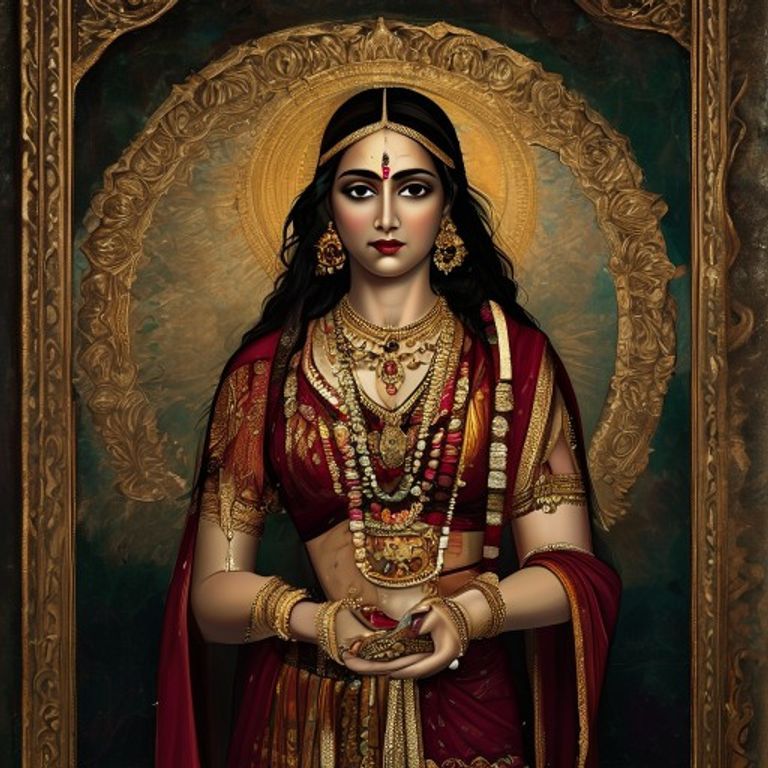
One of the most documented accounts of alleged past-life recall, where an Indian girl in the thirties accurately described details of the life of a woman who had died years earlier in another city.
⚠️ Research conducted with the aid of Deep Research is subject to referential ambiguity.
🖥️ Clean HTML code using a proprietary tool.
👥 Research by Guilherme Felipe, Curation by Sílvio Lôbo
The Shanti Devi Enigma: A Soul That Remembers Another Life
Amidst the vastness of archived cases and historical mysteries, few capture the imagination and challenge logic as persistently as the so-called "Shanti Devi Case." What could have been just a peculiar anecdote about reincarnation turned into an investigation that, even decades later, casts shadows of doubt over our understanding of consciousness and memory. As a senior investigative journalist with a fascination for unsolved enigmas, I delved into the files, the witnesses, and the fragments of an event that defies easy explanations.
1. The Context and the Incident: Where, When, and How the Mystery Began
The case unfolds in India, in a setting that blends ancestral mysticism with everyday reality. It all began in Mathura, Uttar Pradesh, in 1929. A girl named Shanti Devi, born into a traditional Hindu family, began to manifest vivid memories of a previous life. Initially, her parents and the community attributed such talk to childhood imagination, but the insistence and specificity of Shanti's narratives soon sparked unease.
Shanti claimed to have been a woman named Lata, who lived in Vrindavan, about 145 km from Mathura. She described intimate details of her life as Lata, including her marriage, her husband's profession, the circumstances of her death – which allegedly occurred due to complications during childbirth – and even the names of relatives and friends. The girl was distressed by the situation, begging to be taken to Vrindavan to find her "previous family."
2. Timeline of Events: A Chronological Reconstruction
- 1929: Shanti Devi, still a child, begins to report memories of a previous life as Lata in Vrindavan.
- 1930: Shanti's insistence and the precision of her details lead her parents to consider the possibility that her claims are more than mere fantasy.
- 1930-1934: Shanti's stories become increasingly detailed, including the location of assets and the identity of people in Vrindavan. The family initially tries to contact Lata's family in Vrindavan, but without success.
- 1935: Shanti Devi's story reaches the ears of prominent figures, including the respected scholar Dr. K.L. Shrimali (who would later become India's Minister of Education). He becomes interested in the case and decides to investigate.
- 1935: A delegation, including Shanti, her parents, and Dr. Shrimali, travels to Vrindavan.
- 1935: During the visit to Vrindavan, Shanti Devi demonstrates remarkable recognition of places and people she claimed to know from her life as Lata. She manages to correctly identify members of Lata's family, describe past events, and even point out the location of objects that allegedly belonged to Lata.
- 1935: An investigation committee, formed by eminent citizens and scholars, is established to examine the case.
- 1936: The committee publishes its report, confirming the veracity of Shanti Devi's claims and finding few rational explanations for her detailed knowledge.
3. The Main Theories: Possible Explanations
The Shanti Devi case became fertile ground for speculation, ranging from the paranormal to more mundane explanations. We analyze the most prominent ones:
3.1. Reincarnation (Paranormal/Spiritual Theory)
This is the explanation that naturally emerges from the claims themselves and their apparent validity. The theory postulates that Lata's consciousness, after her death, reincarnated into the body of Shanti Devi, retaining memories of her previous life. The logic here lies in the belief in cycles of life and death, where the soul (atman) transmigrates to a new body, potentially carrying experiences and knowledge with it. Shanti's success in identifying people and locations in Vrindavan is seen as the primary evidence for this theory.
3.2. Coincidence and Subconscious Memory (Psychological Hypothesis)
A skeptical explanation suggests that Shanti Devi may have somehow absorbed information about Lata before claiming her memories. This could have occurred through conversations overheard in childhood, information disseminated by the family, or even inadvertent suggestions. Subconscious memory, in this context, would activate this information as if it were genuine memories. The vast amount of information obtained by Shanti, however, makes this hypothesis challenging, as it would require an extraordinary degree of prior exposure and retention.
3.3. Fraud and Manipulation (Skeptical/Conspiracy Theory)
The possibility of fraud can never be completely ruled out in high-profile cases. There could have been a conspiracy orchestrated by Shanti Devi's family or by individuals interested in exploiting the story for personal gain or to promote spiritual beliefs. The conspirators could have provided information to Shanti in advance, or the child herself could have been trained to respond convincingly. However, public scrutiny and the involvement of respected figures like Shrimali make the idea of a large-scale fraud difficult to sustain without concrete evidence.
3.4. Suggestion and Contamination of Ideas (Sociological/Psychological Hypothesis)
Similar to subconscious memory, this theory focuses on environmental influence. Once the idea of reincarnation was introduced, Shanti Devi, as an impressionable child, may have begun to shape her fantasies and observations to fit that narrative. Social pressure and the desire to please or confirm adult expectations may have played a role. This theory, however, still faces the obstacle of specificity and Shanti's ability to provide details that, according to reports, were unknown to most people.
3.5. Unexplained Psychic Phenomenon (Alternative Paranormal Theory)
There are other possibilities within the paranormal spectrum that are not strictly limited to reincarnation. It could be a case of clairvoyance, where Shanti Devi accessed information about Lata through unconventional psychic means. Or, perhaps, a remnant of consciousness or residual energy left by Lata's spirit, which Shanti was able to tune into. These hypotheses, by their nature, are difficult to prove or refute with conventional scientific methods.
4. Controversies and Blind Spots
The investigation of the Shanti Devi case, while remarkable for its time, is not free from criticism and dark areas that fuel the debate to this day:
- The Nature of Evidence: Much of the "evidence" lies in testimonies and Shanti Devi's ability to identify people and locations. Official reports, such as that of the investigation committee, rely heavily on the interpretation of events and the credibility of witnesses. The lack of forensic expertise or objective comparative documentation is a significant blind spot.
- The Investigation Committee: Although respected, the committee members had their own biases and beliefs. The composition of the commission and the way the interviews were conducted may have been subtly influenced by their pre-existing views on reincarnation.
- Control and Preparation: Critics point to the possibility that the delegation that took Shanti to Vrindavan may have, inadvertently or purposefully, provided clues or prepared the girl for certain encounters. The logistics of the trip and the prior interaction with Lata's family are points of speculation.
- Information Obtained by Other Means: The possibility that Shanti heard conversations or received information unconsciously, even during the trip, is difficult to completely rule out. The atmosphere of expectation created around the visit could have intensified this absorption.
- The Final Report: Although the official report declared the veracity of Shanti's claims, it did not offer a definitive explanation, leaving room for varied interpretations. The absence of an indisputable scientific conclusion keeps the case open for debate.
5. Curiosities and Legacy
The Shanti Devi case transcended the local sphere to become an international phenomenon, inspiring studies and academic debates on reincarnation, memory, and the nature of consciousness.
- Cultural Impact: The case was widely reported in newspapers and books, becoming one of the most cited examples in discussions about life after death and the validity of beliefs in reincarnation.
- Subsequent Studies: Researchers such as Dr. Ian Stevenson, from the University of Virginia, who dedicated his career to the study of children with memories of past lives, included the Shanti Devi case in his extensive research. Stevenson, although he did not directly investigate the original event, considered the case remarkable evidence.
- Shanti's Fate: After most of the initial clamor subsided, Shanti Devi grew up, married, and lived a relatively normal life. She never renounced her memories of Lata and continued to maintain the story.
- Current Status: The Shanti Devi case remains archived by traditional police authorities, as it does not constitute a crime in itself. However, it continues to be an object of intense study for parapsychologists, theologians, and those fascinated by unsolved mysteries. There are no indications of a formal reopening of a criminal investigation, but intellectual debate and public curiosity persist.
The Shanti Devi Enigma, with its aura of mystery and its challenge to Cartesian logic, serves as a poignant reminder that the universe of human experience may contain secrets that our current tools struggle to unravel. It is an invitation to reflection, healthy doubt, and the exploration of the inexplicable.





