



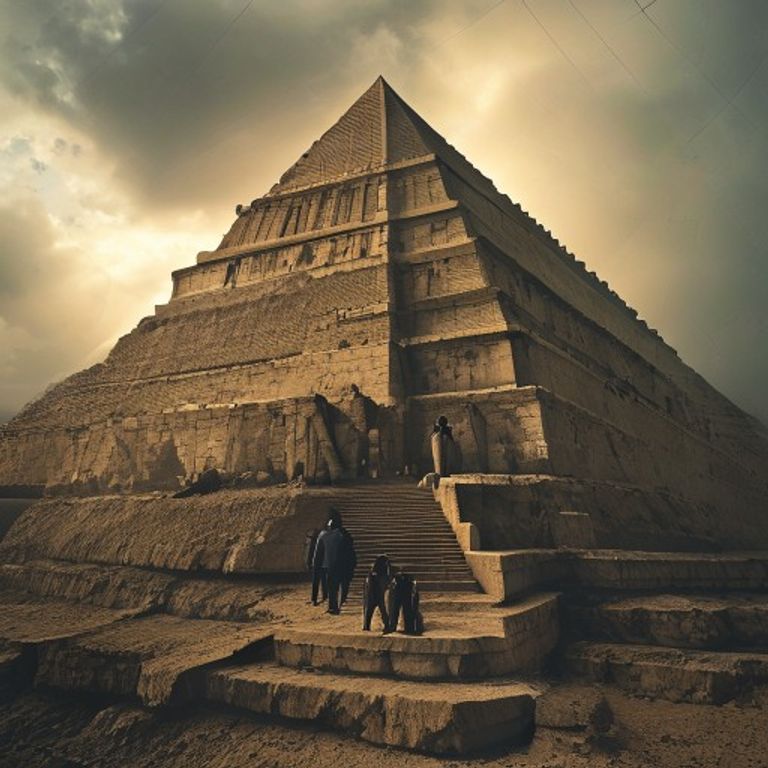
A pyramidal structure in Greece whose dating tests suggest it may be older than the great Egyptian pyramids, challenging the classical chronology of civilization.
⚠️ Research conducted with the aid of Deep Research is subject to referential ambiguity.
🖥️ Clean HTML code using a proprietary tool.
👥 Research by Guilherme Felipe, Curation by Sílvio Lôbo
The Mystery of the Hellinikon Pyramid: A Persistent Greek Enigma
In the rolling hills of the Argolis, in southern Greece, stands a structure that defies understanding and has fueled the popular imagination for centuries: the Hellinikon Pyramid. Far from the majestic constructions of Egypt, this smaller, more rustic-looking pyramid holds a secret that intrigues archaeologists, historians, and mystery enthusiasts alike: its origin and purpose. This documentary article aims to unravel the layers of speculation and the concrete facts surrounding this historical enigma.
The Context and the Incident: Where, When, and How the Mystery Began
The Hellinikon Pyramid, located a few kilometers from the village of Mycenae, is one of the few pyramids known in the Greek world. Its existence, relatively discreet compared to other Greek archaeological sites, only began to attract consistent academic and popular attention from the 19th century onwards. The "mystery" does not lie in a specific incident, such as a disappearance or a crime, but rather in the lack of a clear consensus on who built it, why, and when. The absence of dedicatory inscriptions or artifacts clearly associated with a specific period of ancient Greek history is the core of the enigma.
The structure itself is composed of large limestone blocks arranged in inclined layers, forming a truncated pyramidal shape. Its dimensions are significantly smaller than the Egyptian pyramids, with a base of approximately 7 to 9 meters per side and an original estimated height of about 3 to 4 meters. The peculiar architecture and the absence of obvious funerary contexts in the surroundings fueled early speculations about its nature.
Timeline of Events: A Chronological Reconstruction of Key Facts
Although the structure is ancient, the history of its investigation and the development of the "mystery" can be outlined as follows:
- Ancient Period: The Hellinikon Pyramid exists. Its original function is known to local populations, but details are lost over time.
- 18th-19th Century: European travelers and explorers begin to document the existence of pyramidal structures in Greece, including Hellinikon. Initial descriptions are fragmentary and often compare the structure to Egyptian monuments.
- 1880s: Archaeologist Christos Tsountas, a pioneer in the excavation of Mycenae, examines the Hellinikon Pyramid. His initial findings suggest a possible Hellenistic or even older origin, but without definitive dating.
- 1930s: More systematic research is carried out, but still without definitive conclusions regarding dating and purpose.
- Mid-20th Century: Interest in the Hellinikon Pyramid grows, driven by the rise of alternative theories about antiquity and lost civilizations.
- 1960s-1970s: Archaeologists such as George Mylonas and Spiros Iakovidis investigate the structure and its surroundings, collecting artifacts that date from different periods, which complicates a unique attribution.
- 1980s onwards: Various studies and excavations continue, employing more modern methods, such as radiocarbon dating on organic materials found nearby.
- Present: The Hellinikon Pyramid remains a site of interest, with persistent academic debates about its origin and function.
Main Theories: Unraveling Possible Explanations
The enigma of the Hellinikon Pyramid has generated a myriad of theories, ranging from scientific and forensic hypotheses to more esoteric speculations:
Conventional Scientific and Archaeological Theories:
- Ancient Military Fortress: One of the hypotheses most accepted by some archaeologists suggests that the structure served as a watchtower or an outpost for the ancient city of Mycenae or for important trade routes in the region. The strategic location and the robustness of the construction would support this theory. However, the absence of additional nearby fortifications raises questions.
- Civil or Religious Building: Other theories propose that it could be a type of sanctuary, a place of worship, or even a civil building of unknown purpose. The lack of funerary findings or clear votive items makes confirmation difficult.
- Support Structure for Another Construction: A less explored possibility is that the pyramid was the base or support for a taller structure that would have been destroyed over time.
- Minor Funerary Building: Although not a tomb for a famous king, it could have served as a grave for individuals of lesser prominence, similar in function to small tombs found in other civilizations, but with an unusual architecture for Greece.
Alternative, Conspiracy, and Paranormal Theories:
- Pre-Hellenistic or Mycenaean Construction: Dating it to a period before the Hellenistic, possibly linked to the Mycenaean civilization or even older cultures that preceded the Minoans and Mycenaeans. The argument is based on superficial architectural similarities with other ancient structures and the possible antiquity of other structures in the region.
- Alien or Atlantean Construction: A popular theory among mystery enthusiasts is that the pyramid was not built by humans of the time, but by an advanced civilization, such as extraterrestrials or the legendary inhabitants of Atlantis. This hypothesis relies on the difficulty of explaining the precision of the stones and the antiquity attributed to the structure by some.
- Military Base or Hidden Power Center: Some conspiracy theories suggest that the pyramid served as a secret base for some organization or hidden power throughout history, justifying the lack of clear information.
- Gateway to Another Dimension or Energy Point: More mystical and paranormal theories suggest that the structure could have an energetic purpose, serving as a portal or a focal point for cosmic energies.
Controversies and Blind Spots: Inconsistencies in Official Investigations
The lack of academic consensus is, in itself, a point of controversy. Several factors contribute to this:
- Uncertain Dating: Attempts to date the structure through artifacts found in the surroundings have yielded varied results. Some findings date to the Hellenistic period (3rd century BC), while others suggest older origins, dating back to the classical Greek or even Mycenaean period. The absence of conclusive radiocarbon dating on materials directly associated with the construction is a significant blind spot.
- Contaminated Organic Material: In some excavations, organic materials that could be dated were found in layers that appeared to have been disturbed, raising the possibility of contamination and inaccurate results.
- Lack of Ancient Written Sources: There are no clear mentions of the Hellinikon Pyramid in ancient Greek written sources that detail its construction or purpose. Later descriptions by travelers are speculative and often influenced by comparisons with Egypt.
- Divergent Interpretations of Findings: The interpretation of archaeological findings, such as pottery and tools, varies among researchers, leading to conflicting conclusions about the period of use and the function of the structure.
- Limited Research Compared to Other Sites: Due to its less monumental nature and the priority given to sites like Mycenae and Epidaurus, the Hellinikon Pyramid may not have received the same depth of research as other ancient Greek monuments.
Curiosities and Legacy: Cultural Impact and Current Status
The Hellinikon Pyramid, despite its modest scale, has left an indelible mark on the popular imagination and continues to be a symbol of historical mystery:
- The "Greek Egypt": The structure is often called "the Greek Egypt," a designation that reflects the fascination and comparison with Egyptian pyramids, fueling speculations about connections between ancient civilizations.
- Attraction for Mystery Seekers: The site has become a point of interest for enthusiasts of alternative theories, ufologists, and seekers of legends, who see in the pyramid a vestige of lost knowledge or extraterrestrial interventions.
- Cultural Heritage: The Hellinikon Pyramid is a protected archaeological site, attracting tourists and scholars. Its preservation is a priority for Greek authorities.
- Current Status: The mystery of the Hellinikon Pyramid remains largely unresolved. Although archaeological research continues, a definitive consensus on its origin, precise dating, and purpose has not yet been reached. The structure continues to be an invitation to reflect on the gaps in our knowledge of the past and the human capacity to build and to forget.
The Hellinikon Pyramid reminds us that, even in regions as studied as Ancient Greece, the land still holds secrets, and the search for the truth is a continuous journey, often filled with more questions than answers.





