



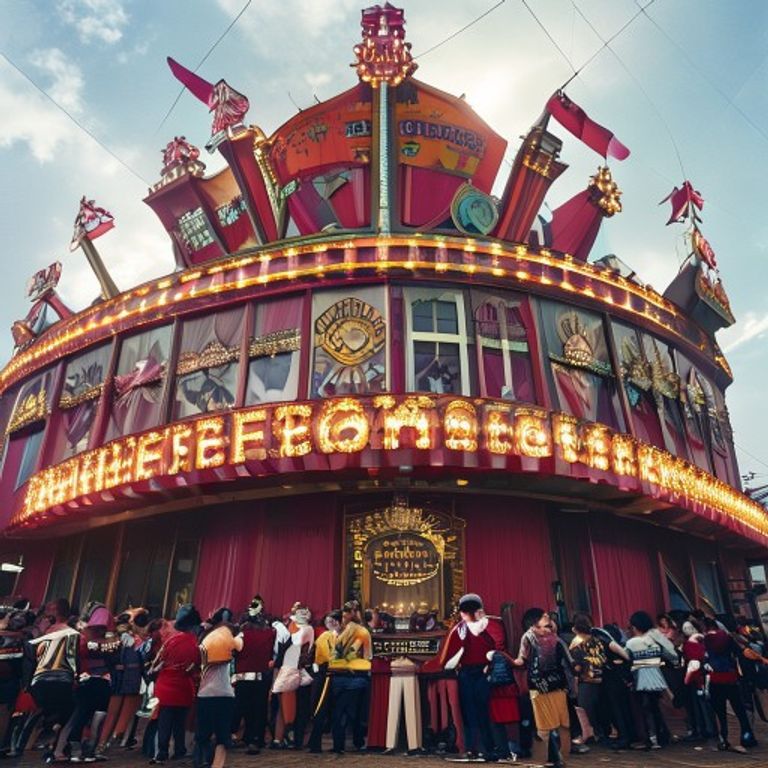
The tragedy that occurred in Niterói in 1961, where a criminal fire claimed the lives of hundreds of people, remains one of the greatest disasters in entertainment venues worldwide.
⚠️ Research conducted with the aid of Deep Research is subject to referential ambiguity.
🖥️ Clean HTML code using proprietary tools.
👥 Research by Guilherme Felipe, Curation by Sílvio Lôbo
The Inferno Born at the Hartford Circus: An Enigma Burned into History
For many, a circus tent evokes images of joy, wonder, and the sweet aroma of popcorn. But for the residents of Hartford, Connecticut, and the hundreds of souls who packed the Ringling Bros. and Barnum & Bailey Circus (known as the Hartford Circus) on July 6, 1944, the same tent became the stage for one of the most tragic and mysterious fires in American history. More than 160 people lost their lives, mostly women and children, in a catastrophe whose causes remain, in part, shrouded in smoke and speculation decades after the flames were extinguished.
This article investigates the Hartford Circus Fire Case, delving into the proven facts, the divergent theories, and the persistent gaps that haunt this dark event.
The Context and the Incident: Where, When, and How the Mystery Began
On that fateful summer afternoon, the Hartford Circus, one of the most popular entertainment spectacles of the time, was preparing for another performance. The circus was set up in a field in Hartford, Connecticut. It is estimated that about 6,000 to 7,000 people, mostly families, had gathered under the big top to watch the acrobats, exotic animals, and clowns that promised hours of fun.
The weather was hot and humid, and concerns about fire safety in large gathering places were, unfortunately, secondary to the urgency of meeting popular demand. The circus used a tent made of cotton canvas, impregnated with a flammable mixture of paraffin and gasoline to make it more resistant to water and fire—a peculiar safety measure that, ironically, contributed significantly to the speed and ferocity of the disaster.
Around 9:10 PM, during the performance, as the famous artist Alfredo Codona was about to perform his levitation act, the fire started. Witnesses report that the flames appeared near the main entrance, in the section of the tent where the emergency exit was located. What followed was an inferno of panic and despair. The canvas, a fuel magnet, was quickly consumed, and the only emergency exit known to many was blocked or inaccessible.
Timeline of Events
A chronological reconstruction of the crucial events offers a clearer view of the tragedy:
- July 6, 1944, approximately 2:00 PM: The Hartford Circus opens its doors in Hartford, Connecticut, for the first performance of the day.
- July 6, 1944, approximately 7:00 PM: The second performance of the day begins, with a considerable crowd present.
- July 6, 1944, approximately 9:10 PM: The fire is first spotted near the main entrance and the emergency exit area.
- July 6, 1944, 9:15 PM - 9:30 PM: The flames spread rapidly through the canvas impregnated with flammable substances. Panic ensues, leading to a chaotic stampede and the formation of crowds at the exits.
- July 6, 1944, 9:30 PM - 10:00 PM: The main tent collapses. Firefighters arrive at the scene, but the intensity of the fire hinders rescue efforts.
- Following nights: Rescue and identification operations for the victims' bodies continue.
- Initial investigations: Preliminary reports are drafted, focusing on accidents.
- December 1944: An official report is released, concluding that the fire was accidental, possibly started by a poorly extinguished cigarette or a spark.
The Main Theories
Over the years, several theories have attempted to explain the origins of the fire, from the most prosaic to the most fantastic:
1. Theory of an Accident Caused by a Cigarette or Spark (Official Hypothesis)
- Logic: The hypothesis most accepted by authorities at the time. It suggests that a spectator or staff member may have discarded a lit cigarette in an inappropriate place, or that a spark from one of the circus's electrical generators came into contact with the flammable canvas. The presence of paraffin and gasoline on the canvas would have accelerated the ignition.
- Supporting Evidence: 1944 official report. Testimonies regarding the presence of smoke before the fire spread completely.
- Controversies: The speed with which the fire spread and its exact origin were never definitively proven, raising doubts about the sufficiency of this explanation.
2. Theory of Arson (Suspicions and Speculations)
- Logic: The magnitude of the tragedy and the unusual circumstances led to the suspicion of a deliberate act. It could have been sabotage for financial reasons, revenge, or even an act of protest against the circus.
- Supporting Evidence: The difficulty in identifying the exact origin of the flames. Reports from people who claimed to have seen something unusual before the fire. The lack of concrete clues that completely ruled out this possibility.
- Controversies: There was never a formally accused or convicted suspect. The lack of solid forensic evidence of deliberate ignition weakens this theory.
3. Theory of Safety Failure and Criminal Negligence
- Logic: Not necessarily an intentional criminal act, but negligence so severe that it borders on criminal. The impregnation of the canvas with flammable materials without adequate safety measures, the lack of well-marked and accessible emergency exits, and overcrowding could be considered serious failures that led directly to the tragedy.
- Supporting Evidence: Subsequent knowledge about the flammability of the canvas and the precarious safety conditions. The high number of victims due to the lack of effective escape routes.
- Controversies: Although negligence is evident, proving criminal intent or direct guilt of specific individuals for each failure proved complex.
4. Alternative and Paranormal Theories (Low-Credibility Speculations)
- Logic: In cases of great mystery and tragedy, more exotic theories tend to emerge. These range from unusual natural phenomena to paranormal interference, such as disgruntled spirits or negative energies concentrated at the site.
- Supporting Evidence: Anecdotal reports, sightings of "strange lights," or inexplicable sensations by some witnesses.
- Controversies: These theories lack any scientific basis or concrete evidence, relying purely on subjective interpretations and speculations.
Controversies and Blind Spots
The official investigation, although it concluded the cause of the fire, left a trail of controversies and blind spots that fuel the mystery:
- The Imprecision of the Origin: Initial reports were vague regarding the exact location where the fire started. Some pointed to the entertainment section, others to the animal areas. This imprecision hinders the validation of any specific theory.
- The Canvas Contradiction: The idea of a "fireproof" canvas treated with paraffin and gasoline is inherently contradictory. The lack of a detailed technical report on the exact composition and the risks associated with this mixture at the time is a significant failure.
- Conflicting Testimonies about Exits: Witnesses reported that some emergency exits were blocked by temporary fences or that people, in a panic, could not find them. The confusion surrounding escape routes is a crucial factor in the high mortality rate.
- Lost or Ignored Evidence: The speed with which the fire consumed the main structure and the destruction of much physical evidence hindered a thorough forensic investigation. There is speculation that some objects or traces that could have been crucial to determining the cause may have been lost or overlooked.
- The Lack of Clear Accountability: Despite the tragedy, few individuals or entities were formally held accountable for criminal negligence. The circus's corporate structure and the lack of strict regulation at the time obscured the chain of responsibility.
Curiosities and Legacy
The Hartford Circus Fire left an indelible mark on American history and culture:
- The High Number of Child Victims: The massive presence of children in the audience, many accompanied by their parents, made the tragedy even more poignant and added immense emotional weight to the event.
- The Use of Impregnated Canvas: The discovery that the canvas was intentionally treated with flammable materials to make it more water-resistant shocked the public and raised questions about the safety priorities of the time.
- The Symbol of Tragedy: The case became a symbol of safety failures in mass entertainment venues and spurred significant reforms in fire safety regulations for public events in the United States.
- Memorial and Recognition: A memorial was erected in Hartford to honor the victims. The case is frequently cited in studies on public safety, disaster history, and human behavior in panic situations.
- Current Status: The case was officially closed by authorities at the time, with the conclusion of an accident. However, the mystery surrounding the exact cause and the circumstances that led to a tragedy of such magnitude remains. There has been no formal reopening of the case, but the memory and persistent questions continue to generate interest and debate.
The Hartford Circus burned in 1944, but the fire it ignited in history—the fire of doubt, investigation, and memory—continues to burn, reminding us of the fragility of life and the eternal search for answers in the face of the inexplicable.





