



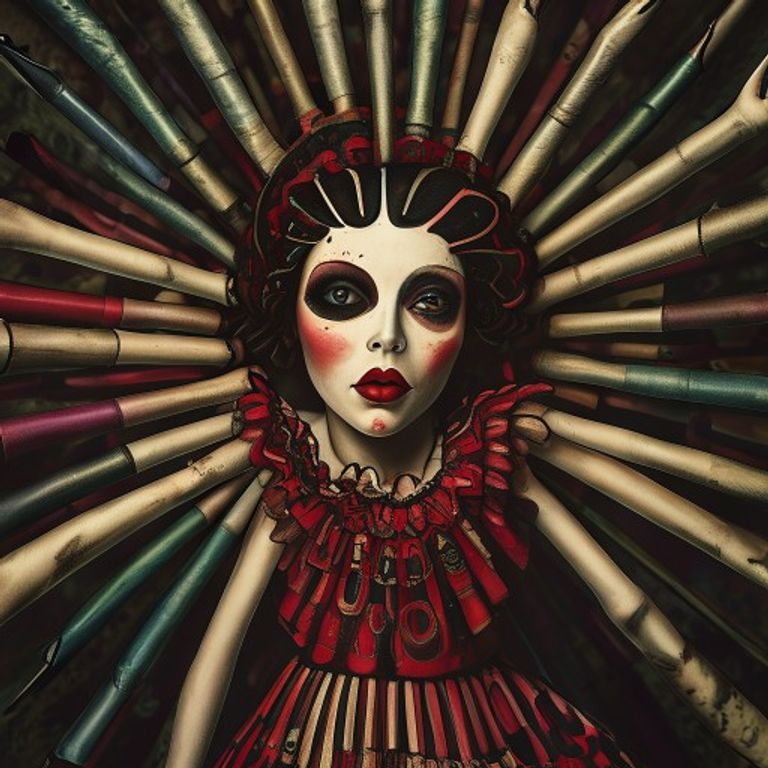
Hundreds of people in Strasbourg began dancing uncontrollably in the streets for days without apparent reason, resulting in dozens of deaths from exhaustion and heart attacks in a mass psychogenic outbreak.
⚠️ Research conducted with the aid of Deep Research is subject to referential ambiguity.
🖥️ Clean HTML code using a proprietary tool.
👥 Research by Guilherme Felipe, Curation by Sílvio Lôbo
The Unfinished Mystery: Unraveling the Dancing Plague of 1518
Amidst the fervor of the Renaissance in Europe, a bizarre and terrifying event took hold of the city of Strasbourg, in the Holy Roman Empire, in the summer of 1518. Without warning, an invisible force seemed to possess the inhabitants, triggering a dancing frenzy that lasted for weeks, claiming lives and leaving a trail of bewilderment that echoes to this day. As investigative journalists, we have dedicated ourselves to re-examining this historical enigma, separating dubious facts from conspiracy theories in search of a truth that the chronicles of the time left obscured.
1. The Context and the Incident: The Germ of Dancing Madness
In July 1518, in the midst of economic and cultural expansion, Strasbourg was a prosperous city, but also plagued by social problems. Hunger, poverty, and disease were constant companions for a large part of the population. It was in this scenario of fragility that the phenomenon manifested. It all began with a woman, identified in the chronicles as "Frau Troffea". On a hot summer day, she emerged from her home and began to dance frantically on a busy street. Her dance, described as desperate and uncontrolled, did not cease, attracting the attention of passersby.
What initially seemed like an isolated case of eccentricity quickly turned into something much more sinister. In the following days, more people began to join Frau Troffea, driven by an uncontrollable impulse. The dance spread like a contagion, involving hundreds of individuals, men, women, and even children. The dance was not festive; it was a spectacle of agony, exhaustion, and, in many cases, death.
2. Timeline of Events: The Dance That Devoured Strasbourg
- Early July 1518: Frau Troffea begins to dance compulsively on a street in Strasbourg.
- First week of July: The number of dancers increases exponentially, with dozens of people joining the frenzy. Local authorities, initially perplexed, attempt to intervene.
- Mid-July: The dance reaches its peak, with estimates of up to 400 people dancing simultaneously. Exhaustion and dehydration begin to take a fatal toll. Reports mention deaths occurring due to exhaustion.
- End of July: Desperate authorities implement drastic measures. They believe the dance is a "cure" and organize stages and musicians to encourage the dancers to "exhaust" their impulses. This strategy, ironically, seems to have intensified the problem.
- August 1518: The number of dancers begins to gradually decrease. The event loses momentum, but the legacy of fear and mystery remains. The exact cause of the end of the epidemic is not clear in the sources.
3. The Main Theories: In Search of Rational and Inexplicable Explanations
The "Dancing Plague Case" became fertile ground for speculation, ranging from the scientific to the paranormal. Let us analyze the most prominent hypotheses:
3.1. Huntington's Chorea/Saint Vitus' Dance Theory (Neurological Hypothesis)
This is one of the most accepted scientific explanations. Huntington's Chorea is a hereditary neurodegenerative disease that causes involuntary, spasmodic movements, often described as "dancing." Saint Vitus' Dance (or acute chorea) is a similar condition, usually linked to infections like rheumatic fever, which can induce uncontrolled movements.
- Logic: In a period of stress, famine, and disease, the prevalence of medical conditions causing involuntary movements could have increased. The contagious nature of the dance would be explained by social contagion and suggestion in a vulnerable population. Observing others dancing could trigger symptoms in predisposed individuals.
- Weaknesses: The speed and scale of the contagion, with hundreds of people affected simultaneously, are difficult to explain solely by isolated neurological diseases. Furthermore, reports describe a purposeful dance, not just random movements.
3.2. Food Poisoning Theory (Ergotism/Mushroom Poisoning)
Ergotism, also known as "Saint Anthony's Fire," is a disease caused by the ingestion of cereal grains contaminated with a parasitic fungus (Claviceps purpurea). This fungus produces alkaloids that can cause a variety of symptoms, including seizures, hallucinations, and, in rare cases, spasmodic movements.
- Logic: Bread was the staple food at the time, and storage conditions were not always ideal, increasing the risk of ergot contamination. The symptoms of ergotism, such as hallucinations and involuntary movements, could be interpreted as "dancing."
- Weaknesses: Although possible, ergot poisoning usually does not induce prolonged, coordinated "dancing" behavior in masses. Symptoms are typically more chaotic and debilitating.
3.3. Psychological Contagion/Mass Hysteria Theory (Collective Dissociative Disorder)
This theory suggests that the epidemic was an outbreak of mass hysteria or a collective dissociative disorder. In times of great social stress, fear, and superstition, the human mind can react in extreme ways.
- Logic: The population of Strasbourg was under significant pressure due to famine, disease, and instability. Superstition was prevalent, and the belief in demonic possession or curses was common. Seeing a person dancing frantically could have triggered a psychological response in others, leading them to imitate the behavior or succumb to a trance state induced by fear and suggestion. The religious and civil authorities of the time, by treating the dance as a divine punishment or a disease to be cured through dancing, may have inadvertently reinforced the behavior.
- Weaknesses: The physical intensity and duration of the dance, which led to the death of many, are difficult to explain by hysteria alone. However, under extreme conditions, the mind can push the body to surprising limits.
3.4. Alternative and Conspiracy Theories
Over the centuries, other theories have emerged, some bordering on the paranormal and baseless speculation.
- Demonic Possession: At the time, the most obvious explanation for inexplicable behavior was demonic intervention. The idea of mass possession would justify the dancing frenzy as a sign of the work of evil.
- Curse or Witchcraft: Similar to possession, the belief in curses cast by witches or enemies could be an invoked explanation.
- Alchemical/Chemical Experiments: A more modern and conspiratorial theory suggests that the events could have been the result of some failed experiment with chemical or alchemical substances by the city itself or a secret group. There is no concrete evidence to support this hypothesis.
4. Controversies and Blind Spots: The Gaps in Investigations
The greatest controversy of the case lies in the lack of a formal and conclusive investigation at the time. Authorities, operating with the knowledge and beliefs of the 16th century, approached the event as a problem to be contained, not as a mystery to be scientifically unraveled.
- Lack of Medical Examinations: There are no records of autopsies or detailed medical examinations of the victims that could identify the exact cause of their deaths or the nature of their "symptoms."
- Inadequate Intervention: The decision to organize stages and musicians to "cure" the dance is seen today as a counterproductive measure, which likely exacerbated the problem by providing more "incentive" and structure to the frenzy.
- Fragmented Records: The surviving reports are largely chronicles by notaries, clergy, and local historians. Although they provide vivid descriptions, their objectivity and the completeness of the information are limited. Some crucial details, such as the precise identification of all victims and the exact circumstances of the end of the epidemic, remain obscure.
- Absence of Key Testimonies: There are no records of detailed testimonies from the affected people themselves, or their close relatives, that could provide insights into the onset of the behavior or their feelings.
5. Curiosities and Legacy: The Dance That Is Not Forgotten
The case of 1518 transcended its time, becoming an icon of historical mystery and human fragility in the face of the inexplicable.
- Cultural Impact: The event has inspired countless works of art, literature, and music over the centuries, serving as a symbol of collective madness and the power of suggestion. It has often been portrayed as a cautionary tale about the consequences of superstition and social repression.
- Current Status of the Case: The "Dancing Plague Case of 1518" has not been "reopened" in a legal or criminal sense, as there are no suspects or a crime to be judged. However, the mystery continues to be the subject of academic study and debate. Researchers continue to analyze historical documents, cross-referencing information and proposing new interpretations in light of modern scientific knowledge.
- Enduring Fascination: The seemingly irrational nature and scale of the event ensure its place in the pantheon of historical mysteries. The absence of a definitive explanation fuels a perennial fascination, inviting us to reflect on the limits of our understanding of the human mind and social behavior under extreme circumstances.
The Dancing Plague of 1518 remains a grim reminder that, even in the most civilized societies, the line between reason and frenzy can be dangerously thin. And while the chronicles record the facts, the true nature of what drove hundreds of people to dance to their deaths remains an enigma wrapped in a veil of uncertainty.





