



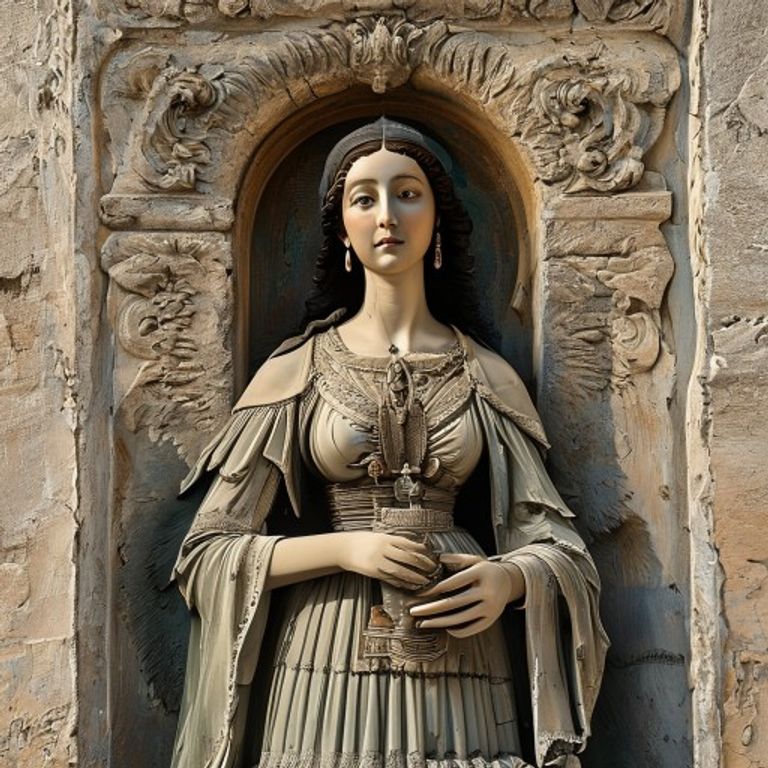
A 17th-century nun who wrote a letter supposedly dictated by the devil in a complex code that was only partially deciphered using algorithms in 2017.
⚠️ Research conducted with the aid of Deep Research is subject to referential ambiguity.
🖥️ Clean HTML code using a proprietary tool.
👥 Research by Guilherme Felipe, Curation by Sílvio Lôbo
The Silent Enigma: The Case of the Nun of Palma di Montechiaro
The air of Sicily, known for its picturesque beauty and turbulent past, holds secrets that defy logic and reason. Among the most intriguing emerges the Case of the Nun of Palma di Montechiaro, a mystery that unfolded in the 17th century and which, to this day, echoes with unanswered questions. This documentary article aims to unveil the veils of this enigma, separating what the records offer us factually from what imagination and speculation have brought to the narrative.
1. The Context and the Incident: An Awakening to the Inexplicable
The mystery began in 1647, at the convent of Santa Maria do Monte, located in the city of Palma di Montechiaro, in the province of Agrigento, Sicily. In an era where faith and religious devotion permeated daily life, the order of Benedictine nuns lived in seclusion, dedicating themselves to prayer and manual labor. Life in the convent followed a monotonous and regulated rhythm, until a singular event broke the serenity of monastic daily life and gave rise to one of the most famous cases of inexplicable communication in history.
The central point of the incident lies in a series of letters and documents that were supposedly written by one of the nuns, Sister Maria Crocifissa della Concezione. The peculiarity lies in the content and the way these messages were written: in an unknown language, full of strange and enigmatic symbols, defying any attempt at decipherment by the authorities and theologians of the time.
2. Timeline of Events: A Trail of Symbols and Suspicions
The chronological reconstruction of the facts, based on the few reports and preserved documents, points to the following milestones:
- 1647: The beginning of the events. Sister Maria Crocifissa, a relatively young nun who had entered the convent at just over 15 years old, begins to exhibit altered behavior. Later reports describe that she had woken up in her cell, distraught, with her face, hands, and clothing stained with ink.
- Subsequent days and weeks: The nun, still confused and according to reports "possessed by an evil force," begins to write a series of texts. These texts, which would become the core of the mystery, were written in a hitherto unknown language, using a particular alphabet and symbols that seemed to originate from a tormented mind or an external source.
- Attempts at Decipherment: The nuns, the local clergy, and scholars of the time tried tirelessly to decipher the meaning of the messages. Theologians were summoned, and Sister Maria Crocifissa herself, when questioned, claimed not to remember how she wrote or what she wrote, describing terrifying visions of a demon that forced her to write the texts.
- The Legacy of the Letters: Despite numerous attempts, no definitive decipherment was achieved. The letters, some of which still exist and are preserved, became objects of fascination and study, fueling speculation about their origin.
3. The Main Theories: From Possession to Science
The Case of the Nun of Palma di Montechiaro gave rise to a diverse range of theories that attempt to make sense of an event that transcends common understanding. Each of these hypotheses seeks to explain the origin of the enigmatic texts:
Religious and Paranormal Theories:
- Demonic Possession: This was, and still is, one of the strongest theories directly linked to the accounts of Sister Maria Crocifissa herself. The belief was that a demon had possessed the nun, forcing her to write the language of hell, a form of language unknown to men, as a way to torment and mock the faith. The ink on her hands and the post-event confusion were seen as signs of this possession.
- Misinterpreted Divine Intervention: A less dark perspective suggests that the messages could have been a form of divine communication, but of such an elevated or complex nature that the human mind, especially under the condition of seclusion and religious fervor, could not understand or interpret it correctly.
- Sleepwalking or Altered States of Consciousness: More modern hypotheses, although applied retrospectively, suggest that Sister Maria Crocifissa could have suffered from episodes of sleepwalking or altered states of consciousness induced by factors such as stress, sleep deprivation, or even substances consumed accidentally in the convent environment. In these states, she could have accessed subliminal content and expressed it automatically and disconnectedly.
Scientific and Psychological Theories:
- Spontaneous Xenoglossy (or Pseudoxenoglossia): This is a complex area of parapsychology that studies an individual's ability to speak or write in a language they have never consciously learned. In the nun's case, pseudoxenoglossia would manifest as the creation of a genuinely new and complex, albeit artificial, linguistic system generated by the unconscious.
- Dissociative Identity Disorder (formerly Multiple Personality Disorder): Although difficult to diagnose retrospectively and without a detailed clinical study from the time, dissociation could explain the apparent lack of control over the acts of writing and the feeling of "being possessed" by an external force.
- Effects of Illnesses or Substances: Neurodegenerative diseases, high fevers, or even the accidental ingestion of psychoactive substances present in herbs or food handled in the convent could have induced states of delirium and hallucination, leading to the creation of incoherent graphics and texts.
Cryptographic and Linguistic Theories:
- Cipher or Secret Code: One possibility is that the texts were, in fact, a code or cipher created by the nun herself or by someone with whom she maintained secret communication. The complexity of the symbols could be an attempt to hide a specific message, perhaps related to internal intrigues in the convent or communications with the outside world.
- Invented Language (or Conlang): The creation of an artificial language, a "conlang," is a known practice. The complexity and the apparent system in the symbols could suggest that Sister Maria Crocifissa, for some unknown reason, dedicated herself to creating a new form of communication, perhaps as an intellectual exercise or a personal refuge.
4. Controversies and Blind Spots: The Void in Investigations
The investigation of the Case of the Nun of Palma di Montechiaro, given the time and circumstances, was marked by significant gaps and controversies that make a definitive conclusion difficult:
- Lack of forensic rigor: There are no records of linguistic or psychological examinations performed with modern standards. The conclusions were based on testimonies and theological interpretations.
- Conflicting testimonies: Although many reports point to Sister Maria Crocifissa as the sole author, the possibility of external influence or manipulation could not be entirely ruled out at the time.
- Loss of evidence: Over the centuries, the integrity and totality of the documents may have been compromised. The way the letters were handled and stored may have led to the loss of crucial information.
- The "supernatural" factor as an excuse: In a deeply religious society, the supernatural explanation (possession) may have served as a shortcut, discouraging deeper and more scientific investigations into the possible natural or psychological causes of the phenomenon.
- The very nature of the writing: Without a clear context about what inspired the nun to write, or even if she was fully aware of what she was doing, any theory becomes speculative. Maria Crocifissa's "erased memory" is a crucial point and an obstacle to uncovering the truth.
5. Curiosities and Legacy: An Enigma That Persists
The Case of the Nun of Palma di Montechiaro transcended the borders of Sicily and time, becoming a landmark in the study of inexplicable phenomena and the fascination with the human mind:
- The Cryptogram: The original letters, composed of about 15 lines of enigmatic writing, were the subject of analysis by modern cryptographers. In 2017, a team of Italian researchers, using text analysis techniques and comparing the symbols to an alphabet of an ancient script used in Malta, arrived at a possible partial translation, which would describe the nature of God, Jesus, and Satan, suggesting a struggle between good and evil. However, this translation is not universally accepted and still generates debate.
- Reopening the Case?: The case was never officially "reopened" in the mold of a modern criminal investigation, but academic interest and public fascination continue. New approaches, with digital analysis tools and knowledge of linguistics and psychology, are occasionally applied to the few existing records.
- Cultural Inspiration: The story has inspired books, documentaries, and debates, solidifying its place as one of the great historical mysteries. The figure of the nun, trapped between the sacred and the profane, the known and the unknown, continues to captivate the imagination.
- Current Status: The Case of the Nun of Palma di Montechiaro remains open. The letters and historical accounts are the only tangible evidence, and the lack of new discoveries or a scientific consensus means the mystery persists, a silent witness to the human capacity to create and lose oneself in enigmas that challenge reality itself.





