



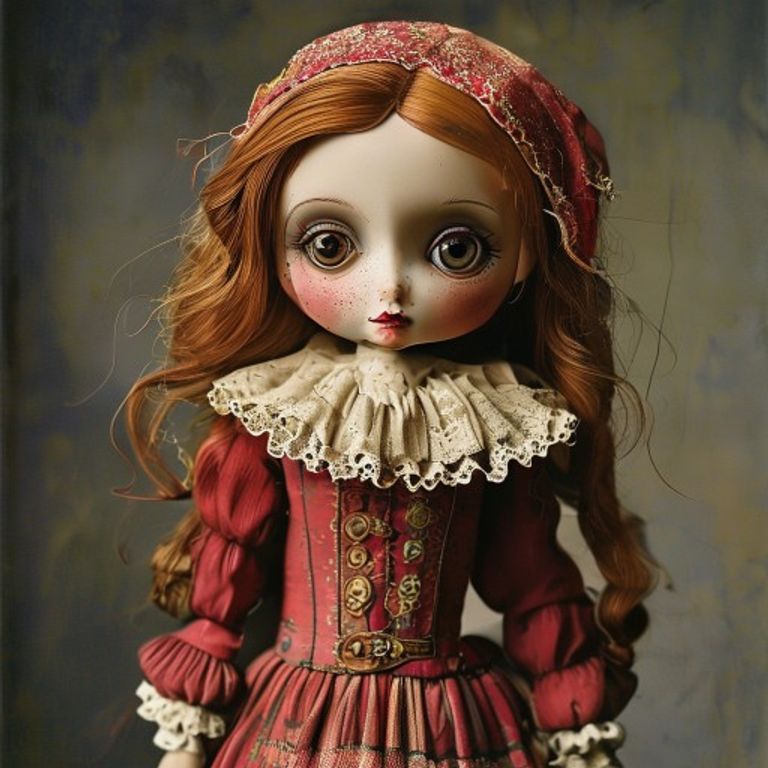
A supposedly cursed doll in Florida that allegedly belonged to an artist and, according to reports, would move on its own and cause misfortune to those who disrespected it.
⚠️ Research conducted with the aid of Deep Research is subject to referential ambiguity.
🖥️ Clean HTML code using a proprietary tool.
👥 Research by Guilherme Felipe, Curation by Sílvio Lôbo
The Enigma of Robert the Doll: A Toy That Haunts Stories and Minds
Even as time passes and new technologies emerge, some mysteries stubbornly remain, challenging logic and the human capacity for explanation. Among them, the case of the doll known as Robert, or Robert the Doll, stands out as one of the most persistent and unsettling of the 20th century. Located in the bucolic city of Key West, Florida, this inanimate object, harmless at first glance, became the epicenter of a plot that blends history, folklore, and a veil of mystery that refuses to dissipate.
1. The Context and the Incident: Where, When, and How the Mystery Began
The story unfolds at the beginning of the 20th century. Official history states that the doll was gifted to a young boy named Robert Eugene Otto, the son of a prominent Key West family, by a former family servant in 1904. This servant, supposedly unhappy with the Ottos, had allegedly imbued the doll with a curse or a spirit. The doll, approximately three feet tall and wearing a sailor suit, was remarkably similar to Robert Eugene Otto, who began to be called "Robert" by the doll. From there, the narrative branches between family accounts and the gradual emergence of strange events.
Initially, the incidents were discreet but curious. It is said that the doll would change positions on its own, that objects in the Otto house were mysteriously moved, and that inexplicable noises echoed through the hallways. The Otto family tried to attribute these events to a child's fertile imagination. However, Robert Eugene Otto's behavior with the doll also caused concern. He would speak to the doll in a dual personality, and his parents reported hearing distinct voices—one being Eugene's and another unknown—coming from the child's room.
2. Timeline of Key Events
- 1904: Robert Eugene Otto receives the supposedly cursed doll from a former family servant. The doll is named "Robert."
- 1900s-1920s: Initial reports of the doll's strange behavior and the peculiar relationship between Eugene and the doll begin to emerge within the Otto family circle.
- 1918: Robert Eugene Otto marries Anne. It is believed the doll remained with the couple at their residence in Key West.
- 1972: Robert Eugene Otto passes away. The doll is donated to the Key West Public Library.
- 1970s onwards: The doll is transferred to the East Martello Museum in Key West, where it remains to this day. From this point on, reports of paranormal phenomena intensify and become public knowledge.
- 1980s - Present: The case of Robert the Doll gains national and international notoriety through books, documentaries, and the popularity of the museum where he resides.
3. Main Theories
The case of Robert the Doll attracts a diverse range of interpretations, from rational explanations to supernatural speculations:
3.1. Scientific and Logical Explanations (Probable Hypotheses)
- Suggestion and Child Psychology: One of the most plausible hypotheses, especially considering the early phase of the case. Robert Eugene Otto's strong bond with the doll, combined with his childhood imagination and possibly a predisposition to dissociative identity disorders, could explain the "voices" and movements attributed to the doll. The family itself might have contributed, consciously or unconsciously, to the perpetuation of the belief in the supernatural due to the story told by the servant.
- Collective Psychological Phenomena: After the doll became a public attraction, the expectation and prior knowledge that it is "haunted" can lead observers to interpret everyday events (drafts, objects moving due to floor vibrations, etc.) as paranormal manifestations. This phenomenon is known as confirmation bias.
- Museum Malfunctions: During the museum exhibition, some of the alleged incidents could be attributed to normal environmental factors, such as drafts, building vibrations, or even interference from staff or visitors, whether intentional or not.
3.2. Alternative, Conspiracy, or Paranormal Theories
- Curse and Spiritual Possession: This is the most popular theory that fuels the mystery. It is believed that the doll was intentionally cursed by the disgruntled servant, imbued with a malevolent spirit, or that it attracts and amplifies negative energies. Reports of bad luck, accidents, and disasters attributed to those who disrespect or provoke the doll reinforce this belief.
- Residual Energy and Psychotronics: Some proponents of more esoteric theories suggest that the doll may have become a receptacle for residual energy, perhaps linked to the intense emotions of its original owners, or that it was used in some type of psychotronic experiment that gave it a "life" of its own.
- The Doll as an Entity: The most extreme theory is that the doll itself developed a consciousness or an independent life form, capable of moving, influencing, and even communicating in subtle or evident ways.
4. Controversies and Blind Spots
Despite the long history and popularity of the case, there is a notable scarcity of concrete and verifiable evidence to corroborate the paranormal claims. Several points remain murky:
- Lack of Detailed Official Reports: Although there have been incidents reported over decades, there are no detailed police reports or extensive formal investigations into paranormal phenomena attributed to the doll. The occurrences are mostly anecdotal and come from reports by visitors, museum staff, or the Otto family.
- Conflicting or Absent Evidence: Many of the reports of the doll "changing positions" are based on photographs that can be easily manipulated or misinterpreted. There are no forensic records detecting physical anomalies in the doll that would justify its alleged mobility.
- The Truth Behind the Servant: The figure of the servant who allegedly cursed the doll is shrouded in mystery. Few concrete details about her identity or motivations are widely disclosed in reliable sources, which leaves room for speculation and folkloric narratives.
- Disappearance of Potential Evidence: As with many historical mysteries, the possibility that initial evidence was lost or deliberately suppressed cannot be ruled out, although there are no concrete indications of this in Robert's case.
5. Curiosities and Legacy
The cultural impact of Robert the Doll is undeniable:
- Tourist Attraction: The doll is undoubtedly one of the biggest attractions at the East Martello Museum. Visitors from all over the world travel to Key West to see him, and many report feeling a peculiar atmosphere in his presence.
- Folklore and Modern Mythology: Robert the Doll has become an icon of contemporary American folklore, inspiring countless books, documentaries, television shows, and even horror films. He represents the human fascination with the inexplicable and the idea that inanimate objects can harbor hidden forces.
- Museum Protocols: Due to his reputation, the museum has specific protocols for visitors. It is believed that taking photos without permission or disrespecting the doll can bring bad luck. Letters of apology and requests for forgiveness are reportedly received regularly.
- Current Status: The case of Robert the Doll has not been officially reopened as a crime, as there is no crime to be investigated in the traditional sense. It remains a historical mystery and a cultural phenomenon. The doll remains on display at the East Martello Museum, fueling the fascination and imagination of generations.
The enigma of Robert the Doll persists as a somber reminder that, even in an increasingly rationalized world, some mysteries are so deeply rooted in the human psyche that they defy attempts at complete resolution, continuing to haunt the collective imagination.





