



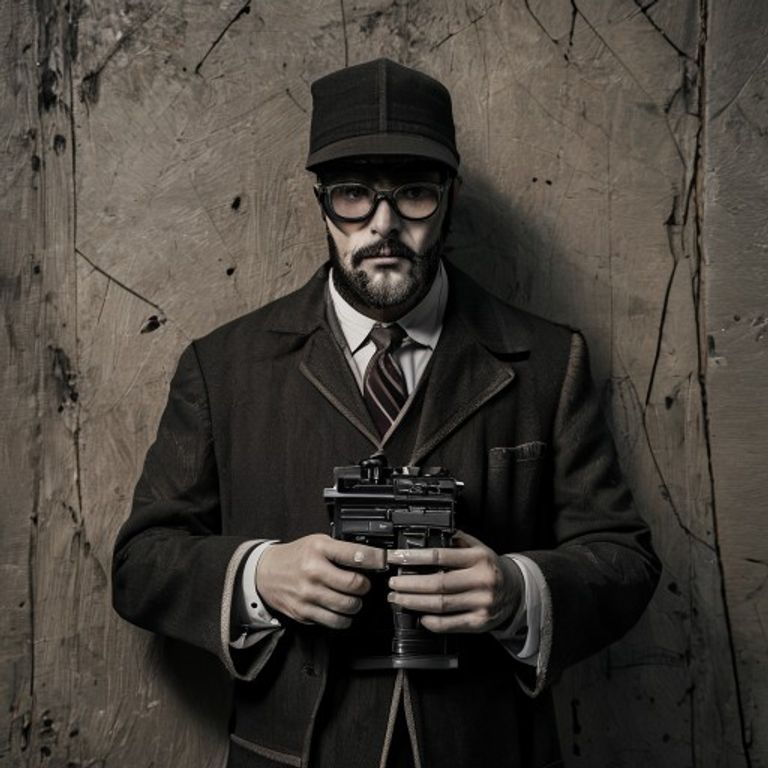
A series of fatal attacks in 1946 committed by a masked killer known as 'The Phantom', who was never identified and inspired classic horror cinema.
⚠️ Research conducted with the aid of Deep Research is subject to referential ambiguity.
🖥️ Clean HTML code using a proprietary tool.
👥 Research by Guilherme Felipe, Curation by Sílvio Lôbo
The Moonlight Enigma: Unraveling the Texarkana Murders Case
In a nation obsessed with unsolved mysteries, few stories evoke a chill as enduring as the "Texarkana Moonlight Murders Case." Between April and May 1946, fear spread through the twin cities of Texarkana, Texas and Arkansas, fueled by a series of brutal murders and a perpetrator who seemed to exist only in the shadows of the night, guided by the pale glow of the moon.
This article investigates the dark details of this historical enigma, separating proven facts from the speculation that has fueled debates and theories for decades. We will dive into the events, the investigations, the hypotheses, and the persistent legacy of a crime that, to this day, remains one of America's great unsolved mysteries.
1. The Context and the Incident: Where Fear Met the Moonlight
The setting for the terror was the city of Texarkana, a locality divided by the river and the state border between Texas and Arkansas. In the spring of 1946, the region, like much of the United States, was returning to normalcy after the end of World War II. However, the peaceful atmosphere was abruptly interrupted by a wave of violence that seemed orchestrated by a relentless predator.
The first attack occurred on the night of April 16, 1946. The couple James Earl Vada and Betty Jo Thomas were attacked in their car parked on a rural road known as "Lovers' Lane." Both were brutally wounded but survived to tell a terrifying story of a masked assailant and a modus operandi that would become his macabre signature.
Subsequent attacks followed a disturbing pattern, leading the police and residents into a panic. The killer, nicknamed by the press as "The Phantom Killer" or "The Moonlight Killer," seemed to choose his victims randomly, but always operated at night, with a particular focus on couples seeking privacy in isolated locations.
2. Timeline of Crucial Events
The chronology of events is fundamental to understanding the escalation of fear and the unfolding of the investigation:
- April 16, 1946: First attack. James Earl Vada and Betty Jo Thomas are brutally attacked on Lovers' Lane. Both survive.
- April 22, 1946: First murder. Richard L. Griffin and Paul M. Real are found dead in their cars, shot and mutilated.
- April 23, 1946: The city enters a panic. Authorities issue an alert and reinforce patrols.
- May 3, 1946: Second murder. W. E. Jones and Alice M. Carrier are found dead in their cars.
- May 7, 1946: Third murder and fourth attack. Virgie L. Allen is found dead. Tommy L. and Mary Ann (surname not officially revealed to preserve privacy) survive an attack similar to the one on April 16.
- May 3, 1946: Fourth murder. Lillian W. Johnson and Charles R. Edwards are found dead.
- May 14, 1946: The pattern ceases abruptly.
The series of crimes, although intense, lasted little more than a month, but the psychological impact on Texarkana was profound and lasting.
3. The Main Theories: Seeking the Face Behind the Mask
The absence of a concrete suspect and the bizarre nature of the crimes gave rise to a myriad of theories, ranging from the plausible to the downright esoteric.
3.1. Police and Scientific Hypotheses
- The Local Killer: The most prevalent theory among investigators at the time was that the killer was a resident of Texarkana or the surrounding area. Familiarity with rural roads and lovers' lanes suggested intimate knowledge of the area. It is believed the assailant may have had some personal connection to the victims, although investigations failed to establish a clear link between all victims.
- An Individual with Mental Disorder: The brutality and apparent randomness of the targets led many to believe the killer suffered from deep psychological issues. The use of a mask and the theatrical nature of the crimes could indicate a desire for control, domination, and a personality disorder.
- A Serial Criminal with Sexual Motivation: The nature of the attacks, focused on couples and with elements of mutilation in some cases, suggested a sexual motivation, although it could not be fully confirmed by the evidence. Police at the time lacked the advanced forensic tools of today to analyze clues like DNA.
3.2. Alternative and Conspiracy Theories
- "Mad Mad Mad" Simpson: A prominent figure in conspiracy theories surrounding the case is Maxwell "Mad Mad Mad" Simpson, a street criminal from Texarkana who was arrested in 1947 for other crimes and sentenced to prison. Some believe he was the "Phantom Killer," citing similarities in his behavior and a possible motive. However, he was never formally charged with the Texarkana murders, and there are doubts about his physical capacity to commit all the attacks.
- The Avenger or Scorned Ex-Lover: A recurring theory is that of an individual seeking revenge against couples meeting in isolated locations, perhaps due to a traumatic personal experience or jealousy. However, the lack of clear connections between the victims makes it difficult to support this hypothesis solidly.
- Organized Crime or a Powerful Executive: Rumors emerged that the murders could be linked to illicit activities in the region or to powerful figures who wanted to silence someone. This theory, without concrete evidence, resides more in the realm of speculation and sensationalism.
3.3. Paranormal Theories
The mysterious nature and reports of the killer's unusual behavior led some to explore explanations that transcend the natural:
- Supernatural Activity: Given the speed and apparent elusiveness of the killer, some theories speculate on the intervention of something non-human, a sinister force that hovered over Texarkana. This perspective is generally relegated to folklore and urban legends.
4. Controversies and Blind Spots: The Cracks in the Investigation
The investigation into the Texarkana Moonlight Murders Case was marked by challenges and, for some, by failures:
- Disappearance of Evidence: Reports suggest that some important evidence may have been lost or poorly documented over the years, hindering future reopenings of the case. The disorganized nature of some evidence, especially in a period without advanced forensic technology, may have been a crucial factor.
- Ignored Clues: There were reports that certain clues or testimonies were not properly investigated or were dismissed prematurely. Public pressure and the desire to solve the case quickly may have led to rushed investigations.
- Conflicting Testimonies: As in many complex cases, there were testimonies that contradicted each other, making it difficult to discern the truth. The description of the killer, for example, varied in some reports, although the presence of a mask was a constant element.
- Failure to Connect the Dots: Despite the evident pattern, police had difficulty establishing a definitive connection between all attacks, which may have led to parallel investigations and a lack of focus on a single main suspect.
- The Search for a "Phantom": The very nickname given to the killer, "Phantom Killer," reflects the authorities' difficulty in apprehending him, suggesting he was elusive and, perhaps, even invisible in a sense.
5. Curiosities and Legacy: The Shadow That Does Not Fade
The Texarkana Moonlight Murders Case left an indelible mark on popular culture and criminal history:
- Cultural Impact: The case inspired countless books, documentaries, films, and episodes of true crime TV shows. The image of the "Phantom Killer" became an archetype of the elusive and terrifying serial killer.
- Fear and Paralysis: During the months of attacks, the city of Texarkana lived under a climate of constant fear. Many residents locked their doors, avoided going out at night, and traveled in groups. Schools even closed and a curfew was imposed.
- The "Manhunt" and the Police: Local and state police, with the support of the FBI at one point, conducted an intense but fruitless search for the killer. The inability to capture him generated criticism and a feeling of helplessness.
- Current Status: The Texarkana Moonlight Murders case remains officially unsolved. Although there have been speculations and suspects over the years, no arrest or conviction was made specifically for these crimes. Files have been partially declassified, but the veil of mystery persists. Local police still keep the case open, awaiting new clues that may finally bring light to this persistent darkness.
The Texarkana enigma continues to haunt us, a dark reminder that, at times, evil hides in plain sight, just waiting for the moonlight to reveal its terrifying face.





