



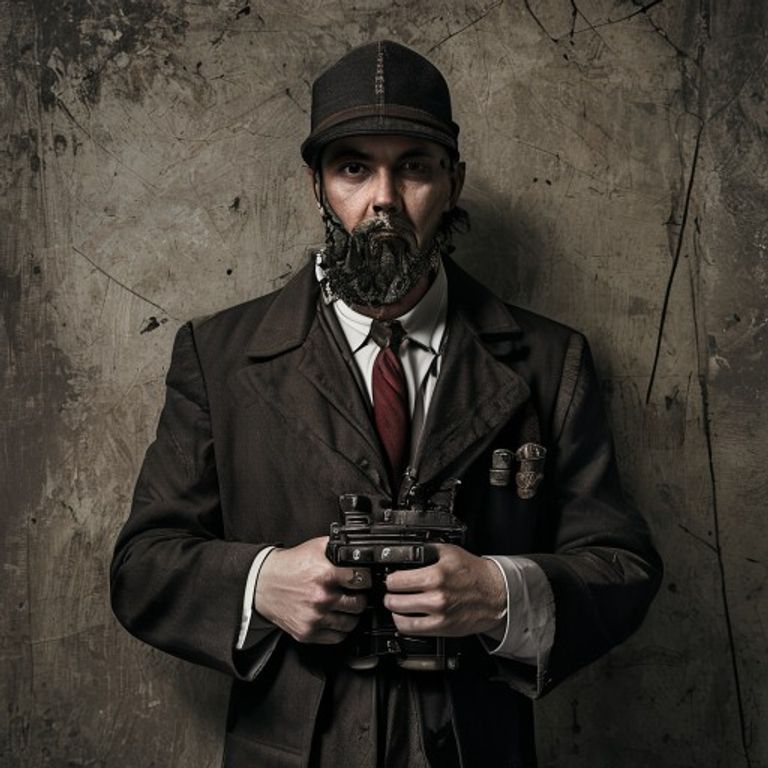
A series of attacks occurring in 1946 by a masked killer known as 'The Phantom', which inspired films and was never captured by Texas police.
⚠️ Research prepared with the aid of Deep Research is subject to referential ambiguity.
🖥️ Clean HTML code using a proprietary tool.
👥 Research by Guilherme Felipe, Curation by Sílvio Lôbo
The Texarkana Phantom: A Shadow Haunting the Night and Justice
On the border between Texas and Arkansas, a city called Texarkana became the stage for one of America's most disturbing and enduring mysteries: the "Texarkana Moonlight Murders," also known as the "Phantom Killer" crimes. Between February and May 1946, a series of brutal attacks terrorized residents, leaving behind a trail of deaths, serious injuries, and a police enigma that, to this day, defies logic and investigation.
1. The Context and the Incident: Where, When, and How the Mystery Began
Texarkana, a city divided by the state line, was a relatively quiet place at the time, experiencing a post-war boom. However, the tranquility was shattered with the arrival of terror. The attacks began on February 22, 1946, with a young couple, James V. Martin and Rosemary Kinzie, being attacked in their car on an isolated road on the outskirts of the city. Martin survived, but Kinzie was seriously injured.
What made the case notorious was the brutality and apparent randomness of the crimes. The killer, who dubbed himself "the phantom killer," seemed to choose his victims without a clear pattern, attacking mostly couples in isolated locations, usually parked in cars. The modus operandi was consistently violent, involving firearm discharges and, in some cases, physical assaults.
2. Timeline of Events
The chronology of events is fundamental to understanding the escalation of fear and the difficulty of the investigation:
- February 22, 1946: First attack on an isolated road. James V. Martin and Rosemary Kinzie are attacked. Kinzie survives, but Martin is wounded.
- February 24, 1946: Murder of Marjorie A. Fuller and Willard J. Jackson. Both are found dead in a car.
- March 1, 1946: Murder of Betty Sue Perdue and Phyllis Ann "Peggy" Davis. The two young friends are found dead in a car.
- March 14, 1946: Murder of Eppie Lou Smith and Richard Smith. The couple is found dead in their car.
- April 17, 1946: Murder of Mary Ellen "Shorty" Johnson and Charles "Buddy" Edwards. Found dead in their car.
- May 3, 1946: Murder of Paul "Red" Martin and Mildred Jeanette "Milly" "Pebbles" Carter. The bodies are found in their car. This is the last murder officially attributed to the Phantom Killer.
- May 3, 1946: An attack occurs later the same day, where W.A. Wilson and his wife are attacked but survive.
After the last attack, the murders ceased abruptly, leaving the police with an unsolved mystery and a city plagued by fear.
3. Main Theories
Over the decades, several theories have emerged to try to explain the identity and motivation of the Phantom Killer. They range from plausible police explanations to more fantastic speculations:
3.1. Police and Scientific Hypotheses
- A Single Killer: The most prevalent theory among investigators is that a single individual was responsible for all the attacks. The consistency in the modus operandi (attacks on couples in cars, use of a firearm) supports this hypothesis. The police investigation focused intensely on the search for a suspect with access to a firearm and knowledge of the isolated areas.
- Sexual Motivation or Psychopathy: The violent nature of the attacks and the focus on couples suggest a possible twisted sexual motivation or traits of psychopathy. The absence of robbery or other obvious motives reinforces this line of investigation, which would seek individuals with deep psychological problems.
- Influence of Other Cases: Some investigators considered the possibility that the killer was influenced by other notorious crimes of the time, seeking to replicate or surpass the notoriety of other criminals.
3.2. Alternative Theories and Speculations
- A Double Murderer: A less common but still discussed theory is that the murders were committed by two people working together. The idea is that the division of tasks could explain the efficiency and audacity of the crimes.
- "False" Phantom Killer Theory: A speculative hypothesis suggests that, after the first attacks, other criminals may have tried to imitate the Phantom Killer's style to gain notoriety or divert attention from other crimes. However, the consistency of the violence and the modus operandi makes this explanation difficult.
- Conspiracy Theories: As in many unsolved cases, conspiracy theories have emerged, involving local authorities who might have covered up the killer's identity for political reasons or to avoid panic. However, the lack of concrete evidence makes these theories difficult to sustain.
- Paranormal/Supernatural Theories: The elusive nature of the killer and the sudden cessation of the crimes fueled speculation about the possibility of something non-human being involved. Although these theories lack scientific basis, the atmosphere of fear and mystery provided fertile ground for them.
4. Controversies and Blind Spots
The investigation of the Texarkana Case was marked by failures, contradictions, and clues that seem to have been ignored:
- Lack of Robust Forensic Evidence: At the time, forensic techniques were less advanced. The collection and analysis of evidence may have been insufficient to link a suspect to the crimes conclusively.
- Ignored Suspect Lead: A man named Foy Richard "Buddy", a former soldier with a history of violence and mental disorders, was briefly considered a suspect. He possessed a weapon compatible with the calibers used in the crimes and was arrested under suspicious circumstances. However, he was released, and the investigation did not pursue him with due diligence, according to some critics.
- Conflicting Testimonies: There were reports from witnesses who described an individual fleeing with different characteristics, which may have confused the investigation and led to false leads.
- Disappearance of Evidence: Reports about the loss or poor storage of crucial evidence, such as the murder weapon (if it had been found) or traces found at the scenes, add a layer of uncertainty to the investigation.
- Public Pressure and the Search for a Scapegoat: The pressure to solve the crimes quickly may have led to a rushed investigation, with excessive focus on suspects who did not fit the profile perfectly, while the true culprit remained at large.
5. Curiosities and Legacy
The Texarkana Moonlight Murders Case left an indelible mark on popular culture and the city's memory:
- The Fear of the "Phantom Killer": The figure of the phantom killer became an archetype of the elusive and invincible criminal. The fear was so palpable that residents locked themselves in their homes after dark, and a curfew was imposed.
- The Murder Weapon: The weapon used by the killer was consistently described as a .38 pistol. The search for the weapon became a constant focus of the investigation.
- The Legacy of an Unsolved Mystery: The case continues to fascinate and frustrate investigators, historians, and enthusiasts of unsolved mysteries. The lack of a definitive outcome allows new theories and reinterpretations to emerge constantly.
- Current Status: Officially, the case remains unsolved. Although there have been efforts to reopen the investigation and revisit the clues with new technologies, no significant discovery has been announced publicly. The "Phantom Killer" continues to be a shadow in the history of Texarkana, a grim reminder that some mysteries may remain buried forever.
The story of the Texarkana Phantom Killer is a dark tale of fear, failure of justice, and the persistence of the inexplicable. A story that continues to echo in the silent nights of the city, fueling the imagination and the search for answers that may never come.





