



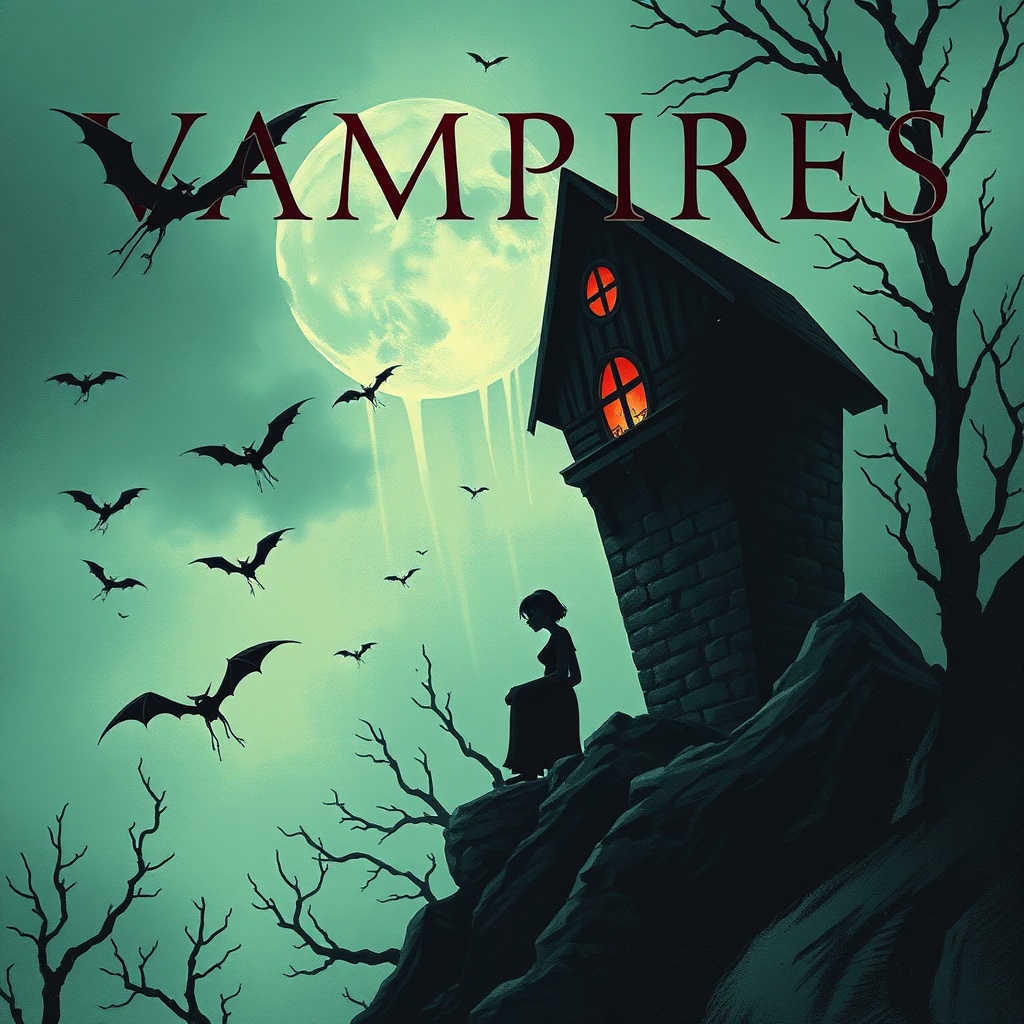
(Translated from German) From Serbian вампир/vampire, it is folklore and mythology, a night-dwelling bloodsucker, and usually the reanimated human corpse, human or animal blood and supernatural forces' lives has. Depending on the culture and the mythic forces are the vampires and various magical properties attributed. Sometimes also non-humans are considered as creatures about demons or animals (e.g., bats, dogs, spiders).
Named after the legendary figure, the blood-feeding bat (Desmodontinae), the only mammal group that exclusively feeds on the blood of other animals.
Reality and Myth
Origin
The models for the most widespread idea of vampires today originating from Southeastern Europe and Slavic folklore and Romanian mythology. The vampire has evolved from the Carpathian region through Romania (Transylvania), Hungary, into Eastern Austria, Bulgaria, Albania, Serbia, and Greece. These vampires are scientifically supported and, above all, understood as a social, anthropological phenomenon, primarily as a cause of suffering for individuals or the community due to illness, crop failure, or general misfortune. The "blood-sucking" of the vampire is not, in popular belief, the primary concern; rather, the most important aspect is the removal from one's own grave. The cause had to be traced and identified by the village communities. Found in a suspected grave (Peter Kreuter calls a cross or a rat hole a reference) was a decaying corpse, which was not handled in various ways: it was killed again and then burned, which is still depicted in most films, etc., at the end of a vampire's fate.
In Orthodox Christian belief in Southeastern Europe, priests have a relatively large distance from the dying process, and the lack of a sacrament can be seen here as a blurring of the boundary between the living and the dead, favoring such beliefs.
The idea of vampires is not only spread in Southeastern Europe. Almost all over the world, there are myths about vampires or beings that share the most important characteristics with them, for example:
- ASANBOSAM (Ghana, Togo, Côte d'Ivoire)
- ASWANG (Philippines)
- Baobhan Sith (Scotland)
- Ghouls (Greece, since ancient times)
- Wrukolakas (also Greece)
- Chiang-Shih (China)
- Dhampir (or vampire) (Albania)
- Vampire (Vampire), Vukodlak (werewolf), Serbia, Croatia, Dalmatia)
The most famous alleged first vampire was from Croatia, from the small village of Kringa (Istria), who died in 1652 and lived there in his later years. He was a farmer and was named Jure Grando. In 1672, his grave was opened, and he is said to have terrorized the village many times. In Vajkard Valvasor's literary work, this vampire is mentioned for the first time in Europe. Johann Joseph Görres, in his multi-volume work "Christian Mysticism," printed in Regensburg from 1836-1842, led to the background.
The founding fathers of the modern vampire myth include John Polidori, J. Sheridan Le Fanu (1814-1873), and Bram Stoker. While the former awoke general interest in the vampire figure, Bram Stoker shaped its concrete image.
The international media's popular vampire types and their names were largely determined by the British occultist Montague Summers (1880-1948). Summers was convinced of the existence of vampires and werewolves and declared every conceivable spooky being as proof of his theory, even if the folklore of the country had some remote similarity to blood-sucking, even if the essence of the definition differed. Summers himself disagreed with the definition of an undead.
Similarly, the vampire myth stems from vampirism back to superstition and the idea that consuming blood is essential for life. Notorious in this context is the blood-drinking "Countess" Erzsébet Báthory (Elizabeth Bathory), from a Hungarian aristocratic family. After her husband's death, she allegedly bathed in the blood of over six hundred virgins from her castle to maintain her youth. This accusation was never proven or substantiated. Similarly, the hustle and bustle around Countess Bathory in Eastern Europe contributed to the emergence of the vampire myth.
The most famous vampire from Romanian popular mythology is connected to Dracula (Vlad III. Dracula), also known as Vlad Tepes (in German: "the Impaler"). This appears to be a mistranslation or misinterpretation, as a 19th-century Scottish writer supposedly compiled world lore and provided all sorts of fantastic characteristics to 20th-century non-fiction writers, until he was established in vampire encyclopedias.
To this day, vampires or vampire-like forms are said to exist among various ethnic groups in Asia, Africa, and South America, as well as in Eastern Europe. The Internet, in particular, has emerged as a popular medium for dissemination.
The last exciting international vampire event in Europe dates back to 2005: In the Romanian village of Marotinu de Sus, the body of a resident who had died two years earlier was exhumed. This was suspected of being a local form of vampire, the Strigoi – believed to cause evil. The family members cut out the heart, burned it, dissolved the ashes in water, and drank the solution.[1]
Upir
As an alternative to the term "vampire," the name "Upir" (Ukrainian упир) became common in the early modern period, originating from Polish and Ukrainian. The suffix "pir" means "wing" or "hanging being," a sign of the supposed flight of the vampire. The term "Upir" is also likely related to the fact that its origin is assumed to be in Southeastern Europe rather than in Poland.
The first mention of the name Upir found is from the year 1047 AD, referring to Prince Upir lichyi near Novgorod in northwestern Great Russia. In Western Russia, there are also places called Upiry and Upirow, whose inhabitants boast of being descendants of vampires.
Strigoi
Another variation of the vampire belief found in ancient Romanian folklore is the "Strigoi." Romanian is a Romance language, so the word originates from Latin, where "strix" means "witch." Unlike "Upir" and the Greek "Wrukolakas," "Strigoi" are only human and not demonic spirits returned from the dead. "Strigoi" are also divided into two categories: "Strigoi morti" (dead Strigoi) and "Strigoi vii" (living Strigoi). The former are the living dead; the latter are people cursed in their lifetime who, after death, simply "must" become Strigoi.
Descent from a "Strigoi Mort" or, more rarely, the heavy sins of the mother can lead to this. Anatomical anomalies, such as tail-like spinal processes or parts grown from the amniotic sac, which in Romanian is called "vernaculum" (from Latin: "net," German: amniotic sac, see caul), are interpreted as signs of such a curse. Originally, Strigoi had nothing to do with vampirism. Thirst for blood and other attributes were later attached by horror films, books, etc. It is believed that Strigoi visit the relatives of the deceased and want to take them with them. To create a boundary between the realm of the dead and the living, fuse threads are attached to the coffin at funerals and burned. Often, mirrors, soap, razors, etc., are placed in the grave as grave goods so that the deceased has no reason to return to the realm of the living and act as Strigoi. This belief is widespread in Romania and Eastern European countries. Some iron is placed in the dead, or a burning heart is attached. This is to prevent the dead from becoming Strigoi. In rare cases, Strigoi search for their relatives to make them ill or kill them.
Vampires in the German Language
Especially in the 18th century, many vampire cases were reported, primarily in villages in Southern Eastern Europe. After the end of the last Turkish war in 1718, parts of the country, such as northern Serbia and parts of Bosnia, fell to Austria. These lands were settled by Orthodox Christian refugees who were granted the special status of armed farmers. They were responsible for agricultural development and border security, which is why vampire reports first appeared in the German language.
Between 1718 and 1732, real vampire epidemics were reported in villages in Eastern European countries. One of the first and most famous reports from 1724-1725 refers to the village of Kisolova in central eastern Serbia. The Kameralprovisor Frombald was tasked with investigating what was believed to be a vampire responsible for cases. His report[2] was published in the Austrian state newspaper on July 21, 1725. Frombald described his experiences in Kisolova. In this village, an increase in the mortality of residents became apparent; within eight days, nine people died, some of them suffering from illness. Peter Plogojowitz (also Plagojevic, actually Blagojevic) was blamed, who had died ten weeks earlier. On his deathbed, he allegedly told the patients that they had been strangled by Plogojowitz in their sleep, which was interpreted as the act of a vampire. Plogojowitz's grave was opened, and the corpse was found in a state characteristic of a vampire: it was still quite incorruptible, had a fresh complexion, and a foul smell of rot emanated from it. Furthermore, his skin, hair, and nails had grown, after which the old skin and nails had peeled off. Fresh blood was found in the orifices, believed to be the blood of his victims. The villagers therefore decided to exhume the corpse and burn it.
The report aroused great interest, and the vampires of Eastern Europe quickly entered the German language but were soon forgotten. Mostly, doctors or priests were sent to the affected villages to investigate the vampire cases. These individuals allegedly exhumed the vampires and wrote – often extensive – reports on the plague. They also ensured that all suspicious bodies were decapitated and burned.
Since 1732, vampire reports were viewed from many different perspectives, especially by medical and scientific investigations. Numerous dissertations were written on the subject. In 1732, reports on the vampire myth also reached the French and Dutch public through the publication of reports from military villages in various newspapers. Doctors and theologians from the corresponding regions often attributed the deaths to a previously unknown disease. If victims buried too shallowly died from this disease, it was believed they could transfer it, which explained the increase in deaths in the villages.
According to Michael Ranft, who responded to the 1725 report from Kisolova as the first, all "typical" vampire indicators can be explained by natural causes. He wrote several treatises, such as "Dissertatio historico-critica de mortuorum in tumulis masticatione," or the chewing and cracking of the dead in graves. He argued that all rational signs of vampires, such as chewing and snapping with decomposition processes and sounds of animal predation, the incorruptibility depending on environmental influences and the deceased's constitution, as well as the fresh blood from body openings stained red and secretion, were due to fear, superstition, and exaggerated imagination.
Augustin Calmet, a French Benedictine scholar, explained in his work published in 1745, "Dissertations sur les apparitions des Anges, des démons et des esprits, et sur les revenans et vampires dans la Hongrie, la Moravie, &c.," that reports of vampires, especially from Serbian and Slavic languages, had existed since 1680. He also attributed natural causes to the vampire signs.
In 1755, Gerard van Swieten was sent from Moravia to investigate the vampire situation in the country. Van Swieten was the personal physician to Maria Theresa, Archduchess of Austria and Queen of Hungary and Bohemia. He carefully examined the alleged vampire cases and wrote a sober report in which, like Ranft[4], he attributed natural causes as an explanation for the vampire.
Thus, Gerard van Swieten was likely one of the most important figures in combating the so-called superstition of the "common" people. Because of his report, Maria Theresa issued a decree on the subject of vampires, prohibiting traditional measures such as stakes, decapitation, and burning. She also ordered that references to so-called reanimated dead should no longer be reported to the church, which still obeyed superstition, but to the authorities. In 1756, they also sent the German surgeon Georg Tallar to the affected areas in Eastern Europe to investigate the situation again and compose a new report. Eastern Europe was precisely considered backward and in need of civilization at that time. It was therefore viewed in the 18th century as the antithesis of Western and Central Europe, which described itself as enlightened. The Enlightenment considered it scandalous how such "superstition could arise."
Jean-Jacques Rousseau aptly described the myth of the vampire in the 18th century:
"S'il y a jamais eu une histoire au monde et une seule garantie prouvée, c'est celle des vampires. Rien ne manque: rapports officiels, témoignages de personnes de qualité, de chirurgiens, de prêtres, de juges: l'évidence est complète."
(Translated approximately: "If ever in the world there was a proven and tested story, it is that of vampires. Nothing is missing: official reports, testimonies from people of quality, surgeons, priests, judges: the evidence is complete." )
The church, which allegedly still fueled the superstition – as per Maria Theresa's opinion – was at least partially rectified and largely opposed the "measures" against vampires. Pope Benedict XIV himself responded to a question from a Polish archbishop, stating that he could rely on van Swieten's report regarding the "vampire" act. The Pope, considered a progressive and a patron of the Enlightenment, clearly indicated in his letter that he considered the vampire claims absurd and instructed the archbishop to "eradicate this superstition." He also threatened priests who promoted superstition with being stripped of their office.
In Germany, the term "vampire" has been in use since around 1720, i.e., since the first reports about the so-called "Serbian vampires" (Kisolova, Medveca). Earlier evidence, such as a supposed execution in Münster in 1643, a French nobleman called the villain of Boaz, and pseudopoetic forgeries, are considered unproven.
Goethe's ballad "The Bride of Corinth" (1797) incorporated the vampire myth – at least in echoes – into literature. His undead bride does not suck blood but leads her lover to her grave.
In German-speaking countries, the pure form of the vampire is not encountered, although there are various references such as parallel beliefs and actions that could be taken against an undead. After the majority of the country's appearance, the undead remained in the grave and, as so-called Nachzehrer (after-eaters), sucked the life force from it. As early as the 14th to 17th centuries in Europe, there was a belief in so-called "Nachsterben" to kill ghosts and thus Nachzehrer. They were said to sit upright in the grave and chew their own limbs or shroud, drawing life energy from their relatives and bringing it to the grave. Death took so long that the shroud was consumed, during which time a thumping sound was heard from the grave.
Furthermore, the "butcher bird" (Pomerania, Eastern Prussia) and the double "sucker" (Wendland) are figures that come very close to the classic vampire figure, and their combat is similar in detail to that of vampires from Southeastern Europe.
As some vampire manuals report, there is an idea in South America that vampires can turn into bats. The specific source of evidence for this transformation is the widespread idea that it will never truly be provided. If these reports on transformation from imagination meet reality, this would likely be due to the fact that in South America there is a group of bats (hematophagous bats) that feed exclusively on blood, but primarily animal blood. Reports of attacks by blood-feeding bats on humans are partly speculative or sensationalistic fantasy products, but are indeed isolated.
This shows the historical connection of the vampire subject with the belief in werewolves (also called lycanthropes).
Attributed Characteristics
The different traditions of the vampire myth describe various characteristics and properties that make up the modern idea of the vampire. Such characteristics have been passed down from different sources, which vary in detail. It is estimated that only a fraction of the myths from that time have survived, but that allows for a unified description of a vampire to some extent.
According to this, vampires are undead creatures in human form who live in their graves and sleep in their coffins during the day. They are characterized by their pale appearance and feed exclusively on blood. Probably for this reason, vampires have an abnormal bite, characterized by their sharp canine teeth, as the jaw is used to characterize all of this beforehand. In many ancient depictions, two, rarely four, canines are mentioned. These vampires inflict a bite wound on their victims, who are essentially humans, usually in the neck area near the artery. Then they drink their victims' blood to quench their thirst. Other representations depict vampires as having human form, but capable of transforming into bats or giant bat-like creatures. They can also climb walls.
A key feature of the vampire is its immortality, combined with superhuman strength (generally) and a thirst for blood – a large part of the terror of the vampire myth. Furthermore, vampires are said to have a pronounced sexual drive. Vampires are said to have a powerful attraction to their chosen sex and be masters of seduction.
Those bitten by vampires become vampires themselves. In some legends, however, vampire bites are also a prerequisite for various types of transformation. In some states, the vampire can decide whether its victim becomes a vampire or a type of zombie-like being. It is known that the ghoul has nothing to do with the vampire myth in a traditional sense, as it originated in Persian and Arab mythology circles as a flesh-eating demon. However, other stories say that a victim of a vampire could only become a vampire if they had, at some point, jumped over an impure animal, such as a cat, or an open grave. Another variation states that the victim of a vampire would only become a vampire if they drank the vampire's blood.
In some legends, vampires can transform into bats or (rarely) into wolves, which has since proven that the transformation of the bat from Romanian popular mythology does not occur. Vampires are mainly seen as nocturnal beings that dissolve into dust or burn when exposed to sunlight. This seems to be primarily an invention of director Friedrich Wilhelm Murnau for his film Nosferatu. In Abraham Stoker's depiction, this vulnerability is absent; rather, it is only a weakening of the vampire during the day. This often also means that they do not possess mirrors. Furthermore, it is reported that vampires could not cross running water or were generally afraid of water.
Vampires can only enter an occupied building if an inhabitant has invited them. Additionally, vampires are often attributed the ability to recover quickly from injuries.
Further details about vampires are uncommon; filling the mouth of a deceased with silver coins is said to prevent an undead from transforming. Relevant to the different myths are examples from the written work "Rational and Christian Thoughts on the Vampire" (1733) by Johann Christoph Harenberg, and a much-cited report[7] by military doctor Johann Flückinger from this period.
Defense
Legends provide passive protection against vampires, some of which were widely applied in the 18th century. Garlic and representations of a crucifix serve as deterrents. However, after an experimental study with blood, the effectiveness attributed to garlic was questioned.[8] Holy water also harms vampires. The latter, in particular, emphasizes the idea of a vampire's "demonic nature." Forms of destroying a vampire included decapitation and, above all, impalement (driving a wooden stake through the heart). In some depictions, however, impalement only leads to a kind of rigor mortis, from which the vampire will eventually recover. Approaching the combination of these two practices (decapitation and impalement) is also said to prevent the vampire from returning as an undead. In this method, the vampire is impaled, and the creature's head is severed with a gravedigger's shovel. Then the mouth of the deceased is filled with garlic.
In other regions, people place objects in the coffins of the dead to prevent these deceased from rising from their graves again. This is done by placing objects related to their earthly life, such as fishing nets or poppy seeds, in the graves. The deceased were supposed to open a knot or eat a poppy seed each year and remain occupied. Thus, they would be kept busy.
Vampires in Media
The first vampire was famously romanticized in literature[9]. Bram Stoker's first vampire novel, Dracula (1897), as well as earlier stories like Carmilla by Joseph Sheridan LeFanu (1872) and John Polidori's The Vampyre (1819), laid the foundation and portrayed the dangerous monsters as beings of desire and soul. Stoker's vampire name, Dracula, became the epitome of the primeval vampire. Although historically the namesake model for Stoker's Dracula was the Romanian prince Vlad III. Dracula, also known as Vlad Tepes (Vlad the Impaler), Romanian tradition states that the prince was never described as a vampire or undead, but it is said that he occasionally drank from the collected shells in the blood of vanquished enemies. In modern literature, the theme is explored in Anne Rice's The Vampire Chronicles and Stephenie Meyer's Twilight saga, or in Angela Sommer-Petersburg's children's book series The Little Vampire.
Film and Television
→ Main article: List of vampire films and Dracula adaptations
In 1912, the first vampire feature film, Vampyrdanserinden, by August Blom, appeared in Denmark. Since Friedrich Murnau's film Nosferatu, numerous other literary and cinematic works on the theme of vampires have emerged, including Dracula (Tod Browning, 1931), Vampyr – der Traum der
Mel Brooks parodied Dracula in his film Dracula – Dead and Loving It. 30 Days of Night is a twisted 2007 horror film with some different vampires. The Princess Vampire is a 2007 American documentary. Let Me In is a 2008 Swedish film based on the novel of the same name by John Ajvide Lindqvist.
Vampires in Video Games
Vampires are part of many games of various genres. In card games, based on famous vampire films, vampires appear as army units (e.g., in the Heroes of Might and Magic series), controllable characters (Legacy of Kain, Vampire: The Masquerade), or antagonists (Castlevania).
Vampires in Other Media
The theme of vampires is the subject of various theatrical productions, such as the RPGs Buffy and Vampire. The latter describes Cain's father as the first vampire, on whom God imposed vampirism as the mark of Cain.
Half-Vampires
Modern horror and fantasy literature features the fictional figure of the half-vampire or dhampir, alongside the classic vampire. This character is primarily used in literature and film for the struggle between "good and evil." As a hybrid between human and vampire, the half-vampire usually sides with humanity and takes on the role of a vampire hunter. (See also Dhampir)
Real Vampires
→ See main article: Vampire (Lifestyle)
The term Real Vampires or Modern Vampires refers to people of all age groups who (presumably) adopt a lifestyle that pays homage to vampires – primarily in terms of clothing, appearance, false fangs, etc. – but also includes extremes such as blood consumption. This scene is not to be confused with Satanism, although there are overlaps. Often, adherents of this scene identify with goths, as the "Vampire Cult," as the scene is sometimes called, is also found in the gothic scene. However, the Real Vampire cult is a separate culture that has existed for decades.
Literature
Paul Barber: Vampires, Burial, and Death: Folklore and Reality. Yale University Press, New Haven CT 1988
Norbert Borrmann: Vampirism or the Desire for Immortality. 1999, ISBN 3-424-01351-X
Basil Copper: The Vampire in Legend, Art, and Reality. Leipzig, 2007, ISBN 978-3-86552-071-5.
Harald Gebhardt, Mario Ludwig: From Dragons, Vampires, and Yetis – Fabled Creatures on the Trail. VLB-Verlag, Munich 2005. ISBN 3-405-16679-9.
Stefan Grothe: The Influence of Epidemics on the Development of the Vampire Myth in the Mirror of the Leipzig Vampire Debate 1725-1734. Cologne, 2001.
Dieter Harmening: The Genesis of Dracula. On the History of the Stories. Würzburg, 1983
Markus Heitz: Vampires! Vampires! – Everything About Vampires. Piper Verlag, Munich, 2008, ISBN 978-3-492-29181-1.
Gerd H. Hövelmann: Vampire Scientific Literature. A Bibliographical Survey. In: Zeitschrift für Anomalistik 7, 2007, pp. 205-235
Lee Byron Jennings: An Old German Vampire Tale: Waiblinger's "Wilhelm Olura" (first published 1986). In: Stuttgarter Arbeiten zur Germanistik, No. 423, Hans-Heinz Dieter Verlag, Akademischer Verlag, Stuttgart 2004 [2005], pp. 295-306, ISBN 3-88099-428-5.
Stefan Keppler, Michael Will (eds.): The Vampire Film. Classics of the Genre in Individual Interpretations. Würzburg, 2006, ISBN 978-3-8260-3157-1.
Peter Kremer: Dracula's Cousins. On the Trail of Vampire Belief in Germany. Düren, 2006
Peter Mario Kreuter: The Vampires of Eastern Europe. Studies on the Genesis, Meaning, and Function. Romania and the Balkans, Berlin, 2001, ISBN 978-3-89693-709-4
Florian Kührer: Vampires. Monster – Myth – Media Star, Butzon Bercker & Publisher, Kevelaer, 2010 ISBN 978-3-7666-1396-7
Hagen Schaub: Blood Traces: The History of Vampires. On the Trail of a Myth. Graz, 2008, ISBN 978-3-7011-7628-1.
Montague Summers: The Vampire. His Friends and Foes. London, 1928
Montague Summers: The Vampire in Europe. Reprint London, 1929 (UDT as The Vampire in Lore and Legend. New York, 2002).
Historical Works (Ordered by date)
Whye: Actus und wohlmaßte Relationes von denen Vampiren oder Blut-, Menschen- und Viehsaugenden Menschen, die dieses und in vorigen Jahren im Königreich Serbien herfürgethan. Martini August, Leipzig, 1732 (digitized, Wikisource).
Whye: Curieuse und viel wunderbahre Relation, von denen newen Sachen, die die Blutsauger oder Vampire, aus authentischen Nachrichten mitgetheilet haben, und mit philosophischen und historischen Anmerckungen begleithet. Whye [Sl], 1732 (digitized, Wikisource).
Heinrich Gottlob Vogt: Kurtzer und wohlbedachter Discurs von denen Actus und wohlmaßten Relationen wegen der sogenannten Vampyren, oder Blut- und Kuhsaugenden Menschen. Martini August, Leipzig, 1732 (digitized, Wikisource, a refutation of Whye's work, the so-called spirit world).
Johann Christoph Harenberg: Christliche und vernünfftige Gedancken von denen Blut-saugenden Vampyren oder Todten, Wolfenbüttel, 1733 (digitized, Wikisource).
Michael Ranft: Tractat von denen todten im Grabe kauenden und knirschenden, was deren bey sich habende eigentliche Natur der Hungarischen Vampyren und Blutsauger aller dieser fragwürdigen Sache ist, die auch die Arnst. Schrifft recensiret worden. Teubnerische Buchdruckerey, 1734 (digitized, Wikisource, revised edition: uBook-Verlag, 2006, ISBN 3-86608-015-8).
Augustin Calmet: Dissertations sur les apparitions des Anges, des démons et des esprits, et sur les revenans et vampires dans la Hongrie, la Moravie, &c. 1746; German: Gelehrte Untersuchung der Materie von Gespenstern und Vampyren in Ungarn und Mähren. 1749 (Webrepro, digitized, revised edition: Edition Roter Drache, 2007, ISBN 978-3-939459-03-3).
Compilations of historical texts
Klaus Hamberger: Nicht umgebracht, gestorben. Documents on Vampirism 1689-1791. Vienna, 1992. ISBN 978-3-85132-025-1
Klaus Hamberger: On Vampirism: Medical Records and Interpretations 1808-1899. Vienna, 1992. ISBN 978-3851320268
Dieter Sturm, Klaus Volker (eds.): Where Vampires and Suckers Come From. Documents and Testimonies. Hanser, Munich, 1968
References
1. ↑ Report from the British newspaper The Observer
2. ↑ Frombald: Copia einer Relation aus dem Gradisker Districte. In: eLib, Hg Projekt eLibrary v., in: literature.at / elib (February 29, 2008).
3. ↑ [Augustin Calmet: Gelehrte Untersuchung der Materie von Gespenstern und Vampyren in Ungarn und Mähren. Edition Roter Drache, 2007 (digitized).
4. ↑ Michael Ranft: Tractat von denen todten im Grabe kauenden und knirschenden, was deren bey sich habende eigentliche Natur der Hungarischen Vampyren und Blutsauger aller dieser fragwürdigen Sache ist, die auch die Arnst. Schrifft recensiret worden. 1734, Teubnerische Buchdruckerey.
5. ↑ Eduard Hoffmann-Krayer, Hanns Baechtold-Stäubli (eds.): Handwörterbuch des deutschen Aberglaubens. Volume 6, de Gruyter, Berlin, 2002, p. 819 ISBN 3-11-006594-0
6. ↑ Johann Christoph Harenberg: Christian and Sensible Thoughts on the Vampire (1733)
7. ↑ Flückinger Johann: Christian and Sensible Thoughts on the Vampire. The Actenmäßige Report on the Vampire, which was supposed to have been in Medvegia in Serbia on the Turkish Borders. In: eLib, Hg Projekt eLibrary v., in: literature.at / elib (February 29, 2008).
8. ↑ Sandvik, H. & Baerheim, A. (1994): (Does garlic protect against vampires? An experimental study). Tidsskr. Nor. Laegeforen., 114(30): 3583-3586. (Article in English, abstract in Norwegian at http://www.ncbi.nlm.nih.gov/pubmed/7825135?ordinalpos=4&itool=EntrezSystem2.PEntrez.Pubmed.Pubmed_ResultsPanel.Pubmed_DefaultReportPanel.Pubmed_RVDocSum)
9. ↑ See, for example: Prof. Christoph Augustynowicz: TRAG MICH NACH SÜDEN. In: eLib, Hg Projekt eLibrary v., in: literature.at / elib (February 29, 2008).
{wiki.de}
(Translated from German) From Serbian вампир/vampire, it is folklore and mythology, a night-dwelling bloodsucker, and usually the reanimated human corpse, human or animal blood and supernatural forces' lives has. Depending on the culture and the mythic forces are the vampires and various magical properties attributed. Sometimes also non-humans are considered as creatures about demons or animals (e.g., bats, dogs, spiders).
Named after the legendary figure, the blood-feeding bat (Desmodontinae), the only mammal group that exclusively feeds on the blood of other animals.
Reality and Myth
Origin
The models for the most widespread idea of vampires today originating from Southeastern Europe and Slavic folklore and Romanian mythology. The vampire has evolved from the Carpathian region through Romania (Transylvania), Hungary, into Eastern Austria, Bulgaria, Albania, Serbia, and Greece. These vampires are scientifically supported and, above all, understood as a social, anthropological phenomenon, primarily as a cause of suffering for individuals or the community due to illness, crop failure, or general misfortune. The "blood-sucking" of the vampire is not, in popular belief, the primary concern; rather, the most important aspect is the removal from one's own grave. The cause had to be traced and identified by the village communities. Found in a suspected grave (Peter Kreuter calls a cross or a rat hole a reference) was a decaying corpse, which was not handled in various ways: it was killed again and then burned, which is still depicted in most films, etc., at the end of a vampire's fate.
In Orthodox Christian belief in Southeastern Europe, priests have a relatively large distance from the dying process, and the lack of a sacrament can be seen here as a blurring of the boundary between the living and the dead, favoring such beliefs.
The idea of vampires is not only spread in Southeastern Europe. Almost all over the world, there are myths about vampires or beings that share the most important characteristics with them, for example:
- ASANBOSAM (Ghana, Togo, Côte d'Ivoire)
- ASWANG (Philippines)
- Baobhan Sith (Scotland)
- Ghouls (Greece, since ancient times)
- Wrukolakas (also Greece)
- Chiang-Shih (China)
- Dhampir (or vampire) (Albania)
- Vampire (Vampire), Vukodlak (werewolf), Serbia, Croatia, Dalmatia)
The most famous alleged first vampire was from Croatia, from the small village of Kringa (Istria), who died in 1652 and lived there in his later years. He was a farmer and was named Jure Grando. In 1672, his grave was opened, and he is said to have terrorized the village many times. In Vajkard Valvasor's literary work, this vampire is mentioned for the first time in Europe. Johann Joseph Görres, in his multi-volume work "Christian Mysticism," printed in Regensburg from 1836-1842, led to the background.
The founding fathers of the modern vampire myth include John Polidori, J. Sheridan Le Fanu (1814-1873), and Bram Stoker. While the former awoke general interest in the vampire figure, Bram Stoker shaped its concrete image.
The international media's popular vampire types and their names were largely determined by the British occultist Montague Summers (1880-1948). Summers was convinced of the existence of vampires and werewolves and declared every conceivable spooky being as proof of his theory, even if the folklore of the country had some remote similarity to blood-sucking, even if the essence of the definition differed. Summers himself disagreed with the definition of an undead.
Similarly, the vampire myth stems from vampirism back to superstition and the idea that consuming blood is essential for life. Notorious in this context is the blood-drinking "Countess" Erzsébet Báthory (Elizabeth Bathory), from a Hungarian aristocratic family. After her husband's death, she allegedly bathed in the blood of over six hundred virgins from her castle to maintain her youth. This accusation was never proven or substantiated. Similarly, the hustle and bustle around Countess Bathory in Eastern Europe contributed to the emergence of the vampire myth.
The most famous vampire from Romanian popular mythology is connected to Dracula (Vlad III. Dracula), also known as Vlad Tepes (in German: "the Impaler"). This appears to be a mistranslation or misinterpretation, as a 19th-century Scottish writer supposedly compiled world lore and provided all sorts of fantastic characteristics to 20th-century non-fiction writers, until he was established in vampire encyclopedias.
To this day, vampires or vampire-like forms are said to exist among various ethnic groups in Asia, Africa, and South America, as well as in Eastern Europe. The Internet, in particular, has emerged as a popular medium for dissemination.
The last exciting international vampire event in Europe dates back to 2005: In the Romanian village of Marotinu de Sus, the body of a resident who had died two years earlier was exhumed. This was suspected of being a local form of vampire, the Strigoi – believed to cause evil. The family members cut out the heart, burned it, dissolved the ashes in water, and drank the solution.[1]
Upir
As an alternative to the term "vampire," the name "Upir" (Ukrainian упир) became common in the early modern period, originating from Polish and Ukrainian. The suffix "pir" means "wing" or "hanging being," a sign of the supposed flight of the vampire. The term "Upir" is also likely related to the fact that its origin is assumed to be in Southeastern Europe rather than in Poland.
The first mention of the name Upir found is from the year 1047 AD, referring to Prince Upir lichyi near Novgorod in northwestern Great Russia. In Western Russia, there are also places called Upiry and Upirow, whose inhabitants boast of being descendants of vampires.
Strigoi
Another variation of the vampire belief found in ancient Romanian folklore is the "Strigoi." Romanian is a Romance language, so the word originates from Latin, where "strix" means "witch." Unlike "Upir" and the Greek "Wrukolakas," "Strigoi" are only human and not demonic spirits returned from the dead. "Strigoi" are also divided into two categories: "Strigoi morti" (dead Strigoi) and "Strigoi vii" (living Strigoi). The former are the living dead; the latter are people cursed in their lifetime who, after death, simply "must" become Strigoi.
Descent from a "Strigoi Mort" or, more rarely, the heavy sins of the mother can lead to this. Anatomical anomalies, such as tail-like spinal processes or parts grown from the amniotic sac, which in Romanian is called "vernaculum" (from Latin: "net," German: amniotic sac, see caul), are interpreted as signs of such a curse. Originally, Strigoi had nothing to do with vampirism. Thirst for blood and other attributes were later attached by horror films, books, etc. It is believed that Strigoi visit the relatives of the deceased and want to take them with them. To create a boundary between the realm of the dead and the living, fuse threads are attached to the coffin at funerals and burned. Often, mirrors, soap, razors, etc., are placed in the grave as grave goods so that the deceased has no reason to return to the realm of the living and act as Strigoi. This belief is widespread in Romania and Eastern European countries. Some iron is placed in the dead, or a burning heart is attached. This is to prevent the dead from becoming Strigoi. In rare cases, Strigoi search for their relatives to make them ill or kill them.
Vampires in the German Language
Especially in the 18th century, many vampire cases were reported, primarily in villages in Southern Eastern Europe. After the end of the last Turkish war in 1718, parts of the country, such as northern Serbia and parts of Bosnia, fell to Austria. These lands were settled by Orthodox Christian refugees who were granted the special status of armed farmers. They were responsible for agricultural development and border security, which is why vampire reports first appeared in the German language.
Between 1718 and 1732, real vampire epidemics were reported in villages in Eastern European countries. One of the first and most famous reports from 1724-1725 refers to the village of Kisolova in central eastern Serbia. The Kameralprovisor Frombald was tasked with investigating what was believed to be a vampire responsible for cases. His report[2] was published in the Austrian state newspaper on July 21, 1725. Frombald described his experiences in Kisolova. In this village, an increase in the mortality of residents became apparent; within eight days, nine people died, some of them suffering from illness. Peter Plogojowitz (also Plagojevic, actually Blagojevic) was blamed, who had died ten weeks earlier. On his deathbed, he allegedly told the patients that they had been strangled by Plogojowitz in their sleep, which was interpreted as the act of a vampire. Plogojowitz's grave was opened, and the corpse was found in a state characteristic of a vampire: it was still quite incorruptible, had a fresh complexion, and a foul smell of rot emanated from it. Furthermore, his skin, hair, and nails had grown, after which the old skin and nails had peeled off. Fresh blood was found in the orifices, believed to be the blood of his victims. The villagers therefore decided to exhume the corpse and burn it.
The report aroused great interest, and the vampires of Eastern Europe quickly entered the German language but were soon forgotten. Mostly, doctors or priests were sent to the affected villages to investigate the vampire cases. These individuals allegedly exhumed the vampires and wrote – often extensive – reports on the plague. They also ensured that all suspicious bodies were decapitated and burned.
Since 1732, vampire reports were viewed from many different perspectives, especially by medical and scientific investigations. Numerous dissertations were written on the subject. In 1732, reports on the vampire myth also reached the French and Dutch public through the publication of reports from military villages in various newspapers. Doctors and theologians from the corresponding regions often attributed the deaths to a previously unknown disease. If victims buried too shallowly died from this disease, it was believed they could transfer it, which explained the increase in deaths in the villages.
According to Michael Ranft, who responded to the 1725 report from Kisolova as the first, all "typical" vampire indicators can be explained by natural causes. He wrote several treatises, such as "Dissertatio historico-critica de mortuorum in tumulis masticatione," or the chewing and cracking of the dead in graves. He argued that all rational signs of vampires, such as chewing and snapping with decomposition processes and sounds of animal predation, the incorruptibility depending on environmental influences and the deceased's constitution, as well as the fresh blood from body openings stained red and secretion, were due to fear, superstition, and exaggerated imagination.
Augustin Calmet, a French Benedictine scholar, explained in his work published in 1745, "Dissertations sur les apparitions des Anges, des démons et des esprits, et sur les revenans et vampires dans la Hongrie, la Moravie, &c.," that reports of vampires, especially from Serbian and Slavic languages, had existed since 1680. He also attributed natural causes to the vampire signs.
In 1755, Gerard van Swieten was sent from Moravia to investigate the vampire situation in the country. Van Swieten was the personal physician to Maria Theresa, Archduchess of Austria and Queen of Hungary and Bohemia. He carefully examined the alleged vampire cases and wrote a sober report in which, like Ranft[4], he attributed natural causes as an explanation for the vampire.
Thus, Gerard van Swieten was likely one of the most important figures in combating the so-called superstition of the "common" people. Because of his report, Maria Theresa issued a decree on the subject of vampires, prohibiting traditional measures such as stakes, decapitation, and burning. She also ordered that references to so-called reanimated dead should no longer be reported to the church, which still obeyed superstition, but to the authorities. In 1756, they also sent the German surgeon Georg Tallar to the affected areas in Eastern Europe to investigate the situation again and compose a new report. Eastern Europe was precisely considered backward and in need of civilization at that time. It was therefore viewed in the 18th century as the antithesis of Western and Central Europe, which described itself as enlightened. The Enlightenment considered it scandalous how such "superstition could arise."
Jean-Jacques Rousseau aptly described the myth of the vampire in the 18th century:
"S'il y a jamais eu une histoire au monde et une seule garantie prouvée, c'est celle des vampires. Rien ne manque: rapports officiels, témoignages de personnes de qualité, de chirurgiens, de prêtres, de juges: l'évidence est complète."
(Translated approximately: "If ever in the world there was a proven and tested story, it is that of vampires. Nothing is missing: official reports, testimonies from people of quality, surgeons, priests, judges: the evidence is complete." )
The church, which allegedly still fueled the superstition – as per Maria Theresa's opinion – was at least partially rectified and largely opposed the "measures" against vampires. Pope Benedict XIV himself responded to a question from a Polish archbishop, stating that he could rely on van Swieten's report regarding the "vampire" act. The Pope, considered a progressive and a patron of the Enlightenment, clearly indicated in his letter that he considered the vampire claims absurd and instructed the archbishop to "eradicate this superstition." He also threatened priests who promoted superstition with being stripped of their office.
In Germany, the term "vampire" has been in use since around 1720, i.e., since the first reports about the so-called "Serbian vampires" (Kisolova, Medveca). Earlier evidence, such as a supposed execution in Münster in 1643, a French nobleman called the villain of Boaz, and pseudopoetic forgeries, are considered unproven.
Goethe's ballad "The Bride of Corinth" (1797) incorporated the vampire myth – at least in echoes – into literature. His undead bride does not suck blood but leads her lover to her grave.
In German-speaking countries, the pure form of the vampire is not encountered, although there are various references such as parallel beliefs and actions that could be taken against an undead. After the majority of the country's appearance, the undead remained in the grave and, as so-called Nachzehrer (after-eaters), sucked the life force from it. As early as the 14th to 17th centuries in Europe, there was a belief in so-called "Nachsterben" to kill ghosts and thus Nachzehrer. They were said to sit upright in the grave and chew their own limbs or shroud, drawing life energy from their relatives and bringing it to the grave. Death took so long that the shroud was consumed, during which time a thumping sound was heard from the grave.
Furthermore, the "butcher bird" (Pomerania, Eastern Prussia) and the double "sucker" (Wendland) are figures that come very close to the classic vampire figure, and their combat is similar in detail to that of vampires from Southeastern Europe.
As some vampire manuals report, there is an idea in South America that vampires can turn into bats. The specific source of evidence for this transformation is the widespread idea that it will never truly be provided. If these reports on transformation from imagination meet reality, this would likely be due to the fact that in South America there is a group of bats (hematophagous bats) that feed exclusively on blood, but primarily animal blood. Reports of attacks by blood-feeding bats on humans are partly speculative or sensationalistic fantasy products, but are indeed isolated.
This shows the historical connection of the vampire subject with the belief in werewolves (also called lycanthropes).
Attributed Characteristics
The different traditions of the vampire myth describe various characteristics and properties that make up the modern idea of the vampire. Such characteristics have been passed down from different sources, which vary in detail. It is estimated that only a fraction of the myths from that time have survived, but that allows for a unified description of a vampire to some extent.
According to this, vampires are undead creatures in human form who live in their graves and sleep in their coffins during the day. They are characterized by their pale appearance and feed exclusively on blood. Probably for this reason, vampires have an abnormal bite, characterized by their sharp canine teeth, as the jaw is used to characterize all of this beforehand. In many ancient depictions, two, rarely four, canines are mentioned. These vampires inflict a bite wound on their victims, who are essentially humans, usually in the neck area near the artery. Then they drink their victims' blood to quench their thirst. Other representations depict vampires as having human form, but capable of transforming into bats or giant bat-like creatures. They can also climb walls.
A key feature of the vampire is its immortality, combined with superhuman strength (generally) and a thirst for blood – a large part of the terror of the vampire myth. Furthermore, vampires are said to have a pronounced sexual drive. Vampires are said to have a powerful attraction to their chosen sex and be masters of seduction.
Those bitten by vampires become vampires themselves. In some legends, however, vampire bites are also a prerequisite for various types of transformation. In some states, the vampire can decide whether its victim becomes a vampire or a type of zombie-like being. It is known that the ghoul has nothing to do with the vampire myth in a traditional sense, as it originated in Persian and Arab mythology circles as a flesh-eating demon. However, other stories say that a victim of a vampire could only become a vampire if they had, at some point, jumped over an impure animal, such as a cat, or an open grave. Another variation states that the victim of a vampire would only become a vampire if they drank the vampire's blood.
In some legends, vampires can transform into bats or (rarely) into wolves, which has since proven that the transformation of the bat from Romanian popular mythology does not occur. Vampires are mainly seen as nocturnal beings that dissolve into dust or burn when exposed to sunlight. This seems to be primarily an invention of director Friedrich Wilhelm Murnau for his film Nosferatu. In Abraham Stoker's depiction, this vulnerability is absent; rather, it is only a weakening of the vampire during the day. This often also means that they do not possess mirrors. Furthermore, it is reported that vampires could not cross running water or were generally afraid of water.
Vampires can only enter an occupied building if an inhabitant has invited them. Additionally, vampires are often attributed the ability to recover quickly from injuries.
Further details about vampires are uncommon; filling the mouth of a deceased with silver coins is said to prevent an undead from transforming. Relevant to the different myths are examples from the written work "Rational and Christian Thoughts on the Vampire" (1733) by Johann Christoph Harenberg, and a much-cited report[7] by military doctor Johann Flückinger from this period.
Defense
Legends provide passive protection against vampires, some of which were widely applied in the 18th century. Garlic and representations of a crucifix serve as deterrents. However, after an experimental study with blood, the effectiveness attributed to garlic was questioned.[8] Holy water also harms vampires. The latter, in particular, emphasizes the idea of a vampire's "demonic nature." Forms of destroying a vampire included decapitation and, above all, impalement (driving a wooden stake through the heart). In some depictions, however, impalement only leads to a kind of rigor mortis, from which the vampire will eventually recover. Approaching the combination of these two practices (decapitation and impalement) is also said to prevent the vampire from returning as an undead. In this method, the vampire is impaled, and the creature's head is severed with a gravedigger's shovel. Then the mouth of the deceased is filled with garlic.
In other regions, people place objects in the coffins of the dead to prevent these deceased from rising from their graves again. This is done by placing objects related to their earthly life, such as fishing nets or poppy seeds, in the graves. The deceased were supposed to open a knot or eat a poppy seed each year and remain occupied. Thus, they would be kept busy.
Vampires in Media
The first vampire was famously romanticized in literature[9]. Bram Stoker's first vampire novel, Dracula (1897), as well as earlier stories like Carmilla by Joseph Sheridan Le Fanu (1872) and John Polidori's The Vampyre (1819), laid the foundation and portrayed the dangerous monsters as beings of desire and soul. Stoker's vampire name, Dracula, became the epitome of the primeval vampire. Although historically the namesake model for Stoker's Dracula was the Romanian prince Vlad III. Dracula, also known as Vlad Tepes (Vlad the Impaler), Romanian tradition states that the prince was never described as a vampire or undead, but it is said that he occasionally drank from the collected shells in the blood of vanquished enemies. In modern literature, the theme is explored in Anne Rice's The Vampire Chronicles and Stephenie Meyer's Twilight saga, or in Angela Sommer-Petersburg's children's book series The Little Vampire.
Film and Television
→ Main article: List of vampire films and Dracula adaptations
In 1912, the first vampire feature film, Vampyrdanserinden, by August Blom, appeared in Denmark. Since Friedrich Murnau's film Nosferatu, numerous other literary and cinematic works on the theme of vampires have emerged, including Dracula (Tod Browning, 1931), Vampyr – der Traum der Gräfin (Carl Theodor Dreyer, 1932), Plan 9 from Outer Space (Edward D. Wood Jr., 1959), Nosferatu – Phantom of the Night (Werner Herzog, 1979), Roman Polanski's Dance of the Vampires, Dracula, Blade, Van Helsing, Underworld, Queen of the Damned, Interview with the Vampire, The Lost Boys, From Dusk Till Dawn, and TV series Buffy the Vampire Slayer, Moonlight, Angel – Hunter of Darkness, and Blood Ties, as well as adaptations of Stephenie Meyer's novels Twilight – Bis(s) zum Morgengrauen, and Bram Stoker's Dracula.
Mel Brooks parodied Dracula in his film Dracula – Dead and Loving It. 30 Days of Night is a twisted 2007 horror film with some different vampires. The Princess Vampire is a 2007 American documentary. Let Me In is a 2008 Swedish film based on the novel of the same name by John Ajvide Lindqvist.
Vampires in Video Games
Vampires are part of many games of various genres. In card games, based on famous vampire films, vampires appear as army units (e.g., in the Heroes of Might and Magic series), controllable characters (Legacy of Kain, Vampire: The Masquerade), or antagonists (Castlevania).
Vampires in Other Media
The theme of vampires is the subject of various theatrical productions, such as the RPGs Buffy and Vampire. The latter describes Cain's father as the first vampire, on whom God imposed vampirism as the mark of Cain.
Half-Vampires
Modern horror and fantasy literature features the fictional figure of the half-vampire or dhampir, alongside the classic vampire. This character is primarily used in literature and film for the struggle between "good and evil." As a hybrid between human and vampire, the half-vampire usually sides with humanity and takes on the role of a vampire hunter. (See also Dhampir)
Real Vampires
→ See main article: Vampire (Lifestyle)
The term Real Vampires or Modern Vampires refers to people of all age groups who (presumably) adopt a lifestyle that pays homage to vampires – primarily in terms of clothing, appearance, false fangs, etc. – but also includes extremes such as blood consumption. This scene is not to be confused with Satanism, although there are overlaps. Often, adherents of this scene identify with goths, as the "Vampire Cult," as the scene is sometimes called, is also found in the gothic scene. However, the Real Vampire cult is a separate culture that has existed for decades.
Literature
Paul Barber: Vampires, Burial, and Death: Folklore and Reality. Yale University Press, New Haven CT 1988
Norbert Borrmann: Vampirism or the Desire for Immortality. 1999, ISBN 3-424-01351-X
Basil Copper: The Vampire in Legend, Art, and Reality. Leipzig, 2007, ISBN 978-3-86552-071-5.
Harald Gebhardt, Mario Ludwig: From Dragons, Vampires, and Yetis – Fabled Creatures on the Trail. VLB-Verlag, Munich 2005. ISBN 3-405-16679-9.
Stefan Grothe: The Influence of Epidemics on the Development of the Vampire Myth in the Mirror of the Leipzig Vampire Debate 1725-1734. Cologne, 2001.
Dieter Harmening: The Genesis of Dracula. On the History of the Stories. Würzburg, 1983
Markus Heitz: Vampires! Vampires! – Everything About Vampires. Piper Verlag, Munich, 2008, ISBN 978-3-492-29181-1.
Gerd H. Hövelmann: Vampire Scientific Literature. A Bibliographical Survey. In: Zeitschrift für Anomalistik 7, 2007, pp. 205-235
Lee Byron Jennings: An Old German Vampire Tale: Waiblinger's "Wilhelm Olura" (first published 1986). In: Stuttgarter Arbeiten zur Germanistik, No. 423, Hans-Heinz Dieter Verlag, Akademischer Verlag, Stuttgart 2004 [2005], pp. 295-306, ISBN 3-88099-428-5.
Stefan Keppler, Michael Will (eds.): The Vampire Film. Classics of the Genre in Individual Interpretations. Würzburg, 2006, ISBN 978-3-8260-3157-1.
Peter Kremer: Dracula's Cousins. On the Trail of Vampire Belief in Germany. Düren, 2006
Peter Mario Kreuter: The Vampires of Eastern Europe. Studies on the Genesis, Meaning, and Function. Romania and the Balkans, Berlin, 2001, ISBN 978-3-89693-709-4
Florian Kührer: Vampires. Monster – Myth – Media Star, Butzon Bercker & Publisher, Kevelaer, 2010 ISBN 978-3-7666-1396-7
Hagen Schaub: Blood Traces: The History of Vampires. On the Trail of a Myth. Graz, 2008, ISBN 978-3-7011-7628-1.
Montague Summers: The Vampire. His Friends and Foes. London, 1928
Montague Summers: The Vampire in Europe. Reprint London, 1929 (UDT as The Vampire in Lore and Legend. New York, 2002).
Historical Works (Ordered by date)
Whye: Actus und wohlmaßte Relationes von denen Vampiren oder Blut-, Menschen- und Viehsaugenden Menschen, die dieses und in vorigen Jahren im Königreich Serbien herfürgethan. Martini August, Leipzig, 1732 (digitized, Wikisource).
Whye: Curieuse und viel wunderbahre Relation, von denen newen Sachen, die die Blutsauger oder Vampire, aus authentischen Nachrichten mitgetheilet haben, und mit philosophischen und historischen Anmerckungen begleithet. Whye [Sl], 1732 (digitized, Wikisource).
Heinrich Gottlob Vogt: Kurtzer und wohlbedachter Discurs von denen Actus und wohlmaßten Relationen wegen der sogenannten Vampyren, oder Blut- und Kuhsaugenden Menschen. Martini August, Leipzig, 1732 (digitized, Wikisource, a refutation of Whye's work, the so-called spirit world).
Johann Christoph Harenberg: Christliche und vernünfftige Gedancken von denen Blut-saugenden Vampyren oder Todten, Wolfenbüttel, 1733 (digitized, Wikisource).
Michael Ranft: Tractat von denen todten im Grabe kauenden und knirschenden, was deren bey sich habende eigentliche Natur der Hungarischen Vampyren und Blutsauger aller dieser fragwürdigen Sache ist, die auch die Arnst. Schrifft recensiret worden. Teubnerische Buchdruckerey, 1734 (digitized, Wikisource, revised edition: uBook-Verlag, 2006, ISBN 3-86608-015-8).
Augustin Calmet: Dissertations sur les apparitions des Anges, des démons et des esprits, et sur les revenans et vampires dans la Hongrie, la Moravie, &c. 1746; German: Gelehrte Untersuchung der Materie von Gespenstern und Vampyren in Ungarn und Mähren. 1749 (Webrepro, digitized, revised edition: Edition Roter Drache, 2007, ISBN 978-3-939459-03-3).
Compilations of historical texts
Klaus Hamberger: Nicht umgebracht, gestorben. Documents on Vampirism 1689-1791. Vienna, 1992. ISBN 978-3-85132-025-1
Klaus Hamberger: On Vampirism: Medical Records and Interpretations 1808-1899. Vienna, 1992. ISBN 978-3851320268
Dieter Sturm, Klaus Volker (eds.): Where Vampires and Suckers Come From. Documents and Testimonies. Hanser, Munich, 1968
References
1. ↑ Report from the British newspaper The Observer
2. ↑ Frombald: Copia einer Relation aus dem Gradisker Districte. In: eLib, Hg Projekt eLibrary v., in: literature.at / elib (February 29, 2008).
3. ↑ [Augustin Calmet: Gelehrte Untersuchung der Materie von Gespenstern und Vampyren in Ungarn und Mähren. Edition Roter Drache, 2007 (digitized).
4. ↑ Michael Ranft: Tractat von denen todten im Grabe kauenden und knirschenden, was deren bey sich habende eigentliche Natur der Hungarischen Vampyren und Blutsauger aller dieser fragwürdigen Sache ist, die auch die Arnst. Schrifft recensiret worden. 1734, Teubnerische Buchdruckerey.
5. ↑ Eduard Hoffmann-Krayer, Hanns Baechtold-Stäubli (eds.): Handwörterbuch des deutschen Aberglaubens. Volume 6, de Gruyter, Berlin, 2002, p. 819 ISBN 3-11-006594-0
6. ↑ Johann Christoph Harenberg: Christian and Sensible Thoughts on the Vampire (1733)
7. ↑ Flückinger Johann: Christian and Sensible Thoughts on the Vampire. The Actenmäßige Report on the Vampire, which was supposed to have been in Medvegia in Serbia on the Turkish Borders. In: eLib, Hg Projekt eLibrary v., in: literature.at / elib (February 29, 2008).
8. ↑ Sandvik, H. & Baerheim, A. (1994): (Does garlic protect against vampires? An experimental study). Tidsskr. Nor. Laegeforen., 114(30): 3583-3586. (Article in English, abstract in Norwegian at http://www.ncbi.nlm.nih.gov/pubmed/7825135?ordinalpos=4&itool=EntrezSystem2.PEntrez.Pubmed.Pubmed_ResultsPanel.Pubmed_DefaultReportPanel.Pubmed_RVDocSum)
9. ↑ See, for example: Prof. Christoph Augustynowicz: TRAG MICH NACH SÜDEN. In: eLib, Hg Projekt eLibrary v., in: literature.at / elib (February 29, 2008).
{wiki.de}





