



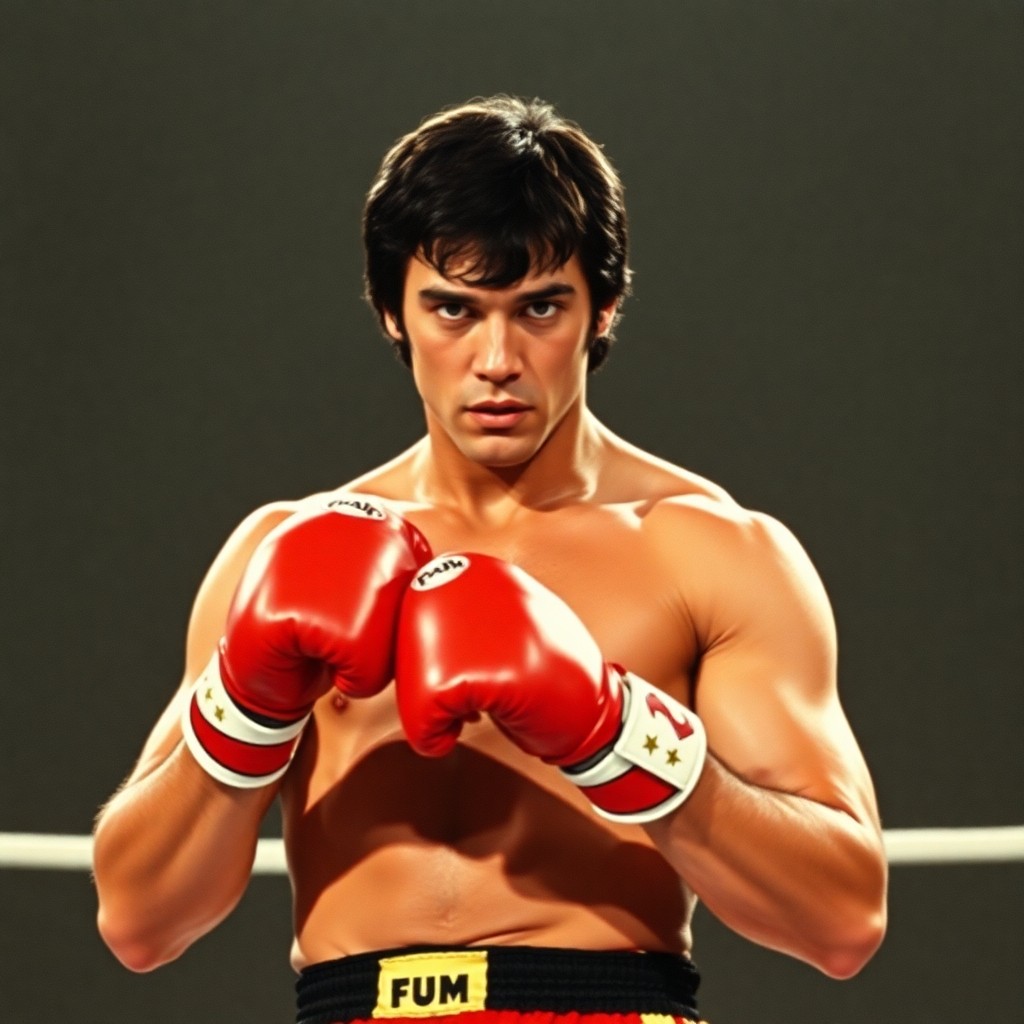
Released in 1976 under the direction of John G. Avildsen and written by a then-unknown Sylvester Stallone, Rocky transcended the sports drama genre to become one of the greatest cultural phenomena in cinema history. The film tells the unlikely journey of a small-time Philadelphia boxer who gets the chance of a lifetime when he is challenged by the world heavyweight champion, symbolizing the very essence of the "American Dream" and redefining the structure of underdog narratives in global pop culture.
Analysis and Plot
To understand the impact of Rocky, one must first strip the work of its immense commercial baggage accumulated over nearly five decades and see it as the realistic and melancholic drama it truly is. Set in a gray, decaying, and cold Philadelphia of the mid-1970s, the film introduces us to Rocky Balboa, a 30-year-old man who works as a debt collector for a local loan shark, Tony Gazzo, and fights in filthy, clandestine boxing arenas for mere pocket change. Rocky is not a hero; he is a survivor marginalized by a declining industrial society.
The plot develops along two parallel fronts that complement each other perfectly: the search for personal dignity and the birth of an unlikely love. Rocky is secretly in love with Adrian Pennino, an extremely shy and introspective pet shop clerk, the sister of his temperamental and frustrated best friend, Paulie. The romance between Rocky and Adrian is built subtly, based on the mutual recognition of their loneliness and social inadequacies. He, a misunderstood giant with the soul of a street poet; she, a young woman silenced by family oppression.
The major dramatic turning point arises when the world heavyweight champion, Apollo Creed (played masterfully by Carl Weathers), sees his title challenger get injured on the eve of a major commemorative fight for the United States Bicentennial. Seeing an unprecedented marketing opportunity, Apollo decides to give the chance to an unknown local pugilist, under the pretext that America is the "land of opportunity." Rocky, nicknamed "The Italian Stallion," is the chosen one.
From that moment on, the feature film focuses on Rocky's physical and psychological preparation, aided by Mickey Goldmill, an elderly former fighter and trainer who sees in Rocky a chance to redeem his own past frustrations. The training dynamic—immortalized by Bill Conti's triumphant soundtrack and the scenes of Rocky running through the streets of Philadelphia and climbing the steps of the Museum of Art—becomes one of the greatest cinematic montage moments of all time.
The Hidden Meaning of the Ending
The film's climax presents the brutal clash between Rocky and Apollo Creed. Contrary to the conventional formula of the sports films that would follow it, Rocky does not win the fight. After 15 rounds of pure violence, endurance, and blood, Apollo is declared the winner by a split decision of the judges. However, Rocky's true triumph had already been established the night before the fight, in an intimate scene of extreme emotional vulnerability where he confesses to Adrian:
"I just want to go the distance. If I can go that distance, and that bell rings and I'm still standing, I'm gonna know for the first time in my life, see, that I weren't just another bum from the neighborhood."
The ending of Rocky is one of the most poetic resolutions in American cinema. When the fight ends, amidst the absolute chaos of the ring invaded by journalists, cameras, and fans, Rocky completely ignores the announcement of the judges' result. He doesn't want to know who won the belt. He screams desperately for Adrian. The sporting loss is irrelevant compared to his existential victory. By going the 15 rounds against the most dangerous man in the world, Rocky proves his worth to himself and to the world, while the final embrace with Adrian seals the true prize of his journey: love, dignity, and self-acceptance.
Cast and Standout Performances
The dramatic success of Rocky rests directly on the organic nature of its performances. Sylvester Stallone delivers the performance of his life. His Rocky has a slurred speech, a heavy gait, but eyes filled with a sweetness and vulnerability that prevent the character from being seen merely as a brute. Stallone humanized the action hero even before the term was consolidated in Hollywood cinema.
Talia Shire, as Adrian, performs a brilliant transformation on screen. She begins the film almost invisible, hidden behind heavy glasses and baggy coats, and gradually blossoms, acquiring posture and voice as Rocky's love frees her from her emotional prison. The chemistry between Shire and Stallone is the beating heart of the narrative.
Burgess Meredith delivers a visceral and historic performance as Mickey Goldmill. His raspy voice, grumpy temperament, and scoldings filled with regret give the film a unique dramatic gravity. Equally brilliant is Burt Young as Paulie, a man embittered by his own mediocrity, whose envy and loyalty to Rocky create a constant and realistic lower-middle-class tension.
Finally, Carl Weathers builds a magnetic Apollo Creed. Inspired directly by the legendary boxer Muhammad Ali, Apollo is not a cartoonish villain; he is an intelligent, charismatic, proud showman and a supreme athlete. Weathers' screen presence established a perfect counterpoint to Rocky's rusticity.
Behind the Scenes, Trivia, and the Invention of the Steadicam
The production of Rocky is, in itself, a story of overcoming worthy of cinema. Sylvester Stallone, then a broke actor with only a few hundred dollars in the bank, wrote the original script in just three and a half days, shortly after watching the fight between champion Muhammad Ali and underdog Chuck Wepner in 1975.
Producers Irwin Winkler and Robert Chartoff loved the script and offered Stallone exorbitant amounts (by the standards of the time, reaching about $350,000) for the rights to the text. The producers' only condition was that a renowned actor—such as Robert Redford, James Caan, Burt Reynolds, or Ryan O'Neal—play Rocky. Stallone, despite going through serious financial difficulties (even having to sell his pet dog for $40 because he couldn't afford to feed him), categorically refused all offers. He insisted that he would only sell the script if he himself were the lead. The producers finally gave in, but drastically reduced the film's budget to about $1 million, an extremely low value for the time.
With a tight budget and a filming schedule of only 28 days, the production had to improvise constantly. Many of Rocky's running scenes through the streets of Philadelphia were filmed in "guerrilla" style, without official permission from the city. The pedestrians and local merchants who appear in the film were not extras; they didn't know a movie was being shot, which explains the genuine looks of curiosity (including the stall owner who throws an apple to Rocky during his run).
One of the greatest technical milestones in cinema occurred behind the scenes of Rocky: the pioneering use of the Steadicam, a camera stabilization system newly invented by Garrett Brown. Without the resources for expensive camera tracks, Brown used his prototype to follow Stallone's runs through the city and, crucially, to run up the stairs of the Philadelphia Museum of Art. The scene became iconic precisely because of the unprecedented fluidity of the camera, which seemed to float alongside the protagonist, forever changing the visual language of action and sports films.
Controversies and Political Readings
Although universally celebrated as a modern fairy tale, Rocky did not escape controversies and academic debates of a social and political nature over the years. The main controversy involves the real-life boxer Chuck Wepner, known as "The Bayonne Bleeder." Wepner, who fought bravely until the 15th round against Muhammad Ali before being knocked out, filed a lawsuit against Sylvester Stallone decades after the film's release, claiming he never received financial compensation or proper credit for being the direct inspiration for the character of Rocky. The parties reached an amicable out-of-court settlement in 2006.
In the field of cultural and political criticism, many analysts point to the racial subtext implicit in the confrontation between Rocky and Apollo Creed. In the 1970s, real boxing was dominated by imposing and politically active Black athletes, led by the charismatic and defiant Muhammad Ali. Left-wing critics and film historians argue that Rocky functioned, intentionally or not, as a compensatory fantasy for the American white working class (Richard Nixon's so-called "Silent Majority"), who felt marginalized by the achievements of the civil rights movement and the cultural transformations of the time. By placing a humble white worker ("The Great White Hope") to resist the arrogant and media-savvy Black champion, the film touched on deep social tensions in American society, although Stallone has always denied any political motivation behind his writing.
Critical Reception, Box Office, and Legacy
The reception of Rocky was a true mass phenomenon. Produced with just under $1.1 million, the film grossed an impressive $117 million in the United States alone and over $225 million worldwide, becoming the highest-grossing film of 1976 and one of the most profitable films in history in terms of return on investment.
The specialized critics of the time bowed to the film's charisma. Legendary critic Roger Ebert gave the film four stars, comparing Sylvester Stallone to a young Marlon Brando for his physical presence and rustic sensitivity. At the 1977 Oscar ceremony, Rocky consolidated its consecration by receiving 10 nominations and winning three of the most important categories of the night: Best Picture (beating immortal classics like Martin Scorsese's Taxi Driver, Alan J. Pakula's All the President's Men, and Sidney Lumet's Network), Best Director for John G. Avildsen, and Best Film Editing.
| Category (1977 Oscars) | Result | Major Competitors |
|---|---|---|
| Best Picture | Winner | Taxi Driver, Network, All the President's Men |
| Best Director (John G. Avildsen) | Winner | Ingmar Bergman, Sidney Lumet, Alan J. Pakula |
| Best Original Screenplay (Sylvester Stallone) | Nominated | Lost to Paddy Chayefsky (Network) |
| Best Actor (Sylvester Stallone) | Nominated | Lost to Peter Finch (Network) |
The legacy of Rocky is incalculable. It not only spawned a billion-dollar franchise of sequels (which culminated in the acclaimed Creed trilogy, extending the film's universe to new generations), but also established the dramatic formula that shaped almost all subsequent sports films, from The Karate Kid (also directed by Avildsen) to contemporary dramas. The bronze statue of Rocky, originally created for the filming of Rocky III, remains to this day at the foot of the Philadelphia Museum of Art steps, serving as a global tourist spot and a monument to human perseverance.
Ultimately, Rocky stands the test of time because it is not a film about boxing. It is a film about the intrinsic need of every human being to be seen, heard, and respected. Through their disarming emotional honesty, Stallone and Avildsen created a monument to the common citizen, proving that true victory is not measured by belts or trophies, but by the courage to keep standing when the whole world expects you to fall.
Sources Researched
- IMDb - Rocky (1976): www.imdb.com/title/tt0075148/
- Box Office Mojo - Rocky: www.boxofficemojo.com/title/tt0075148/
- Rotten Tomatoes - Rocky Reviews: www.rottentomatoes.com/m/rocky
- Roger Ebert Classic Review - Rocky: www.rogerebert.com/reviews/great-movie-rocky-1976
- The Academy Awards Database (1977): www.oscars.org/oscars/ceremonies/1977





