



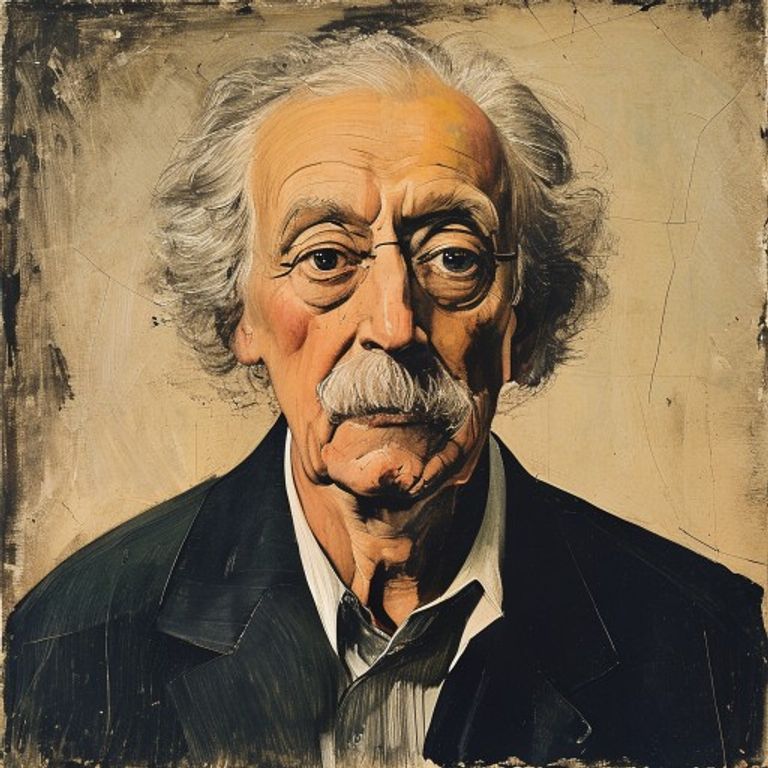
I- Author:
José Oswald de Sousa Andrade was born in São Paulo in 1890. He had his first studies at Ginásio de São Bento and graduated in Law in 1919. Upon returning from Europe, he brought Marinetti's Futurist ideas to Brazil. A revolutionary above all, he always sought to stir up the artistic scene, defending the innovative purposes of Anita Malfatti's Expressionist painting. He participated intensely in the Week of Modern Art and, in 1925, launched the poetry volume Pau-Brasil, with which he inaugurated the modernist group of the same name. Two years later, he germinated the "Anthropophagic" movement, founding the "Revista de Antropofagia" at that time.
Oswald de Andrade is one of the greatest spirits of Brazilian Modernism. He actively participates in the movement, influencing the unfolding of events and infecting his contemporaries with vibrant, sometimes irreverent enthusiasm, which leads to the statement: "Oswald de Andrade is an anti-academic to the core, he lived scandal for the pleasure of scandalizing."
II- Pau-Brasil Poetry Manifesto
The manifesto written by Oswald de Andrade was initially published in the newspaper Correio da Manhã, on March 18, 1924. The following year, a reduced and altered version of the manifesto opened the Pau-Brasil poetry book. In the manifesto and the Pau-Brasil book [illustrated by Tarsila do Amaral], Oswald proposes a literature extremely linked to Brazilian reality, from a rediscovery of Brazil. Or, as Paulo Prado states when prefacing the book:
"Oswaldo de Andrade, on a trip to Paris, from the top of an atelier in Face Clichê - the navel of the world - discovered his own land with amazement. The return to his homeland confirmed, in the enchantment of Manueline discoveries, the surprising revelation that Brazil existed.
This fact, which some already suspected, opened his eyes to the radiant vision of a new, unexplored, and mysterious world. Pau-Brasil poetry was created."
III- Work:
Why was a poetry book called Pau-Brasil published in Paris in 1925? The answer was immediately given by Paulo Prado in the preface to that same edition: "Oswald de Andrade, on a trip to Paris, from the top of an atelier in Place Clich - the navel of the world - discovered his own land with amazement." Indeed, distance awakened his consciousness of Brazilianness, giving rise to a renewing poetry: pau-brasil poetry. The designation pau-brasil comes from the tree that, in the colonial era, was one of our first export products, thanks to its dyeing properties. Based on this premise, Oswald creates
what he would call "export poetry."
The project aimed to break away from poetic models imported from the last century, ending grandiloquence and seriousness. It thus proposed the use of European avant-garde techniques to give expression to Brazilian themes.
This innovative vision of the national element is realized in several ways. Firstly, there is the proposal to write the history of Brazil in poetic form. In this sense, Oswald rescues texts from the past and rewrites them, transforming them into a parody that re-establishes links with history while criticizing it. The language is surprisingly colloquial, synthetic, and full of humor. The visual element is notable, as is the dynamism of the images. The illustrations accompanying the original edition of Pau-Brasil are by Tarsila do Amaral, whose quick and naive stroke reflects the mood of the poems.
Postes da Light is a visionary poem of São Paulo, in its precocious description of the great metropolis, composed of "Skyscrapers/Fords/Viaducts." It is an urban description devoid of heroes, but fueled by the crowd, by new technological artifacts, and by the language of advertising.
IV- Poems:
The girls at the station
They were three or four young ladies, very pretty and very kind
With very black hair down their shoulders
And their youths so high and so shapely
That by looking at them very well
We had no shame
Pronouns
Give me a cigarette
Says the grammar
Of the professor and the student
And the smart mulatto
But the good black man and the good white man
Of the Brazilian Nation
Say every day
Stop it, buddy
Give me a cigarette
Song of Return to the Homeland
My land has palm trees
Where the sea chirps
The birds here
Don't sing like those from there
Mine has more roses
And almost more loves
My land has more gold
My land has more land
Gold, land, love, and roses
I want everything from there
May God not let me die
Without returning there
May God not let me die
Without returning to São Paulo
Without seeing Rua 15
And the progress of São Paulo_
I- Author:
José Oswald de Sousa Andrade was born in São Paulo in 1890. He had his first studies at Ginásio de São Bento and graduated in Law in 1919. Upon returning from Europe, he brought Marinetti's Futurist ideas to Brazil. A revolutionary above all, he always sought to stir up the artistic scene, defending the innovative purposes of Anita Malfatti's Expressionist painting. He participated intensely in the Week of Modern Art and, in 1925, launched the poetry volume Pau-Brasil, with which he inaugurated the modernist group of the same name. Two years later, he germinated the "Anthropophagic" movement, founding the "Revista de Antropofagia" at that time.
Oswald de Andrade is one of the greatest spirits of Brazilian Modernism. He actively participates in the movement, influencing the unfolding of events and infecting his contemporaries with vibrant, sometimes irreverent enthusiasm, which leads to the statement: "Oswald de Andrade is an anti-academic to the core, he lived scandal for the pleasure of scandalizing."
II- Pau-Brasil Poetry Manifesto
The manifesto written by Oswald de Andrade was initially published in the newspaper Correio da Manhã, on March 18, 1924. The following year, a reduced and altered version of the manifesto opened the Pau-Brasil poetry book. In the manifesto and the Pau-Brasil book [illustrated by Tarsila do Amaral], Oswald proposes a literature extremely linked to Brazilian reality, from a rediscovery of Brazil. Or, as Paulo Prado states when prefacing the book:
"Oswaldo de Andrade, on a trip to Paris, from the top of an atelier in Face Clichê - the navel of the world - discovered his own land with amazement. The return to his homeland confirmed, in the enchantment of Manueline discoveries, the surprising revelation that Brazil existed.
This fact, which some already suspected, opened his eyes to the radiant vision of a new, unexplored, and mysterious world. Pau-Brasil poetry was created."
III- Work:
Why was a poetry book called Pau-Brasil published in Paris in 1925? The answer was immediately given by Paulo Prado in the preface to that same edition: "Oswald de Andrade, on a trip to Paris, from the top of an atelier in Place Clich - the navel of the world - discovered his own land with amazement." Indeed, distance awakened his consciousness of Brazilianness, giving rise to a renewing poetry: pau-brasil poetry. The designation pau-brasil comes from the tree that, in the colonial era, was one of our first export products, thanks to its dyeing properties. Based on this premise, Oswald creates
what he would call "export poetry."
The project aimed to break away from poetic models imported from the last century, ending grandiloquence and seriousness. It thus proposed the use of European avant-garde techniques to give expression to Brazilian themes.
This innovative vision of the national element is realized in several ways. Firstly, there is the proposal to write the history of Brazil in poetic form. In this sense, Oswald rescues texts from the past and rewrites them, transforming them into a parody that re-establishes links with history while criticizing it. The language is surprisingly colloquial, synthetic, and full of humor. The visual element is notable, as is the dynamism of the images. The illustrations accompanying the original edition of Pau-Brasil are by Tarsila do Amaral, whose quick and naive stroke reflects the mood of the poems.
Postes da Light is a visionary poem of São Paulo, in its precocious description of the great metropolis, composed of "Skyscrapers/Fords/Viaducts." It is an urban description devoid of heroes, but fueled by the crowd, by new technological artifacts, and by the language of advertising.
IV- Poems:
The girls at the station
They were three or four young ladies, very pretty and very kind
With very black hair down their shoulders
And their youths so high and so shapely
That by looking at them very well
We had no shame
Pronouns
Give me a cigarette
Says the grammar
Of the professor and the student
And the smart mulatto
But the good black man and the good white man
Of the Brazilian Nation
Say every day
Stop it, buddy
Give me a cigarette
Song of Return to the Homeland
My land has palm trees
Where the sea chirps
The birds here
Don't sing like those from there
Mine has more roses
And almost more loves
My land has more gold
My land has more land
Gold, land, love, and roses
I want everything from there
May God not let me die
Without returning there
May God not let me die
Without returning to São Paulo
Without seeing Rua 15
And the progress of São Paulo_





