



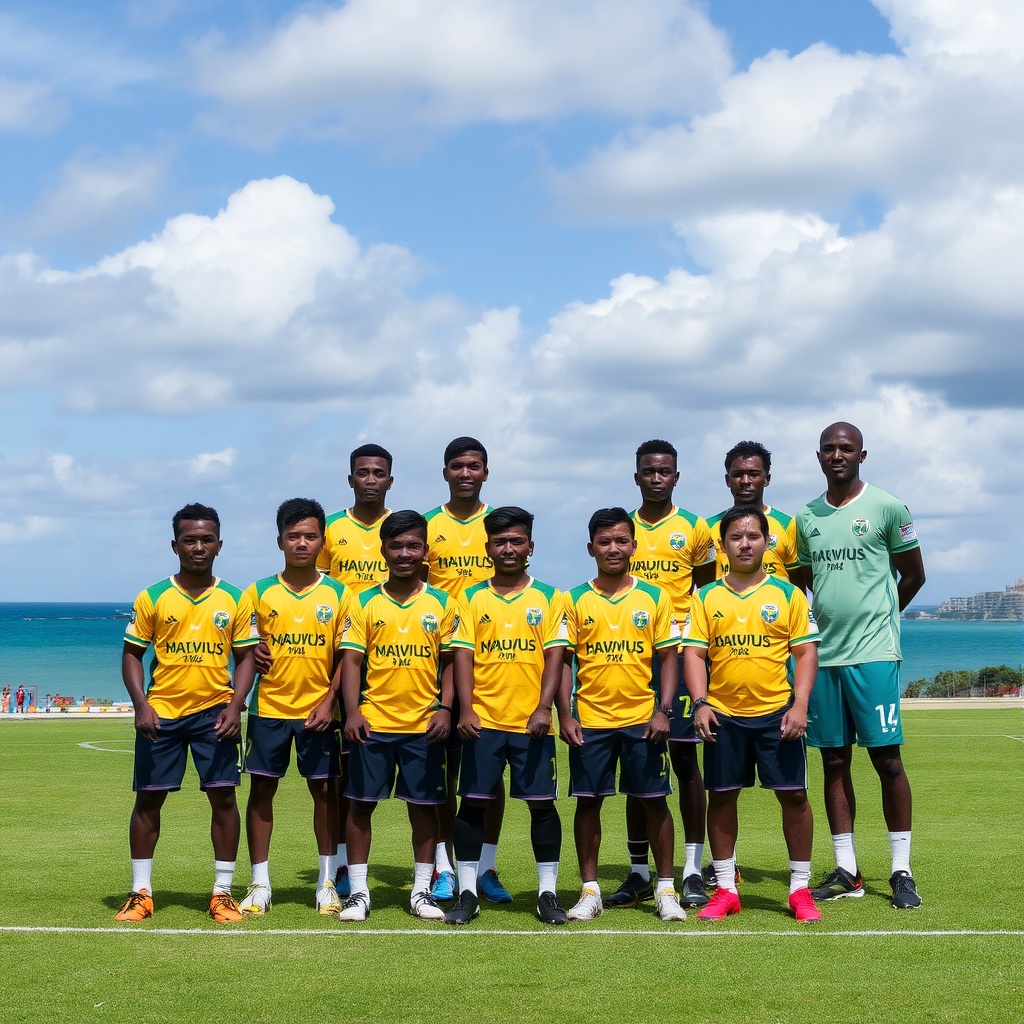
For the vast majority of global citizens, the Republic of Mauritius immediately evokes idyllic images of white sandy beaches, luxury resorts, and a turquoise sea resting placidly in the southwest Indian Ocean. However, behind this tropical paradise facade lies one of the most complex, politicized, and melancholic trajectories in African football. The Mauritius national team, historically known as "Club M" or affectionately nicknamed "Les Dodos" — in honor of the extinct endemic bird that became the national symbol — carries on its shoulders the weight of a highly fragmented social mosaic. Football on this island is not just a sport; it is a mirror of ethnic tensions, British and French colonial legacies, and an incessant search for a unified national identity. On the continental stage, Mauritius currently inhabits the periphery of the Confederation of African Football (CAF), consistently appearing in the lowest positions of the FIFA Rankings. However, reducing the history of Mauritian football to its current competitive modesty is to ignore a rich saga that involves a historic participation in the 1974 Africa Cup of Nations, intense regional rivalries in the Indian Ocean, and a traumatic political restructuring that forever changed the fate of the sport in the country at the end of the 20th century. This dossier dives deep into the bowels of Mauritian football, analyzing its genesis, its moments of glory, the structural crises that paralyzed it, and the complex reconstruction tactics of a team struggling to stop being a mere romantic memory on the football map.
1. Origins and Formation of National Identity
The introduction of football in Mauritius is intrinsically linked to its complex colonial past. Unlike other African nations where football was introduced late, the island of Mauritius experienced the sport as early as the 19th century, under the administration of the British Empire. British soldiers stationed on the island and sailors docking in Port Louis were the first to kick a leather ball on the colony's improvised fields. However, the social structure of Mauritius, characterized by a unique demographic division — composed of descendants of enslaved Africans (Creoles), indentured Indian laborers (Hindus and Muslims), and an elite of Franco-Mauritian landowners — quickly appropriated the game. Football ceased to be a British military distraction and transformed into a vehicle for identity affirmation for each of these communities.
In the early decades of the 20th century, clubs began to emerge not based on purely geographical criteria, but on strictly ethnic and religious lines. The Dodo Club, founded by the white Franco-Mauritian elite, represented economic power and French heritage. In contrast, the Fire Brigade SC became the bastion of the Creole community, mostly Catholic and working-class. Indo-Mauritians of the Hindu faith found their representation in the Hindu Cadets (later known as Cadets Club), while the Islamic community founded the Muslim Scouts (later Scouts Club). This division was not just sporting; it was the transposition of the island's social and political tensions onto the pitch. The Stade George V, inaugurated in Curepipe in the 1950s, became the great coliseum where these community rivalries were staged weekly under an atmosphere of extreme passion and, frequently, latent violence.
The founding of the Mauritius Football Association (MFA) in 1952 sought to organize this melting pot. Affiliation with FIFA in 1964 and CAF in 1963, a few years before the country's official independence in 1968, brought the promise that football could act as a unifying agent. The first prominent technical commissioner and one of the most influential figures in the history of the sport in the country was Ram Ruhee, who would later become a member of the International Olympic Committee. Ruhee understood that the national team, Club M, needed to transcend the divisions of local clubs so that the country could compete at an international level. The red, blue, yellow, and green uniform — the colors of the new national flag — was adopted as a symbol of reconciliation. However, convincing fans to support a unified team when their weekend loyalties were based on their own ethnic origins proved to be one of the greatest sociological challenges in the history of Mauritius, a dilemma that would shape the tactical and administrative development of the sport for decades to come.
2. Golden Era, Great Campaigns, and Eternal Idols
The culmination of Mauritian football history occurred in the 1970s, a period that older fans still recall with reverent nostalgia. Under the technical command of the legendary Mamade Elahee, an astute strategist who perfectly understood the psychology of his players, Mauritius achieved what is still considered its greatest feat: qualification for the final phase of the 1974 Africa Cup of Nations (AFCON), held in Egypt. The qualifying campaign was an epic. Club M overcame the Lesotho national team and, in the decisive phase, eliminated the strong Tanzania team in a thrilling penalty shootout in Port Louis, sparking an unprecedented national commotion on the newly independent island.
In the final phase of the tournament in Egypt, Mauritius was drawn into Group B, alongside continental powerhouses such as Congo (then defending champion), Guinea, and Zaire (which would represent Africa in that year's World Cup). As expected, the physical and structural disparity was noticeable. Club M lost all three games: 2-0 to Congo, 2-1 to Guinea, and 4-1 to Zaire. However, the dignity shown by the Mauritians on the field was widely praised by the international press. The great hero of this campaign was striker Dany Imbert. Endowed with refined technique and impressive speed for the region's standards, Imbert scored the only two goals for Mauritius in the competition's history (one against Guinea and one against Zaire). To this day, Dany Imbert is revered as the greatest player the island has ever produced, a symbol of an era when local football could compete on equal terms with the giants of the continent.
In addition to the historic participation in the 1974 AFCON, the Mauritian national team found its ground of glory in the Indian Ocean Island Games (Jeux des îles de l'océan Indien - JIOI). This regional multi-sport competition, which brings together Mauritius, Reunion, Madagascar, Seychelles, Comoros, and the Maldives, became the true World Cup for the inhabitants of these islands. Mauritius won the gold medal in football on two memorable occasions: in 1985 and 2003. The 1985 victory, playing at home in a packed Stade George V under the leadership of players like Jean-Marc Ithier, consolidated football as the country's number one sport. Ithier, a prolific striker who would later make history in South African football playing for Santos Cape Town, became the spiritual heir to Dany Imbert, demonstrating that Mauritian talent was capable of shining beyond its maritime borders. The 2003 victory, again on Mauritian soil, beat rival Reunion in the final and represented the last great moment of collective celebration for national football before the plunge into a long identity crisis.
3. Rivalries, Crises, and Behind the Scenes of Power
The intense passion that fueled Mauritian football also contained the seeds of its own destruction. The rivalry between ethnically-based clubs reached its boiling point on May 23, 1999, a day marked in the country's history as the "L'Amicale Tragedy." After a decisive national championship match between Fire Brigade SC (Creole-based) and Scouts Club (Muslim-based) at Stade Anjalay, which secured the title for Fire Brigade, violent clashes broke out outside the stadium. Groups of extremist fans set fire to the "L'Amicale de Port Louis" gambling house. The fire resulted in the tragic death of seven people, including women and children. The incident shocked the nation and exposed the fragility of social peace in Mauritius, demonstrating that football was being used as a catalyst for sectarian hatred.
The response from the government led by then-Prime Minister Navin Ramgoolam was immediate, drastic, and, for many sports analysts, fatal to the development of the sport. The national championship was suspended for eighteen months, and all clubs based on ethnic or religious criteria were summarily banned. The government imposed a complete restructuring, requiring new clubs to be strictly regionalized. Thus, legendary teams like Fire Brigade, Scouts Club, and Cadets Club disappeared from the map, replaced by regional entities such as AS Port-Louis 2000, Curepipe Starlight SC, and Pamplemousses SC. Although the measure achieved the political goal of pacifying stadiums and eliminating community violence, it had a devastating side effect: it destroyed the local football fan base. Without historical and emotional identification with the clubs, the public abandoned the stadiums. Average attendance plummeted from tens of thousands to mere hundreds of spectators per match.
The loss of public interest led to the almost total withdrawal of private sponsors, plunging Mauritian football into a deep financial and technical crisis from which the country never fully recovered. The Mauritius Football Association (MFA) began to be managed under constant accusations of corruption, nepotism, and administrative incompetence. FIFA interventions became recurrent due to internal power struggles and electoral irregularities in the federation. While local football withered on empty fields without structure, the national team, deprived of a strong and competitive league, plummeted in the FIFA rankings, reaching the 203rd position in 2012. The regional rivalry with Madagascar and Reunion, which was once balanced, became widely unfavorable for Mauritius, highlighting the abyss that formed between Club M and its Indian Ocean neighbors.
4. The Current Moment: Tactics, Generation, and Challenges
In the contemporary scene, the Mauritius national team seeks to redefine its tactical and technical identity under the leadership of coaching staffs trying to modernize Club M's style of play. Historically characterized by a fast-transition football, based on the speed of its wingers and physical vigor, Mauritian football suffered for a long time from a lack of tactical discipline and defensive consistency. In clashes against African continental powers, Mauritius often adopted an overly defensive stance, a low-density line that ended up inviting the opponent into its own half, resulting in inevitable routs.
In recent years, there has been a conscious effort to implement a more structured game system, generally varying between 4-2-3-1 and 4-5-1 in the defensive phase, prioritizing compactness between lines and quick exits down the flanks. The major paradigm shift for the current moment of the national team is the active search for players from the Mauritian diaspora, mainly in Europe. As many Mauritians migrated to France, England, and Belgium in recent decades, a new generation of dual-nationality athletes began to be integrated into the national squad. Players like Lindsay Rose, an experienced defender with stints at Lyon, Lorient, and Legia Warsaw, and Kevin Bru, a technical midfielder trained in the Rennes youth academy with a long spell at Ipswich Town, brought a level of professionalism, tactical reading, and international experience that the local squad simply could not develop in the island's amateur league.
Despite this injection of talent from abroad, the backbone of the national team still depends on athletes who play locally, which creates a visible mismatch in rhythm and intensity during World Cup and AFCON qualifying matches. The lack of high-level friendly matches and logistical difficulties in gathering the full squad on FIFA dates limit tactical cohesion. When Club M takes the field, the challenge for the coach of the day is to balance the defensive solidity brought by European-based athletes with the creativity and enthusiasm of local players, who often lack the tactical refinement necessary to sustain ninety minutes of pressure against elite teams from the African continent.
5. Talent Development, Structure, and Future
The future of football in Mauritius depends fundamentally on the reconstruction of its grassroots infrastructure and the creation of a viable path for the professionalization of young athletes. Currently, the Mauritian national league remains semi-professional, meaning the overwhelming majority of players must balance training with regular jobs in the tourism industry, the public sector, or agriculture. Without a sustainable economic ecosystem, the island's most talented youth often abandon competitive football in their late teens to pursue more stable academic or professional careers, leading to a chronic "brain drain" of sporting talent.
To combat this reality, the MFA, in partnership with the Mauritian government and FIFA development programs (such as FIFA Forward), has been trying to structure regional technical training centers. The goal is to identify talent early in schools and offer them systematic training. However, the absence of professional clubs with structured academies — like those that exist in South Africa or North African countries — severely limits the development ceiling of these youths. The main export route for Mauritian players remains quite modest, directed mainly to the neighboring island of Reunion (which has a better-structured league, although it is a French overseas department) or to lower-tier leagues in Europe and South Africa.
The comparative analysis with Madagascar, which reached the AFCON quarterfinals in 2019 by structuring its football based on a strong connection with the diaspora in France and investments in local academies, serves as a model and inspiration for Mauritian officials. The path for Mauritius to become competitive again on the continental stage involves the modernization of Stade Anjalay and Stade George V, massive investment in synthetic pitches to circumvent the island's climatic difficulties (subject to frequent tropical cyclones), and the creation of a unified professional league in the Indian Ocean, an idea that has been debated behind the scenes to increase the region's competitive level. Until these structural reforms leave the drawing board, Club M will continue its lonely search for redemption, trying to prove that, just as the dodo is reborn in its nation's heraldry, its football can also find a way to rise from the ashes of its troubled past.





