



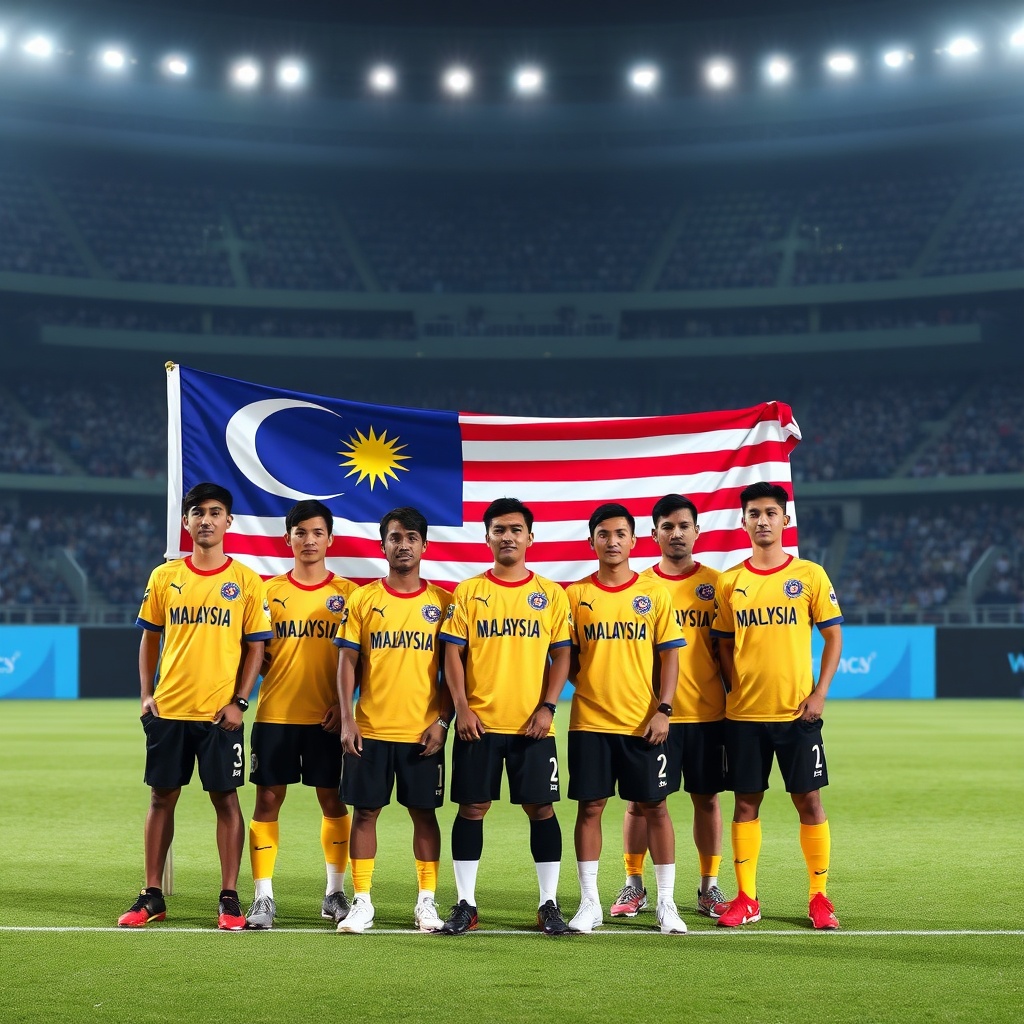
In the vast and complex landscape of Asian football, few narratives are as rich, dramatic, and sociologically fascinating as that of the Malaysian national team. Known as the Harimau Malaya (the Malayan Tigers), this squad carries on its shoulders the weight of a glorious mid-20th-century past, the deep scars of corruption scandals that nearly decimated the sport in the country during the 1990s, and a present defined by tactical and geopolitical reconstruction. Today, under the influence of massive investments from local royal dynasties, an aggressive policy of naturalizing athletes, and the importation of foreign tactical methodologies, Malaysia seeks to redefine its identity. It is a football culture that mirrors the contradictions of the nation itself: a multicultural fusion of Malay, Chinese, and Indian ethnicities attempting to find, on the pitch of the imposing Bukit Jalil National Stadium, the unity and greatness it once displayed before the powers of the world's largest continent.
1. Origins and the Formation of National Identity
To understand football in Malaysia, it is imperative to unearth the colonial roots that shaped the Malay archipelago. The sport was introduced in the late 19th century by British colonizers. Soldiers, colonial administrators, and educators brought the first leather balls and established the initial clubs, which were initially restricted to the European elite. However, the seed of football found extremely fertile soil in local communities. Malay, Chinese, and Indian youths quickly adopted the game, transforming it into a space for sociability that transcended the segregationist barriers imposed by the British colonial regime.
The founding of the Football Association of Malaysia (FAM) in 1933, initially under the name of the Malaya Football Association, marked the beginning of the sport's institutionalization. The great catalyst for national identity through football, however, was the tournament conceived by Prime Minister Tunku Abdul Rahman: the Pestabola Merdeka (Independence Tournament), established in 1957 to celebrate the country's emancipation from British rule. The Merdeka Cup was not just a sporting competition; it was a declaration of political and cultural sovereignty in Asia. Under the lights of the historic Merdeka Stadium in Kuala Lumpur, the Malaysian national team began to forge its continental reputation.
The squad of those early post-independence years was the perfect reflection of the "Bangsa Malaysia" (unified Malayan nation) ideal. On the pitch, the team displayed a multi-ethnic harmony that the central government struggled to consolidate in the political and social spheres. Players of Malay origin shared the locker room with descendants of Chinese and Indians, creating a unique synergy of playing styles. The technical skill and physical resilience of these athletes turned Malaysia into a feared force in Southeast Asia. Football became the primary element of social cohesion for a young country seeking its voice amidst the tensions of the Cold War and the challenges of integrating its diverse communities. Each victory of the Harimau Malaya was celebrated not as the triumph of one ethnic group, but as the affirmation of a modern, strong, and united Malaysia.
The Role of Merdeka Stadium in the National Narrative
Merdeka Stadium was not just concrete and grass; it was the temple of independence. It was there that Tunku Abdul Rahman shouted "Merdeka!" seven times on August 31, 1957. When the ball rolled on that pitch, football took on a sacred character. The packed stands reflected the country's demographics, with Indian turbans, Chinese hats, and the traditional Malay songkok blending into a single mass of supporters. Beating South Korea, Japan, or Indonesia at the Merdeka was proof that the new nation was ready to compete on equal footing with the continent's giants.
2. Golden Era, Great Campaigns, and Eternal Idols
The 1970s and 1980s represent the technical, tactical, and emotional peak of Malaysian football. It was a period when the Harimau Malaya not only dominated the regional scene but also challenged the powers of the Asian Football Confederation (AFC). The turning point of this golden era was the historic qualification for the 1972 Munich Olympic Games. Under the command of legendary coach Jalil Che Din, Malaysia overcame traditional opponents in the qualifiers and traveled to West Germany. On Olympic soil, the Malaysians recorded a stunning 3-0 victory over the United States, a feat that echoed globally and firmly placed the country on the international football map.
The 1972 feat was repeated in 1980, when Malaysia secured a spot for the Moscow Olympics. In a memorable campaign, the team defeated the powerful South Korea 2-1 in the decisive match in Kuala Lumpur. However, fate held immense frustration for that golden generation. In alignment with the US-led boycott protesting the Soviet invasion of Afghanistan, the Malaysian government decided not to send its delegation to Moscow. The players, who had reached the pinnacle of their careers on the pitch, saw their Olympic dream sacrificed on the altar of global geopolitics. This story of triumph and melancholy was immortalized years later in the acclaimed Malaysian film Ola Bola, which brought back the pride of that generation for the youth of the 21st century.
No debate about the golden era of Malaysian football is complete without mentioning the names that became demigods in the country. The greatest of them was, without a doubt, Mokhtar Dahari, affectionately nicknamed "Supermokh." Dahari was a formidable striker, endowed with immense physical strength, explosive speed, and devastating finishing. He scored an impressive 89 official goals for the national team (a record that places him among the greatest international goalscorers of all time, alongside legends like Cristiano Ronaldo, Lionel Messi, and Ali Daei). Supermokh was so revered that, in 1975, after scoring two goals in a friendly against Arsenal, rumors emerged of offers from English football giants, which he refused out of love for his home state, Selangor, and his homeland. His premature death in 1991, at age 37, due to amyotrophic lateral sclerosis (ALS), plunged the nation into deep mourning and marked the symbolic end of an era of innocence and greatness.
Alongside Dahari shone the defender and captain Soh Chin Ann, known as "Tauke" (The Boss). Chin Ann was elegance in the form of a defender, an impeccable reader of the game who commanded the backline with imperial authority. Recognized by FIFA as one of the players with the most international caps in the history of world football, he formed a legendary defensive partnership with Santokh Singh. In goal, Malaysia relied on the almost supernatural agility of R. Arumugam, nicknamed "Spiderman" due to his extraordinary reach and acrobatic saves. Together, these men of different ethnic origins personified the country's brightest moment, setting a standard of excellence that subsequent generations would struggle, almost always in vain, to emulate.
3. Rivalries, Crises, and Behind-the-Scenes Power
Geographic proximity and complex political relations in Southeast Asia have shaped intense rivalries for Malaysia. The fiercest of them is against Indonesia, a clash known as the "Nusantara Derby." This classic transcends the sporting aspect, carrying historical tensions, disputes over cultural heritage, and episodes of fan violence that often require military security schemes. Another rivalry of enormous political weight is the "Causeway Derby" against Singapore. Singapore's political separation from the Federation of Malaysia in 1965 transferred directly to the pitch, turning every match into a battle for moral and sporting supremacy on the peninsula.
However, the darkest period of Malaysian football was not caused by defeats in classics, but by an internal enemy that nearly destroyed the sport irreversibly: the catastrophic match-fixing scandal of 1994. During that season, a massive police investigation revealed that the national league (M-League) had been completely infiltrated by international illegal betting syndicates. The verdict was devastating for the country's sport. More than 80 players and coaches were detained, suspended, or permanently banned from football. Entire clubs were dismantled, and the sport's credibility collapsed. The public abandoned the stadiums, sponsors withdrew their investments, and the technical level of the national team plummeted into the abyss. Malaysia, which once challenged Asian powers, found itself relegated to international insignificance, beginning a long and painful period of technical exile that would last nearly three decades.
Parallel to the integrity crisis, the corridors of the Football Association of Malaysia (FAM) have always been fertile ground for political power struggles and royal influence. Historically, the FAM presidency was occupied by members of the royal families of the different Malaysian states. The late Sultan Ahmad Shah of Pahang presided over the association for an impressive three decades (from 1984 to 2014). Although his management brought financial stability and political prestige, it was also widely criticized for the lack of professional modernization, structural nepotism, and resistance to structural reforms necessary to keep pace with the evolution of global football. The transition of power in the FAM often reflected the country's political dynamics, where football was used as a public relations platform for the aristocracy and influential politicians, often to the detriment of the technical development of athletes in youth categories.
The Impact of the 1994 Scandal on the Collective Imagination
For the Malaysian fan, the year 1994 is an open wound. The discovery that national idols were accepting bribes from betting syndicates based in Singapore and Hong Kong broke the bond of trust between the public and the game. Parents stopped taking their children to stadiums, and an entire generation of young people grew up watching the English Premier League on television, ignoring local football. The process of rebuilding this trust required not only reforms in security and federation governance but also a deep cultural shift that took decades to consolidate.
4. The Current Moment: Tactics, Generation, and Challenges
After years of stagnation, Malaysian football began a process of tactical and structural rebirth in the last decade. The great modern watershed was the hiring of South Korean coach Kim Pan-gon in 2022. With a rigorous methodological approach, Pan-gon revolutionized the playing style of the Harimau Malaya. He abandoned the defensive pragmatism and reliance on long balls that characterized previous administrations, implementing a modern system based on high pressing, ultra-fast offensive transitions, and compact tactical organization, generally structured in a dynamic 3-4-3 or 4-3-3.
Under the South Korean coach's command, Malaysia achieved a historic feat: qualification on its own merit for the 2023 AFC Asian Cup (played in early 2024 in Qatar), something that had not happened since 1982 (in 2007, the country participated only as a co-host). In the continental tournament, the Harimau Malaya staged one of the most exciting games of the competition by drawing 3-3 with the powerful South Korea, led by Jürgen Klinsmann and starred by Son Heung-min. The courageous and tactically disciplined performance in that game was definitive proof that Malaysia had regained its competitive dignity on the international stage.
The current generation of the Harimau Malaya is an intriguing mix of local talents, heritage players, and naturalized athletes. This global recruitment strategy, although controversial among some local purists, has considerably raised the team's physical and technical level. Among the pillars of this new cycle are:
- Dion Cools: An international-class defender with UEFA Champions League experience for Club Brugge and Midtjylland, son of a Malaysian mother and a Belgian father, who took on the captain's armband and the team's defensive leadership.
- Matthew Davies: An extremely consistent right-back, born in Australia, who offers defensive solidity and excellent support to the attack.
- Paulo Josué: A naturalized Brazilian midfielder who became the creative brain of the offensive sector, offering excellent vision and precision in free kicks.
- Romel Morales: A striker of Colombian origin, whose physical power and goal-scoring instinct added a new dimension to the Malaysian attack.
- Arif Aiman Hanapi: The crown jewel of local football. A right-winger with baffling dribbling, explosive speed, and mature decision-making, trained in domestic academies and touted as one of the most promising young talents in all of Asia.
Despite the evident progress, the national team faces new challenges with the sudden departure of Kim Pan-gon in mid-2024. The technical command was assumed on an interim basis by his Spanish assistant, Pau Martí Vicente. Vicente's great challenge is to continue his predecessor's tactical legacy, keeping the team competitive in the 2026 World Cup qualifiers and consolidating Malaysia as an unquestionable force in the FIFA top-100 ranking.
5. Talent Development, Structure, and Future
The rebirth of the Malaysian national team is inseparable from the structural revolution that occurred in the country's club football, led almost absolutely by Johor Darul Ta'zim FC (JDT). Under the ambitious vision and massive investments of the heir to the Johor throne, Crown Prince Tunku Ismail Sultan Ibrahim (popularly known as TMJ), JDT transformed into a Southeast Asian superpower. The club won an unprecedented sequence of Malaysia Super League titles and became a constant presence in the decisive stages of the prestigious AFC Champions League.
JDT's facilities, including the ultra-modern Sultan Ibrahim Stadium and its world-class training centers, set a new professional standard in the region. The club essentially functions as the backbone of the national team, providing not only the majority of called-up players but also a winning mentality and professional habits that athletes transfer to the national team environment. The influence of TMJ and JDT, however, generates intense debate in the country. While many celebrate the club as the engine pulling Malaysian football upward, critics point out that the enormous financial and structural disparity between JDT and other clubs in the domestic league weakens the competitiveness of the local championship and creates excessive dependence on a single institution for the success of the Harimau Malaya.
Beyond the JDT phenomenon, the Malaysian government and the FAM have invested in talent development through the National Football Development Programme (NFDP), launched in 2014. The heart of this program is the renowned Mokhtar Dahari Football Academy (AMD), located in Pahang. This elite academy recruits the most promising young talents from all regions of the country, offering them a combination of formal academic education and high-performance sports training under the supervision of European technical directors. The long-term goal is to create a continuous flow of technically refined and tactically intelligent athletes, capable of competing in modern football without the exclusive need to resort to the naturalization of foreign players.
The future of Malaysian football crucially depends on the country's ability to export its best talents to more competitive leagues in Asia (such as Japan's J-League and South Korea's K-League) or to European football. Historically, Malaysian players have shown reluctance to leave the financial and cultural comfort zone of the domestic league. Breaking this mental and structural barrier is the next major step needed for the national team to reach a truly global level. If the federation can align its grassroots programs with the professional management of its clubs and keep the integrity of the sport away from the ghosts of the past, the Harimau Malaya will be well-positioned to roar loudly again, honoring the legacy of Mokhtar Dahari and proving that football in Malaysia is not just a popular passion, but an inseparable part of the soul and destiny of its nation.
The Challenge of Financial Sustainability
Although JDT represents the pinnacle of professionalism, the rest of the Malaysia Super League still suffers from financial instability. Traditional clubs often face problems with salary delays and amateur administrations. The long-term sustainability of Malaysian football requires the FAM to implement strict club licensing and financial fair play rules. Only with a strong, balanced, and financially healthy league in its entirety can Malaysia ensure that the flow of talent to the national team is continuous, allowing the country to dream, realistically, of an unprecedented qualification for a senior World Cup in the coming decades.





