



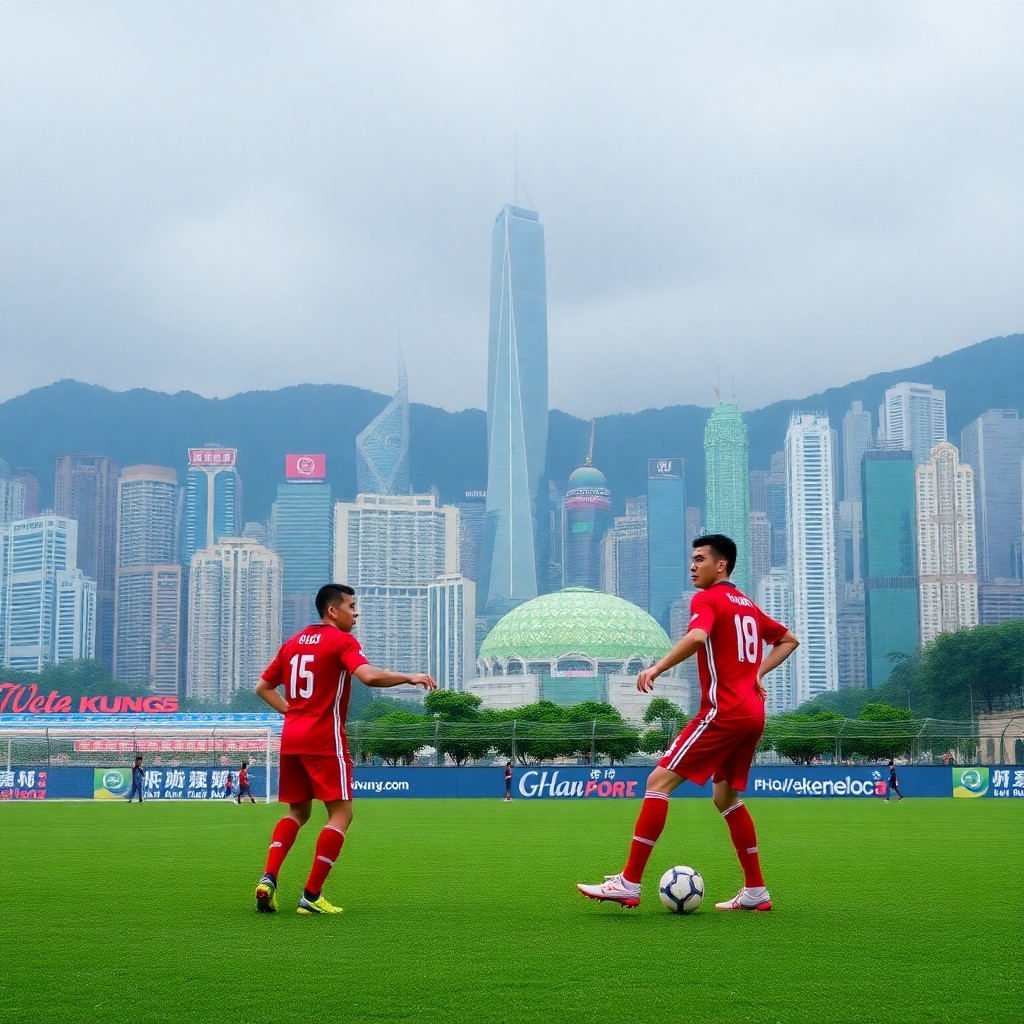
In the beating heart of Southeast Asia, where glass skyscrapers defy gravity and the aroma of jasmine tea mingles with the steam of Victoria Harbour, football is not merely a sport of colonial heritage; it is a geopolitical mirror of an identity in constant dispute. The Hong Kong national football team, often relegated to the periphery of the major FIFA spotlights, carries on its red and white crest the complexity of a territory living on the threshold between two worlds. Under the aegis of the "One Country, Two Systems" principle, this football team represents much more than eleven players on the pitch: it symbolizes the cultural resistance of a Cantonese community that seeks, through the green rectangle, to assert its uniqueness in the face of the political and demographic gigantism of mainland China. From the historic victory over Beijing in 1985 to the recent and apotheotic return to the Asian Cup in 2024, after more than half a century of absence, Hong Kong football is a testament to resilience, passion, and profound structural transformations.
1. Origins and the Formation of National Identity
To understand the genesis of football in Hong Kong, one must go back to the late 19th century, when the territory was consolidating itself as a crucial commercial entrepôt for the British Empire following the Treaty of Nanking in 1842. It was British sailors, soldiers, and merchants who introduced the sport to the colony, initially as a leisure activity restricted to colonial elites on the pitches of the Hong Kong Club and the Cricket Club. However, the seed of football germinated rapidly among the local Cantonese population, who saw in the game a unique opportunity for social affirmation and symbolic confrontation against the colonizers.
The founding of the Hong Kong Football Association (HKFA) in 1914—the oldest on the Asian continent—marked the institutionalization of the sport in the region. However, the true turning point in the formation of the local footballing identity was the emergence of the South China Athletic Association (SCAA), founded in 1910 as the "Chinese Football Club." The SCAA was born with the explicit mission of promoting Chinese national pride and challenging the hegemony of clubs formed exclusively by British expatriates. On the dirt pitches and in the first wooden stadiums of Hong Kong, South China became a mass phenomenon, drawing crowds who saw in the team the personification of their own cultural strength.
During the 1920s and 1930s, Hong Kong established itself as the epicenter of Asian football. The territory not only exported talent but also provided the backbone for the Republic of China national team (under the Kuomintang government) that competed in the 1936 Berlin Olympic Games. The legendary striker Li Wai-tong, widely considered the "King of Football" in Asia and born in Tai Hang, Hong Kong, led that Olympic team. Li Wai-tong was a mythical figure; his technical skill and finishing ability were celebrated throughout East Asia, setting a standard of excellence that put Hong Kong on the global football map, even before the local team competed formally under its own flag.
World War II and the subsequent Japanese occupation devastated the territory's sports infrastructure, but the post-war reconstruction was rapid and vigorous. In 1954, the HKFA became one of the founding members of the Asian Football Confederation (AFC), securing its affiliation with FIFA as an autonomous sports entity, separate from mainland China. This sporting autonomy, achieved decades before the 1997 transfer of sovereignty, allowed Hong Kong to develop a unique footballing identity. The style of play that emerged during this period was a fascinating fusion: the tactical discipline and physical rigor inherited from British pragmatism combined with the agility, close dribbling, and quick thinking characteristic of Cantonese players. Football thus became the first and most visible expression of a distinct "Hong Konger" identity, shaped by the cultural hybridization between East and West.
2. Golden Era, Great Campaigns, and Eternal Idols
The period between the mid-1950s and the late 1980s is widely revered as the "Golden Era" of Hong Kong football. The starting point of this glorious era occurred in 1956, when the territory hosted the inaugural edition of the Asian Cup. Before packed stands at the historic Government Stadium (now Hong Kong Stadium), the local team achieved an honorable third place, competing on equal footing with emerging powers like South Korea and South Vietnam. The tournament established Hong Kong as a respectable force on the continental stage and ignited a football fever that would dominate the territory for the next three decades.
In the 1970s, Hong Kong football took a giant qualitative leap with the introduction of professionalism. Visionary local businessmen began investing heavily in clubs like Seiko SA and Bulova, transforming the local league into one of the richest and most competitive in Asia. Internationally renowned players, including stars of Dutch and British football in the twilight of their careers—such as Arie Haan, René van de Kerkhof, and even the legendary Bobby Moore—arrived in the territory to play in the local league. This daily interaction with high-level professionalism drastically raised the technical standard of local players.
It was in this highly competitive environment that the greatest idols in the history of Hong Kong football emerged. The name of Wu Kwok-hung, affectionately nicknamed "Alai," stands out as the greatest technical exponent of that generation. A midfielder with aristocratic vision, millimeter-perfect passes, and quiet leadership, Wu played for Seiko SA and the national team with an elegance that defined the romantic football of the era. Beside him shone Wan Chi-keung, known as the "Iron Center-Forward." Wan was the physical antithesis of Wu: strong, relentless in the air, and endowed with an unwavering determination that turned him into a folk hero and, later, a television celebrity.
However, no moment in the history of Hong Kong football compares to May 19, 1985. In a match valid for the 1986 World Cup qualifiers, the Hong Kong team, led by strategist Kwok Ka-ming, traveled to Beijing to face the powerful People's Republic of China national team at the Workers' Stadium. China needed only a draw to advance to the next stage, and the atmosphere in the stadium was one of absolute confidence in a home victory. What followed was one of the greatest upsets in the history of Asian football, an event known in China as the "May 19 Incident" (or "519").
Adopting an extremely disciplined defensive tactical stance and exploiting rapid counter-attacks with surgical precision, Hong Kong opened the scoring in the 19th minute with a spectacular free-kick goal by Cheung Chi-tak. China equalized in the first half, pressing the visitors intensely. However, 15 minutes into the second half, defender Ku Kam-fai capitalized on a rebound in the box to score the historic 2-1 winning goal. The final whistle triggered a wave of sepulchral silence at the Workers' Stadium, followed by civil unrest in the stadium's vicinity—the first records of fan violence in the history of sports in Communist China. In Hong Kong, the victory was celebrated as an epic triumph of David against Goliath, consolidating the national team as a symbol of pride and uncompromising cultural autonomy.
3. Rivalries, Crises, and Behind-the-Scenes Power
The transition of Hong Kong's sovereignty from the United Kingdom to the People's Republic of China in 1997 brought with it profound political transformations that inevitably echoed behind the scenes of football. Under the "One Country, Two Systems" formula, the Basic Law of Hong Kong guaranteed the maintenance of its own sports federation and national team. However, football became a sensitive thermometer of political tensions between the local population and the central government in Beijing. The sporting rivalry with mainland China, which was once purely athletic, acquired dramatic geopolitical contours in the last decade.
The peak of this tension occurred during the 2018 World Cup qualifiers. Drawn into the same group as China, the 2015 clashes turned into true pitched battles off the pitch. In Hong Kong, the political climate was already highly polarized after the 2014 "Umbrella Revolution." When the Chinese national anthem—the "March of the Volunteers," which is also the official anthem of Hong Kong—was played before matches at Mong Kok Stadium, thousands of local fans booed deafeningly and turned their backs to the pitch. Banners reading "We Are Hong Kong" were raised in an effort to demarcate linguistic and cultural identity (Cantonese versus Mandarin).
On the pitch, the Hong Kong team, led by goalkeeper Yapp Hung-fai, resisted heroically, snatching two historic 0-0 draws against China, both in Shenzhen and Hong Kong. The results were celebrated locally as moral victories of immense magnitude, but they also provoked the wrath of Beijing's sports and political authorities. FIFA imposed heavy fines on the HKFA due to the fans' behavior, and the subsequent approval of the National Anthem Law in Hong Kong made the desecration of the "March of the Volunteers" a crime, criminalizing booing in stadiums and drastically altering the atmosphere in the stands.
Parallel to the political turmoil, Hong Kong football plunged into a severe administrative and technical crisis starting in the 1990s. The professional league lost its historic sponsors, stadium attendance plummeted, and the technical level declined sharply. Match-fixing scandals shook the sport's credibility. In 2009, the Hong Kong government commissioned a detailed study that culminated in "Project Phoenix," a strategic plan for local football restructuring funded by public resources. The project aimed to modernize the HKFA's governance, professionalize the league (which was renamed the Hong Kong Premier League in 2014), and revitalize youth categories.
However, the implementation of Project Phoenix and its subsequent plans faced severe criticism and bureaucratic resistance. Sports activists and analysts pointed out that, despite the millions of dollars invested, the HKFA continued to suffer from cronyism, lack of transparency, and administrative inefficiency. The closure of traditional clubs due to financial difficulties and the constant lack of adequate training pitches revealed the limitations of a reform that, for many, prioritized state bureaucracy over the organic development of the sport in local communities.
4. The Current Moment: Tactics, Generation, and Challenges
Hong Kong football is currently experiencing a period of tactical transition and renewed expectations, driven by a historic campaign in the 2023 Asian Cup (held in January 2024 in Qatar). Under the command of charismatic Norwegian coach Jørn Andersen, who took over as head coach in December 2021, the national team underwent a true stylistic revolution. Andersen broke with the traditional defensive and pragmatic stance that characterized local football for decades, implementing a game system based on high pressing, vertical offensive transitions, and extreme physical intensity.
This change in tactical mentality was fundamental for Hong Kong to qualify for the final stage of the Asian Cup after a 55-year absence. The qualification was achieved dramatically in Kolkata, India, in June 2022, with convincing victories over Afghanistan and Cambodia. In Qatar, despite being eliminated in the group stage after losses to the United Arab Emirates, Iran, and Palestine, the Hong Kong team received praise from international critics for its tactical courage and collective organization, demonstrating that the team was no longer just a "punching bag" on the continent.
The backbone of the current squad reflects the diversity and contradictions of the Hong Kong territory itself. The roster is composed of a mix of local talents trained in the region and naturalized players of diverse geographical origins—a policy that sparks intense debates about national identity. Players such as Brazilian-born striker Everton Camargo, British-born defender Sean Tse, and striker Michael Udebuluzor (born in Hong Kong, but of Nigerian descent) play crucial roles in the team. The naturalization of foreign athletes who complete the seven years of continuous residence required by the Basic Law of Hong Kong has been a vital tool to compensate for the physical and technical deficit of local football.
However, the reliance on veteran naturalized players is seen by many analysts as a palliative that masks structural problems in the training of local athletes. Among genuinely local talents, young left-back Shinichi Chan, who plays for Kitchee SC and has had trials in European football, and experienced midfielder Tan Chun Lok stand out. The unexpected departure of Jørn Andersen in mid-2024 to take over a club in Chinese football opened a period of uncertainty, with the appointment of English coach Ashley Westwood, whose main mission is to consolidate Andersen's aggressive style while promoting a necessary generational renewal.
Tactically, the Hong Kong team usually structures itself in a dynamic 4-3-3 or 4-2-3-1. The team seeks to exploit the speed of its wingers, especially Everton Camargo, whose diagonal runs from the right side constitute the team's main offensive weapon. The midfield requires a huge physical workload to sustain the high press, a constant challenge for players who play in a national league with a pace considerably lower than the international standard. Defensive solidity, commanded by goalkeeper and captain Yapp Hung-fai—the absolute record holder for national team appearances—remains the pillar upon which any hope of competitive success is built.
5. Talent Development, Structure, and Future
The Achilles' heel of Hong Kong football lies in its grassroots infrastructure and the socioeconomic limitations imposed by one of the most densely populated metropolises on the planet. In a city where residential square footage is among the most expensive in the world, the scarcity of physical space is a physical and existential obstacle to the development of the sport. Official-sized football pitches with natural grass are absolute rarities, forcing the vast majority of football schools and grassroots clubs to train on synthetic grass pitches of questionable quality or on concrete courts.
The inauguration in 2018 of the Jockey Club HKFA Football Training Centre in Tseung Kwan O—a modern training complex funded by the Hong Kong Jockey Club—represented a significant step forward. With six regulation-sized pitches (three natural grass and three synthetic), the center serves as the base of operations for all national teams, from the U-13 categories to the senior team. However, access to these elite facilities is still restricted, and Hong Kong Premier League clubs continue to wander through different public parks managed by the Leisure and Cultural Services Department (LCSD) to conduct their daily training.
Beyond physical barriers, Hong Kong football faces a formidable cultural and educational barrier. The Hong Kong education system is highly competitive and focused on rigorous academic performance. For most middle and upper-class families, pursuing a career in professional football is viewed with extreme skepticism, often considered a waste of academic potential or a risky financial choice. As a result, many young talents abandon high-performance sports upon reaching university age, depriving local football of a critical mass of athletes in the transition phase to professionalism.
To circumvent these limitations, the export of players to more competitive leagues has been encouraged as a development route. Geographical proximity and sporting ties facilitate the transfer of Hong Kong players to the Chinese Super League (CSL) and China League One. Under the rules of the Chinese Football Association, players with a Hong Kong passport who have not represented another national association can be registered as local athletes in the Chinese league, which considerably increases their market value. Players like midfielder Vas Nuñez and defender Yue Tze-nam have stood out in Chinese football, benefiting from a level of competitive intensity and training infrastructure that simply does not exist in Hong Kong.
The future of Hong Kong football depends on a delicate balance between preserving its unique identity and pragmatically integrating into the sports structures of the Guangdong-Hong Kong-Macau Greater Bay Area. Although the complete merger of the leagues is not on the immediate agenda due to FIFA's regulatory complexities, increased sports exchange with the mainland is inevitable. The great challenge for the HKFA in the coming decades will be to sustainably professionalize the local league, attract consistent private investment, and create a viable transition path so that young local talents can choose football not just as a childhood passion, but as a viable and dignified professional career. Only then will the Hong Kong national team be able to stop being an eternal romantic underdog and consolidate itself as a competitive and respected force in the dynamic chess of Asian football.





