



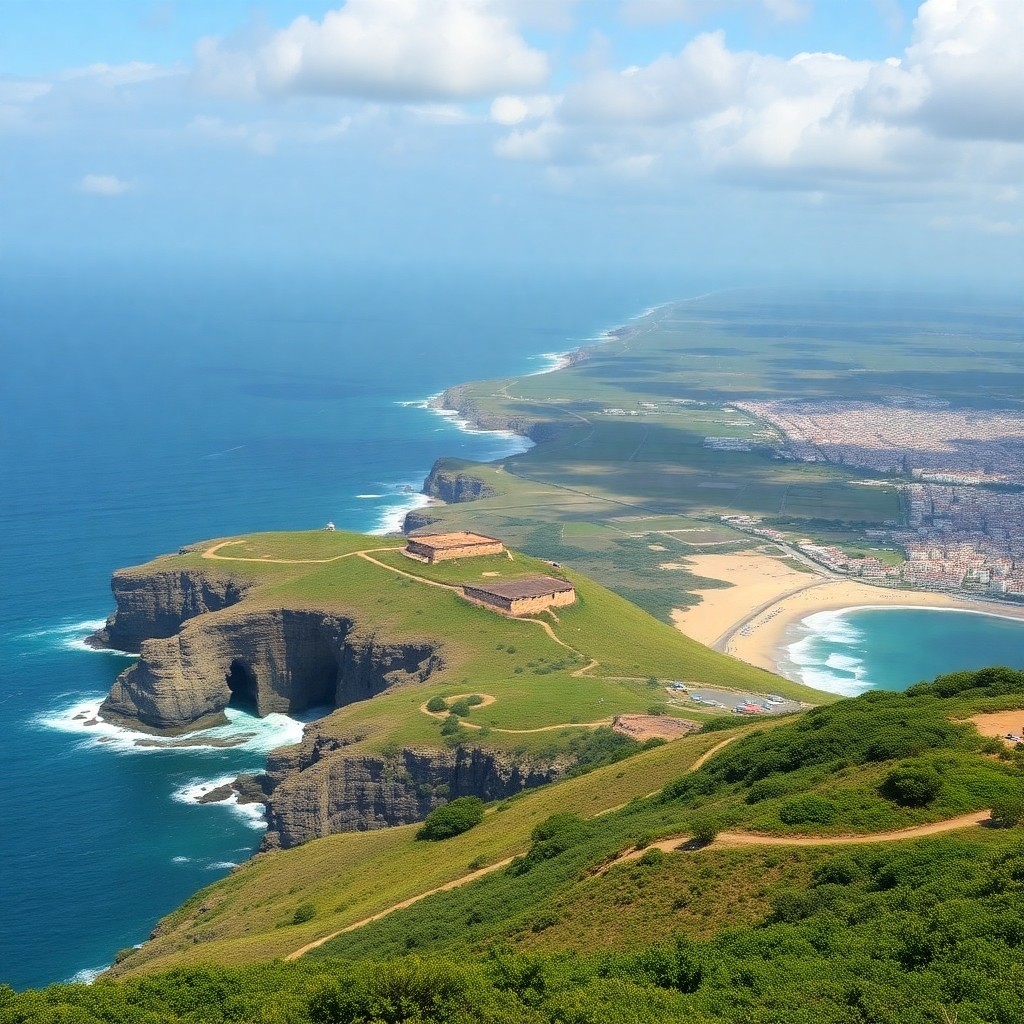
In the unforgiving heart of the North Atlantic, where the wind lashes against basalt cliffs of almost mythological grandeur and the mist dictates the rhythm of daily life, football transcends mere entertainment to become a manifesto of sovereignty and resilience. The Faroe Islands, a volcanic archipelago consisting of eighteen autonomous islands under the Danish crown, are home to just over fifty-four thousand inhabitants. Yet, it is on the green carpet—often synthetic and battered by gusts of wind that defy the laws of physics—that this island territory with narrow geographical limits projects its global identity. The Faroe Islands national football team, affectionately nicknamed Landsliðið, carries with it one of the most unique, poetic, and tactically intriguing trajectories in modern international football.
Far from being just a picturesque punching bag of the European continent, the Faroese side has built, over little more than three decades of official affiliation with FIFA and UEFA, a reputation for granite-like resistance. From the historic and folkloric afternoon of 1990 in Landskrona, when they shocked the planet by defeating Austria, to the recent and historic campaign of KÍ Klaksvík in the UEFA Conference League—which put the country's club football on the map of the European group stages—the islands have proven that organized passion and structural planning can mitigate severe demographic and climatic limitations. This dossier dives into the depths of a football molded by harsh weather, analyzing its historical genesis, its unlikely heroes, its complex geopolitical relations, its recent tactical revolution, and the training model that turned fishermen and laborers into high-performance athletes capable of challenging the greatest powers of the Old Continent.
1. Origins and Formation of National Identity
To understand the genesis of football in the Faroe Islands, it is imperative to decouple the sport from its mere recreational dimension and place it in the context of the cultural affirmation of a people who, historically, oscillated between absolute geographical isolation and external political tutelage. Under Danish rule since the Treaty of Kiel in 1814, the Faroese developed a deep sense of self-sufficiency. Football arrived in the archipelago at the end of the 19th century, brought by students and sailors returning from the continent. The first formal club, TB Tvøroyri, was founded in 1892, followed quickly by HB Tórshavn and B36 Tórshavn in the capital. At that time, playing football on the islands was an act of physical heroism: the pitches were black volcanic sand beaches at low tide or rocky, uneven terrain where the heavy leather ball absorbed constant moisture, becoming a dangerous weapon for the athletes.
The Transition from Gravel Pitches and the Founding of the FSF
For decades, Faroese football survived in a state of almost complete isolation. International clashes were limited to friendly and unofficial matches against neighboring teams of a similar profile, such as the Shetland Islands, Orkney, and Iceland—which, at the time, was also testing professionalism. The major infrastructural and administrative turning point occurred in the 1970s. In 1979, the Faroe Islands Football Association (Fótbóltssamband Føroya - FSF) was founded, which took over the organization of local championships and began the process of disassociating from the Danish federation for sporting purposes. The FSF's main challenge was not just technical, but geographical: how to ensure the practice of football in a territory where natural grass simply does not survive the harsh winter, the salty wind, and constant trampling? The answer came with the pioneering introduction of first-generation artificial turf in the 1980s. Although hard and abrasive, these pitches allowed young Faroese to play year-round, regardless of Atlantic storms, shaping a style of play characterized by speed of thought and physical resistance to impact.
The Battle for International Recognition
Official recognition by FIFA in 1988 and UEFA in 1990 was not just a sporting achievement, but an event of profound geopolitical relevance. For an autonomous territory that sought to preserve its own language (Faroese, of ancient Nordic root) and its fishing traditions against the cultural hegemony of Copenhagen, admission to the highest football entities meant that, for the first time, the Faroese flag (the Merkið) would be hoisted and the national anthem (Tú alfagra land mítt) would be played on prestigious international stages. Football became the archipelago's most effective ambassador. However, the international community received the new members with skepticism. The European press frequently questioned the legitimacy of a team composed of amateurs—postmen, carpenters, teachers, and fishermen—competing against the millionaires of professional football. This initial disdain served as psychological fuel for building a working-class playing identity, where mutual physical commitment and almost military tactical discipline compensated for the obvious technical disparity.
2. Golden Era, Great Campaigns, and Eternal Idols
If admission to UEFA was the prologue, September 12, 1990, is, without any room for dispute, the most sacred chapter in the history of Faroese sport. In their first official competitive match, valid for the Euro 1992 qualifiers, the Faroe Islands faced the star-studded Austrian team, which had played in the World Cup in Italy months earlier. Due to the total absence of UEFA-approved natural grass pitches in the archipelago, the game was moved to the Swedish city of Landskrona. The scenario seemed designed for a crushing defeat by the Austrians, led by star Toni Polster.
The Miracle of Landskrona and Knudsen's Beanie
What happened over the next two hours in Sweden defied all logic of football. With a compact defense and superhuman determination, the Faroese resisted the initial pressure. In goal, the iconic figure of Jens Martin Knudsen stood out, a goalkeeper with impressive reflexes who played wearing a wool beanie with a pom-pom—a medical precaution adopted after suffering a serious head injury in childhood. In the 17th minute of the second half, midfielder Torkil Nielsen, who worked for a building materials company, threaded the Austrian defense and unleashed a low left-footed shot, beating goalkeeper Michael Konsel. The 1-0 scoreline was defended tooth and nail until the final whistle. The "Miracle of Landskrona" not only shocked Europe but set the standard that no continental giant could visit the Faroe Islands—or face them on neutral ground—expecting an easy afternoon. Upon arrival in Tórshavn, the delegation was greeted by a crowd representing almost half the country's population, a moment of collective catharsis that consolidated football as the great national passion.
The Allan Simonsen Era and Consolidation
To prevent the victory over Austria from being labeled as an isolated stroke of luck, the FSF made a bold decision in 1994: to hire the Dane Allan Simonsen, a legend of Borussia Mönchengladbach and Barcelona, and winner of the 1977 Ballon d'Or, as head coach. Hiring Simonsen was a professional watershed. He introduced modern concepts of nutrition, physical preparation, and tactical analysis that were completely unknown to local amateur athletes. Under Simonsen's command, the Faroe Islands stopped being a team that only defended in their own box to become an organized side, capable of picking up precious points against mid-tier teams like Hungary, Finland, and Wales. It was during this transition that names like Fróði Benjaminsen emerged, a midfielder of inexhaustible physical vigor who would become the player with the most appearances in the national team's history (121 games), and Rógvi Jacobsen, the slender striker who took over as the team's all-time top scorer, netting memorable goals against powers like Italy and Scotland.
The Double Upset of Ranieri's Greece
Two decades after the feat against Austria, the Faroe Islands returned to haunt the continent during the Euro 2016 qualifiers. Drawn in the same group as Greece—European champions in 2004 and coming off an excellent performance in the 2014 World Cup under the command of the prestigious Claudio Ranieri—the Faroese staged what many analysts consider one of the biggest upsets in terms of FIFA ranking. On November 14, 2014, at the Karaiskakis Stadium in Piraeus, a goal by Jóan Símun Edmundsson secured a 1-0 victory, prompting Ranieri's immediate dismissal. Seven months later, on June 13, 2015, at the Tórsvøllur Stadium in Tórshavn, the Faroese proved their superiority by beating the Greeks again 2-1, with goals from Hallur Hansson and Brandur Hendriksson Olsen. These victories were not the result of chance, but of a generation of players who were already playing professionally in Scandinavian leagues, demonstrating that the technical abyss between the islands and the rest of Europe was consistently shrinking.
3. Rivalries, Crises, and Behind-the-Scenes Power
Although the external narrative about Faroese football is often romantic, the behind-the-scenes of the sport in the archipelago are marked by political tensions, intense parochial rivalries, and the constant geopolitical tug-of-war with Denmark. The relationship with the Danish "motherland" is, in itself, full of nuances. Although many Faroese players developed in the youth academies of Danish clubs like Brøndby and FC Copenhagen, there is a fierce nationalist pride that rejects any interference from Copenhagen. Historically, direct clashes against Denmark in official competitions are treated by the Faroese not just as football matches, but as assertions of de facto independence, where standing up to the colonizers takes on the contours of historical drama.
The North Atlantic Derby and Regional Hegemony
Regionally, the Faroe Islands' biggest rivalry is against Iceland. Known as the "North Atlantic Derby," the clash carries centuries of shared history of isolation, fishing, and Viking heritage. During the 1970s and 1980s, games against the Icelanders were frequent and extremely physical. Iceland, which began its football revolution a few years before the Faroes, served as both a mirror and a rival to be beaten. Each Faroese victory over their northern neighbors is celebrated with special fervor, symbolizing the supremacy of small fishing communities over the region's largest island. Furthermore, there is a latent rivalry with other European micro-nations, such as Andorra, Liechtenstein, and San Marino. In these clashes, the pressure is reversed: the Faroe Islands take on the role of "favorites," and any result other than a victory is treated by the local press as a national crisis of catastrophic proportions.
The Crisis of Transition to Professionalism and Internal Conflicts
The transition from romantic amateurism to semi-professionalism and full professionalism did not occur without social and administrative friction. In the early 2000s, the FSF faced serious internal governance crises. The central debate revolved around the distribution of resources: the capital clubs, HB and B36, which concentrated political and economic power, were accused by clubs from the peripheral islands (such as KÍ Klaksvík in the north and TB Tvøroyri in the south) of monopolizing investments in infrastructure and training. This geographical division reflects the archipelago's own social organization, where residents of the northern islands often feel marginalized by the centralizing decisions of Tórshavn.
Furthermore, the federation had to deal with the ethical and financial dilemma of maintaining athletes who balanced their routines between national team training and their daily jobs. On several occasions, foreign coaches clashed with the FSF board by demanding exclusive dedication from players who could not afford to abandon their stable professional careers in the fishing industry or civil service for short, unstable contracts in local football. There were documented cases of athletes who refused call-ups for World Cup qualifying matches because the daily allowances offered by the federation did not cover the lost work days in their respective civilian professions—a bizarre reality by modern football standards, but routine in the North Atlantic.
4. The Current Moment: Tactics, Generation, and Challenges
Under the technical command of experienced Swedish coach Håkan Ericson, who took the job in 2019 after a successful stint with the Swedish Olympic team, the Faroe Islands have experienced a profound tactical and methodological revolution. Ericson quickly understood that the traditional "park the bus and long ball" approach (the classic British kick and rush, heavily influenced by geographical and cultural proximity to Scotland) was no longer enough to compete on the contemporary stage, where even lower-ranked teams present impeccable tactical organization.
Håkan Ericson's Tactical Modernization
Ericson implemented a gradual transition from the traditional 5-4-1 scheme, extremely deep and passive, to a dynamic 4-1-4-1 or 4-4-2 that prioritizes mid-block compactness, coordinated pressure on the opponent's build-up, and fast offensive transitions down the flanks. The main focus shifted to maintaining ball possession under pressure, something previous generations had extreme difficulty executing. Instead of simply booting the ball forward in an attempt to relieve defensive pressure, today's Faroese defenders are instructed to start building play from the back, utilizing the tactical intelligence of modern midfielders.
- Defensive Organization: Compact lines of four defenders, with full-backs pushing up to press opposing wingers, supported by a defensive midfielder with a strong physical presence.
- Offensive Transition: Intensive use of the flanks, exploiting the speed of players who play in Scandinavian football, with quick crosses into the box looking for the target striker.
- Set Pieces: The team's great historical asset has been refined. Under Ericson, corner kicks and wide free kicks are exhaustively rehearsed, taking advantage of the tall stature and natural physical strength of Nordic athletes.
The Pillars of the Current Generation
The backbone of the current national team reflects the success of the talent export process to leagues with higher competitive demands in Europe. In goal, Gunnar Nielsen, with his vast experience in English football (where he even debuted in the Premier League for Manchester City) and Icelandic football, was the team's spiritual leader for years, paving the way for a new crop of secure goalkeepers. In the defensive line, left-back and captain Viljormur Davidsen, who built a solid career in Denmark and Sweden, offers defensive balance and quality in offensive support.
The team's greatest technical quality lies in the midfield sector. Players like Brandur Hendriksson (with stints at FC Copenhagen and Helsingborgs) and Jóannes Bjartalíð bring creativity, vision, and long-range finishing ability—characteristics that were once rare in the national team. In attack, the physical presence and mobility of athletes playing in the Norwegian and Danish first divisions ensure that the team can retain the ball in the attacking third, allowing the defensive block to move up and breathe during moments of greatest opposing pressure.
Consolidation in the UEFA Nations League
The fruits of this tactical evolution were indisputably harvested in the UEFA Nations League. In the 2020-21 edition, the Faroe Islands earned promotion from League D to League C undefeated, overcoming teams like Malta, Latvia, and Andorra. In the following campaign, in League C, the Faroese proved they belonged at that level by defeating the traditional Turkish national team 2-1 in Tórshavn on September 25, 2022. This victory over a team full of stars playing in major European leagues was the definitive validation of Ericson's work and the tactical maturity of a group of players who refuse to be treated as mere supporting actors.
5. Talent Development, Structure, and Future
The sustainable success of Faroese football is not a divine miracle, but the direct result of a highly planned, centralized, and intelligently funded sports development model. In a country with just over 50,000 inhabitants, the margin for error in talent detection is zero. If a young person with athletic potential decides to play another sport or gives up football due to a lack of incentive, the loss to the national system is immeasurable. Therefore, the FSF, in partnership with the local government and municipalities, has developed one of the most impressive per capita sports infrastructures on the planet.
The Infrastructure Revolution and Indoor Pitches
To mitigate the severe climatic limitations that historically prevented the practice of football during the autumn and winter months, the archipelago invested massively in the construction of state-of-the-art FIFA-approved synthetic grass pitches, as well as modern gymnasiums and indoor arenas known as "multihalls." Today, practically every village with more than a few hundred inhabitants has access to a high-quality football pitch. This ensures that any Faroese child, regardless of how remote their home island is, can train in ideal conditions throughout the year.
The Success Story of KÍ Klaksvík
The ultimate materialization of the success of this structural model occurred in the 2023-24 season, when KÍ Klaksvík, a club from the second-largest city in the Faroe Islands (with a population of only 5,000 inhabitants), reached the group stage of the UEFA Conference League. In the qualifying rounds, Klaksvík eliminated national giants like Ferencváros of Hungary (with a humiliating 3-0 victory in Budapest) and BK Häcken, the Swedish champions. Klaksvík's feat was not just a historic milestone for the country's football, but served as irrefutable proof that the technical level of the local championship, the Betri deildin, has evolved to the point of competing on equal terms with established professional leagues on the continent.
The Export Model and Scandinavian Integration
The path for the development of young Faroese talent follows a well-defined route integrated with the Scandinavian market. The FSF maintains informal partnerships and close communication channels with clubs in Denmark, Norway, Sweden, and Iceland. Young players who stand out in local youth categories are quickly integrated into exchange programs or transferred to elite Scandinavian club academies at age 15 or 16. This early and planned exodus ensures that athletes finish their training process in highly competitive environments, returning to the national team as complete and tactically mature professionals.
Future Perspectives and the Demographic Challenge
The great challenge for the future of Faroese football lies in maintaining the sustainability of this model in the face of inevitable demographic limitations. The FSF works continuously to expand the base of practitioners, with a special focus on the growth of women's football, which has also shown impressive results at the continental level. In the long term, the goal is to permanently consolidate the national team in League C of the Nations League and, eventually, seek a historic and unprecedented qualification for the final stage of a European Championship—a dream that, given the evolution shown in recent years, no longer seems to belong exclusively to the realm of utopian fantasy, but rather to the strategic planning of a people accustomed to bending the Atlantic winds in their favor.





