



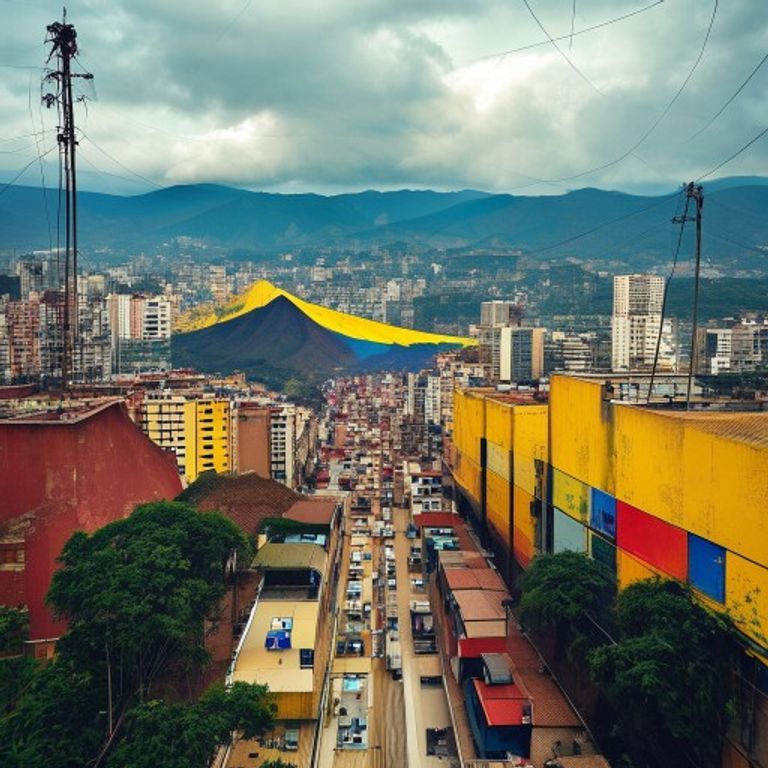
Possessing the world's largest oil reserves, Venezuela also boasts unparalleled natural beauty, such as Angel Falls, the highest waterfall on the planet. With a stunning Caribbean coastline and the tepuis of Gran Sabana, the country has a privileged geography. Despite recent political challenges, it maintains a strong cultural identity, marked by music, baseball, and biodiversity.
⚠️ Research conducted with the aid of Deep Research is subject to referential ambiguity.
🖥️Clean HTML code using a proprietary tool.
👥 Research by Guilherme Felipe, Curation by Sílvio Lôbo
The Multifaceted Voice of a Nation: An Overview of Venezuelan Literature
Venezuela, a land of exuberant natural beauty and a complex, often turbulent history, finds in its literature a powerful mirror of its multifaceted cultural identity. From the cry for freedom to the whispers of contemporary melancholy, Venezuelan writers have delved into the particularities of their land and people, creating a rich and diverse literary body. This essay aims to explore this production, highlighting crucial authors, historical movements, significant publications, and how local identity manifests in their works.
Roots and Early Voices: The Beginning of Literary Formation
The first literary manifestations in Venezuela, as in much of Latin America, are intrinsically linked to the colonial period and the struggle for independence. Poetry and historical writings dominated the initial scene. However, it is in the 19th century that we begin to glimpse a more robust national sentiment. Authors like Andrés Bello, although better known for his work as a humanist and philologist, also made important contributions to poetry and essay writing that influenced Venezuelan thought.
The novel, as a genre of mass appeal and social reflection, gained strength later. It is impossible to speak of Venezuelan literature without mentioning Rómulo Gallegos. His work, especially "Doña Bárbara" (1929), is an inseparable landmark of national identity. Gallegos masterfully portrays the conflict between civilization and barbarism, man and land, personified in the figure of the powerful rancher and the wild landscape of the Venezuelan Llanos. The language he used, full of regionalisms and sounds, captures the essence of the "llanero" and the rural environment, consolidating a collective imagination.
Historical Literary Movements and Their Marks
The 20th century was a stage for literary effervescence, with various movements seeking new forms of expression and addressing Venezuelan realities with distinct perspectives:
- Generation of '28: This group, known for its strong political and social engagement, was fundamental in challenging the dictatorial regime of Juan Vicente Gómez. Authors like Miguel Otero Silva, in works such as "Fiebre" and "Casas Muertas," and Raimundo Pidal, brought themes of oppression, social injustice, and the hardships of exile to literature.
- Boletín de la Poesía (1940s): Although not a formal literary movement, the publication of this bulletin and the poetic activity around it propelled experimentation and renewal of poetic language.
- "El Círculo de Witt" and Surrealism: In the 1950s, some writers like Vicente Gerbasi and Otero Silva, with surrealist influences, explored the unconscious and the dreamlike universe, seeking new ways to portray Venezuelan reality, often marked by violence and instability.
Authors Who Shaped Thought and Sensitivity
Besides Rómulo Gallegos, Venezuela has a pantheon of authors whose works continue to resonate and influence Latin American literature and thought:
- Rómulo Gallegos: As already mentioned, his work is a pillar of Venezuelan literature.
- Miguel Otero Silva: His engaged prose and skill in weaving historical and social narratives make him a reference author.
- Alejandro Dumas: Despite being a name more associated with French literature, he is the author of "The Count of Monte Cristo," a work with a strong presence in Venezuela.
- Salvador Garmendia: Known for his experimental prose and for portraying urban life and the existential dilemmas of modern man, with works such as "Los Pequeños Sabios" and "Memorias de Alicia."
- Adriano González León: His fiction, often with a melancholic and dreamlike tone, explores memory, identity, and the human condition, with "País Portátil" being a standout.
- Milagros Socorro: One of the most important female voices in contemporary Venezuelan literature, with a body of work that oscillates between realism and the fantastic, addressing issues of gender and identity.
- Luis Britto García: An essayist and novelist, his works frequently address Venezuelan history and politics with a critical and insightful perspective.
Important Publications and the Imprint of Memory
The dissemination of Venezuelan literature is facilitated by various publications, both historical and contemporary:
- "El Nacional" and "El Universal": These historical newspapers were important vehicles for the publication of short stories, chronicles, and poems, as well as fostering literary and cultural debates.
- Literary Magazines: Over time, various magazines have emerged and disappeared, but many have played a crucial role in promoting new talents and articulating aesthetic movements.
- Independent Publishers: In recent times, the proliferation of independent publishers has been fundamental in giving voice to authors who might not find space in large publishing groups, allowing for greater thematic and stylistic diversity.
Cultural Identity in Ink and Paper
Venezuelan literature is a melting pot of identities. Indigenous, African, and European influences intertwine in the formation of the national character, and this is deeply reflected in the works:
- The Venezuelan "Being": The search for the definition of what it means to be Venezuelan is a recurring theme. The relationship with the land, ancestry, music (such as joropo and merengue), cuisine, and popular beliefs emerge as identity elements.
- The Influence of Politics and History: Political instability, dictatorships, revolutions, and oil wealth have shaped the Venezuelan experience. Authors like Otero Silva and Britto García frequently delve into these themes, uncovering the layers of history and their consequences on individual and collective life.
- Everyday Life and the City: Urban life, with its contradictions, poverty and opulence, the search for a place in the world, are masterfully portrayed by authors like Salvador Garmendia.
- Melancholy and Hope: In times of crisis and uncertainty, Venezuelan literature has become a refuge for reflection on loss, longing for the homeland, and resilience. At the same time, there is a constant yearning for a better future, a seed of hope that pulses in many narratives.
In summary, Venezuelan literature is a vast and vibrant universe, where the voices of its authors narrate the saga of a nation in constant transformation. From the echo of the llanos to the agitation of the metropolises, each book is a fragment of the Venezuelan soul, an invitation to unravel the complexities of a rich and resilient culture.





