



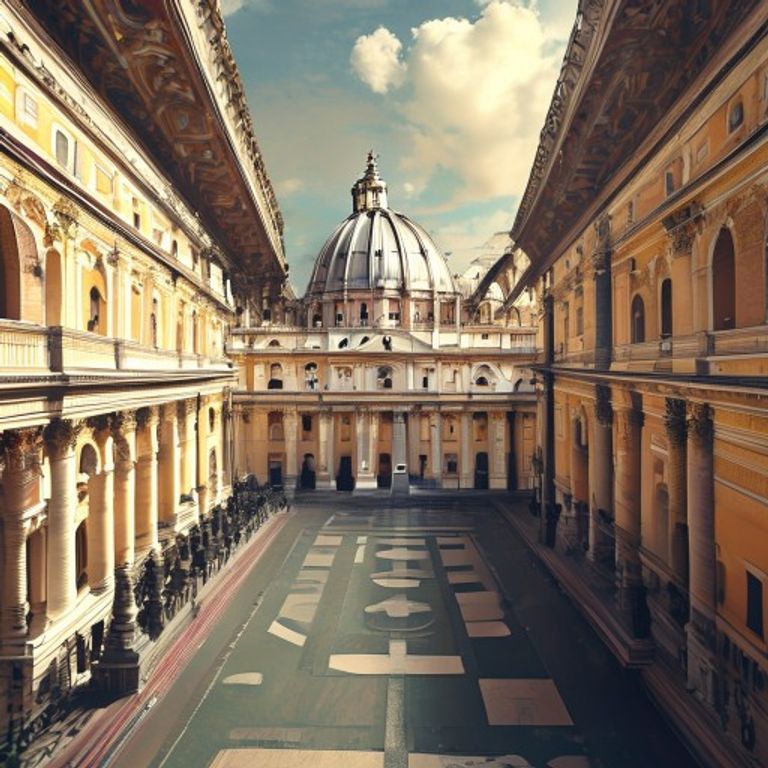
The world's smallest sovereign state, the Vatican is the spiritual heart of the Catholic Church and the residence of the Pope. Nestled in Rome, it houses incalculable artistic treasures such as St. Peter's Basilica and Michelangelo's Sistine Chapel. With fewer than 1000 inhabitants and guarded by the Swiss Guard, it is a center of pilgrimage and global diplomacy, transcending its physical size.
⚠️ Research elaborated with the aid of Deep Research is subject to referential ambiguity.
🖥️Clean HTML code using a proprietary tool.
👥Research by Guilherme Felipe, Curation by Sílvio Lôbo
The Citadel of Words: An Analysis of Vatican Literature
The Vatican, a sovereign state of minuscule dimensions but colossal influence, is not only the spiritual center for billions but also a cultural microcosm where the written word has found fertile ground to flourish, albeit in a unique way. Vatican literature, often overshadowed by the weight of its religious history and the grandeur of its institutions, is a field rich in theological, philosophical, and existential reflections, intrinsically linked to its unique identity.
Key Authors and Voices
Literary production originating from the Vatican is not limited to one genre or a restricted group of authors. On the contrary, it spans a diverse spectrum, with prominent figures who have shaped and continue to shape intellectual and spiritual discourse. It is crucial to recognize that many of the most influential writers associated with the Vatican are, in fact, clergy, theologians, and scholars who lived and worked within its domains, leaving a lasting legacy.
- Pope John Paul II (Karol Wojtyła): Perhaps the most prominent literary figure directly linked to the Vatican in the 20th and early 21st centuries. Wojtyła was a prolific poet, playwright, and philosopher. His poems, such as The Gold and the Brilliancy, explore themes of faith, love, and human nature with remarkable lyrical sensitivity. His philosophical essays, like The Acting Person, are pillars of Christian anthropological thought.
- Joseph Ratzinger (Pope Benedict XVI): A world-renowned theologian, Ratzinger produced a vast and complex body of work that delves into faith, reason, and the history of Christianity. His writings, though primarily academic and theological, possess a literary and stylistic depth that elevates them beyond mere treatises. Books like Introduction to Christianity and Jesus of Nazareth are examples of his erudition and clarity of expression.
- Various Ecclesiastics and Academics: Throughout the centuries, countless cardinals, bishops, and scholars from the Pontifical Gregorian University and other Vatican institutions have contributed to literature with works on theology, philosophy, church history, and canon law. While not always published under the strict label of "literature," these works form the intellectual framework that underpins much of the Vatican's discursive output.
Historical Literary Movements and Their Implications
It is difficult to speak of "literary movements" in the Vatican in the same way one would in secular literary centers. The primary influence and driving force have always been theological tradition and the doctrine of the Catholic Church. However, we can identify trends and currents of thought that have been reflected in literary forms:
- The Divine Word and Theological Dialectic: From the earliest writings of the Church Fathers to modern treatises, a constant has been the exploration of the "Divine Word" (the Logos) and the complex dialectic between faith and reason. This approach, often expressed in theological essays and homilies, can be considered a literary form in itself, with its own rhetoric and argumentative structure.
- Christian Humanism: Particularly evident during the pontificate of John Paul II, Christian humanism sought to reconcile the intrinsic dignity of the human person with faith. This current manifested itself in both philosophical texts and more personal literary works, which celebrated the beauty of creation and the complexity of human experience in light of faith.
- Biblical Interpretation and Narrative: The analysis and interpretation of the Holy Scriptures have always been a pillar of Vatican intellectual life. While not "fiction" in the conventional sense, biblical commentaries and reflections on biblical narratives often employ literary techniques to bring ancient texts to life and make them relevant to the present.
Important Publications and the Flow of Knowledge
Publications originating from the Vatican are crucial for disseminating its thought and maintaining its intellectual legacy. While there isn't a strict canon of "Vatican literature" in terms of secular fiction, the following areas and institutions play a vital role:
- Pontifical Publications (Libreria Editrice Vaticana - LEV): LEV is the official publisher of the Holy See and publishes a wide range of works, including official documents from the Pope and the Roman Curia, encyclicals, apostolic exhortations, but also books on theology, spirituality, history, and biographies of important ecclesiastical figures.
- Academic and Theological Journals: Institutions such as the Pontifical Gregorian University publish renowned periodicals that serve as platforms for theological and philosophical research and debate, often containing essays with literary depth.
- Diaries and Memoirs of Ecclesiastical Figures: Although not always officially published by the Vatican, diaries, letters, and memoirs of cardinals and other prominent individuals linked to the Holy See offer valuable insights into their lives and thoughts, often with literary qualities.
Cultural Identity Reflected in Books
Vatican literature is, in essence, a reflection of its unique cultural identity: a center of faith, history, art, and diplomacy. This identity manifests in various ways:
- The Primacy of Faith and Theology: Catholic faith is not only the central theme of many works but also the lens through which the world is understood and interpreted. The pursuit of divine truth and humanity's relationship with the sacred are constant concerns.
- A Dialogue with History: The Vatican is a repository of centuries of history. The literature produced within its domains frequently engages in dialogue with this history, whether through reflections on the evolution of doctrine, the lives of saints, or the Church's influence over time.
- Universality and Mission: The Vatican's identity is intrinsically global, oriented towards a universal mission. This is reflected in works that seek to address fundamental human questions and propose paths for understanding and coexistence, often with a strong ethical and moral appeal.
- The Influence of Art and Architecture: While not directly manifested in fictional narrative, the artistic and architectural richness of the Vatican, a repository of masterpieces, inevitably permeates the sensibility of authors, influencing how beauty, transcendence, and order are perceived and described.
In summary, Vatican literature is a complex and multifaceted field, intimately linked to its nature as the seat of the Catholic Church. While it may not boast the genre diversity of secular literature, its theological depth, historical resonance, and constant search for meaning make it an intellectual and spiritual testament of inestimable value, a beacon of words in a citadel of faith.





