



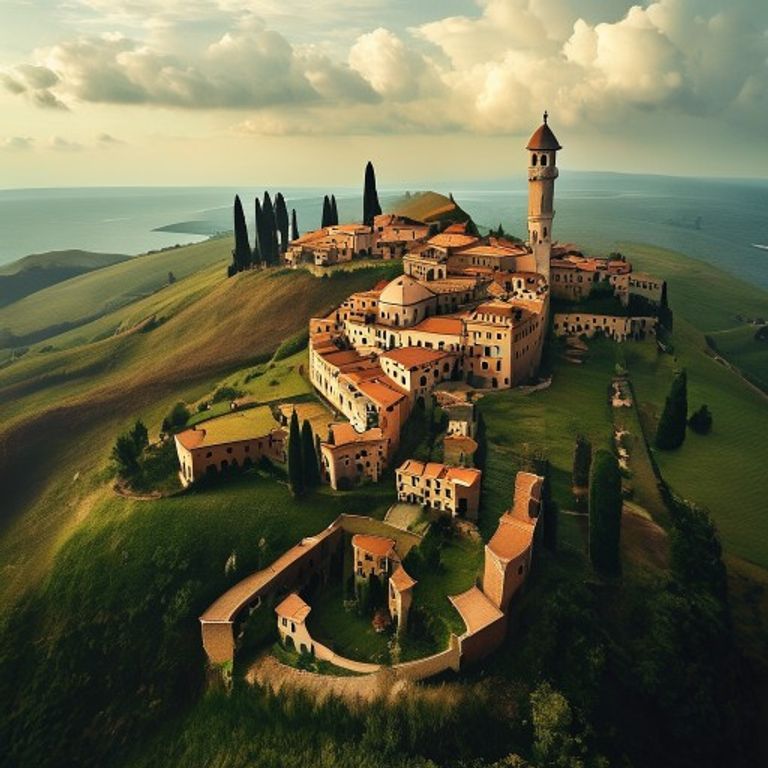
The cradle of the Roman Empire and the Renaissance, Italy is an open-air museum where history meets modern fashion. World-renowned for its unparalleled cuisine of pasta and wines, the country offers landscapes ranging from the canals of Venice to the Amalfi Coast. Italian passion is manifested in art, sports car design, and the relaxed, elegant Mediterranean lifestyle.
⚠️ Research elaborated with the aid of Deep Research is subject to referential ambiguity.
🖥️Clean HTML code using a proprietary tool.
👥 Research by Guilherme Felipe, Curation by Sílvio Lôbo
The Soul of the Boot: A Deep Dive into Italian Literature
Italy, with its millennia-old history and breathtaking landscapes, is an inexhaustible cradle of literary creativity. From Classical Antiquity to the Renaissance, through the Enlightenment and into the complexities of contemporaneity, Italian literature has been a faithful mirror and a driving force for the transformation of a people's cultural identity. This essay aims to explore the deepest veins of this literary tradition, highlighting its exponents, movements, masterpieces, and the intrinsic relationship between writing and the Italian spirit.
The Pillars of the Word: Unforgettable Authors
The Italian literary history is marked by names that echo through the centuries, whose works have shaped not only literature itself but also Western thought. It is impossible to speak of Italian literature without evoking Dante Alighieri, whose monumental "The Divine Comedy" is not only a landmark of medieval poetry but a pillar of the Italian language and a profound reflection on faith, morality, and the human condition. His journey through Hell, Purgatory, and Paradise established a paradigm for allegorical narrative and influenced generations of writers.
In the Renaissance, the figure of Francesco Petrarca stands out. Considered the "father of humanism," his "Canzoniere" introduced introspective lyricism and a deep exploration of amorous feelings, establishing the sonnet as the dominant poetic form. Alongside him, Giovanni Boccaccio, with his "Decameron," offered a vivid and often irreverent portrait of the society of the time, using rich prose and unparalleled narrative skill to weave stories that address everything from love and fortune to cunning and questionable morality.
Moving forward to modern times, names like Alessandro Manzoni and his epic historical novel "The Betrothed" (I Promessi Sposi) are fundamental. The work, set in 17th-century Lombardy, not only masterfully portrays a turbulent period in Italian history but also became a powerful instrument in the linguistic unification of the country, using accessible and expressive Italian.
In the 20th century, Italian literature exploded in diversity and intensity. Existentialism and Neorealism found powerful voices in authors like Italo Calvino, whose experimental and playful works, such as "Six Memos for the Next Millennium" and "The Baron in the Trees," challenged narrative conventions and explored the nature of fiction and reality. Alberto Moravia, with his penetrating analysis of the bourgeoisie and alienation, and Elsa Morante, with her unique sensitivity in portraying childhood and social marginalization, are other crucial names for understanding post-war literature.
20th-century poetry also produced giants. Eugenio Montale, a Nobel laureate in Literature, is known for his hermetic poetry and his deep connection with nature and the human condition in times of crisis. Giuseppe Ungaretti, with his concise and visceral poetry, marked by his experiences in World War I, offered a poignant testimony to the fragility of life.
Literary Movements: The Evolution of Italian Expression
Italian literature is not a monolithic block but a tapestry woven by various movements that reflect the historical and social contexts of each era:
- Humanism and Renaissance: The rediscovery of Greco-Roman classics and the focus on the individual propelled the development of lyrical poetry, narrative prose, and theater. Authors like Petrarca and Boccaccio are the greatest exponents.
- Arcadia: A movement reacting against the Baroque, seeking a return to simplicity and naturalness, with an emphasis on bucolic and pastoral themes.
- Enlightenment and Neoclassicism: The influence of Enlightenment ideas manifested in the pursuit of clarity, reason, and social criticism. Works like Giambattista Vico's "The New Science" marked philosophical and historical thought.
- Romanticism: Especially in the 19th century, Italian Romanticism was characterized by nationalism, the exaltation of feeling, the pursuit of freedom, and historical themes, in line with the Risorgimento. Alessandro Manzoni is a crucial representative.
- Verismo: Parallel to French Naturalism, Verismo sought to portray social reality objectively and in detail, focusing on the lower classes and their struggles. Giovanni Verga is the name most associated with this movement.
- Neorealism: In the post-World War II era, Neorealism manifested in cinema and literature, with a strong social and political commitment, depicting life in cities and the countryside amidst poverty and reconstruction. Cesare Pavese and Vasco Pratolini are important figures.
- Experimentalism and Postmodernism: The second half of the 20th century and the beginning of the 21st saw an explosion of new forms and themes, with authors like Italo Calvino and Umberto Eco challenging the boundaries of narrative and intertextuality.
Essential Publications: A Legacy in Words
Several publications have been crucial for the dissemination and consolidation of Italian literature throughout the centuries:
- "The Divine Comedy" (Dante Alighieri): The epic poem that defined the Italian language and literature.
- "Decameron" (Giovanni Boccaccio): A collection of short stories that established narrative prose and depicted medieval society.
- "Canzoniere" (Francesco Petrarca): The work that revolutionized lyrical poetry and consolidated the sonnet.
- "The Betrothed" (Alessandro Manzoni): A historical novel that served as a model for modern Italian language.
- "The House by the Medlar Tree" (Giovanni Verga): An exponent of Verismo, depicting the lives of fishermen in Sicily.
- "The Baron in the Trees" (Italo Calvino): An example of Calvino's experimental genius, exploring the relationship between man and nature.
- "The Name of the Rose" (Umberto Eco): A historical and philosophical novel that became a global phenomenon, demonstrating the capacity of Italian literature to engage with complex themes.
Cultural Identity in the Literary Mirror
Italian literature is inseparable from its multifaceted cultural identity. The richness of dialects, the importance of family, the intrinsic relationship with history and art, gastronomy, Catholicism, and the very geographical landscape – from the Alpine Mediterranean to fertile plains – all are reflected in the pages of its books.
The novels of Leonardo Sciascia, for example, delve into the complexities of Sicily, uncovering the intricacies of the mafia, politics, and justice with impressive intellectual rigor. The work of Elena Ferrante, with her "My Brilliant Friend" quartet, viscerally captures life in Naples, exploring female friendship, social inequalities, and the search for identity in a vibrant and sometimes oppressive urban setting.
Cuisine often transcends mere detail and becomes a fundamental narrative element, connecting characters and evoking memories. The passion for football, the melodrama of family relationships, the aesthetic beauty present in everyday life, all find a place in Italian literature, manifesting through a language that, even when translated, still carries the melody and expressiveness of the original tongue.
In summary, Italian literature is an inexhaustible treasure, a constant invitation to reflect on the human condition, the beauty of life, and the labyrinths of the soul. Its authors, movements, and publications are not just remnants of the past but living forces that continue to shape the present and inspire the future, reaffirming Italy as a beacon of literary creativity on the world stage.





