



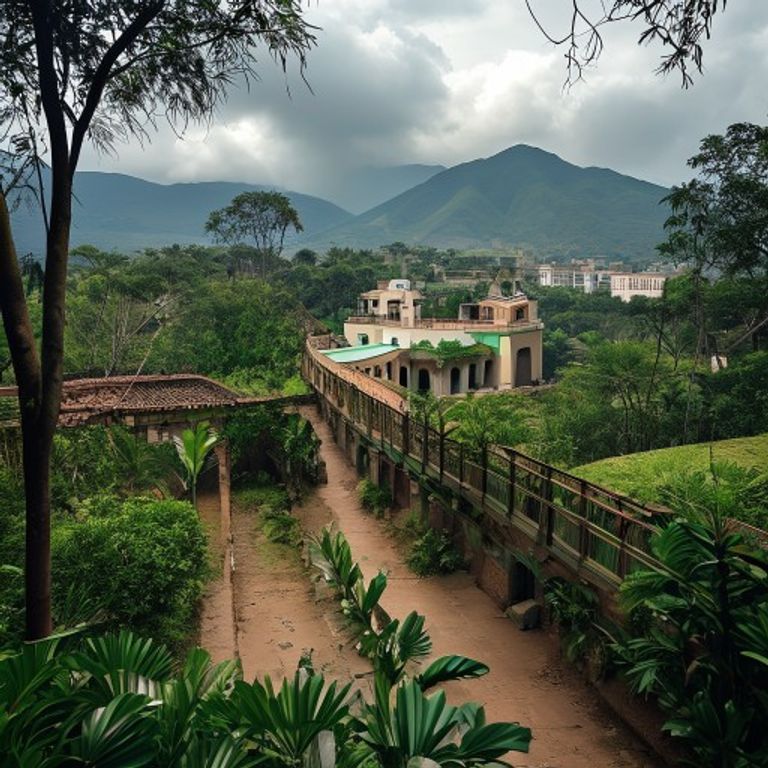
The heart of the Mayan world, Guatemala is home to Tikal, one of the largest and most impressive ancient cities in America. Its landscape is dominated by active volcanoes and the beautiful Lake Atitlán. Its living culture is reflected in the colorful markets of Chichicastenango and traditional textiles. It is a land of eternal spring, blending religious syncretism, colonial history in Antigua, and lush nature.
⚠️ Research elaborated with the help of Deep Research is subject to referential ambiguity.
🖥️Clean HTML code using a proprietary tool.
👥 Research by Guilherme Felipe, Curation by Sílvio Lôbo
The Voice of Guatemala: A Literary Mosaic Between Mountains and History
Guatemalan literature, a vibrant reflection of its rich and sometimes turbulent history, pulses with narratives that transcend geographical borders to touch upon universal themes of identity, struggle, and hope. As a literary critic and researcher, embarking on the exploration of the letters born or deeply rooted in this land is to unravel a complex mosaic, shaped by the voices of its writers, the echoes of its literary movements, and the intrinsic connection to its unique cultural identity.
Heritages and Fundamental Voices
The strength of Guatemalan literature lies, in large part, in its visionary authors, whose works not only defined periods but also continue to inspire generations. Undoubtedly, the most prominent name is that of Miguel Ángel Asturias, a Nobel laureate in Literature in 1967. Asturias is celebrated for his innovative fusion of magical realism with elements of Mayan cosmology, as exemplified in works such as "El Señor Presidente" (The President), a powerful indictment against dictatorship, and "Hombres de Maíz" (Men of Corn), which delves into indigenous traditions and spirituality.
Alongside Asturias emerges the figure of Humberto Ak'abal, a K'iche' poet whose work, written in his native language and later translated into Spanish and other languages, offers a profound and authentic perspective on the Mayan worldview. His poems, filled with ancestral wisdom and images of nature, resonate with a simple and deep beauty, connecting the reader to an often-forgotten spiritual and ecological world. The publication of collections such as "Ajkem naq jun tzij / El tejedor de palabras" (The Weaver of Words) solidified his place as one of the most important chroniclers of living Mayan culture.
Other significant voices include:
- Luis Cardoza y Aragón: Poet, essayist, and art critic, his work oscillates between surrealism and political engagement, addressing the social and artistic reality of the country in works like "La Nuance de la Noche".
- Rodolfo Arévalo Martínez: Chronicler and novelist, known for his clean style and exploration of everyday and historical Guatemalan themes.
- Ana María Rodas: Poet and essayist, her work explores feminism, identity, and the condition of women in contemporary Guatemala.
- Julio Fausto Aguilera: Author who contributed significantly to Guatemalan narrative with his explorations of social and historical themes.
Literary Movements and Historical Trajectories
Guatemalan literature is not static; it has evolved through various movements and historical periods. The 20th century was marked by a strong influence of Modernism, which manifested in poetry with a pursuit of formal beauty and lyricism. However, Guatemala's political and social turbulence, especially during dictatorial periods and the internal armed conflict, profoundly shaped literary expressions.
The post-World War II period saw the emergence of more engaged literature, influenced by the currents of Social Realism. Writers began to use literature as a tool for denunciation, portraying social injustices, poverty, and oppression. Miguel Ángel Asturias's work, while transcending labels, aligns with this concern for unmasking power mechanisms.
Contemporary Guatemalan literature, in turn, exhibits a plurality of voices and themes. Magical realism, which found a master in Asturias, continues to be explored, but in a renewed way. There is also a growing presence of narratives that address the experience of the diaspora, the scars of the armed conflict, the issue of migration, and the resilience of indigenous communities. The search for a multifaceted national identity, embracing both Mayan heritage and Western influences, is a constant thread.
Publications and Spaces for Expression
Throughout history, various publications and institutions have played a crucial role in disseminating Guatemalan literature. Newspapers and literary magazines, often ephemeral due to the political context, served as platforms for the publication of short stories, poems, and essays. The creation of publishing houses, both national and international, dedicated to publishing Guatemalan authors, has been fundamental in bringing visibility to their works.
The Editorial Universitaria, affiliated with the University of San Carlos of Guatemala, has historically been an important space for the publication of academic and literary authors. More recently, independent publishers and literary collectives have emerged, offering new platforms and experimenting with formats and distribution.
Literary festivals, such as the International Poetry Festival of Quetzaltenango, and cultural events at universities and cultural centers also serve as meeting points, exchange, and promotion, fostering continuous dialogue between authors, readers, and critics.
Cultural Identity on Paper
Guatemalan cultural identity is, without a doubt, one of the central pillars of its literature. The coexistence of a rich indigenous heritage, with its languages, myths, and worldviews, with the influences of Spanish colonization and the complexities of modern life, creates fertile ground for literary exploration.
Guatemalan books frequently portray:
- Mayan Heritage: The spirituality, rituals, relationship with nature, and ancestral wisdom of the Mayan peoples are recurring themes, especially in the work of authors like Humberto Ak'abal.
- Social and Political Reality: Poverty, inequality, corruption, violence, and the effects of the armed conflict are addressed with frankness and depth, often as a form of resistance and memory.
- The Search for Identity: The duality of being Guatemalan, amidst so many influences and heritages, leads to a constant reflection on what it means to belong to this land.
- Relationship with Nature: The lush landscapes, mountains, volcanoes, and biodiversity of Guatemala often serve as settings and metaphors in narratives.
In summary, Guatemalan literature is a powerful testament to the resilience, creativity, and spiritual depth of a people. Through their words, we are invited to enter a universe of ancestral myths, social struggles, and an incessant search for meaning and belonging. The continuous production of relevant works ensures that the voice of Guatemala resonates, enriching the global literary landscape with its uniqueness and poetic strength.





