



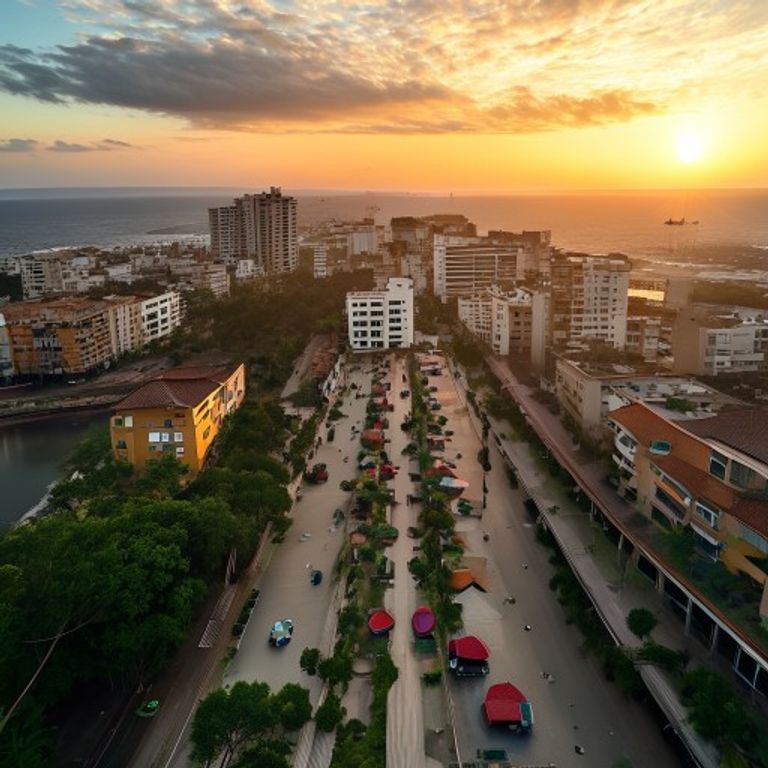
Goiás's planned capital, it stands out for its urban greenery and service sector. It is the political and economic center of the state, uniting modernity with a rich cultural heritage of the Cerrado.
⚠️ Research elaborated with the aid of Deep Research is subject to referential ambiguity.
🖥️Clean HTML code using a proprietary tool.
👥 Research by Guilherme Felipe, Curation by Sílvio Lôbo
The Literary Soul of Goiânia: Trajectories, Voices, and Reflections of a Capital Under Construction
Goiânia, the planned city that emerged from the Cerrado, boasts a multifaceted cultural identity, and its literary production, though younger compared to traditional centers, has consolidated itself as a vibrant mirror of its history, its challenges, and its people. As a literary critic and researcher, delving into the literature produced in or about Goiânia is to uncover a mosaic of voices that narrate the construction of a territory, the adaptation of its inhabitants, and the search for a place on the national stage.
Roots and First Verses: The Pioneers and the Literary Foundation
The early days of Goiânia's literature are intrinsically linked to the city's founding and development process. Although literary production was not as explicit an initial hallmark as architecture and urbanism, writing always accompanied the flow of people and ideas. Authors who arrived with the vision of a new capital brought their cultural baggage, which gradually merged with the local landscape and spirit.
A name that stands out in this initial period is Gastone Antonioli, an Italian who settled in Goiás and left a legacy of writings that captured the atmosphere of the time, even if his work is not exclusively Goianian. The prose and poetry that depicted the daily lives, difficulties, and hopes of the pioneers were fundamental to the formation of a local literary consciousness.
Movements and Publications: The Consolidation of a Literary Field
The 1970s and 1980s marked a period of cultural effervescence in Goiânia, with the emergence of groups and publications that boosted literary production. The desire to give voice to a reality distinct from that portrayed in Brazil's major urban centers motivated the creation of literary magazines and anthologies, which served as platforms for new talents.
The magazine "Gris", for example, was an important milestone, bringing together poets, short story writers, and essayists who sought to break away from more traditional aesthetics and explore contemporary themes. These publications not only disseminated works but also promoted debates and connections among writers, fostering the formation of a literary community.
Great Names and Their Works: The Legacy of Authors Settled and Born in Goiânia
The strength of Goiânia's literature is manifested in the work of authors who, either by birth or adoption, have rooted themselves in the city and made it the stage for their narratives. The diversity of styles and themes reflects the metropolis's own complexity.
- Luiz Fernando Guimarães: Although better known for his career in theater and film, Guimarães has a literary facet that explores memory and identity with a peculiar and often humorous perspective, frequently dialoguing with his origins.
- Cora Coralina: Despite her work being discovered late and her strongest connection being with the city of Goiás Velho, Cora Coralina's influence and presence in the literary formation of Goiás are undeniable. Her poems about daily life, popular wisdom, and life in the countryside resonate deeply in the Goianian soul.
- Edival Rosa: A poet and essayist, Edival Rosa is a central figure in contemporary Goianian literature. His work, marked by reflection on the city, the landscape, and the human condition, has been fundamental to literary criticism and experimentation in the region.
- Alice Spíndola: A poet and short story writer, globally acclaimed, with works in several languages, being an active correspondent in the literary world.
- Edson Franco: A versatile writer, active in short stories, novels, and poetry, Edson Franco is another name that significantly contributes to the consolidation of literature in Goiânia. His narratives often address urban life and human relationships with sensitivity and depth.
- Dalva Lemes: A novelist and short story writer, Dalva Lemes's work has a strong connection with social issues and Brazilian reality, often transposing the particularities of Goianian daily life to paper.
Cultural Identity on Stage: Goiânia's Reflection in Books
Goiânia's cultural identity is a recurring and multifaceted theme in the literature produced in the city. The idea of a "planned city," with its wide avenues, parks, and Art Deco architecture, serves as a backdrop for stories that explore the individual's relationship with urban space. The contrasts between the modern and the traditional, the countryside and the city, are also explored.
Goiânia's literature often portrays the experience of migrants who arrived in the city seeking new opportunities, the difficulty of adaptation, the building of social ties, and the formation of a collective identity in a constantly transforming environment. The Cerrado, with its peculiar vegetation, its scents, and its sounds, also makes its presence felt, bringing an element of authentic Brazilianness to the narratives.
The way authors address themes such as local politics, regional customs, cuisine, and cultural manifestations contributes to the construction of a literary narrative that not only reflects but also shapes the perception of Goianian identity. Literature in Goiânia is, therefore, a laboratory of meanings, a space where the city and its inhabitants meet, reinvent themselves, and leave their mark.
Future Perspectives: A Constantly Expanding Literature
Literature in Goiânia, much like the city itself, continues to evolve. New authors emerge, new themes gain space, and publications diversify, reaching an ever-larger audience. The role of universities, independent publishers, and literary events is crucial for the sustenance and growth of this field.
Academic research on Goianian literary production also intensifies, uncovering new layers of meaning and recognizing the importance of this production for the Brazilian literary scene. Goiânia's literature, in its uniqueness and its capacity for dialogue with the universal, demonstrates that the soul of a capital under construction has much to say.





