



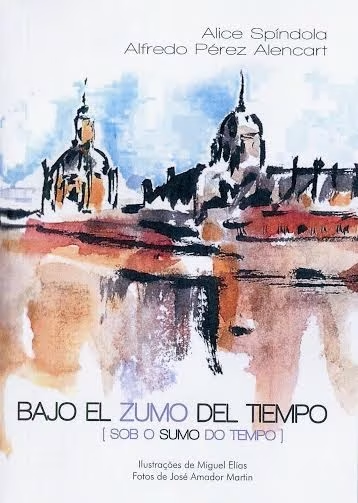
UNDER THE JUICE OF TIME
Illustrations by Miguel Elias, Photos by José Amador Martin.
⚠️ Research conducted with the aid of Deep Research is subject to referential ambiguity.
🖥️Clean HTML code using a proprietary tool.
👥 Research by Guilherme Felipe, Curation by Sílvio Lôbo
In-depth Analysis of Alice Spíndola's "Bajo el Zumo del Tempo"
The in-depth essay on Alice Spíndola's work "Bajo el Zumo del Tempo" (Under the Juice of Time) aims to unravel the layers of meaning, stylistic influences, and central themes that make it a significant piece in the contemporary literary landscape. Spíndola, with her unique prose, invites the reader to immerse themselves in a universe that oscillates between the personal and the universal, the concrete and the abstract, the tangible and the ethereal.
The Poetics of the Everyday and the Subversion of the Ordinary
One of the fundamental pillars of "Bajo el Zumo del Tempo" lies in how Alice Spíndola elevates the everyday to the category of art. The ordinary, often relegated to the background in more grandiose narratives, is here deconstructed and re-signified. The aroma of morning coffee, the texture of an old fabric, the silence of an empty room – these and other mundane elements gain a new dimension, laden with symbolism and emotional resonance. Spíndola demonstrates mastery in finding poetry in the prosaic, revealing that the extraordinary hides in the cracks of the common.
Time as a Character and Transformative Element
The very title, "Bajo el Zumo del Tempo" (Under the Juice of Time), already announces the centrality of temporality in the work. Time is not merely a backdrop but an active force, almost a character, that shapes, erodes, preserves, and transforms. Spíndola explores the fluidity of time, its comings and goings, its leaps and its stagnations. Memory, intrinsically linked to the perception of time, assumes a crucial role, acting as a link between the past, the present, and future projections. The narrative unfolds in a non-linear fashion, mirroring the complex and subjective nature of human temporal experience itself.
Fragmentation, Memory, and Identity
The structure of "Bajo el Zumo del Tempo" is often characterized by fragmentation. Spíndola chooses to unite fragments of memories, impressions, and reflections, creating a mosaic that the reader is invited to assemble. This fragmentation is not a sign of disorganization but a deliberate aesthetic choice to represent the multifaceted nature of memory and identity construction. Identity emerges not as a monolithic entity but as a construct in constant development, influenced by past experiences, present perceptions, and future expectations. Subjectivity is exalted, allowing multiple voices and perspectives to intertwine.
Language as a Tool for Sensoriality and Reflection
Alice Spíndola's prose is remarkably sensorial. The author uses language rich in imagery, textures, sounds, and smells, transporting the reader into the narrative universe. This sensory approach aims not only to create a vivid portrayal but also to evoke an emotional and introspective response. Words function as brushstrokes, delineating not only scenes but also states of mind. Furthermore, the density and precision of her language demonstrate a deep care in word choice, inviting reflection on the power and capacity of language to shape our perception of reality.
Relevant Themes Explored in the Work:
- The Ephemerality of Existence: The awareness of the passage of time and the finitude of life is a recurring theme.
- The Search for Meaning: Characters often grapple with the need to find purpose in their lives amidst uncertainties.
- Human Relationships and Their Complexities: Interactions, affections, and distances in interpersonal relationships are explored with subtlety.
- The Nature of Perception: The work questions how we perceive reality and how our individual experiences shape that perception.
- The Transformative Power of Art and Writing: Literary creation itself can be seen as an act of resistance and reconstruction of time and memory.
Conclusion: A Work for Introspection and Feeling
"Bajo el Zumo del Tempo" solidifies itself as a work that transcends mere narrative, inviting the reader to an exercise in introspection and deep feeling. Alice Spíndola, with her unparalleled ability to weave the trivial with the transcendental, offers a mirror to the complexities of the human condition. The work does not offer ready-made answers but prompts questions, stimulates reflection, and, above all, reminds us of the beauty and fragility of the time that flows through us.





