



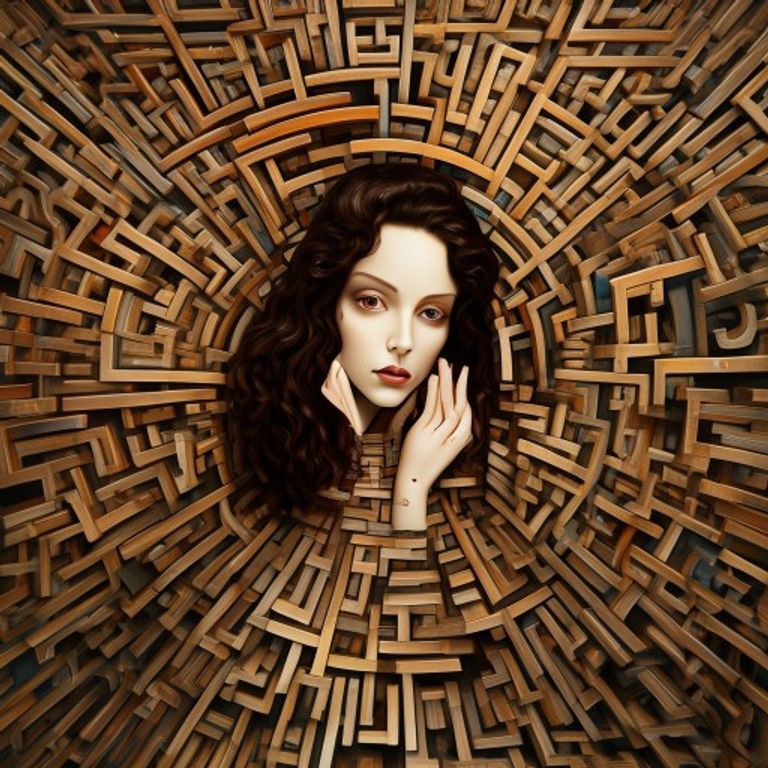
A book guided solely by Ariadne's thread, from the sometimes painful, but always brave, search for the luminous solution of images, from the architecture of dreams without concessions to the irrelevancies of formal daydreams.

Technical sheet
Code 37086801
Barcode 9788572740654
ISBN 8572740651
Publisher UFG
⚠️ Research elaborated with the aid of Deep Research is subject to referential ambiguity.
🖥️Clean HTML code with the use of a proprietary tool.
👥 Research by Guilherme Felipe, Curation Sílvio Lôbo
Labyrinth Thread: An Exploration of Narrative and Identity in Alice Spíndola's Work
The concept of "Labyrinth Thread," while not a consolidated literary or academic work under this specific title, can be interpreted as a powerful metaphor for the complexity of narrative, the journey of identity, and the search for meaning, especially when contextualized within artistic productions that explore these themes. If we consider the work of Alice Spíndola, a contemporary visual artist whose work oscillates between the real and the dreamlike, the "Labyrinth Thread" emerges as an intricate guide through the layers of her production.
The labyrinth, as an archetype, evokes the idea of winding paths, of losses and rediscoveries, of challenges and revelations. The thread, in turn, represents the guiding line, the connection, the hope of finding a way out or of following a purpose. In Alice Spíndola's work, the articulation of these elements suggests a deep exploration of subjectivities, fragmented memories, and self-constructions. Her works often feature solitary figures in ethereal or melancholic settings, where the external landscape seems to echo internal states of mind. The "Labyrinth Thread" here would be the invisible link connecting these different facets of the human experience presented.
The Threads of Memory and Identity
A curious point that causes strangeness in Spíndola's work is the way she disintegrates and reconstructs the human figure. Bodies merge with elements of nature, or fragment into geometric patterns, suggesting that identity is not a fixed entity but a constantly mutating construct. The "Labyrinth Thread," in this context, can be understood as the tenuous line that maintains the coherence of a "self" amidst this fragmentation. This line is not always clear; at times, it tangles, breaks, leaving the viewer to ponder the nature of individual unity.
The recurring elements in her color palette, often pastels and somber tones, create an atmosphere of introspection, almost like a lucid dream. The strangeness arises from the familiarity with the forms, but the decontextualization of their relationships. Faces that seem familiar but have never been seen; bodies in positions that evoke everyday gestures, but in environments that defy logic. These are the knots in the labyrinth's thread, the detours that make us question the path we thought we were following.
Points of Curiosity and Strangeness in "Navigation"
The narrative in works like Spíndola's is rarely linear. The viewer is invited to be an explorer, to trace their own "thread" through the compositions. The curious points are those details that attract the eye and invite reflection: a solitary eye amidst an abstract landscape, a hand reaching out into the void, a half-open door to an unknown space. These elements function as landmarks in the labyrinth, indicating possible paths of interpretation, but without offering definitive answers.
The strangeness, on the other hand, lies in the absence of resolution. Spíndola's "Labyrinth Thread" does not necessarily lead to a clear exit or an absolute truth. Instead, it can guide us through a cycle of contemplation, where the journey itself becomes the destination. The ability to evoke complex feelings, such as melancholy, longing, and hope, through images that seem both intimate and universal, is one of the most fascinating aspects of this approach.
The Thread as a Tool for Unveiling
Ultimately, the "Labyrinth Thread" in Alice Spíndola's work can be interpreted as the very tool the artist uses to unveil the mysteries of human experience. It is the thread that weaves her compositions, connecting the different parts of the same soul, the different phases of a life, the different layers of an emotion. It is an invitation for the viewer to also get lost, but with the confidence that, by carefully following the threads that Spíndola skillfully weaves, it is possible to find a new understanding of oneself and the world.
The points of strangeness in her art are not flaws, but rather the engine that drives critical observation and reflective thought. They force us to leave the comfort zone of easy interpretation and delve into the depths of meaning, where the labyrinth reveals itself not as an insurmountable obstacle, but as a space for discovery.





