




The Architecture of Silence: Life and Work of Edmar Guimarães
Summary: This article presents a bio-bibliographical profile of the Goian poet Edmar Guimarães, highlighting his education, his main works, and the critical reception of his work. The analysis focuses on the evolution of his aesthetics, marked by formal rigor, imagistic synthesis, and dialogue with modern and avant-garde lyrical tradition.
1. Introduction and Education
Born in Goiânia on September 7, 1968, Edmar Guimarães has established himself as one of the most technical and refined voices in contemporary poetry in Goiás. His intellectual foundation was built at the Universidade Católica de Goiás (now PUC-Goiás), where he graduated in Neolatin Letters, a degree that would profoundly influence the linguistic refinement of his writing.
From the beginning of his career, Guimarães was perceived not as a poet in formation, but as a ready artisan. The renowned critic and poet José Godoy Garcia, in an article for Diário da Manhã, celebrated this early maturity, stating that Edmar "is a guardian angel. He was born complete, he is a poetic formal precision."
2. Bibliographic Trajectory and Awards
Edmar Guimarães's work is built with strategic pauses and publications that mark different phases of his poetic maturation.
First Phase (1990s): His debut in the publishing scene was with Palmas dos pulsos, a handmade edition ("arte & xeros") by Divagar e Sempre publishing house. In 1995, he participated in the collaborative anthology Plumas e porradas, alongside poets Ivair Lima and Adaglion Aires de Andrade, inserting himself into the vibrant Goian literary scene of that decade.
Consolidation (2000s): The turn of the millennium marked the institutional recognition of his work. In 2000, he published Caderno (author's edition), a work that reflects a process of stylistic refinement and was boosted by winning the Bolsa de Publicações Hugo de Carvalho Ramos, one of the oldest and most prestigious literary awards in Goiás.
Two years later, in 2002, he released Desenhos de sol through the Instituto Goiano do Livro (IGL). This work was awarded the Prêmio Bolsa de Publicações Cora Coralina, reaffirming the author as a central figure in the state's literature.
Recent Production (2010s): Maintaining his regularity and quality, Edmar released the book Águas de Claudel in 2011, published by Editora da UFG (Universidade Federal de Goiás) through the Coleção Vertentes. This work demonstrates the continuity of his aesthetic research and his permanence in the regional academic canon.
3. The Aesthetics of Precision: Critical Analysis
Edmar Guimarães's poetry is often defined by critics through two pillars: synthesis and image.
Rigor and Geometry Antonio Manoel dos Santos Silva highlights the author's "will for rigor," pointing to an almost geometric construction of verses. The poem Jardim Fechado is the ultimate example of this aesthetic:
“Pétalas/ as raízes do perfume.// Palhas, / as pétalas / do perfume”.
This conciseness allows Guimarães to be placed in the lineage of great poets of lyrical objectivity, being compared to Giuseppe Ungaretti, Eugenio Montale, Jorge Guillén, and the Portuguese Eugenio de Andrade.
Dialogues with Surrealism and Modernism Literary criticism, represented by figures like Fábio Lucas, points out that Edmar possesses a "visceral lyricism" combined with a "spirit of synthesis." Lucas observes that the poet, an "acute reader," brings a new diction to Brazilian poetry by engaging with myths of high literature.
More recent studies expand this analysis, identifying in works like Desenhos de sol traces of late surrealism, adapted to the Cerrado reality, as well as influences from the objectivity of Ezra Pound and Marianne Moore. The "impersonality" of his poetry—where the focus shifts from the poet's 'I' to the architecture of the poem—reinforces his position as a poet of formal precision.
4. Conclusion
Edmar Guimarães represents, in the literature of Goiás and Brazil, the persistence of artisanal work with words. Far from confessional excesses, his work seeks the essence of the image and the economy of the verb. Whether in the handmade editions of the 1990s or the university publications of the 2010s, his trajectory confirms Godoy Garcia's prophecy: that of a poet who "was born complete," whose work withstands time due to the solidity of its construction.
Bibliographical References
-
GUIMARÃES, Edmar. Plumas e porradas. Goiânia: Editora do Autor, 1995. (Co-authored with Ivair Lima and Adaglion Aires de Andrade).
-
GUIMARÃES, Edmar. Caderno. Goiânia: Edição do Autor, 2000.
-
GUIMARÃES, Edmar. Desenhos de sol. Goiânia: Instituto Goiano do Livro (IGL), 2002.
-
GUIMARÃES, Edmar. Águas de Claudel. Goiânia: Editora UFG, 2011. (Coleção Vertentes).
-
LUCAS, Fábio. Fortuna Crítica de Edmar Guimarães. In: Orelha e prefácio de Desenhos de sol. Goiânia: IGL, 2002.
-
SILVA, Antonio Manoel dos Santos. A concisão na poesia de Edmar Guimarães. In: Análise crítica presente na obra Desenhos de sol.
-
GARCIA, José Godoy. Artigo sobre Edmar Guimarães. Jornal Diário da Manhã, Goiânia, [n.d.].
-
REVISTA ÍCONE. Estudos sobre a poesia contemporânea em Goiás. Goiânia: Universidade Estadual de Goiás (UEG), [Various issues].
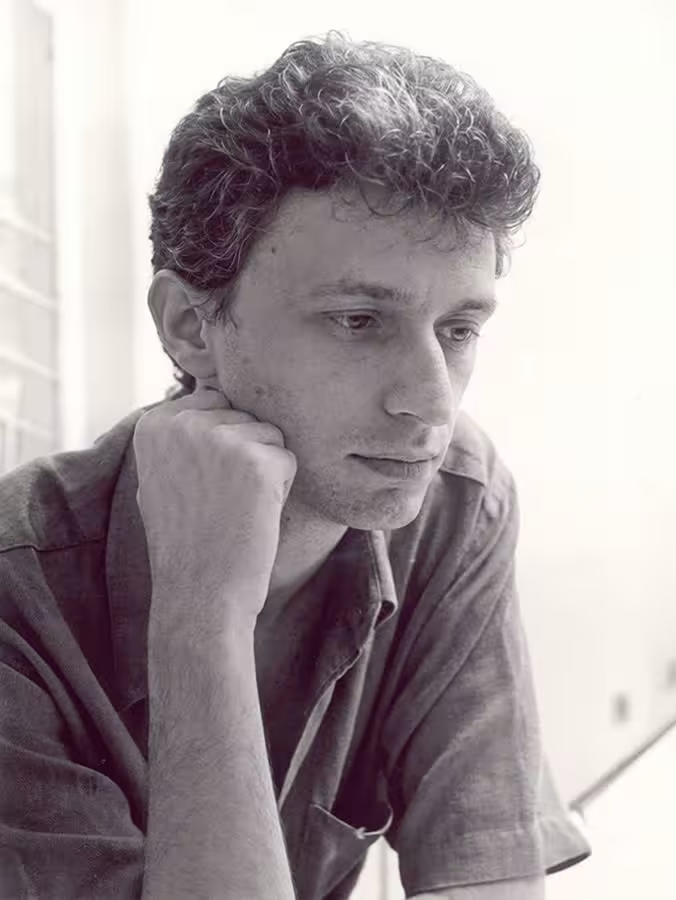
Image at: EDMR GUIMARÃES - POESIA DOS BRASIS - GOIÁS - www.antoniomiranda.com.br

Editor's Note: Research conducted with the assistance of Deep Research is subject to referential ambiguity, potentially confusing facts between homonymous individuals. Although Sílvio Lobo has reviewed the material to rectify such inconsistencies, it is advised that inaccuracies may persist. We count on your help for clarifications and suggestions. Contact me.
The Architecture of Silence: Life and Work of Edmar Guimarães
Summary: This article presents a bio-bibliographical profile of the Goian poet Edmar Guimarães, highlighting his education, his main works, and the critical reception of his work. The analysis focuses on the evolution of his aesthetics, marked by formal rigor, imagistic synthesis, and dialogue with modern and avant-garde lyrical tradition.
1. Introduction and Education
Born in Goiânia on September 7, 1968, Edmar Guimarães has established himself as one of the most technical and refined voices in contemporary poetry in Goiás. His intellectual foundation was built at the Universidade Católica de Goiás (now PUC-Goiás), where he graduated in Neolatin Letters, a degree that would profoundly influence the linguistic refinement of his writing.
From the beginning of his career, Guimarães was perceived not as a poet in formation, but as a ready artisan. The renowned critic and poet José Godoy Garcia, in an article for Diário da Manhã, celebrated this early maturity, stating that Edmar "is a guardian angel. He was born complete, he is a poetic formal precision."
2. Bibliographic Trajectory and Awards
Edmar Guimarães's work is built with strategic pauses and publications that mark different phases of his poetic maturation.
First Phase (1990s): His debut in the publishing scene was with Palmas dos pulsos, a handmade edition ("arte & xeros") by Divagar e Sempre publishing house. In 1995, he participated in the collaborative anthology Plumas e porradas, alongside poets Ivair Lima and Adaglion Aires de Andrade, inserting himself into the vibrant Goian literary scene of that decade.
Consolidation (2000s): The turn of the millennium marked the institutional recognition of his work. In 2000, he published Caderno (author's edition), a work that reflects a process of stylistic refinement and was boosted by winning the Bolsa de Publicações Hugo de Carvalho Ramos, one of the oldest and most prestigious literary awards in Goiás.
Two years later, in 2002, he released Desenhos de sol through the Instituto Goiano do Livro (IGL). This work was awarded the Prêmio Bolsa de Publicações Cora Coralina, reaffirming the author as a central figure in the state's literature.
Recent Production (2010s): Maintaining his regularity and quality, Edmar released the book Águas de Claudel in 2011, published by Editora da UFG (Universidade Federal de Goiás) through the Coleção Vertentes. This work demonstrates the continuity of his aesthetic research and his permanence in the regional academic canon.
3. The Aesthetics of Precision: Critical Analysis
Edmar Guimarães's poetry is often defined by critics through two pillars: synthesis and image.
Rigor and Geometry Antonio Manoel dos Santos Silva highlights the author's "will for rigor," pointing to an almost geometric construction of verses. The poem Jardim Fechado is the ultimate example of this aesthetic:
“Pétalas/ as raízes do perfume.// Palhas, / as pétalas / do perfume”.
This conciseness allows Guimarães to be placed in the lineage of great poets of lyrical objectivity, being compared to Giuseppe Ungaretti, Eugenio Montale, Jorge Guillén, and the Portuguese Eugenio de Andrade.
Dialogues with Surrealism and Modernism Literary criticism, represented by figures like Fábio Lucas, points out that Edmar possesses a "visceral lyricism" combined with a "spirit of synthesis." Lucas observes that the poet, an "acute reader," brings a new diction to Brazilian poetry by engaging with myths of high literature.
More recent studies expand this analysis, identifying in works like Desenhos de sol traces of late surrealism, adapted to the Cerrado reality, as well as influences from the objectivity of Ezra Pound and Marianne Moore. The "impersonality" of his poetry—where the focus shifts from the poet's 'I' to the architecture of the poem—reinforces his position as a poet of formal precision.
4. Conclusion
Edmar Guimarães represents, in the literature of Goiás and Brazil, the persistence of artisanal work with words. Far from confessional excesses, his work seeks the essence of the image and the economy of the verb. Whether in the handmade editions of the 1990s or the university publications of the 2010s, his trajectory confirms Godoy Garcia's prophecy: that of a poet who "was born complete," whose work withstands time due to the solidity of its construction.
Bibliographical References
-
GUIMARÃES, Edmar. Plumas e porradas. Goiânia: Editora do Autor, 1995. (Co-authored with Ivair Lima and Adaglion Aires de Andrade).
-
GUIMARÃES, Edmar. Caderno. Goiânia: Edição do Autor, 2000.
-
GUIMARÃES, Edmar. Desenhos de sol. Goiânia: Instituto Goiano do Livro (IGL), 2002.
-
GUIMARÃES, Edmar. Águas de Claudel. Goiânia: Editora UFG, 2011. (Coleção Vertentes).
-
LUCAS, Fábio. Fortuna Crítica de Edmar Guimarães. In: Orelha e prefácio de Desenhos de sol. Goiânia: IGL, 2002.
-
SILVA, Antonio Manoel dos Santos. A concisão na poesia de Edmar Guimarães. In: Análise crítica presente na obra Desenhos de sol.
-
GARCIA, José Godoy. Artigo sobre Edmar Guimarães. Jornal Diário da Manhã, Goiânia, [n.d.].
-
REVISTA ÍCONE. Estudos sobre a poesia contemporânea em Goiás. Goiânia: Universidade Estadual de Goiás (UEG), [Various issues].
Image at: EDMR GUIMARÃES - POESIA DOS BRASIS - GOIÁS - www.antoniomiranda.com.br
Editor's Note: Research conducted with the assistance of Deep Research is subject to referential ambiguity, potentially confusing facts between homonymous individuals. Although Sílvio Lobo has reviewed the material to rectify such inconsistencies, it is advised that inaccuracies may persist. We count on your help for clarifications and suggestions. Contact me.





