




Very different from what is thought, centuries before Jesus Christ, men observed the sky and drew conclusions about the Universe, especially about nearby celestial bodies, planets, stars, and comets.

Image text: Centuries before Jesus, man already knew that not all celestial bodies in the sky moved in the same way. Five of which, already in the Roman era, were named and called planets, and the observation was made with the naked eye; these were Mercury, Venus, Mars, Saturn, and Jupiter. / Example of the trajectory made by a planet when observed from the ground with the naked eye. /
Five of the planets were already known in the time of the Roman Empire. Many other stars were richly referenced and cited in navigation. The Moon was extremely important for defining the calendar, seasons, and observing tides.
Do celestial bodies move?
Yes, the entire Universe moves; stars, planets, and even the sun. Everything happens simultaneously. And through observation, these trajectories were already known since antiquity.
Let's understand the movements step-by-step,
The Moon revolves around itself and around the Earth. The Earth, like all other planets, revolves around itself and the Sun. This system is called the Solar System.

Image text: It is not possible to represent the solar system in a drawing; it would require a soccer field, and the planets would be tiny dots. To the side, you see the proportion between the planets. Pluto is referenced because, being so small, it is no longer considered a planet.
It is not possible to make a faithful representation of the solar system due to the vast disproportion. The difference between the planets is so great that Pluto was no longer considered a planet and is now known as a dwarf planet.
Observe the proportion of the Planets in the drawing above. Jupiter is the largest; Saturn, Uranus, and Neptune are medium-sized (compared to the others). In decreasing order, we have Earth, Venus, Mars, and Mercury.
Our Planet is blue, as one would expect when looking at the Sky. Large forests like the Amazon and African ones are green; large deserts are ochre, and the poles are grayish.

Image text: Our planet Earth
The easiest observation regarding the movements of celestial bodies is to observe the Moon and the Sun. Both are enchanting and undeniably important for humanity. The Moon has a diameter of 3474.8 km at the equator, with a greater distance. The Moon's rotation period is equal to its revolution period (27 days), so only one of its faces is visible from Earth.

Image text: The satellite of our planet, the Moon.
It is safe to say that without the Sun, life would not exist on our planet. Known as the King of celestial bodies, its central function is decisive. However, contrary to belief, the Sun is not static. Everything is a matter of reference, as even though it appears inert at the center of its System. This entire complex, called the Solar System, revolves around the nucleus of our galaxy, the Milky Way, at an approximate speed of 220 km/s; yes, kilometers per second.

Image text: Sun, our mother star / View from a space telescope
The Milky Way is the galaxy where our Solar System is located. To be exact, our system is in the Orion arm. In the drawing below, you can see how the Milky Way is viewed with the naked eye from the sky.
In our civilization, the name Milky Way comes from the ancient Greeks, who saw it as a "path of milk" in the sky. It is found in various cultures with diverse names. For example, the Tembé indigenous people (southern Pará) call it the "Tapir's Path." (Renado Las Casas)

Image text: Milky Way, the Solar System and practically all stars visible to the naked eye are located in the Orion arm.
The Milky Way also rotates as it expands. Galaxies move towards absolute space, as if receding due to a great initial explosion.
I have made a humble drawing for my friends to aid comprehension.

Image text: True Universe, Visible Universe, Galaxies, Quasar, Center of the True Universe, Big Bang point (Beginning), The space outside the True Universe is called Absolute Space. / Direction of bodies, The true universe is constantly expanding.
The central point is the origin; all celestial bodies emanate from this direction, expanding. With each passing moment, the Universe as we understand it becomes larger. However, when we look at the Universe, we cannot reach its limits; what we see is just a portion. This Universe that we can see, with the naked eye and with the help of terrestrial and space telescopes, is called the Visible Universe.
Image text: The Visible Universe / Our eyes do not reach infinity, but only a part of it, which we call the Visible Universe. / In 2009, the light from a star that exploded 13 billion years ago reached Earth, setting a new record for the most distant individual astronomical object ever observed.
Looking at the Universe from Earth's perspective, we observe that planets, stars, and other celestial bodies move in complex patterns, not just emanating from a single point. This happens because of the frame of reference. Our planet is not the center of the Universe; therefore, an observer will always be the center of the Visible Universe.
A person looking in all directions to infinity can consider themselves the center of the Universe, meaning the center of the Visible Universe.
To understand the Universe, it is necessary to comprehend the whole and the relationship of reference. The Sun appears to move across the Sky, but it is fixed at the center of the Solar System. The Solar System also appears to be fixed, but it moves in the Orion Arm of the Milky Way; everything is a matter of reference. The perception of a planet's movement is slow; it took years and years to understand a planet's orbit in antiquity, when all observation was done without any instruments. However, they succeeded.
Soon, I will post tips on how to observe the sky in this article and on this site.
And where do they go when they move?
Calculations indicate that based on the movement of celestial bodies, they were at the initial point 13.7 billion years ago, and many theories attempt to explain when everything will end.
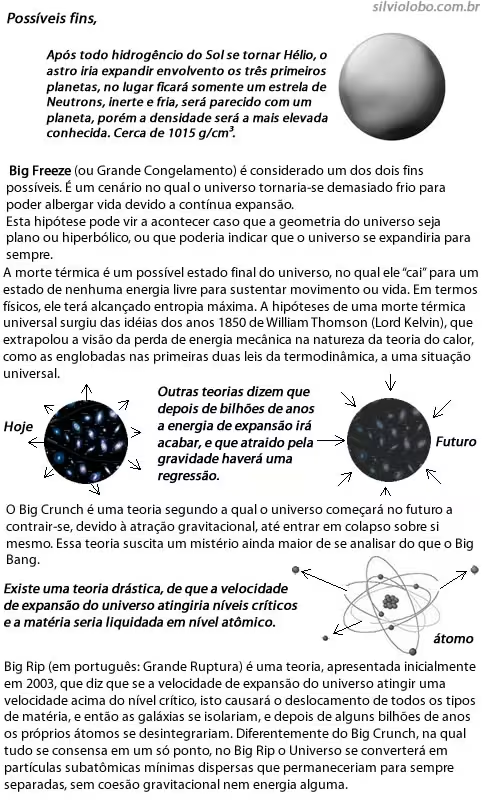
Image text: Possible ends, / After all the hydrogen in the Sun turns into Helium, the star would expand, engulfing the first three planets. In its place, only a Neutron star would remain, inert and cold. It would resemble a planet, but its density would be the highest in the Universe, about 1015 g/cm³. / Big Freeze is considered one of the two possible ends. It is a scenario in which the universe would become too cold to harbor life due to its continuous expansion. This hypothesis may occur if the universe's geometry is flat or hyperbolic, or it could indicate that the universe will expand forever. / Heat death is a possible final state of the universe, in which it "falls" into a state of no free energy to sustain motion or life. In physical terms, it will have reached maximum entropy. The hypothesis of universal heat death arose from William Thomson's (Lord Kelvin) ideas in the 1850s, who extrapolated the view of mechanical energy loss in nature from heat theory, as encompassed in the first two laws of thermodynamics, to a universal situation. / Other theories suggest that after billions of years, the expansion energy will cease, and due to gravity, there will be a regression. / The Big Crunch is a theory according to which the universe will begin to contract in the future, due to gravitational attraction, until it collapses upon itself. This theory presents an even greater mystery to analyze than the Big Bang. / There is a drastic theory that the expansion speed of the universe would reach critical levels, and matter would be liquidated at an atomic level. / Big Rip is a theory, initially presented in 2003, which states that if the expansion speed of the universe reaches a speed above the critical level, it will cause the displacement of all types of matter, and then galaxies will become isolated, and after a few billion years, the atoms themselves will disintegrate. Unlike the Big Crunch, where everything converges into a single point, in the Big Rip, the Universe will convert into dispersed, minuscule subatomic particles that will remain separated forever, without gravitational cohesion or any energy.
This subject is very interesting. I aim to demonstrate some of the most recent ideas on my website, recalling and understanding memorable ideas from antiquity. Thus, I open space for questions, suggestions, and further information.
Until the next chapter, greetings.
Very different from what is thought, centuries before Jesus Christ, men observed the sky and drew conclusions about the Universe, especially about nearby celestial bodies, planets, stars, and comets.
Image text: Centuries before Jesus, man already knew that not all celestial bodies in the sky moved in the same way. Five of which, already in the Roman era, were named and called planets, and the observation was made with the naked eye; these were Mercury, Venus, Mars, Saturn, and Jupiter. / Example of the trajectory made by a planet when observed from the ground with the naked eye. /
Five of the planets were already known in the time of the Roman Empire. Many other stars were richly referenced and cited in navigation. The Moon was extremely important for defining the calendar, seasons, and observing tides.
Do celestial bodies move?
Yes, the entire Universe moves; stars, planets, and even the sun. Everything happens simultaneously. And through observation, these trajectories were already known since antiquity.
Let's understand the movements step-by-step,
The Moon revolves around itself and around the Earth. The Earth, like all other planets, revolves around itself and the Sun. This system is called the Solar System.
Image text: It is not possible to represent the solar system in a drawing; it would require a soccer field, and the planets would be tiny dots. To the side, you see the proportion between the planets. Pluto is referenced because, being so small, it is no longer considered a planet.
It is not possible to make a faithful representation of the solar system due to the vast disproportion. The difference between the planets is so great that Pluto was no longer considered a planet and is now known as a dwarf planet.
Observe the proportion of the Planets in the drawing above. Jupiter is the largest; Saturn, Uranus, and Neptune are medium-sized (compared to the others). In decreasing order, we have Earth, Venus, Mars, and Mercury.
Our Planet is blue, as one would expect when looking at the Sky. Large forests like the Amazon and African ones are green; large deserts are ochre, and the poles are grayish.
Image text: Our planet Earth
The easiest observation regarding the movements of celestial bodies is to observe the Moon and the Sun. Both are enchanting and undeniably important for humanity. The Moon has a diameter of 3474.8 km at the equator, with a greater distance. The Moon's rotation period is equal to its revolution period (27 days), so only one of its faces is visible from Earth.
Image text: The satellite of our planet, the Moon.
It is safe to say that without the Sun, life would not exist on our planet. Known as the King of celestial bodies, its central function is decisive. However, contrary to belief, the Sun is not static. Everything is a matter of reference, as even though it appears inert at the center of its System. This entire complex, called the Solar System, revolves around the nucleus of our galaxy, the Milky Way, at an approximate speed of 220 km/s; yes, kilometers per second.
Image text: Sun, our mother star / View from a space telescope
The Milky Way is the galaxy where our Solar System is located. To be exact, our system is in the Orion arm. In the drawing below, you can see how the Milky Way is viewed with the naked eye from the sky.
In our civilization, the name Milky Way comes from the ancient Greeks, who saw it as a "path of milk" in the sky. It is found in various cultures with diverse names. For example, the Tembé indigenous people (southern Pará) call it the "Tapir's Path." (Renado Las Casas)
Image text: Milky Way, the Solar System and practically all stars visible to the naked eye are located in the Orion arm.
The Milky Way also rotates as it expands. Galaxies move towards absolute space, as if receding due to a great initial explosion.
I have made a humble drawing for my friends to aid comprehension.
Image text: True Universe, Visible Universe, Galaxies, Quasar, Center of the True Universe, Big Bang point (Beginning), The space outside the True Universe is called Absolute Space. / Direction of bodies, The true universe is constantly expanding.
The central point is the origin; all celestial bodies emanate from this direction, expanding. With each passing moment, the Universe as we understand it becomes larger. However, when we look at the Universe, we cannot reach its limits; what we see is just a portion. This Universe that we can see, with the naked eye and with the help of terrestrial and space telescopes, is called the Visible Universe.
Image text: The Visible Universe / Our eyes do not reach infinity, but only a part of it, which we call the Visible Universe. / In 2009, the light from a star that exploded 13 billion years ago reached Earth, setting a new record for the most distant individual astronomical object ever observed.
Looking at the Universe from Earth's perspective, we observe that planets, stars, and other celestial bodies move in complex patterns, not just emanating from a single point. This happens because of the frame of reference. Our planet is not the center of the Universe; therefore, an observer will always be the center of the Visible Universe.
A person looking in all directions to infinity can consider themselves the center of the Universe, meaning the center of the Visible Universe.
To understand the Universe, it is necessary to comprehend the whole and the relationship of reference. The Sun appears to move across the Sky, but it is fixed at the center of the Solar System. The Solar System also appears to be fixed, but it moves in the Orion Arm of the Milky Way; everything is a matter of reference. The perception of a planet's movement is slow; it took years and years to understand a planet's orbit in antiquity, when all observation was done without any instruments. However, they succeeded.
Soon, I will post tips on how to observe the sky in this article and on this site.
And where do they go when they move?
Calculations indicate that based on the movement of celestial bodies, they were at the initial point 13.7 billion years ago, and many theories attempt to explain when everything will end.
Image text: Possible ends, / After all the hydrogen in the Sun turns into Helium, the star would expand, engulfing the first three planets. In its place, only a Neutron star would remain, inert and cold. It would resemble a planet, but its density would be the highest in the Universe, about 1015 g/cm³. / Big Freeze is considered one of the two possible ends. It is a scenario in which the universe would become too cold to harbor life due to its continuous expansion. This hypothesis may occur if the universe's geometry is flat or hyperbolic, or it could indicate that the universe will expand forever. / Heat death is a possible final state of the universe, in which it "falls" into a state of no free energy to sustain motion or life. In physical terms, it will have reached maximum entropy. The hypothesis of universal heat death arose from William Thomson's (Lord Kelvin) ideas in the 1850s, who extrapolated the view of mechanical energy loss in nature from heat theory, as encompassed in the first two laws of thermodynamics, to a universal situation. / Other theories suggest that after billions of years, the expansion energy will cease, and due to gravity, there will be a regression. / The Big Crunch is a theory according to which the universe will begin to contract in the future, due to gravitational attraction, until it collapses upon itself. This theory presents an even greater mystery to analyze than the Big Bang. / There is a drastic theory that the expansion speed of the universe would reach critical levels, and matter would be liquidated at an atomic level. / Big Rip is a theory, initially presented in 2003, which states that if the expansion speed of the universe reaches a speed above the critical level, it will cause the displacement of all types of matter, and then galaxies will become isolated, and after a few billion years, the atoms themselves will disintegrate. Unlike the Big Crunch, where everything converges into a single point, in the Big Rip, the Universe will convert into dispersed, minuscule subatomic particles that will remain separated forever, without gravitational cohesion or any energy.
This subject is very interesting. I aim to demonstrate some of the most recent ideas on my website, recalling and understanding memorable ideas from antiquity. Thus, I open space for questions, suggestions, and further information.
Until the next chapter, greetings.





