




Ammonium Sulfate (Retail price found: R$ 2.20 per Kg)

Composition: It is the product of the reaction between ammonia and sulfuric acid, containing at least 20.5% nitrogen (N).
Characteristics: All nitrogen in ammoniacal form. Fertilizer very rich in sulfur.
Density: 1.0 (0.9 to 1.1)
Action: Long-lasting. Moderate risk of leaching and volatilization.
Presentation: White or gray crystals.
Technical Characteristics
Fertilizer Nitrogen (N) Sulfur (SO3)
Ammonium Sulfate 20.5% 60%
Important.
Ammonium Sulfate is highly soluble. Some manufacturers and merchants mix it into NPK, which can make it difficult to apply through irrigation.
Action: Stimulates vegetative development, i.e., the formation of roots, branches, and leaves. It is part of the amino acids that give rise to proteins and is responsible for the green color of plants due to chlorophyll.
Chilean Saltpeter (Retail price found: R$ 9.00 per Kg)
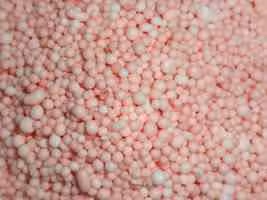
Chemical Characteristics:
Nitrogen* N 15.00%
Potassium K20 14.00%
Sodium** Na 18.00%
Sulfur S 0.25%
Magnesium Mg 0.25%
Boron B 0.05%
Copper Cu Trace
Molybdenum Mo Trace
Iodine I Trace
*N – Total Nitric **C – Acidity Corrector
Potassium Chloride (Retail price found: R$ 2.50 per Kg).

What is a protected crop?
Answer: It is planting in a limited space, such as greenhouses or fields with little or no rotation.
Composition: It is the product of the purification of crude potassium chloride salts, containing 60% potassium (K2O).
Characteristics: All potassium soluble in water. Fertilizer rich in chlorine.
Density: 1.0 (0.9 to 1.1).
Action: Rapid. Risk of leaching in light-textured soils.
Presentation: Pink or brownish crystals or granules. (high water solubility)

Urea
Density: 0.7 (0.6 to 0.8).
Action: Faster as temperature and soil moisture increase. High risk of volatilization.
Presentation: White pearls (prilled) or granulated.
Monoammonium Phosphate or MAP (10% N and 46 to 50% P2O5)

Function: Phosphorus Source
Composition: MAP 12-52-00
Action: Positively influences plant robustness, rooting, and disease resistance, in addition to being the nutrient responsible for the reaction that promotes respiration and photosynthesis, fundamental for energy acquisition by plants. It is also part of deoxyribonucleic acid (DNA), responsible for the transmission of hereditary traits, also aiding in flowering, fruiting, and root system development of vegetables.
Diammonium Phosphate or DAP (16% N and 38 to 40% P2O5),
Common chemical name or generic name: DIAMMONIUM PHOSPHATE (DAP) ((NH4)2HPO4).
Synonym: DIBASIC AMMONIUM PHOSPHATE ((NH4)2HPO4).
Chemical Abstracts Service (CAS No.): 7783-28-0
Ingredients contributing to hazard: ((NH4)2HPO4).
DAP can be used as a fire retardant. The combustion temperature of the material is reduced, decreasing maximum weight loss rates, and causing increased production of residue or char. These effects are important in combating forest fires as they reduce pyrolysis temperature. It is the main component of some popular firefighting products.
DAP is also used as a nutrient yeast for winemaking, mead, and beer; as an additive in certain cigarette brands, supposedly as a nicotine promoter; as a flux for soldering tin, copper, zinc, and bronze; and to control the precipitation of soluble colloidal dyes and insoluble alkaline and acidic dyes in wool.
Single Superphosphate or Super Simple (16 to 18% P2O5 and 18 to 20% Ca - Calcium),
Triple Superphosphate or Super Triple (41% P2O5 and 7 to 12% Ca)

Origin: YUNNAN HONGXIANG CHEM. CO. / KUNMING / CHINA
Function: Phosphorus Source
Composition: 46%P2O5
Action: Positively influences plant robustness, rooting, and disease resistance, in addition to being the nutrient responsible for the reaction that promotes respiration and photosynthesis, fundamental for energy acquisition by plants. It is also part of deoxyribonucleic acid (DNA), responsible for the transmission of hereditary traits, also aiding in flowering, fruiting, and root system development of vegetables.
Thermal Phosphate (18% P2O5, 9% Mg - Magnesium, 20% Ca, and 25% SiO4).
Composition: Fertilizer containing only ammoniacal nitrogen and water-soluble phosphorus, without any other nutrient, dosing 18% nitrogen (N) and 46% phosphorus (P2O5).
Density: 1.0 (0.9 to 1.1).
Action: Rapid.
Presentation: Granulated.
Technical Characteristics
Fertilizer Nitrogen (N) Phosphorus (P2O5)
DAP 18-46-0 18% 46%
Nitromagnesia
Main Use: Top dressing fertilization for all crops. Especially recommended for crops more demanding in magnesium.
Composition: Homogeneous and stable mixture of ammonium nitrate, calcium carbonate, and magnesium.
Characteristics: Half nitric nitrogen and half ammoniacal. Fertilizer rich in calcium and magnesium.
Density: 1.0 (0.9 to 1.1).
Action: Simultaneously rapid and long-lasting. Moderate risk of leaching.
Presentation: White or gray granules.
Technical Characteristics
Fertilizer | Nitrogen (N) | Calcium* (CaO) | Magnesium (MgO), respectively 27 | 27% | 3.5% | 3.5% *Soluble in water
Calcium Nitrate
Main Use: Top dressing fertilization for all crops. Especially recommended for crops more demanding in calcium and to combat deficiencies of this nutrient – blossom end rot in tomatoes and bitter pit in apples.
Composition: Double salt of calcium nitrate and ammonium nitrate, dosing 15.5% nitrogen (N).
Characteristics: All nitrogen in nitric form. Fertilizer very rich in calcium.
Density: 1.1 (1.0 to 1.2).
Action: Very rapid. High risk of leaching.
Presentation: White or light brown granules.
Technical Characteristics
Fertilizer Calcium Nitrate Technical Nitrogen (N)15.5% Calcium* (CaO)27%
*Soluble in water
What about NPK?

NPK is a well-known acronym, and it designates the ratio of the three main nutrients for plants (nitrogen, phosphorus, and potassium), also called macronutrients.
So when you read NPK 20.05.10 (as an example), it means that fertilizer has 20% nitrogen, 5% phosphorus, and 10% potassium.
There is a wide variety of combinations on the market, precisely so that you can seek the balance for each soil.
CURIOSITY (source Embrapa): Average percentage of organic matter (OM), nitrogen (N), phosphorus (P2O5), and potassium (K2O) in the composition, based on dry matter, of organic fertilizers used in pepper production.
| Organic Fertilizer | OM (%) |
N (%) |
P2O5 (%) |
K2O (%) |
| Cattle Manure |
57 | 1.7 | 0.9 | 1.4 |
| Horse Manure |
46 | 1.4 | 0.5 | 1.7 |
| Swine Manure |
53 | 1.9 | 0.7 | 0.4 |
| Sheep Manure |
65 | 1.4 | 1.0 | 2.0 |
| Poultry Manure |
50 | 3.0 | 3.0 | 2.0 |
| Organic Compost |
31 | 1.4 | 1.4 | 0.8 |
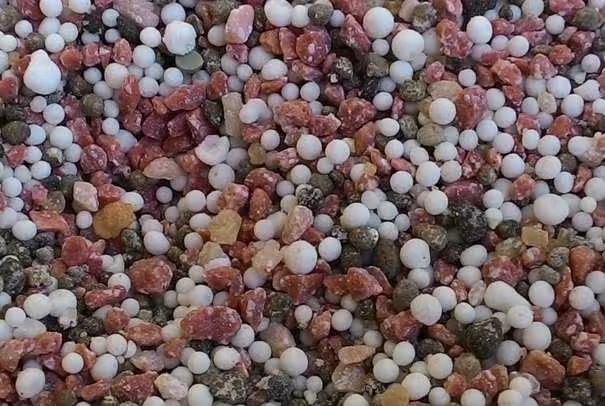
Other fertilizers are used with fancy names and may be commonly called an NPK, for example:
Hortimax Cobertura (13-03-25)... And speaking of which, Hortimax is a common fertilizer in stores but almost unknown on the internet. The following photo was taken by Sílvio de Souza Lôbo Júnior
If you have any questions, write to me, or share information here on the site. Thank you!
Source:
http://www.adp-fertilizantes.pt
http://www.honeywell-pmt.com/sm/sulfn/brasil/sulfn-sulfato-sub/vantagens.html
http://www.agencia.cnptia.embrapa.br/gestor/pimenta/arvore/CONT000gn08zc7m02wx5ok0liq1mqw825isw.html
Ammonium Sulfate (Retail price found: R$ 2.20 per Kg)
Composition: It is the product of the reaction between ammonia and sulfuric acid, containing at least 20.5% nitrogen (N).
Characteristics: All nitrogen in ammoniacal form. Fertilizer very rich in sulfur.
Density: 1.0 (0.9 to 1.1)
Action: Long-lasting. Moderate risk of leaching and volatilization.
Presentation: White or gray crystals.
Technical Characteristics
Fertilizer Nitrogen (N) Sulfur (SO3)
Ammonium Sulfate 20.5% 60%
Important.
Ammonium Sulfate is highly soluble. Some manufacturers and merchants mix it into NPK, which can make it difficult to apply through irrigation.
Action: Stimulates vegetative development, i.e., the formation of roots, branches, and leaves. It is part of the amino acids that give rise to proteins and is responsible for the green color of plants due to chlorophyll.
Chilean Saltpeter (Retail price found: R$ 9.00 per Kg)
Chemical Characteristics:
Nitrogen* N 15.00%
Potassium K20 14.00%
Sodium** Na 18.00%
Sulfur S 0.25%
Magnesium Mg 0.25%
Boron B 0.05%
Copper Cu Trace
Molybdenum Mo Trace
Iodine I Trace
*N – Total Nitric **C – Acidity Corrector
Potassium Chloride (Retail price found: R$ 2.50 per Kg).
What is a protected crop?
Answer: It is planting in a limited space, such as greenhouses or fields with little or no rotation.
Composition: It is the product of the purification of crude potassium chloride salts, containing 60% potassium (K2O).
Characteristics: All potassium soluble in water. Fertilizer rich in chlorine.
Density: 1.0 (0.9 to 1.1).
Action: Rapid. Risk of leaching in light-textured soils.
Presentation: Pink or brownish crystals or granules. (high water solubility)
Urea
Density: 0.7 (0.6 to 0.8).
Action: Faster as temperature and soil moisture increase. High risk of volatilization.
Presentation: White pearls (prilled) or granulated.
Monoammonium Phosphate or MAP (10% N and 46 to 50% P2O5)
Function: Phosphorus Source
Composition: MAP 12-52-00
Action: Positively influences plant robustness, rooting, and disease resistance, in addition to being the nutrient responsible for the reaction that promotes respiration and photosynthesis, fundamental for energy acquisition by plants. It is also part of deoxyribonucleic acid (DNA), responsible for the transmission of hereditary traits, also aiding in flowering, fruiting, and root system development of vegetables.
Diammonium Phosphate or DAP (16% N and 38 to 40% P2O5),
Common chemical name or generic name: DIAMMONIUM PHOSPHATE (DAP) ((NH4)2HPO4).
Synonym: DIBASIC AMMONIUM PHOSPHATE ((NH4)2HPO4).
Chemical Abstracts Service (CAS No.): 7783-28-0
Ingredients contributing to hazard: ((NH4)2HPO4).
DAP can be used as a fire retardant. The combustion temperature of the material is reduced, decreasing maximum weight loss rates, and causing increased production of residue or char. These effects are important in combating forest fires as they reduce pyrolysis temperature. It is the main component of some popular firefighting products.
DAP is also used as a nutrient yeast for winemaking, mead, and beer; as an additive in certain cigarette brands, supposedly as a nicotine promoter; as a flux for soldering tin, copper, zinc, and bronze; and to control the precipitation of soluble colloidal dyes and insoluble alkaline and acidic dyes in wool.
Single Superphosphate or Super Simple (16 to 18% P2O5 and 18 to 20% Ca - Calcium),
Triple Superphosphate or Super Triple (41% P2O5 and 7 to 12% Ca)
Origin: YUNNAN HONGXIANG CHEM. CO. / KUNMING / CHINA
Function: Phosphorus Source
Composition: 46%P2O5
Action: Positively influences plant robustness, rooting, and disease resistance, in addition to being the nutrient responsible for the reaction that promotes respiration and photosynthesis, fundamental for energy acquisition by plants. It is also part of deoxyribonucleic acid (DNA), responsible for the transmission of hereditary traits, also aiding in flowering, fruiting, and root system development of vegetables.
Thermal Phosphate (18% P2O5, 9% Mg - Magnesium, 20% Ca, and 25% SiO4).
Composition: Fertilizer containing only ammoniacal nitrogen and water-soluble phosphorus, without any other nutrient, dosing 18% nitrogen (N) and 46% phosphorus (P2O5).
Density: 1.0 (0.9 to 1.1).
Action: Rapid.
Presentation: Granulated.
Technical Characteristics
Fertilizer Nitrogen (N) Phosphorus (P2O5)
DAP 18-46-0 18% 46%
Nitromagnesia
Main Use: Top dressing fertilization for all crops. Especially recommended for crops more demanding in magnesium.
Composition: Homogeneous and stable mixture of ammonium nitrate, calcium carbonate, and magnesium.
Characteristics: Half nitric nitrogen and half ammoniacal. Fertilizer rich in calcium and magnesium.
Density: 1.0 (0.9 to 1.1).
Action: Simultaneously rapid and long-lasting. Moderate risk of leaching.
Presentation: White or gray granules.
Technical Characteristics
Fertilizer | Nitrogen (N) | Calcium* (CaO) | Magnesium (MgO), respectively 27 | 27% | 3.5% | 3.5% *Soluble in water
Calcium Nitrate
Main Use: Top dressing fertilization for all crops. Especially recommended for crops more demanding in calcium and to combat deficiencies of this nutrient – blossom end rot in tomatoes and bitter pit in apples.
Composition: Double salt of calcium nitrate and ammonium nitrate, dosing 15.5% nitrogen (N).
Characteristics: All nitrogen in nitric form. Fertilizer very rich in calcium.
Density: 1.1 (1.0 to 1.2).
Action: Very rapid. High risk of leaching.
Presentation: White or light brown granules.
Technical Characteristics
Fertilizer Calcium Nitrate Technical Nitrogen (N)15.5% Calcium* (CaO)27%
*Soluble in water
What about NPK?
NPK is a well-known acronym, and it designates the ratio of the three main nutrients for plants (nitrogen, phosphorus, and potassium), also called macronutrients.
So when you read NPK 20.05.10 (as an example), it means that fertilizer has 20% nitrogen, 5% phosphorus, and 10% potassium.
There is a wide variety of combinations on the market, precisely so that you can seek the balance for each soil.
CURIOSITY (source Embrapa): Average percentage of organic matter (OM), nitrogen (N), phosphorus (P2O5), and potassium (K2O) in the composition, based on dry matter, of organic fertilizers used in pepper production.
| Organic Fertilizer | OM (%) |
N (%) |
P2O5 (%) |
K2O (%) |
| Cattle Manure |
57 | 1.7 | 0.9 | 1.4 |
| Horse Manure |
46 | 1.4 | 0.5 | 1.7 |
| Swine Manure |
53 | 1.9 | 0.7 | 0.4 |
| Sheep Manure |
65 | 1.4 | 1.0 | 2.0 |
| Poultry Manure |
50 | 3.0 | 3.0 | 2.0 |
| Organic Compost |
31 | 1.4 | 1.4 | 0.8 |
Other fertilizers are used with fancy names and may be commonly called an NPK, for example:
Hortimax Cobertura (13-03-25)... And speaking of which, Hortimax is a common fertilizer in stores but almost unknown on the internet. The following photo was taken by Sílvio de Souza Lôbo Júnior
If you have any questions, write to me, or share information here on the site. Thank you!
Source:
http://www.adp-fertilizantes.pt
http://www.honeywell-pmt.com/sm/sulfn/brasil/sulfn-sulfato-sub/vantagens.html
http://www.agencia.cnptia.embrapa.br/gestor/pimenta/arvore/CONT000gn08zc7m02wx5ok0liq1mqw825isw.html
Deixe seu comentário - Leave a comment - Deja tu comentario - 发表评论 - अपनी टिप्पणी छोड़ें
O editor não se responsabiliza pelos comentários registrados aqui., El editor no se hace responsable de los comentarios registrados aquí., The editor is not responsible for the comments registered here., 编辑不对此处记录的评论负责。, संपादक यहाँ दर्ज की गई टिप्पणियों के लिए जिम्मेदार नहीं है।





