



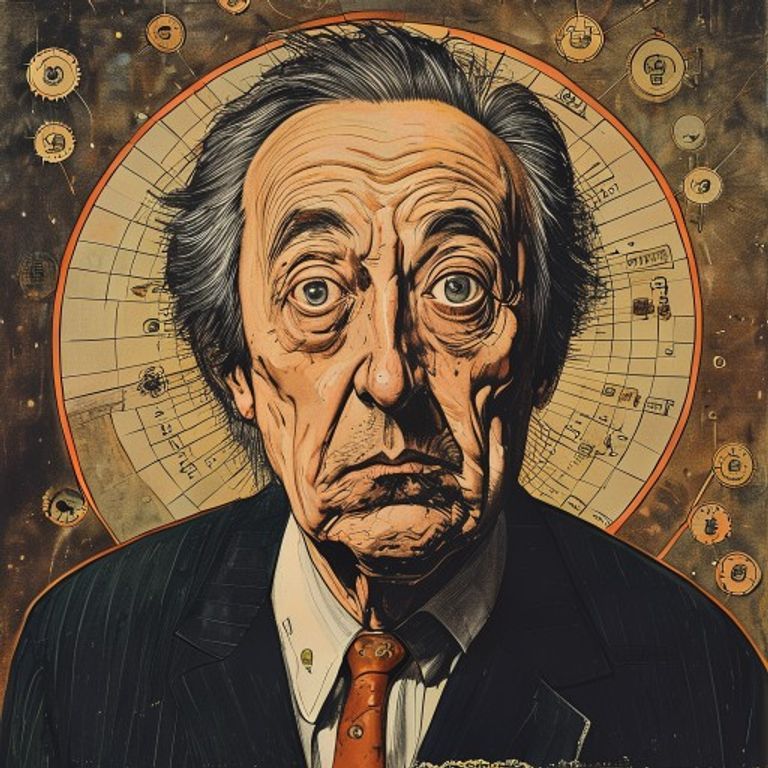
The pseudonym used by the creator of Bitcoin, whose true identity and the location of their original assets remain the greatest technological mystery of our time.
⚠️ Research conducted with the aid of Deep Research is subject to referential ambiguity.
🖥️ Clean HTML code using a proprietary tool.
👥 Research by Guilherme Felipe, Curation by Sílvio Lôbo
The Enigma of Satoshi Nakamoto: A Journey Through the Mysteries of Money and Identity
The financial and technological world was shaken in 2008, but the epicenter of the earthquake—the identity behind the man or group known as Satoshi Nakamoto—remains one of the greatest mysteries of the digital age. Nakamoto is the pseudonymous figure credited with the creation of Bitcoin, the first decentralized digital currency, and the publication of the white paper "Bitcoin: A Peer-to-Peer Electronic Cash System." What followed was a silent revolution, but to whom we should attribute this technological and financial feat remains an enigma worthy of the most celebrated investigative cases.
1. The Context and the Incident: Where, When, and How the Mystery Began
The mystery of Satoshi Nakamoto is not an isolated incident, but rather the birth of a concept that challenged paradigms. Amidst the global financial crisis of 2008, marked by the collapse of the investment bank Lehman Brothers and the subsequent distrust in the traditional banking system, an innovative proposal emerged on the internet. On October 31, 2008, an individual or group under the pseudonym Satoshi Nakamoto sent an email to a cryptography mailing list, presenting the white paper that detailed the architecture of Bitcoin. The document, which proposed an electronic cash system without the need for a central authority, was met with initial skepticism but quickly began to gain momentum.
The first Bitcoin transaction occurred on January 3, 2009, when Nakamoto mined the first block of the blockchain, known as the "genesis block." He then distributed the open-source Bitcoin software, allowing others to join the network. Nakamoto's direct involvement in the Bitcoin community continued until mid-2011, when he abruptly disappeared, leaving behind a legacy of code, ideas, and, of course, a trail of uncertainties.
2. Timeline of Key Events
- October 31, 2008: Publication of the white paper "Bitcoin: A Peer-to-Peer Electronic Cash System" by Satoshi Nakamoto.
- January 3, 2009: Mining of the genesis block and launch of the Bitcoin network.
- January 9, 2009: Official release of the Bitcoin software.
- January 12, 2009: First Bitcoin transaction carried out between Satoshi Nakamoto and Hal Finney.
- 2009 - 2010: Nakamoto actively participates in the development of Bitcoin, communicating with other developers and contributing code.
- March 2010: Nakamoto transfers control of the code repository and Bitcoin security keys to Gavin Andresen.
- April 2011: Last known communication from Nakamoto. He sends an email to Mike Hearn, another developer, stating that he has "moved on to other things."
- 2011 - Present: Various individuals have been speculated to be Satoshi Nakamoto, but no conclusive proof has been presented.
3. The Main Theories: Deciphering the Identity Code
The absence of a concrete identity behind Satoshi Nakamoto has given rise to a myriad of theories, ranging from plausible to purely speculative.
Most Likely and Scientifically Grounded Theories:
- A Solitary and Highly Qualified Individual: The most widely accepted theory is that Nakamoto is an individual with deep knowledge of cryptography, computer science, and economics. His ability to design such a complex and secure system, as well as his impeccable English writing (despite some peculiarities), suggests a high level of expertise. The hypothesis that he stepped away to avoid attention, taxation, or legal issues is plausible.
- A Group of Developers: Another strong theory is that Nakamoto is a pseudonym for a collective of individuals. This would explain the breadth of knowledge demonstrated and the ability to execute a project of such magnitude. The collaborative nature of Bitcoin's development after Nakamoto's disappearance may suggest a smooth transition to a more open model.
Alternative and Conspiracy Theories:
- Designed by Intelligence Agencies: Some theorists suggest that Bitcoin was an initiative by government intelligence agencies (such as the NSA or GCHQ) to create an alternative to the traditional financial system, perhaps as a form of control or for geopolitical purposes. The robust encryption and decentralized nature could be seen as an effort to "hide the trail."
- Designed by Banks or Financial Institutions: A variation of the previous theory, arguing that Bitcoin was created by large financial institutions to monitor transactions and maintain control in a digital landscape, ironically, in response to the threat of decentralized currencies.
- Designed by Renowned Cypherpunks: Several cypherpunks (activists for digital freedom and privacy) have been pointed out as potential Nakamotos. Names like Hal Finney (the first to receive Bitcoin from Nakamoto and a pioneer in cryptography), Nick Szabo (creator of "Bit Gold," a conceptual precursor to Bitcoin), and Adam Back (creator of Hashcash, one of the proof-of-work mechanisms used in Bitcoin) have been widely investigated. Linguistic correspondence and technical knowledge in their work compared to Nakamoto's raise suspicions.
- A Social or Artistic Experiment: Some speculate that Nakamoto may have been an artist or sociologist who launched Bitcoin as an experiment to observe the reactions and impact of a new form of money.
Extravagant or Paranormal Conspiracy Theories:
- Artificial Intelligence: A more "sci-fi" theory suggests that Bitcoin was created by an autonomous artificial intelligence with the intention of dominating the financial world.
- Time Travel: Even more bizarre theories propose that Nakamoto is a time traveler who introduced Bitcoin in the past.
4. Controversies and Blind Spots: The Lost Clues in the Network
The investigation into the identity of Satoshi Nakamoto is dotted with inconsistencies and gaps that fuel the mystery.
- The Link to Dorian Nakamoto: In 2014, Newsweek magazine published a report claiming to have identified Dorian Nakamoto, a retired Japanese-American systems engineer, as the creator of Bitcoin. Dorian vehemently denied being Satoshi, and the Bitcoin community, including Gavin Andresen, expressed considerable doubts due to technical and involvement discrepancies.
- The Craig Wright Case: Australian entrepreneur Craig Wright has repeatedly claimed to be Satoshi Nakamoto. He has presented alleged cryptographic evidence, but the community and experts in general remain skeptical, considering his demonstrations insufficient and inconsistent. Wright has been involved in legal battles to prove his identity.
- The Writing Pattern and Language Use: Linguistic forensic analysts have examined Nakamoto's writings, looking for patterns that could betray his geographic or professional origin. Although his English is proficient, some grammatical constructions and vocabulary choices suggested that he might not be a native speaker.
- The Private Keys and Inactivity: Nakamoto holds a fortune estimated at around 1 million Bitcoins, which have never been moved since their creation. The lack of access or the deliberate decision not to use these private keys is a mystery in itself. If he were an individual, why would he not use this wealth?
- The Involvement of Gavin Andresen: Gavin Andresen, one of the main contributors to Bitcoin after Nakamoto's disappearance, had direct contact with him. His perception and the way he handled the transition of power are crucial, but detailed information about these conversations is limited.
- Non-existent Official Reports: Unlike a traditional crime, there is no "official inquiry" into the identity of Satoshi Nakamoto, unless he is involved in illicit activities, which has never been proven. Investigations are mostly carried out by journalists, researchers, and the cryptocurrency community itself.
5. Curiosities and Legacy: A Ghost in the Machine
Satoshi Nakamoto's legacy transcends technology. He has become a cultural icon, a symbol of anonymity, decentralization, and financial revolution.
- Cultural Impact: The name "Satoshi Nakamoto" is synonymous with mystery and innovation. His figure has inspired countless books, documentaries, works of art, and debates about the future of money, privacy, and technology.
- The Legacy of Bitcoin: Bitcoin, as Nakamoto's creation, revolutionized the financial industry and gave rise to the vast ecosystem of cryptocurrencies. Its blockchain, a public and immutable record of transactions, is a transformative technology with applications in various fields.
- Current Status of the Case: The Satoshi Nakamoto "case" has not been reopened or shelved, as it was never formally a police case. It remains a historical and technological mystery. Speculations continue, and the possibility of his identity being revealed one day is a constant source of fascination. His deliberate absence is, paradoxically, one of his greatest contributions, emphasizing the decentralized and leaderless nature of Bitcoin.
The enigma of Satoshi Nakamoto serves as a powerful reminder that, in the digital age, identity can be as fluid as information itself. Whoever he is, the creator of Bitcoin has left an indelible mark on history, and the search for his identity continues to fuel the world's imagination and curiosity.





