



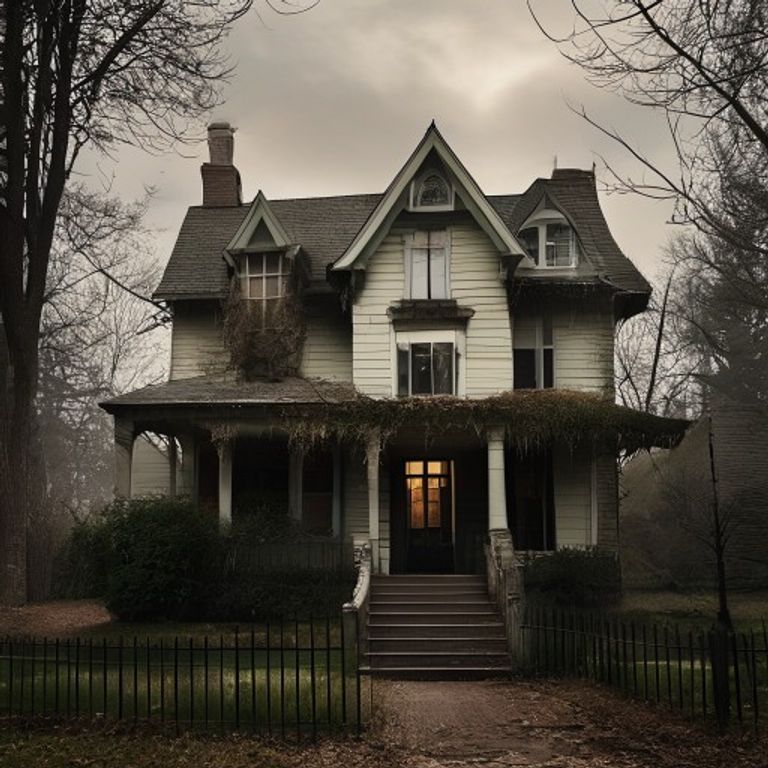
A mansion in California continuously built for decades with stairs leading to nowhere and false doors, supposedly to confuse the spirits of gun victims.
⚠️ Research conducted with the aid of Deep Research is subject to referential ambiguity.
🖥️ Clean HTML code using a proprietary tool.
👥 Research by Guilherme Felipe, Curation by Sílvio Lôbo
The Mystery of the Winchester House: A Labyrinth of Pain and Specters
In the shadows of San Jose, California, stands a structure that defies logic and reason: the Winchester House. More than just a mansion, it is a surreal and eerie monument to paranoia, grief, and, for many, a direct confrontation with the supernatural. What began as a search for solace after a family tragedy transformed into a labyrinthine architectural complex, whose origins and motivations remain shrouded in mystery, fueling decades of speculation and fascination.
1. The Context and the Incident: The Shadow of Tragedy
The epicenter of the mystery lies in the figure of Sarah Lockwood Pardee Winchester, widow of firearms magnate William Wirt Winchester. Tragedy struck Sarah relentlessly. She lost her newborn daughter, Annie, in 1866, and her beloved husband, William, in 1881. It is said that the weight of these losses, combined with the immense fortune she inherited, opened the doors to despair and, according to reports, to a pact with occult forces.
The story that became the core of the mystery is that a devastated Sarah sought out a medium in Boston. This medium allegedly revealed that the Winchester family was cursed by the spirits of the thousands killed by the weapons manufactured by her husband's company. To appease the ghosts' wrath and prolong her own life, Sarah was instructed to move west and build a house that should never stop being built. If construction stopped, her life would also end.
In 1886, Sarah Winchester bought a modest farmhouse in San Jose and began construction. What followed was a building frenzy that lasted an incredible 38 years, until Sarah's death in 1922. Throughout this time, workers labored day and night, adding rooms, hallways, and bizarre features without an apparent master plan.
2. Timeline of Key Events
- 1866: Death of Annie, daughter of Sarah and William Winchester.
- 1881: Death of William Wirt Winchester. Sarah inherits a fortune estimated at US$20 million (equivalent to hundreds of millions today) and 50% of the shares of the Winchester Repeating Arms Company.
- circa 1881-1886: Sarah Winchester, in deep mourning, allegedly sought spiritual guidance and received instructions to build without stopping.
- 1886: Sarah buys the farmhouse in San Jose and begins construction.
- 1906: A strong earthquake hits the region, severely damaging the house and engulfing some built rooms. Sarah orders these areas to be sealed and construction to continue around them.
- 1922 (October): Sarah Winchester passes away peacefully in her bedroom. Construction of the house ceases immediately.
- 1923: The house is sold to private investors and opened to the public as a tourist attraction.
3. The Main Theories: In Search of Explanations
The enigma of the Winchester House unfolds into a range of interpretations, from the most pragmatic to the most ghostly.
Paranormal and Spiritual Theory:
This is the most popular theory and the one that fuels the legend of the house. It is believed that Sarah Winchester was genuinely haunted by the spirits of those killed by Winchester weapons and that the incessant construction was an attempt to confuse or appease these tormented souls. Sarah herself allegedly believed that the spirits guided her in her architectural decisions, instructing her to include elements such as doors that open into walls, stairs that lead nowhere, and windows in floors. Reports from visitors and staff about inexplicable sounds, shadows, and sensations of presence reinforce this hypothesis.
Psychological and Grief Theory:
A more grounded explanation suggests that Sarah's obsession with construction was a symptom of her deep trauma and an undiagnosed mental disorder, possibly severe Post-Traumatic Stress Disorder (PTSD), aggravated by isolation and guilt. Constant construction could be a way to cope with overwhelming grief, an endless project that prevented her from confronting the reality of her losses. The wealth and free time she possessed allowed this compulsion to manifest on a monumental and bizarre scale.
Architectural and Innovation Theory (or Lack Thereof):
Some architects and historians suggest that, although chaotic, the construction may have had elements of experimentation and innovation for the time. Sarah Winchester was known for her interest in novelties and technologies. However, the lack of a unified plan and the seemingly random nature of the additions challenge this view. The most parsimonious hypothesis, within this line, is that Sarah simply enjoyed building and modifying, an expression of her wealth and a peculiar sense of aesthetics, without the need for an external force or mental illness.
Conspiracy Theory (Less Substantiated):
Although less prevalent, more tenuous conspiracy theories arise suggesting that the construction could have been a facade for illicit activities, or that Sarah was hiding something valuable. However, the lack of concrete evidence makes this hypothesis highly speculative.
4. Controversies and Blind Spots: What Doesn't Fit
The investigation into the "mystery" of the Winchester House is, in itself, a labyrinth of fragmented facts and anecdotal reports. The main controversies and blind spots include:
- The Lack of Detailed Construction Records: There are no complete architectural blueprints or records of who made the design decisions. The few plans that exist appear to be partial and incomplete sketches.
- The Role of "Spirit Guides": The medium's narrative is based on reports that emerged much later and are difficult to verify. Sarah Winchester herself never publicly confirmed this story.
- Worker Testimonies: Few workers of the time left detailed written accounts of the construction process. Those that exist are fragmented and often focused on working conditions.
- Evidence of Sarah's "Skepticism": There are reports that Sarah Winchester left her bedroom door open for the spirits, and that she spent long hours in prayer and meditation. These practices, although recorded, do not explain the magnitude of the construction.
- The Exact Motive for Bizarre Features: Doors that open into an abyss, windows on steps, stairs that end at the ceiling – the exact purpose of these architectural peculiarities is still debated. Were they to confuse spirits? Were they design flaws? Or were they just the whims of an eccentric mind?
5. Curiosities and Legacy: An Icon of the Macabre and Enigmatic
The Winchester House has transcended its physical existence to become a cultural icon, associated with American folklore of haunted houses and unsolved mysteries.
- The House is a Living Labyrinth: With over 160 rooms, 10,000 windows, 2,000 doors, 47 fireplaces, 160 rooms, 40 bedrooms, 2 ballrooms, 13 bathrooms, and 6 kitchens, the house is an architectural marvel, even if disconcerting.
- The Origin of the Legend: The legend of the ghosts and the curse was amplified by numerous publications and television programs that explored the case, solidifying the house's status as one of the most haunted locations in the United States.
- Cultural Adaptations: The mystery has inspired films, books, and documentaries, the most recent being the horror film "Winchester" (2018), starring Helen Mirren, which explores the paranormal narrative.
- Current Status: The Winchester House is a popular tourist attraction, offering day and night tours that highlight its peculiar architecture and ghost stories. There has been no official reopening of police or judicial investigations into the case, as there is no "crime" to be solved, but rather a human and architectural enigma.
The Mystery of the Winchester House remains a testament to the complexity of the human mind, the power of grief, and the enduring fascination with the inexplicable. It is a place where the line between reality and imagination fades, inviting each visitor to form their own theory, to get lost in its corridors, and to feel the presence of something that perhaps, just perhaps, still resides there, among the many rooms and the infinite possibilities of a past that refuses to be forgotten.





