



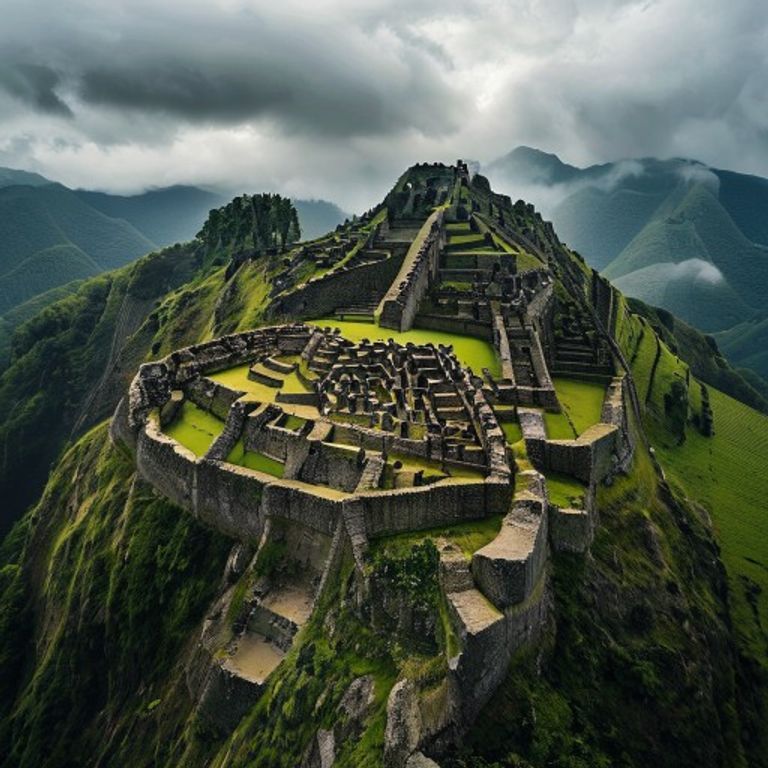
Walls in Peru built with gigantic stones that fit together so perfectly that it is impossible to pass a sheet of paper between them, without the use of any mortar.
⚠️ Research prepared with the aid of Deep Research is subject to referential ambiguity.
🖥️ Clean HTML code using a proprietary tool.
👥 Research by Guilherme Felipe, Curation by Sílvio Lôbo
The Mystery of the Sacsayhuamán Fortification: Stone Giants and Echoes of the Past
In the Andean heights of Peru, where the air is thin and history manifests in monumental forms, stands the enigmatic fortification of Sacsayhuamán. More than just an architectural work, it is a testament to a civilization that defies easy explanations and guards secrets that, to this day, fuel heated debates among archaeologists, historians, and enthusiasts of the inexplicable. The mystery does not lie in a single crime, but in the very existence and construction method of its cyclopean walls, an enigma that has spanned centuries.
The Context and the Incident: Where, When, and How the Mystery Began
The Sacsayhuamán fortification, located a few kilometers from Cusco, the ancient capital of the Inca Empire, is an impressive archaeological complex, famous for its walls built with massive stones, some weighing over 100 tons. The "incident" that gave rise to the mystery is, in fact, the very existence of this structure, which does not fit the known tools and engineering techniques of the time.
The first records of the grandeur of Sacsayhuamán were made by Spanish chroniclers who arrived in Peru in the 16th century. They described an imposing fortress, which the Incas called Saksaywaman, meaning "place where the falcon is satiated." The initial admiration, however, soon turned to perplexity at the magnitude and precision of the work.
Proven Fact: Sacsayhuamán was built by the Incas, with archaeological evidence pointing to a long period of development starting from the 13th century, intensifying in the 15th century under the rule of Pachacuti Inca Yupanqui.
Speculation: The initial perplexity of the Spaniards and the difficulty in replicating such a feat with their own methods set the tone for the speculations that would follow.
Timeline of Events
The timeline of the "mystery" of Sacsayhuamán is, in reality, the evolution of the construction and knowledge about the fortification:
- 13th Century onwards: Beginning of occupation and initial constructions at Sacsayhuamán, possibly as an early ceremonial or defensive center.
- 15th Century (approx. 1438-1471): Under Emperor Pachacuti, Sacsayhuamán undergoes a phase of expansion and monumentalization, with the construction of the gigantic polygonal stone walls.
- 1533: Arrival of the Spanish conquistadors led by Francisco Pizarro. They witness the grandeur of the fortification and record their impressions, often with astonishment.
- 1536: The Sacsayhuamán fortification becomes the scene of significant battles during the Inca resistance against the Spanish, led by Manco Inca Yupanqui. Spanish technological superiority prevails, but the strength of the walls is demonstrated.
- 16th-18th Centuries: Partial dismantling of the walls by the Spanish, who reused many of the stones for the construction of churches and buildings in Cusco.
- 19th Century onwards: Growing interest from Western scholars and travelers in Inca archaeology, with Sacsayhuamán attracting particular attention for its construction techniques.
- 20th and 21st Centuries: Intensification of archaeological research, with the use of new technologies, but the mystery regarding the methods of transporting and setting the stones remains a challenge.
The Main Theories
The theories that seek to explain the construction of Sacsayhuamán range from scientific pragmatism to the frontiers of the paranormal.
Scientific and Archaeological Theories (Most Likely Hypotheses):
- Advanced Inca Engineering and Massive Labor: This is the prevailing theory among archaeologists. It argues that the Incas possessed sophisticated engineering knowledge, using techniques of wedging with smaller stones, levers, ramps, and human force to move and position the stones. The social organization and the large amount of labor available for state projects would be fundamental.
Arguments in favor: Evidence of nearby quarries, stone tools, and the observation of similar techniques in other Inca constructions. The precision in the fit of the stones can be explained by the "friction fit" method, where a stone is shaped to fit perfectly against another through careful abrasion.
- Pressure-Setting Techniques (Press Fit): Some researchers suggest that the stones were positioned in their final locations and then, through a system of pushing and pressing, were adjusted with incredible precision. The very weight of the stones would contribute to the fit.
Arguments in favor: The irregular shape of the stones and the absence of mortar suggest a purely mechanical fit.
Alternative and Speculative Theories:
- Lost or Unknown Technology: This theory postulates that the Incas, or an earlier civilization, possessed some type of technology or knowledge that was lost over time, allowing for the handling of stones of such magnitude. This could include acoustic, magnetic methods, or even rudimentary forms of energy.
Arguments in favor: The difficulty in replicating the feat with currently known methods leads many to seek unconventional explanations.
- Extraterrestrial Influence (Paleo-SETI Theories): A school of thought suggests that the construction of Sacsayhuamán, and other ancient wonders, was facilitated by extraterrestrial beings, who would have provided advanced technology or knowledge to ancient peoples.
Arguments in favor: The monumental scale and precision of the constructions are seen as beyond the human capacity of the time, leading some to infer external help.
- Giants or Antediluvian Civilizations: Some theories, often based on interpretations of myths and legends, suggest that the stones were manipulated by gigantic beings or by very ancient and advanced civilizations that preceded the Incas.
Arguments in favor: The scale of the stones would be more suitable for manipulation by large-sized beings.
Controversies and Blind Spots
Despite decades of study, Sacsayhuamán continues to be a fertile field for controversies and blind spots:
- Method of Stone Transport: This is the murkiest point. Although it is known that there were nearby stone quarries, the logistics of transporting blocks of over 100 tons through mountainous terrain still generate intense debates. The lack of concrete evidence of large-scale transport ramps or complex pulley mechanisms fuels the mystery.
Ignored Clue? Some argue that future archaeological expeditions could focus more on the search for traces of large-scale transport infrastructure.
- The Precision of Cutting and Fitting: The way the stones fit together with millimeter precision, without mortar and without clear signs of scraping or attempts at readjustment, is one of the most fascinating and challenging aspects.
Conflicting Testimonies? The Spanish chroniclers, although they admired the work, did not detail the construction methods, focusing more on its grandeur and military potential.
- The Exact Function of the Fortification: Although called a "fortress," its exact function and the extent of its military use are subjects of debate. The presence of ceremonial areas and the nature of the walls raise questions about whether it was purely defensive or if it had other purposes.
Official Reports: Archaeological reports describe different phases of use, but the overlapping of functions has never been fully clarified.
- Disappeared Evidence: The reuse of stones by the Spanish for the construction of other buildings in Cusco may have led to the loss of original blocks that could contain crucial clues about construction techniques.
Curiosities and Legacy
The mystery of Sacsayhuamán transcends the academic field, influencing popular culture and the collective imagination:
- Cultural Impact: The fortification is one of Peru's postcards and a symbol of the greatness of the Inca Empire. It attracts millions of tourists annually, many fascinated by the stories and enigmas that surround it.
- Inspiration for Theories: Sacsayhuamán is frequently cited in books, documentaries, and television programs about ancient civilizations, historical mysteries, and conspiracy theories.
- Current Status: The case of Sacsayhuamán is not a "case" to be reopened or shelved in the police sense. Archaeological research remains active, with new studies and discoveries being made regularly. However, the fundamental mystery of the construction of the monumental walls persists, fueling fascination and the search for answers.
- A Testament to Ingenuity: Regardless of which theory prevails, Sacsayhuamán remains a powerful testament to the ingenuity, organization, and determination of the Inca people, a wonder that continues to challenge and inspire us through the centuries.





