



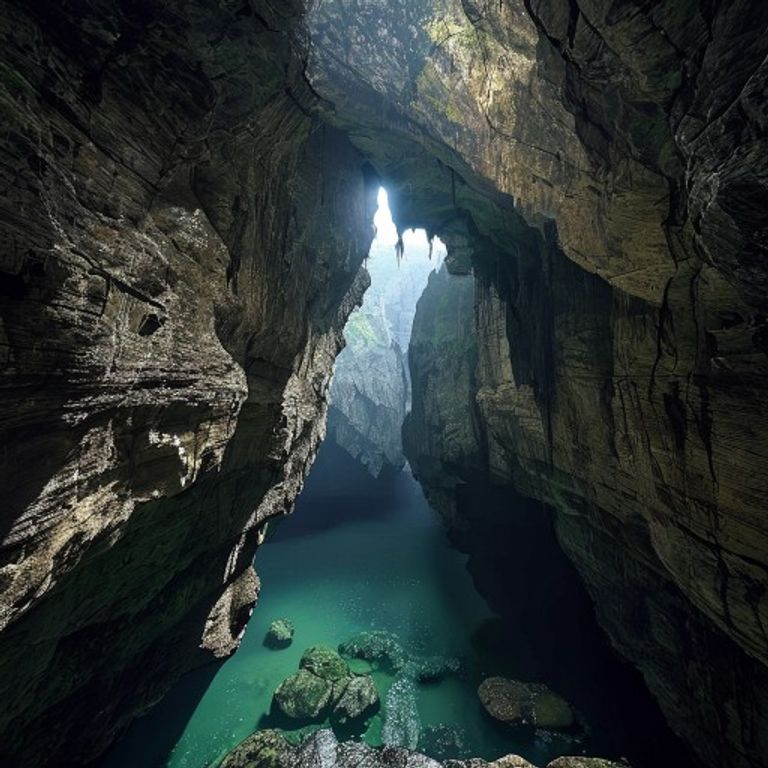
A vast complex of artificial caves in China carved into sandstone with uniform chiseling patterns, with no historical records of their construction or their true purpose.
⚠️ Research conducted with the aid of Deep Research is subject to referential ambiguity.
🖥️ Clean HTML code using a proprietary tool.
👥 Research by Guilherme Felipe, Curation by Sílvio Lôbo
The Mystery of the Longyou Caves: Gigantic Underground Carvings, An Enigma That Defies Time
Amidst the serene landscape of Zhejiang province, China, lies a monumental enigma that has intrigued archaeologists, geologists, and enthusiasts of the inexplicable for decades: the Longyou Caves. Discovered by chance in 1992, these colossal artificial cavities carved underground are not natural formations. They are engineered structures, but by whom, for what, and with what technology? This article investigates the facts, theories, and controversies surrounding one of the deepest mysteries of the ancient world.
1. The Context and the Incident: The Unexpected Discovery
The mystery began in June 1992, when a group of local farmers, led by Wu Jin, decided to drain a small pond in Longyou, a city in Zhejiang province, to expand their arable land. Upon drying, the pond revealed the entrance to an artificial cave. Curiosity led them to explore, and what they found was beyond any expectation: a vast hall carved into the rock, with walls covered in tool marks that defied the understanding of the time. The news spread quickly, attracting the attention of authorities and the scientific community.
Initially, what appeared to be a single cave soon revealed itself to be part of an underground complex. Over the following years, excavations and explorations revealed a total of 24 interconnected caves, each with impressive proportions and unique characteristics. The total area covered by these cavities is estimated at 30,000 square meters.
2. Timeline of Key Events
- June 1992: Accidental discovery of the first cave by farmer Wu Jin and his group.
- August 1992: News spreads, and the first official investigation is initiated by teams of archaeologists and geologists.
- 1993-1995: Systematic excavations reveal 23 additional caves, confirming the artificial nature and vast extent of the complex. Preliminary geological studies are conducted.
- 1996: The Longyou Caves are designated as a Protected Historical and Cultural Site of Zhejiang Province.
- 2000s onwards: Various expeditions and scientific research attempts to unravel the origin and purpose of the caves, with inconclusive results. The lack of artifacts and inscriptions makes the task even more challenging.
- Present: The Longyou Caves are an important tourist site, but the mystery regarding their creation persists.
3. The Main Theories: Attempts to Unravel the Enigma
The absence of any written records or artifacts explaining the origin of the Longyou Caves has given rise to a myriad of theories, ranging from the scientific to the fantastic.
Scientific and Archaeological Theories:
- Quartz/limestone mining for construction: One hypothesis suggests that the caves were excavated for the extraction of minerals, possibly quartz or limestone, to be used in the construction of surface structures. The scale of the work, however, raises doubts about the efficiency and necessity of such an undertaking.
- Storage or fortification: Another possibility is that the caves served as storage sites for grain or supplies, or as defensive fortifications. The uniformity of the cavities and the absence of combat passages, however, weaken this theory.
- Complex for rituals or ceremonies: The grandeur and symmetry of some chambers could indicate a religious or ceremonial purpose, where large groups of people could gather. However, the lack of evidence of religious activity is notable.
- Work of an unknown civilization: The most widely accepted theory within the scientific community is that the caves are the result of the work of an ancient Chinese civilization whose records have been lost to time. The scale and precision of the excavation, however, raise questions about the tools and techniques available at the time. It is estimated that the excavation required the labor of thousands of people for many years, removing millions of tons of rock.
Alternative and Speculative Theories:
- Alien base or extraterrestrial activity: For some, the inexplicable technology and scale of the caves point to a non-human origin. The idea that aliens created these structures as bases or refuges is popular in ufology circles.
- Advanced ancient civilizations (Atlantis, Lemuria): Connecting the caves to myths of lost civilizations with advanced technologies, theories suggest they could be remnants of pre-diluvian cultures that possessed knowledge far superior to what is attributed to the ancient Chinese.
- Ancient secret government project: A more "earthly," yet still speculative, hypothesis suggests that the caves were built as a large-scale secret project by an emperor or obscure dynasty, whose motives were deliberately omitted from history.
4. Controversies and Blind Spots: Gaps in the Investigation
The main controversy surrounding the Longyou Caves lies in the total absence of conclusive evidence. Official reports, while acknowledging the artificiality of the caves, offer little definitive explanation regarding their origin or purpose.
- Lack of artifacts: One of the biggest gaps is the almost complete absence of artifacts, inscriptions, tools, or human remains inside the caves. This lack makes dating and attribution to a specific culture difficult.
- Ongoing or inconclusive assessments: Although various geological and archaeological assessments have been carried out, the results have not provided a definitive answer. The analysis of tool marks on the walls, for example, has not yet been concluded in a way that unequivocally identifies the tools used.
- Exploration history: There are reports that the first explorations may not have been fully documented, leaving the possibility that some important traces may have been lost or not properly recorded.
- Secrets or classifications? China, as a country, has a history of controlling information about significant discoveries. Although there is no concrete proof, speculation about information withheld or classified for national security reasons or to avoid uncontrolled speculation is a constant.
5. Curiosities and Legacy: The Persistent Enigma
The Longyou Caves continue to be one of the most intriguing archaeological enigmas in the world. Their legacy is one of a challenge to our understanding of the past and the human (or non-human) capacity to perform grand feats.
- Artistic impression and engineering: The caves feature walls with parallel groove patterns, which some believe were made by dragging or scraping tools. The precision of the walls and ceilings, the uniformity of the chambers, and the depth of the excavations are impressive, even with modern technology.
- Tourist and cultural appeal: The caves attract thousands of tourists annually, fascinated by the mystery and the magnitude of the work. They have become a symbol of Longyou and Zhejiang.
- Current status: The Longyou Caves remain an active study site, but the case has not been "reopened" in the sense of a new police or legal investigation, as it was never treated as a crime. The mystery remains in the field of archaeology and historical research.
- Inspiration for the fantastic: The mystery of the caves inspires books, documentaries, and theories about lost civilizations and extraterrestrial visitors, fueling human fascination with the unknown.
Until new evidence emerges, or a robust scientific consensus is reached, the Longyou Caves will remain a silent and colossal monument to a past that refuses to reveal its secrets completely, a lasting testament to an enigma that extends beneath the earth and through time.





