



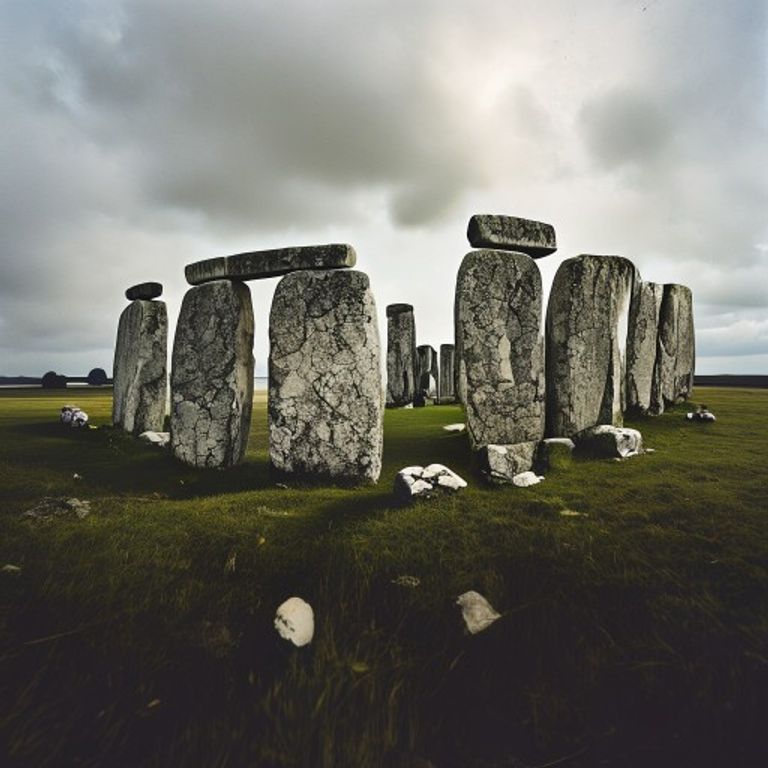
A prehistoric structure in England whose method of transporting giant stones and exact purpose as an observatory or temple remain under debate.
⚠️ Research conducted with the aid of Deep Research is subject to referential ambiguity.
🖥️ Clean HTML code using a proprietary tool.
👥 Research by Guilherme Felipe, Curation by Sílvio Lôbo
The Mystery of Stonehenge: An Enigma of Millennia
For centuries, the majestic stone circle of Stonehenge, on the Salisbury Plain in England, has been a beacon of mystery and wonder. It is not the construction of an ancient structure that intrigues us, but rather the absence of definitive answers regarding its purpose, its builders, and, in some cases, the events that surrounded it throughout different eras of its long existence. This article delves into the depths of this enigma, separating solid archaeological facts from the speculations that continue to fuel the global imagination.
1. The Context and the Incident: Where, When, and How the Mystery Began
The mystery of Stonehenge did not begin with a single incident, but rather with its very existence. Located in the heart of Wiltshire, England, this megalithic monument was erected in several phases, with the earliest constructions dating back about 5,000 years. The most iconic phase, featuring the imposing sarsen stones and the bluestones transported from afar, is attributed to approximately 2500 B.C.
The "incident" that generates the mystery is the very impossibility of determining with absolute certainty the original function of Stonehenge. The lack of written records from its builders, who belonged to prehistoric cultures, leaves an immense interpretive vacuum. Archaeological evidence, while abundant, requires constant inference and debate.
It is crucial to understand that the mystery is not a crime in the modern sense, but a gap in historical and anthropological knowledge. Curiosity and the search for answers began with the first historians who observed the structure, such as Nennius in the 9th century, who already attributed its construction to the legendary Merlin.
2. Timeline of Key Events
Although construction was a long and multi-phase process, we can outline some crucial milestones that shaped the mystery:
- c. 3100 B.C.: Initial construction of a large earth circle and ditch, with a possible arrangement of wooden posts or small monoliths.
- c. 2600 B.C.: Beginning of the most well-known construction phase, with the transport and erection of the bluestones, originating from Wales.
- c. 2500 B.C.: The most monumental phase, with the installation of the imposing sarsen stones, including the "U"-shaped trilithons and the sarsen stone circle.
- Bronze Age (c. 2300 B.C. - 1600 B.C.): Continued use and modifications to the site, with the addition of other stone arrangements and the "Avenue" (ceremonial path).
- Roman Period and Middle Ages: The site is an impressive ruin, and the first attempts at explanation begin, often linked to legends.
- 17th Century: The antiquarian John Aubrey suggests that Stonehenge was a Druidic temple, a theory that gains traction.
- 18th Century onwards: Scientific archaeology begins to investigate the site, uncovering layers of history and sparking new theories.
- 20th and 21st Centuries: The era of radiocarbon dating, DNA analysis, and new excavation techniques provides crucial data, but the central enigma persists.
3. The Main Theories
Theories about Stonehenge range from rigorous scientific explanations to esoteric speculations.
3.1. Scientific and Archaeological Theories
These theories are based on physical evidence and proven investigative methods:
- Astronomical Observatory: The most popular theory, defended by researchers such as Gerald Hawkins. It is believed that Stonehenge was aligned with the summer and winter solstices, serving as an observatory to predict celestial events important for agriculture and rituals. The precision of the alignments is a proven fact.
- Healing Site: Analysis of the bluestones revealed that some of them were possibly associated with healing properties, and the discovery of human remains with signs of disease or injury suggests that the site may have been a center of pilgrimage for healing.
- Ceremonial and Religious Center: The most comprehensive hypothesis, which encompasses others. It is believed that Stonehenge was a sacred site for religious rituals, celebrations, and burials, connecting the world of the living to that of the dead. The presence of graves is a proven fact.
- Reunification Center: Some archaeologists suggest that Stonehenge may have been a meeting point for different tribes or communities, strengthening social and political ties.
- An Ancestral Monument: Another line of thought is that Stonehenge served as a place to venerate ancestors, a physical link to the past and lineage.
3.2. Alternative and Esoteric Theories
These theories transcend strictly archaeological evidence, often incorporating elements of beliefs, legends, or metaphorical interpretations:
- Druidic Temple: Popularized by John Aubrey and furthered by fiction, this theory attributes Stonehenge to the Druids, the Celtic priests. However, archaeology dates the main construction of Stonehenge centuries before the peak of the Druidic culture, although they may have used the site later.
- Site of Magic and Ancient Rituals: Theories that associate Stonehenge with mystical energies, interdimensional portals, or sites of esoteric power. These ideas generally lack empirical evidence and are based on subjective interpretations.
- Alien or Advanced Technological Construction: One of the most speculative theories, which suggests that the complexity of the construction and the transport of the stones were impossible for the technologies of the time, implying extraterrestrial intervention or lost civilizations with superior knowledge.
3.3. Conspiracy Theories
Although less prevalent regarding Stonehenge as a mystery of its origin, conspiracy theories can arise around:
- Concealment of Evidence: The idea that governments or institutions are deliberately hiding information about Stonehenge to maintain certain narratives or for hidden purposes.
- Secret Purpose: A "true" purpose of Stonehenge that is kept secret by elites or secret societies.
4. Controversies and Blind Spots
The investigation of Stonehenge is not free from controversies and blind spots:
- The Origin of the Bluestones: Although we have located the source stones in Wales, the exact logistics and transport routes remain a subject of debate and speculation. How they were moved over long distances without modern technology remains an interpretive challenge.
- The Lack of Significant Human Remains: Despite some graves found, the number of human remains compatible with such a monumental site is surprisingly low, leading to questions about its primary use.
- Changing Interpretations: Archaeology is a constantly evolving field. Theories that were widely accepted in the past (such as the Druidic theory) have been revised or refuted with new evidence. This creates the perception that the "answers" are always changing.
- The Loss of Evidence: In past eras, the lack of preservation and the exploitation of Stonehenge as a "quarry" for other construction projects led to the loss of parts of the structure and potential artifacts.
- Conflicts of Interpretation: Even with scientific data, the interpretation of what this data means in terms of the beliefs and cultural practices of its builders can vary significantly among researchers.
5. Curiosities and Legacy
The cultural impact of Stonehenge is undeniable:
- Cultural Icon: It is one of the most famous prehistoric monuments in the world, attracting millions of visitors annually.
- Artistic Inspiration: It has inspired countless works of art, music, literature, and cinema, fueling the popular imagination about the past and mysticism.
- UNESCO World Heritage Site: Recognized for its exceptional cultural and historical importance.
- Current Status: Stonehenge is an archaeological site under constant study. New excavation and research projects, along with the advancement of analytical technologies, continue to uncover new information. It has not been "reopened" in the sense of a criminal case, but scientific investigation is always active. The central mystery regarding its definitive purpose, however, remains a fascinating invitation to reflection and exploration of our most remote past.





