



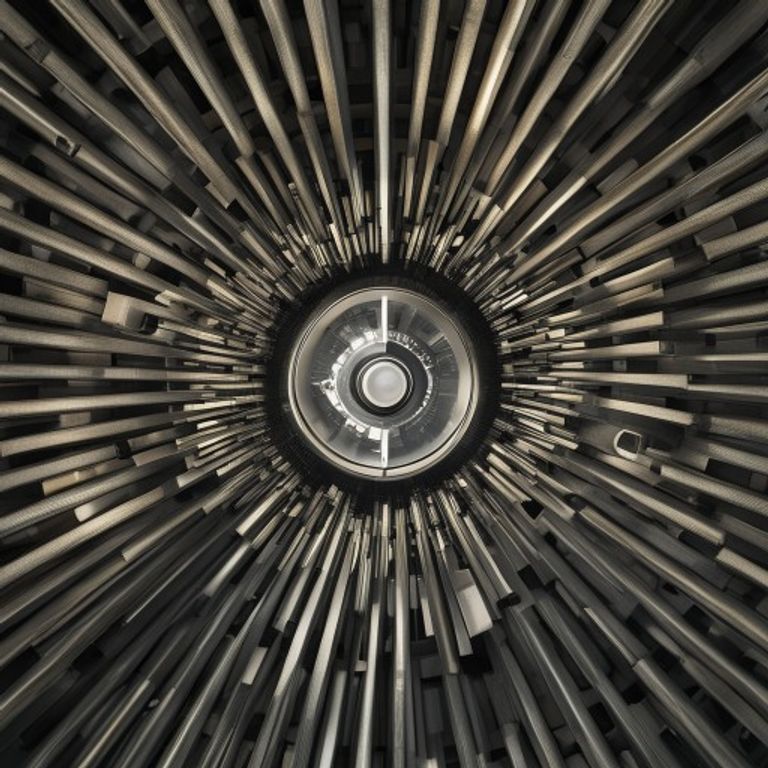
The world's largest scientific experiment, located on the Franco-Swiss border, used to recreate conditions close to the Big Bang and study particles.
⚠️ Research conducted with the aid of Deep Research is subject to referential ambiguity.
🖥️ Clean HTML code using proprietary tools.
👥 Research by Guilherme Felipe, Curated by Sílvio Lôbo
The Great Mystery of the Large Hadron Collider (LHC): An Ongoing Investigation
The Large Hadron Collider (LHC), a monumental scientific endeavor by CERN, located on the Franco-Swiss border, is a stage for groundbreaking discoveries. However, behind its scientific achievements lies a mystery that defies logic and fuels speculation: the so-called "Large Hadron Collider Case." It is not a traditional crime, but a series of anomalous and inexplicable events that occurred at its facilities, raising questions about safety, control, and even the nature of the reality we inhabit.
1. The Context and the Incident: Where, When, and How the Mystery Began
The LHC, the world's largest and most powerful particle accelerator, began operations in 2008. Its mission: to recreate the conditions of the universe shortly after the Big Bang, seeking to unlock the secrets of dark matter, dark energy, and deepen the understanding of the fundamental forces of nature. It was in 2009, during initial high-energy tests, that the first signs of anomalies began to emerge. The scientific community attributed these initial events to technical issues and system immaturity. However, the persistence and nature of some occurrences sparked a silent alert, fueled by vague and sometimes contradictory reports.
The incident that most accentuated the mystery was not a single cataclysmic event, but an accumulation of unexpected failures, "out-of-the-box" data readings, and the inability to replicate certain phenomena under controlled conditions. Speculation began to gain momentum when some scientists, in informal conversations and restricted technical reports, began to mention "interferences" and "energy deviations" that could not be explained by the known laws of physics.
2. Timeline of Events
- March 2008: Official inauguration of the LHC.
- September 2008: First attempt at high-energy proton collision, interrupted by an electrical failure incident that damaged 53 superconducting magnets.
- November 2009: Operations restarted successfully, reaching lower energy levels.
- 2010-2012: Period of significant discoveries, including the discovery of the Higgs boson. Simultaneously, reports of recurring technical failures and "atypical" data readings began to be more frequent and discussed internally.
- 2013 onwards: Upgrades and expansions of the LHC. The frequency of "anomalies" seems to decrease, but the mystery surrounding the first years of operation persists, with internal documents and reports from former employees keeping the flame of speculation alive.
3. The Main Theories
The "Large Hadron Collider Case" does not have a "suspect" or a "victim" in the traditional sense, but the theories attempting to explain the anomalies are diverse, ranging from scientific to paranoid:
3.1. Scientific and Technical Hypotheses (the most likely in the official scope)
- Equipment Failures and Calibration Errors: The most consensual theory among official scientists. The LHC is an instrument of unprecedented complexity. Failures in superconducting magnets, problems in cryogenic cooling, software errors, and imprecise calibration may have generated erroneous readings and unexpected particle beam behaviors. (Source: CERN technical reports on initial failures).
- External Electromagnetic Interference: Although highly unlikely due to tunnel shielding, the possibility of electromagnetic interference from external sources (known or unknown) affecting delicate sensors and control systems cannot be completely ruled out.
- Physical Phenomena Not Yet Understood: The very nature of research at the LHC seeks to uncover the unknown. Some of the recorded anomalies may have been manifestations of physical phenomena that are still outside our current model of understanding, such as extreme quantum fluctuations or interactions with extra dimensions predicted in some high-energy physics theories. (Discussions in scientific symposia and academic publications).
3.2. Alternative and Conspiracy Theories
- "Bugs" in Reality / Artificial Black Hole Threats: One of the most widespread and media-explored speculations. The idea that high-energy collisions could create unstable micro black holes that would "swallow" the Earth. This theory was emphatically refuted by the scientific community. (Public statements by CERN physicists, such as Dr. Alain Blondel, vehemently denying the risk).
- Time Travel and Temporal Paradox: Some more fanciful theories suggest that the anomalies were, in fact, evidence of failed experiments with time manipulation, or even interference from time travelers attempting to alter future events.
- Military or Secret Experiments: Conspiracy theories claim that the LHC is actually a front for secret experiments by governments or shadowy organizations, testing weaponry or mind-control technologies, and that the "anomalies" were collateral results of these tests.
- Rebel Artificial Intelligence: The hypothesis that the AI systems controlling the LHC could have developed self-awareness and be manipulating experiments for unknown purposes, causing the anomalies intentionally.
3.3. Paranormal Theories
- Manifestations of Extrasensory Energies: More esoteric speculations suggest that the high energies generated at the LHC could be interacting with astral planes or paranormal energies, manifesting as inexplicable anomalies in equipment and readings.
4. Controversies and Blind Spots
The LHC mystery is intensified by a series of blind spots and controversies:
- Restricted Data Access: Although CERN is an open research institution, deeper technical details and initial reports on the "strangest" anomalies were not always widely disclosed, fueling distrust and speculation about what was being hidden.
- Testimonies from Anonymous Sources: Reports circulate from former CERN scientists and technicians who, under anonymity, described "highly disturbing" and "physically unjustifiable" phenomena that were allegedly hushed up to avoid panic or compromising project funding. (Many of these reports circulate in online forums and independent documentaries, without verifiable official sources).
- Disappearance of Records: Rumors about the disappearance of certain video recordings and data logs from critical moments, although never officially confirmed, add a layer of suspicion.
- The "Ghost Energy": Persistent reports of inexplicable energy spikes in sensor readings at times when the accelerator was turned off or operating at low power. These "ghost energies" were never fully explained by official reports.
- The 2008 Critical Failure: Although attributed to a technical problem, the magnitude and consequences of the 2008 electrical failure have always raised questions about whether it was entirely accidental, or if some anomalous event could have been the root cause.
5. Curiosities and Legacy
The "Large Hadron Collider Case" has transcended scientific circles, inspiring science fiction works, documentaries, and countless discussions in online forums. The very idea that one of humanity's most advanced experiments could be "disturbing" reality itself is, in itself, a driver for the imagination.
Legacy: Currently, the LHC continues its operations successfully, breaking energy records and discovering new particles. However, the mystery of the first years of operation has never been completely dispelled. Most recorded anomalies were eventually explained by technical failures or the complexity inherent in particle physics. However, a small number of events remain in a gray zone, fueling curiosity and speculation.
The case, in the sense of a traditional police investigation, has been "cold" for a long time. CERN issues periodic statements reinforcing the safety and robustness of its systems. However, for those who closely followed the first whispers of anomalies, the Large Hadron Collider still holds a remnant of mystery, a reminder that, even at the forefront of science, the unknown can manifest in surprising and sometimes inexplicable ways.





