



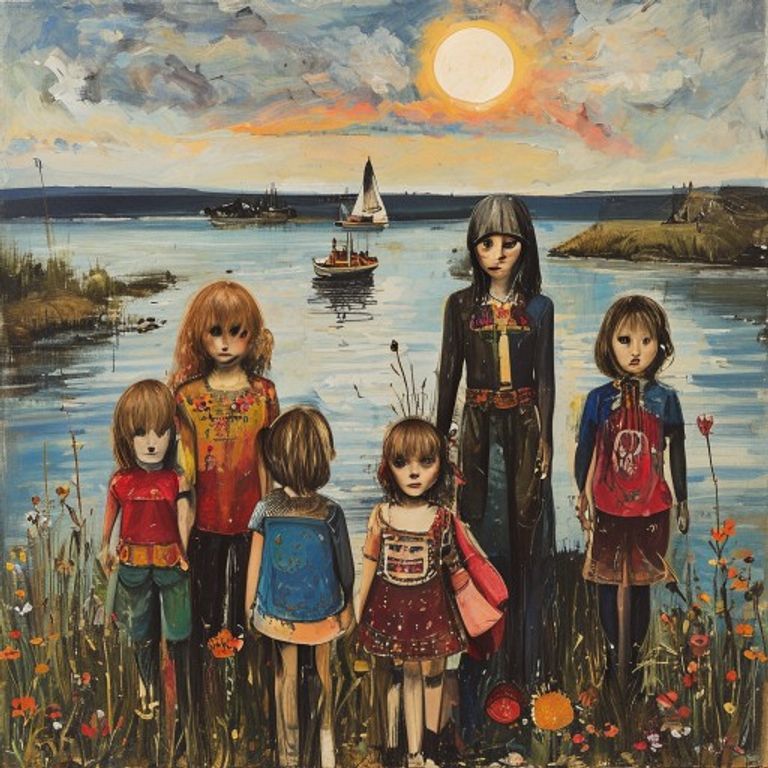
Three teenagers were murdered and one was injured while camping in Finland in 1960; the survivor was put on trial decades later but was acquitted due to lack of evidence, and the crime remains unsolved.
⚠️ Research conducted with the aid of Deep Research may be subject to referential ambiguity.
🖥️Clean HTML code using a proprietary tool.
👥 Research by Guilherme Felipe, Curation by Sílvio Lôbo
The Chilling Enigma of Lake Bodom: An Investigation in Search of Truth
In the silent depths of Finland, on a night that would become synonymous with unspeakable terror, a serene lake transformed into the stage for one of Europe's most disturbing unsolved mysteries. The Lake Bodom Murders Case, which occurred on June 4, 1960, still echoes today, a grim testament to the fragility of life and the persistence of uncertainty. This article seeks to unravel the layers of facts, speculation, and unanswered questions surrounding this heinous crime.
1. The Context and the Incident: The Beginning of the Nightmare
In the early morning hours of June 4, 1960, Lake Bodom, a picturesque lake on the outskirts of Espoo, Finland, was the chosen refuge for four young people for a night of camping. They were: Maila Irmeli Björklund (15 years old), Anja Tuulikki Mäki (15 years old), Seppo Antero Boisman (18 years old), and Nils Gustafsson (18 years old). What began as an innocent getaway under the stars quickly turned into a brutal massacre. Around 4 a.m., an unknown attacker invaded the tent where the young people were sleeping. The attack was swift and savage, leaving three dead and one severely injured survivor.
The deceased victims were Maila Björklund, Anja Mäki, and Seppo Boisman. Nils Gustafsson was the sole survivor, found wandering in a state of shock and with serious injuries. The young people's belongings, including their wallets and shoes, were stolen. The tent was torn, and the bodies showed signs of violent beating and stab wounds. The car they arrived in was also damaged, with broken windows.
2. Timeline of Events
- Night of June 3, 1960: The four young people arrive at Lake Bodom to camp.
- Early morning of June 4, 1960 (approximately 4 a.m.): The attack occurs.
- Morning of June 4, 1960: A survivor, Nils Gustafsson, is found wandering and injured. Authorities are alerted.
- Later on June 4, 1960: Police arrive at the scene, finding the bodies of the three victims and the crime scene.
- Following days and weeks: The police investigation begins, with searches, interviews, and evidence collection.
- 1961: Knut Gustafsson, a vagrant with a criminal record, is arrested and tried as the main suspect but is acquitted due to a lack of conclusive evidence.
- Following decades: The case remains unsolved, with new leads and theories emerging sporadically.
- 2004: The case is reopened with new forensic technologies and the possibility of DNA analysis, focusing again on Nils Gustafsson.
- 2005: Nils Gustafsson is again brought to trial on suspicion of murder but is acquitted due to a lack of irrefutable evidence.
3. The Main Theories
Over the years, the case has generated a myriad of theories, some based on clues, others bordering on the fantastical. The difficulty lies in the scarcity of concrete evidence and the inconsistencies of the initial investigation.
3.1. The Lone Wanderer: The Initial Hypothesis
The most immediate and initially strongest theory pointed to a lone attacker, an individual possibly disoriented or with random criminal intentions. The evidence supporting this hypothesis included:
- The theft of belongings, suggesting a motive of robbery.
- The random nature of the attack on a group of camping youths.
- The presence of unknown footprints at the crime scene.
This theory led to the arrest of Knut Gustafsson, a man known for his erratic behavior and a history of petty offenses. However, he was acquitted due to a lack of concrete evidence directly linking him to the murders.
3.2. The Serial Killer: The Search for Patterns
Some investigators considered the possibility of a serial killer, but the isolated nature and specific brutality of the attack at Lake Bodom did not easily fit the known patterns of serial killers of the time. The lack of similar crimes in the region also weakened this theory.
3.3. The Internal Conspiracy: The Survivor as Suspect
One of the most persistent and controversial theories, which gained momentum with the reopening of the case in 2004, is that Nils Gustafsson, the sole survivor, could be responsible for the crimes. The reasons for this suspicion include:
- The fact that he was the sole survivor and sustained injuries that, for some, could have been self-inflicted to feign an attack.
- Later forensic findings, such as the analysis of Gustafsson's clothes, which revealed traces of blood from the other victims.
- Testimonies suggesting that Gustafsson had an explosive temper and resented the attention Maila Björklund received from other boys.
Despite the reopening of the case and the 2005 trial, Gustafsson was acquitted. The defense argued that the blood on his clothes could have been transferred during the attack, and that the lack of a confession and a clear motive made the accusation unsustainable.
3.4. Alternative and Paranormal Theories
The mystery of Lake Bodom has naturally attracted more speculative and even paranormal theories:
- The Prison Escapee: Rumors circulated about an escapee from a nearby prison who might have committed the crime. However, there is no substantial evidence to support this idea.
- A Mafia or Organized Crime: Some theories, without any solid factual basis, suggest the involvement of criminal groups.
- Paranormal Phenomena: While not considered investigative hypotheses, stories about the lake being haunted or about supernatural influences are part of the folklore that has developed around the case.
4. Controversies and Blind Spots
The investigation into the Lake Bodom Case was marked by failures and inconsistencies that contributed to its perpetuation as a mystery:
- Slow Initial Response: The police were slow to arrive at the crime scene, allowing evidence to be lost or altered.
- Lost or Ignored Evidence: Reports suggest that some crucial evidence, such as the knife believed to be the murder weapon, was found days later and not properly preserved. The initial investigation may have underestimated the importance of certain details.
- Conflicting Testimonies: There were reports from witnesses who saw a suspicious man near the location, but the descriptions varied, making it difficult to identify a single suspect.
- Public Pressure and Media Frenzy: The immense media attention and public pressure for quick answers may have led to hasty conclusions and an excessive focus on certain suspects, possibly at the expense of other lines of investigation.
- The New Forensic Analysis and the 2005 Trial: Although the reopening of the case allowed for the use of modern technologies, the interpretation of the new evidence, especially the blood on Gustafsson's clothes, remained controversial, leading to a new trial that, ironically, did not solve the mystery.
5. Curiosities and Legacy
The Lake Bodom Murders Case has transcended the criminal realm to become an icon of Finnish popular culture and a symbol of impenetrable mystery. Its influence can be seen in:
- The Name of the Lake: "Bodom" itself has become synonymous with tragedy and terror in Finland, often associated with horror narratives.
- Music and Media: The case has inspired countless songs, books, documentaries, and even a heavy metal band named Children of Bodom.
- Residual Fear: Even decades later, the incident contributed to a certain apprehension regarding isolated camping sites in Finland.
- An Unshakeable Mystery: Despite all investigations, theories, and trials, the true killer (or killers) of Maila Björklund, Anja Mäki, and Seppo Boisman remains unknown. The case was largely shelved after Nils Gustafsson's acquittal in 2005, with Finnish authorities stating that new leads would be necessary to reopen it.
Lake Bodom, once a place of serene beauty, now bears the scars of a chilling enigma, a somber reminder that, at times, the truth hides in the shadows, defying even the most meticulous investigations and the most persistent hearts.





